CVA Exam 2
 Call Kai
 Learn
Learn Practice Test
 Spaced Repetition
 Match
Match Flashcards
 Knowt Play
1/104

There's no tags or description
Looks like no tags are added yet.
Name | Mastery | Learn | Test | Matching | Spaced | Call with Kai |
|---|
No analytics yet
Send a link to your students to track their progress
105 Terms
The name Holocephali refers to which of the following traits of chimaeras?
Holostylic suspensorium
The name Elasmobranchii refers to which of the following characteristics of sharks and rays
The gill slits are exposed.
What is the extant (living) diversity of chondrichthyans?
~ 1,400 species
Which of the following traits in not a synapomorphy for chondrichthyans?
Ampullae of Lorenzini
Cookiecutter sharks have ventral light-emitting photophores for deceptively breaking up their silhouettes to predators approaching from below.
True
What is the proportional diversity of Actinopterygii among vertebrates (in species richness)?
50%
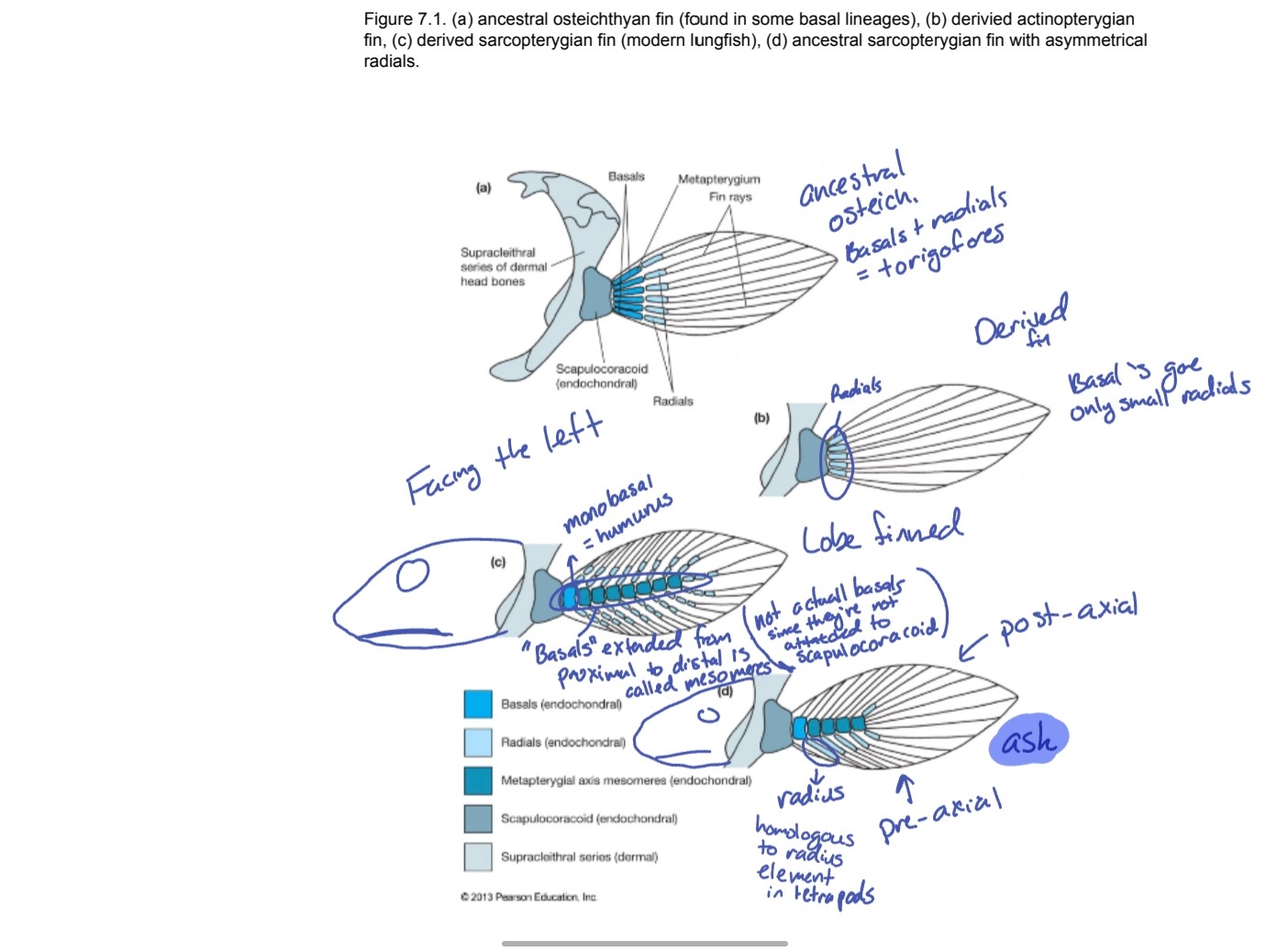
The basal (most proximal) mesomere in a lobe-finned 'fish' is called the __________.
humerus
What is the approximate age of sexual maturity for a female Greenland shark?
150 yrs
Which of the following in not a characteristic of bichirs?
Scales thin and cycloid
Which of the following traits best describes sturgeons?
4 sensory barbels on snout
What portion of chondrichthyans are elasmobranchii and holocephali?
Elasmobranchii: ~ 1350
Holocephali: ~ 50
Elasmobranchii consists of _____ and _______.
The only holocephalans are ___.
Selachii (sharks); Batoidea (skates, rays, sawfish)
chimaeras (ratfish, ghost sharks)
What are the characteristics of Elasmobranchs?
5-7 exposed gill slits
Euhyostylic: Upper jaw not fused to cranium
Replaceable rows of teeth
Placoid scales
Develop a carilaginous vertebrate
What are the characteristics of Holocephalans?
4 gills covered by an opecular fold
Holostylic: Upper jaw fused to cranium
Non-replaceable grinding plates for dentition
Skin mostly smooth (placoid scales mostly lost, except for claspers)
Retain notochord
What does Suspensorium mean?
Refers to how the jaw is fused/formed
Ex. holostylyic and euhyostylic
What are the 5 synapomorphies of chondrichthyes?
Cartilaginous endoskeleton
Placoid scales
Pelvic claspers
Spiral valve intestine
Tooth whorl replacement system
Liver buoyancy system
Ureotolism
What is the tooth whorl replacement system?
Teeth secured to cartilage with ligaments (no bone for sockets) and bone replaced ~ 2-4 weeks
What is the specialized cartilage for chondrichthyans that mostly forms their cartilaginous endoskeleton?
prismatic calcified cartilage
What are the different types of teeth shapes found in chondrichthyans?
Cladodont
Serrated triangular (shearing)
Narrow long (piercing)
‘Pavement’-like tooth plate
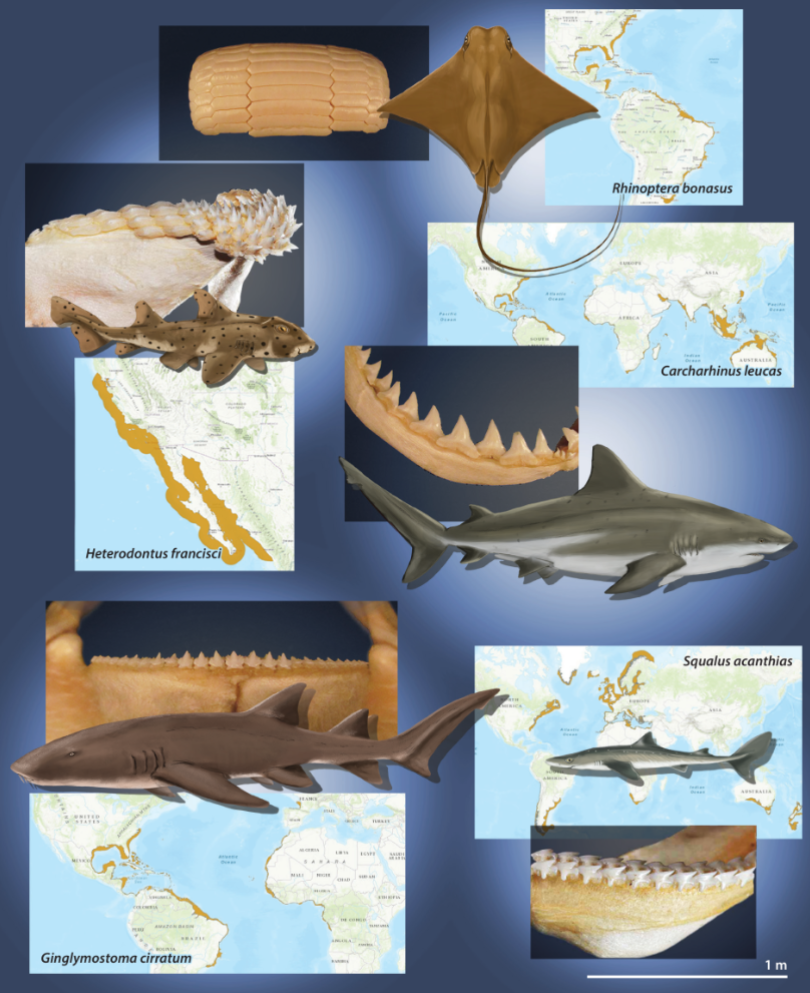
Teeth well-preserved in fossil record have yielded insight on what?
tropic levels/diet in extinct species
What is the liver buoyancy system?
There is no swim bladder, which allows for specific buoyancy that is 15% less dense than seawater
Deep-sea sharks have massive livers and achieve near-neutral bouyancy; allows energy saving in nutrient-poor environments
Benthic sharks and rays have much smaller livers and are negatively buoyant; they sit at the bottom of the sea
System is dual-purpose - combines floatation and long-term ‘fuel tank’ (stores energy reserves, incompressible)
What is ureotelism?
Retention of urea, allows chondrichthyans to maintain an internal osmotic pressure that is slightly higher than surrounding seawater
How does ureotelism work?
Sharks remain saltier than than the sea which causes small amounts of water to naturally diffuse into their bodies through the gills
Urea is generally toxic, however chondrichthyans produce a chemical that stabilizes proteins and enzymes against the destabilizing effects of both urea and deep-sea pressure. What is this chemical?
trimethylamine N-oxide (TMAO)
True or False:
The ampullae of lorenzini, specialized electroreceptors, are an ancestral gnathostome trait, and not unique to chondrichthyans
True
____ and _____ are absent in chondrichthyans.
Swim bladder; ear bones (otoliths)
What is the shark jaw structure called and describe it.
Holostylic
Jaw is suspended by the hyomandibula plus ligaments attached to the cranium, which creates a swinging hinge for protruding the jaw away from the snout
What is the ray and skate jaw structure called and describe it.
Euholostyly
The most extreme suspension; No direct ligament attachment to the front of the jaw and the only support is the hyomandibula
What is winnowing?
A process used by rays and skates that separates food from sediment by repeatedly protruding jaw in a jackhammering motion to sift it for food
What is hydraulic excavation? Who is it used by?
A process used by rays; It is the jetting of water downwards through the mouth or gill slits to dig out feeding depressions in the sand that uncovers buried prey
What is ricochet separation?
Manta rays use this feeding-filtration mechanism that funnels suspended food particles (plankton) into the mouth using specialized cephalic lobes. They are then separated by flap-like filter lobes on the gill rakers; the filter lobes use ricochet separation to bounce food particles into their throat (pharynx) while the water passes over their gills
What do cephalic lobes do?
open up and bring in water
What is another use for the cephalic lobes?
gestural sign language to communicate with other mantas
List the differences in anatomical structure of selachii & batoidea.

The skull of holocephali is ______
holosylic
When did holocephali diverge from elasmobranchs?
~350 mya
~50 species in 3 major groups of holocephali are distinguished by what?
head shape: bulbous, plough-nosed, or long-nosed
with few exceptions, most are deep sea
The palaquadrate, completely fused to the cranium, describes which jaw suspensorium?
holostylic
What is a unique feature in holocephali males?
Tenacula; special retractable appendages on the forehead (cephalic tenaculum) or in the pelvic region (pre-pelvic tenaculum)
What is cephalic tenaculum (sex forehead)?
has true teeth, sharing genetic and developmental pathways with oral teeth
function as a grappling hook to grasp female’s pectoral fin or dorsal fin during copulation
What does durophagous mean?
describes the eating behavior of animals that consume hard-shelled animals
Describe holocephalans unique dental plate
3 pairs (2 upper 1 lower) of beak like tooth plates for crushing hard-shelled prey (durophagous)
Bulk of tooth plates made up of osteodentin, less mineralized version of dentine
What is pleromin?
Mineralized tissue unique to holocephalans that is embedded in osteodentin
pleromin is mineralized with whilockite, which is different from apatite found in the enamel of the teeth of other vertebrates
Holocephalans:
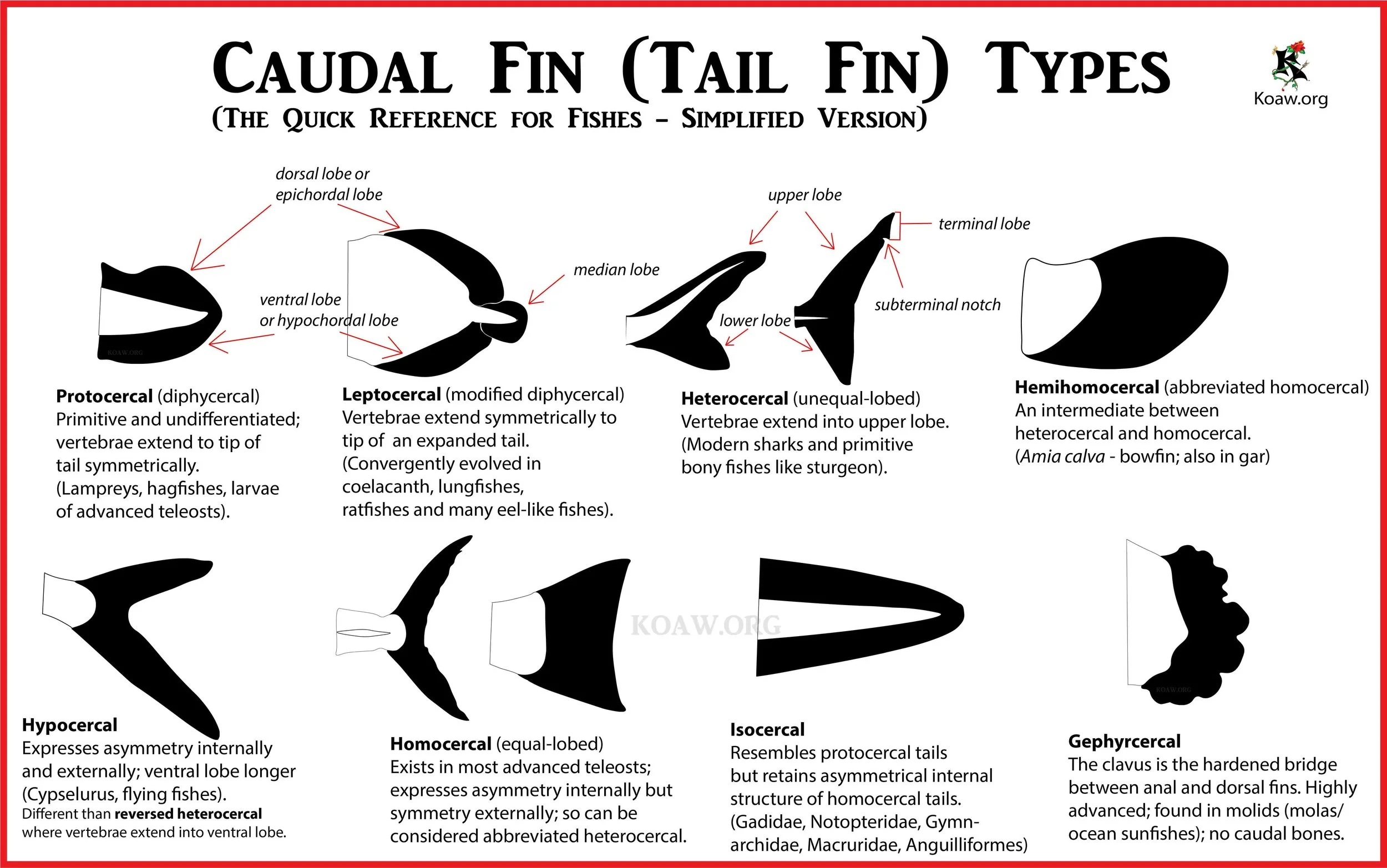
In two groups the tail is _____, thin and whip-like, edged from above and below by fins of similar size. The remaining group, the caudal fin, is _____ which means larger upper fin lobe with vertrabrate extending into lobe.
leptocercal; hertercercal
What kind of parasites are cookiecutter sharks?
Ectoparasites - lives outside the host
Which of the following class is characterized by a leptocephalus larval stage?
Elopomorpha
Which of the following is not a trait of coelacanths?
Weberian apparatus
Which of the following traits corresponds to Australian lungfish?
Single ventral lung
Which of the following would represent a tetrapodomorph fish?
Tiktaalik
A physoclistous swim bladder has direct ‘duct’ connection to the esophagus
False
More than 35000 species (~95% of all fishes) and more than 50% of vertebrate diversity is consisted of ______.
actinopterygian
96% of actinopterygian are _____
teleost
What are actinopterygians?
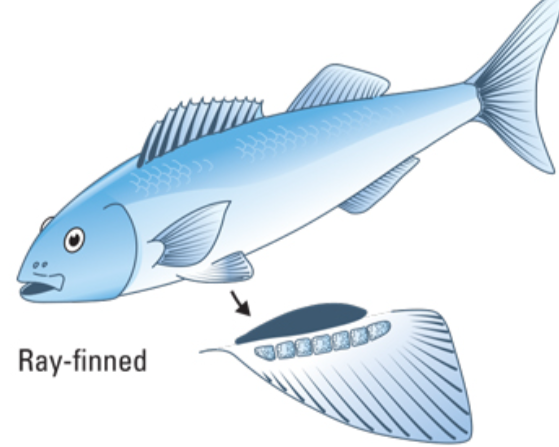
ray-finned fish; fin muscle barely extends onto fin (if at all)
How is diversity divided between actinopterygians?
freshwater and marine forms
What are sarcopterygians?
lobe-finned fish/tetrapods; fins monobasal (single humerus present) with internal bony elements (mesomeres) and muscles external to the body wall, creating a cylinder of meat extending away from the body
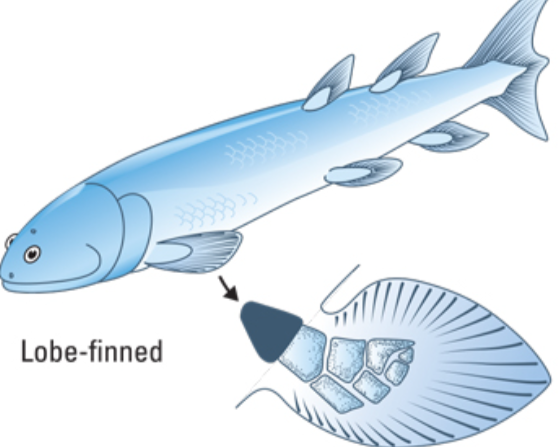
Both lineages (actinopterygians & sarcopterygians) have fin rays or _____
lepidotrichia; jointed bony fin rays that surround bundles of collagen
How are fin rays supported?
Pterygiophores (skeletal elements)
Which basal actinopterygian lineage consists of bichirs and reedfish (ropefish)?
Cladista (polypteriformes)
Characteristics of Cladistia
Body highly elongated with a series of 7-18 dorsal finlets
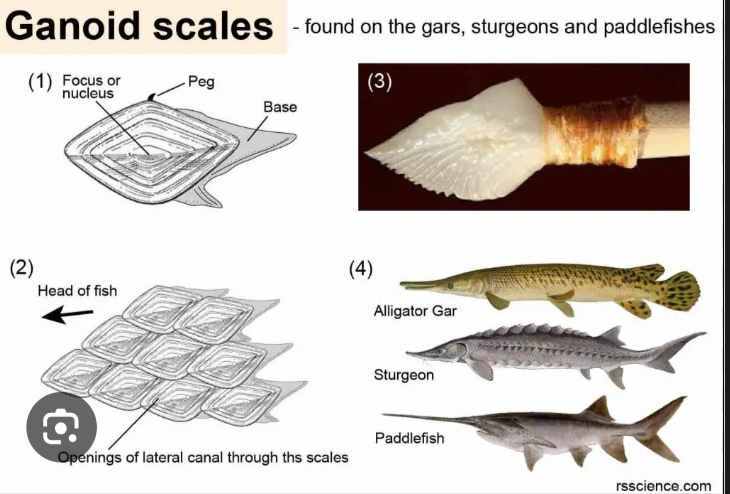
Thick rhomboid ganoid scales
Paired ventral lungs
Spiracular breathing
Fleshy,lobe-like pectoral fins to ‘walk’ over damp terrain; can survive out of water over extended periods of time
Ampullae of Lorenzini
External ‘nasal tentacles’
What are dorsal finlets?
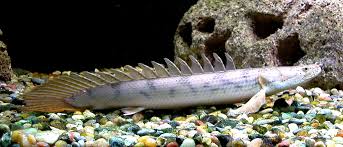
A small series of separate dorsal finlets instead of one long continuous dorsal fin
Describe rhomboid ganoid scales
A multilayered composition consisting of:
Ganoine (enamel-like substance) outer layer
Dentin (cosmine or osteodentin), the middle layer
Basal layer of vascularized cellular bone that happens anchor scale to the dermis
Grow during the life of a fish by adding layers of mineral over time
What are paired ventral lungs?
Respiratory rather than hydrostatic organ, develops as an evagination on the ventral esophagus near the posterior edge of the pharynx
What is spiracular breathing?
Dorsal spiracles behind eyes used to ‘inhale’ air
Spiracles sealed by hinged dermal ossicles that act as valves, opening briefly during inhalation
External ‘___ _____’ are tube-like nostrils that orient olfactory precision in murky waters
nasal tentacles
Which basal actinopterygian lineage consists of sturgeons and paddlefish?
Chondrostei (acipenseriformes)
Synapomorphies that unite the group Chondrostei
Palatoquadrate cartilages link at midline to form symphysis (joint); maxilla and premaxilla lost (jaw functions independently of neurocranium)
Secondary cartilaginous skeleton with persistent notochord and reduced vertebral centra
Heterocercal tail
Peroral snout: development of extensive snout located anterior to ventral mouth
Paired spiracles are present but often vestigial; dorsal swim bladder present
Physostomous, dorsal swim bladder for buoyancy
Characteristics of the sturgeon (acipenseridae)
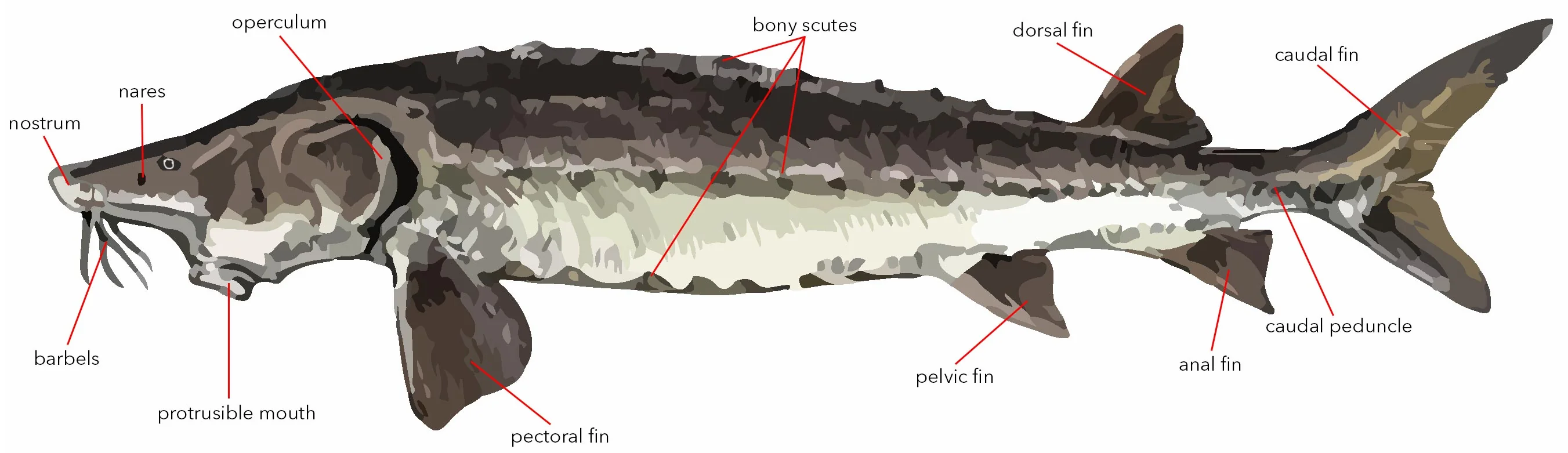
Protrusible, toothless mouth (hyostyly) efficient at suctorial feeding (vacuum prey from riverbed or seafloor)
4 sensitive tactile barbels on underside of snout assist in locating prey
Skin mostly naked except for longitudinal rows of heavy, diamond-shaped bony plates (scutes)
Characteristics of paddlefish (polyodontidae)
Rostrum (“paddle”) can make up one-third of body length
Covered in thousands of electroreceptors (ampullary hair cells) that detect electrical signals produced by zooplankton
not to be confused with ampullae of Lorenzini, though they do act the same
Filter feeders that rely on ram feeding and comb-like gill rakers to strain plankton
How are Neopterygii features characterized?
increased agility
lighter dermal skeleton (excluding gar)
more efficient feeding apparatus
What are the skull addictions for neopterygii?
Symplectic bone - braces the jaw joint and assists in specialized jaw protrusion found in teleosts
Maxilla freed from preoperculum, allowing it to swing forward when the mouth opens
At the base of the Neopterygii group, ____ is lost but a similar system has evolved in some teleosts.
Ampullae of lorenzini
Holostei includes ___ (semionotiformes) and ___ (amiiformes)
gars; bowfins
Characteristics of Holostei
Lightly ossified skeleton, reduced vestigial spiracles, paired vomer and more mobile maxilla
Dorsal, highly vascularized swim bladder, functions to supplement respiration as well as buoyancy
What is the swim bladder helpful for?
Acts as a hydrostatic organ that assists in respiration and buoyancy; it allows survival in hypoxic (low-oxygen) environments
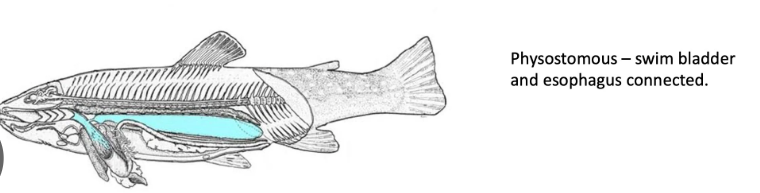
In Holostei as well as Chondrostei, the swim bladder is _____ with direct connection between the foregut and bladder (pneumatic duct) which involved gulping air at the surface
physostomous
True or False.
Both bowfins and gars can breathe air due to their highly vascularized swim bladder
True
What are the characteristics of Seminotiformes?
elongated jaws
abbreviated heterocercal tail
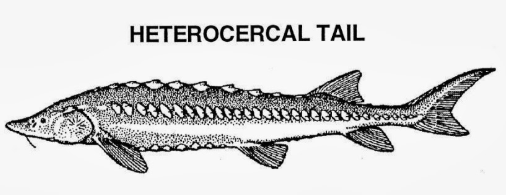
retain heavy ganoid scales
Characteristics of Amiiformes
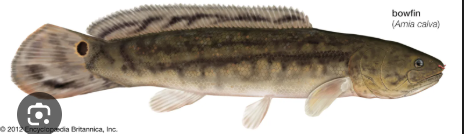
Single extant species: Bowfin (Amia calva) (southeastern North America)
Gular plate retained
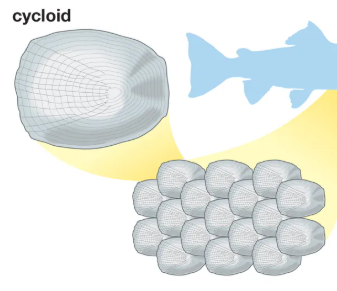
Highly reduced (thin, bony) cycloid scales
Internally asymmetrical tail (external appearance appears symmetrical)
What groups are in Neoterygii?
Holostei and Teleost
_____: 96% of all actinopterygians (most successful and diverse vertebrate group
Teleost
What are the several synapomorphies of Teleost?
Homocercal tail
Scale reduction: Thin cycloid/ctenoid scales (or naked)
Increases swimming efficiency (also present in Amiiformes)
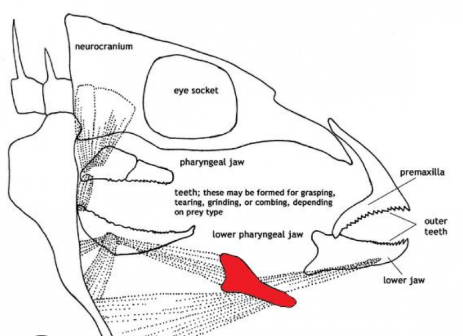
Opercular chain mechanism: Mobile/Disconnected premaxilla (Key innovation of Teleost!!)
Swim bladder specialization (both physostomous and physoclistous)
Weberian apparatus (in clade Ostariophysi)
Weberian only found in this clade!!!
Describe the opercular chain mechanism
The mechanical link allows Teleost to open its mouth rapidly, using the opercula as a lever
A disconnected premaxilla, which allows for it to slide forward and downward, creating a circular orifice and a sudden vacuum for inhaling prey
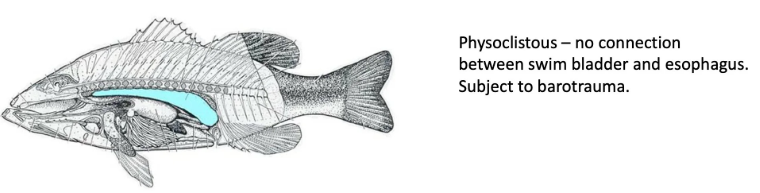
What is a physoclistous bladder?
A type of fish swim bladder not connected to the gut, so the fish cannot gulp or release air through the mouth.
Instead, buoyancy is regulated internally by the gas gland, a specialized bundle of capillaries, which secretes gases into the bladder and the oval window for resorption.
pneumatic duct lost
Problem: Subject to barrow trauma can’t adjust to pressure from being pulled up and explodes
What is the Weberian apparatus? What class is it found in?
Found only in the clade Ostariophysi
A sophisticated middle ear system that consists of four small bones (Weberian ossicles), which are modified versions of the first four vertebrates, and link the swim bladder to the inner ear
The swim bladder acts as a drum that vibrates and conducts sound waves to the inner ear sensory receptors
What are the 3 main groups of Teleost to know about?
Elopomorpha
Ostariophysi
Tetraodontiformes
What are the characteristics of Elopomorpha? (tarpons, els, and bonefish)
Unique leptocephalus larva, transparent, ribbon-like, and leaf-shaped
Unique since most fish larva phase called fry
Drift passively in ocean currents for months; lack a digestive tract for most of the larval period
Early diverging Teleost, many of which retain plesiomorphic traits (gular plate, heavy bony scales, phystomous bladder
Some eels have pharyngeal jaws that shoot forward out of the mouth
Characteristics of Ostariophysi
Contains 30% of all fish species and ~74% of freshwater species (includes catfish, carp, and minnows)
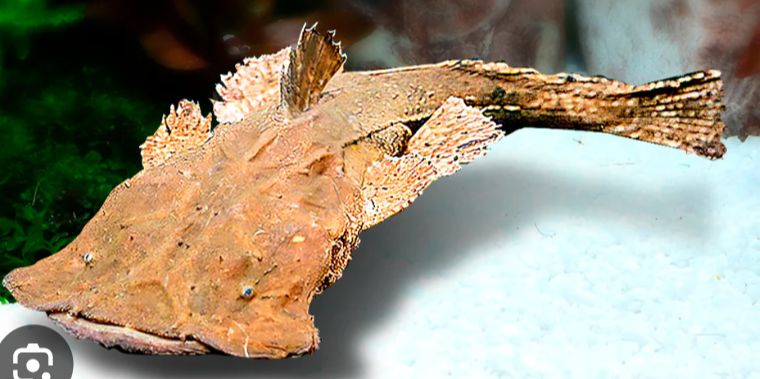
Catfish (Siluriformes) have sensory barbels, extremely sensitive Weberian apparatus, locked spines for predator avoidance, and can be smooth-skinned (naked) or encased in heavy, bony plates
Frogmouth catfish (Chaca Chaca) has tuberculated skin used for camo
Characteristics of Tetraodontiformes (pufferfish, boxfish, and triggerfish)
Beak-like fusion of front teeth, fewest vertebrate of any fish (16-18), complete loss of pelvic fins and girdle, opercular reduced to small, hole-like apertures
Includes the “Mola mola” (Sunfish)- the largest actinopterygian at 5,000 lbs
Long pharyngeal teeth shred gelatinous prey before entering the stomach and digestive tracts that are lined with mucus to protect from nematocysts (small harpoons that contain poison) of sea jellies
Spend long periods thermal basking at the surface to recover metabolism and digest after consuming lots of yummy sea jellies
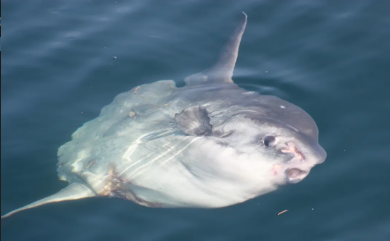
Undulating rudder, the clavus, is not a true caudal fin but a fusion of dorsal and anal fins
Thick, leathery skin often infested with parasites
Summary comparison of actinopterygian traits
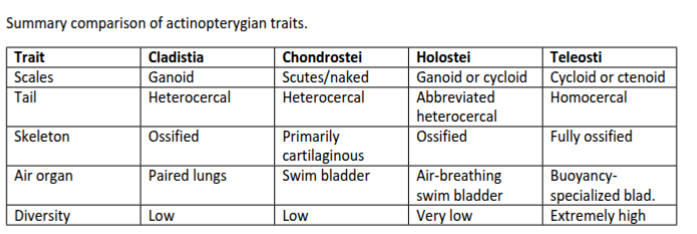
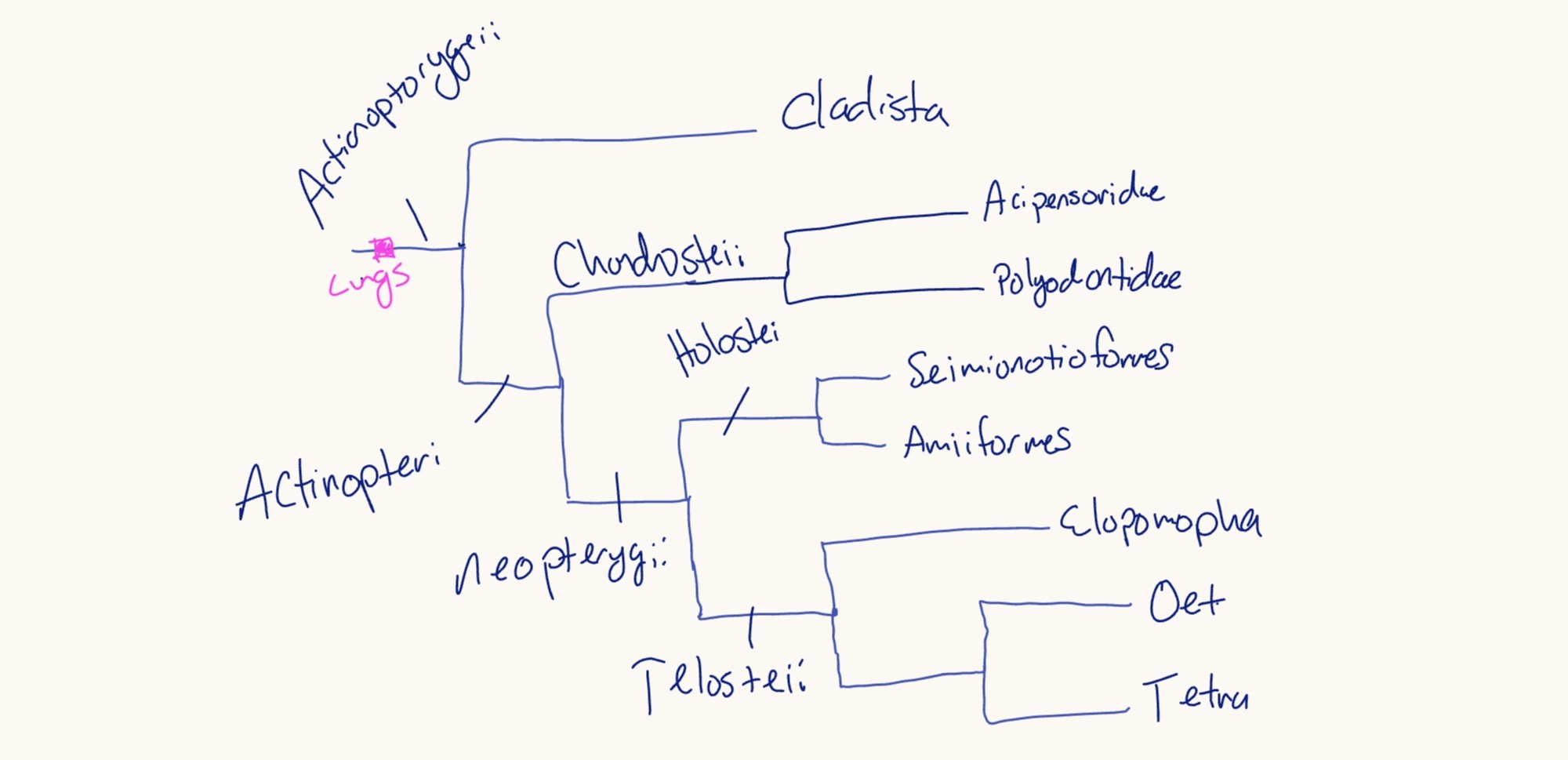
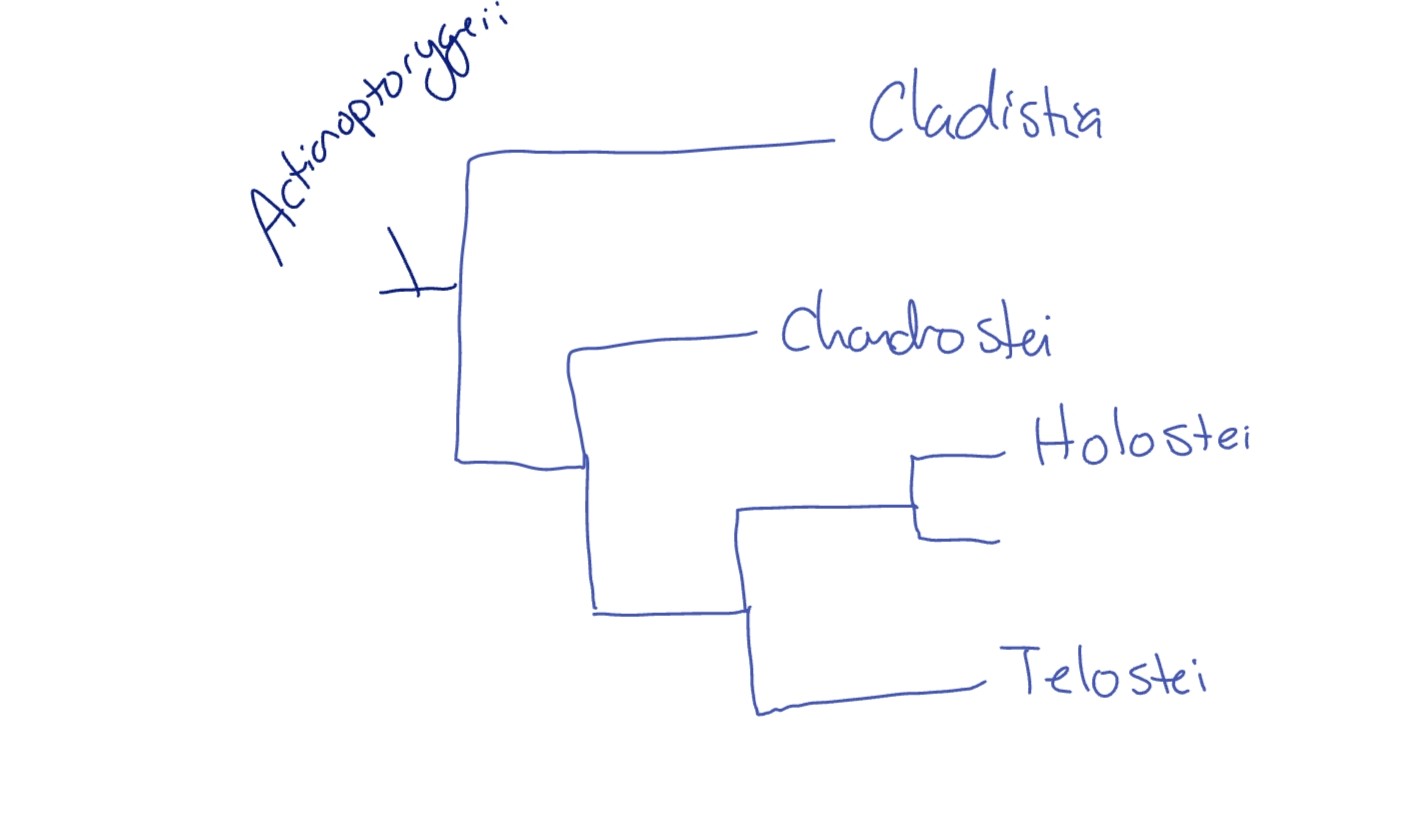
Draw two Actinopterygii trees
One with: Cladista, Chondrostei, Holostei, and Telostri
Other with: Cladista, Actinopteri, Chondrostei, Sturgeons (Acipenseridae), Paddlefish (Polyodontidae), Neopterygii, Holostei, Semionotiformes, Amiiformes, Telostei, Elopomorpha, Ostariophysi, and Tetraodontiformes
Different scales
Heavy - Ganoid
Light - Bony dermal scales
Ctenoid and Cycloid
Male angler fish attach and live off female angler fish parasitically, this is an example of what?
sexual dimorphism
Different actinopterygian fin muscles and exoskeletons