Homeostasis and Pulse Rate
 Studied by 0 people
 Call Kai
 Learn
Learn Practice Test
 Spaced Repetition
 Match
Match Flashcards
 Knowt Play
1/14

There's no tags or description
Looks like no tags are added yet.
Name | Mastery | Learn | Test | Matching | Spaced | Call with Kai |
|---|
No analytics yet
Send a link to your students to track their progress
15 Terms
How is heart rate controlled?
how?
what does this control exhibit?
HR control mechanism: through negative feedback by the ANS
sympathetic nerves to the heart increase the rate of the beat
parasympathetic nerves to the heart decrease the rate of the beat
this control exhibits dynamic equilibrium, as the beat varies minute by minute
Is the heart rate homeostatically regulated? Why?
then what is homeostatically regulated? How does it relate to HR?
The heart is NOT homeostatically regulated because it has no sensor
what is homeostatically regulated is blood pressure and HR acts as its effector
Explain the relationship between blood pressure as a homeostatic variable and HR as its effector
Blood pressure is what our body measures and maintains and HR affects the BP
so HR is adjusted as an effector to help homeostatically regulate BP (mean arterial pressure)
What is an important note to keep about homeostasis and negative feedback
ALL homeostatic mechanisms utilize negative feedback, but not all cases of negative feedback control homeostatic variables
What is the average heart rate?
how about for athletes?
avg: 60-100bpm
avg: 25-40 bpm
What factors influence heart rate?
genetics, size, sex, fitness, age, etc.
HR: Genetics
a persons base HR is set by their pacemaker, which is determined genetically
it may be faster or slower than avg
HR: Size
size matters, large animals (across species) tend to have a lower heart rate while smaller animals tend to have a higher heart rate
HR: Sex
between men and women the same size, women will have a faster heart rate potentially due to hormonal differences and other yet determined factors
HR: fitness
individuals that are physically fit have a stronger heart that pumps more efficiently (higher stroke volume), causing their HR to lower to maintain the same resting cardiac output
Ecological fallacies in HR
you should not assume someone is sick just because their HR is higher or lower than avg, as many individual factor influence the rate
What is cardiac output?
volume of blood pumped per minute
Cardiac output formula
include units
Cardiac Output (CO) = Stroke Volume (SV) x Heart Rate (HR)
ml/min ml/beat beat/min
What is the CO requirement for everyone at rest?
how does it change its rates to main the constant CO?
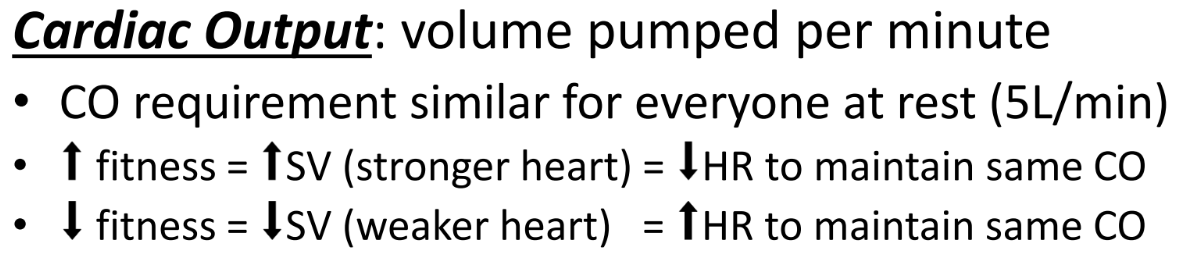
5L/min CO requirement at rest
Higher Fitness results in a stronger heart that has greater stroke volume. Because of this, the heart does not need to beat as often, resulting in a lower resting heart rate
Lower fitness results in a weaker heart that has lower stroke volume. Because of this the heart needs to beat more frequently, resulting in a higher resting heart rate
What is the role of CO in BP regulation?
CO is a major component in determining mean arterial pressure (MAP).
the body homeostatically regulates MAP by adjusting the components of CO, using the HR as an effector to either increase or decrease CO as needed to return MAP to its set point
 Note
Note  Flashcards (131)