Module 10 - Lecture 2 + 3 (Sport Nutr for children + body builders)
 Call Kai
 Learn
Learn Practice Test
 Spaced Repetition
 Match
Match Flashcards
 Knowt Play
1/39

There's no tags or description
Looks like no tags are added yet.
Name | Mastery | Learn | Test | Matching | Spaced | Call with Kai |
|---|
No analytics yet
Send a link to your students to track their progress
40 Terms
True or False: Children are mini-adults when it comes to sport nutrition recommendations
FALSE
they are NOT mini adults esp. when it comes to sport nutrition recommendations
***How are a Childs metabolic + Nutrient requirements compared to adults?
Have Heightened metabolic needs + nutrient requirements relative to adults
*********What are the 4 Key Physiological differences in children compared to adults
Bone health/development
Glycogen utilization
E expenditure
Thermoregulation
*********What are the physiological differences between CHILDREN + adult bone health + development (4 points)
Children’s bones are more porous + cartilaginous than adults
Bones (epiphyseal plates) are not sealed together until after puberty
Childhood + adolescence are key periods for bone development (think Nu Fs 356)
***Due to Childhood + Adolescence being key periods for bone development what is DIFFERENT NUTRITION WISE in children to address this?
Heightened CALCIUM requirements per the DRI need to be factored into diet planning + recommendations
*********How are children different from adult in regards to Glycogen utilization and WHY/HOW?
Children are less efficient at aerobic metabolism than adults + less able to draw upon glycogen stores to fuel ENDURANCE activity
Cardiac stroke volume and respiratory rate, O2 consumption + Glycogen storage capacity is lower in children
***Due to Children being efficient at glycogen utilization what is done NUTRITION WISE in children to address this?
Pre-event meal + eating during sport is important to provide fuel substrate + prevent hypoglycemia
*********How are children different from adult in regards to E expenditure and WHY/HOW?
Higher E expenditure related to GROWTH and…
Higher E expenditure/ kg body wt compared to adults
children burn more calories/kg than adults performing the same activity at the same relative intensity
WHY? = not as efficient at movement + do not adapt to training as efficiently as adults
*********How are children different from adult in regards to Thermoregulation and WHY/HOW?
produce MORE body heat
Prod less sweat due to Immature sweat glands(sweat glands do not mature until well into puberty)
*********What are 2 things to keep in mind regarding children’s hydration?
relation to thermoregulation
Fluid needs to support the increased metabolic needs associate with growth must also be considered
children lack awareness to thirst - may not drink enough as a result
*****Is Estimating E requirements the same for children?
No
Specific calculation of E cost per sport + activity in children is lacking
Also limited data on the cost/kg of specific activities in kids
******How is a Childs EER calculated?
used the adult EER equations or those provided in children as a starting point for estimation
A lot of MONITORING
******What are the 3 things what we are monitoring in relation to EER Calc. in children?
Weight changes = expect growth related increases (diff from adults)
Hunger
Sport performance
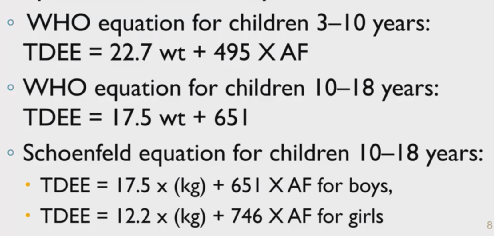
*******What are the 2 most accururate predictive equations to estimate EER in Healthy children?
FAO/WHO
Schoenfeld equation
Baseline E/kg body wt + additional E X AF
Add Activity factor for all cases
********In terms of Estimating Fluid Requirements For children, is it the same as for adults?
What is the best way
any Caveates/challenges?
Some principle
BEST = Calculate a tailored sweat rate + provide fluid to replace
caveate = DIFFICULT with children → requires tracking + monitoring
******What is the Difference between Athletic + Non-athletic children in terms of amount of sweat loss per day?
Athletic = 0.5-1.0 L/day ABOVE daily fluid turnover of non-athletic children
*******What is the GOAL in terms of amount of hydration for children athletes?
MEET DRI for fluid for children/youth then top up based on sweat losses
sweat losses either the estimate of 0.5 - 1.0 L above
OR sweat loss calculations
******What are some Tips to encourage meeting fluid requirements?
what are 5 somethings we can do to ensure proper hydration?
Pre-training or competition hydration is critical
Encourage used of water fountains at school or water bottles in the classroom
Make water bottles mandatory at all practices/training sessions
Work with coaches to ensure they recognize + honor the athlete’s fluid needs (recognize that children need to drink more frequently)
Encourage extra fluids at lunch in prep for afterschool training
Teach the “pee-chart” to athletes
*****Do children need Fluid replacement beverages?
Canadian Pediatric Society Position Statement (2017) are they correct?
Sport drinks are generally unnecessary for children engaged in routine or play-based physical activity (they are correct)
this does NOT mean that child athletes should not used fluid replacement beverages
Children’s thirst can be enhanced by adding NaCl + Carb in amounts typically found in sports drinks
Key takeaway = Fluid replacements such as Powerade or Gatorade is not something that should be drunk at school for fun or with dinner
It should only be used within sport) can lead to excess calories from sugar + excess c
What are athletes judged on in Competitive Body building? (3 things) what role does diet play?
Muscularity (size)
Conditioning (absence of body fat)
Symmetry (muscular proportion)
Diet plays a key role in helping bodybuilders achieve these elements of their sport
****What are the Nutrient Requirements for Body builders?
Is there well supported data?
Data that clearly define the nutrient requirements of bodybuilders are lacking (estimates exist)
Body building is frequently associated with eating practices that are not evidence based
*****What do Nutrient requirements for Body builders vary based on?
Phase + Volume of training
Gender, wt, body composition
*******Body building is periodized in to how many phases
What are these phases
4 Phases
maintenance phase
Building phase
Tapering phase
Cutting phase
Goal is to mesh diet with phase of training + promote adequate nutrient intakes
*****Diet phase transitions: Body building diets typically transition ______ (slowly/quickly) from a caloric surplus to a caloric deficit
Why?
SLOWLY (ideally)
Why? too quick = loss of muscle mass
****Most of the calories that are cut will eventually come from the elimination of _____ and ____? And ______ intake tends to increase (As a % of total E) over time
think the 3 macros
Elimination of: carbs + Fat
Increase in: Protein
******During the Maintenance phase what is the:
Goal
Is it on or Off season training
How often are workouts?
Goal = Maintain body comp, avoid loss of LBM or Fat gain
OFF-season training
Workouts: 1x/day, 4-6 days/week
******During the Muscle buidling phase what is the:
Goal
Is it on or Off season training
How often are workouts?
Goal = build LBM while minimizing fat gain
START of COMP. season
Workout = 1-2x/day, 5-6 days/week
Need more calories to match increased training to maximize muscle gain
******During the Tapering phase what is the:
Goal
Is it on or Off season training, how close relative to comp.
How often are workouts?
Goal = slight gains in LBM, FAT LOSS, Gain muscular DEFINITION
ON season → 12 weeks prior to competition
Workout = 1-2x/day, 6-7 days/week + increased aerobic activity to promote E deficit + fat loss
******During the Cutting phase what is the:
Goal
Is it on or Off season training, how close relative to comp.
How often are workouts?
NOT always NEEDED (some people don’t need to)
Goal = FAT loss, gain DEFINITION
ON season → 1 week prior to comp.
Workout = 1-2x/day, 6-7 days/week
really cut back on calories
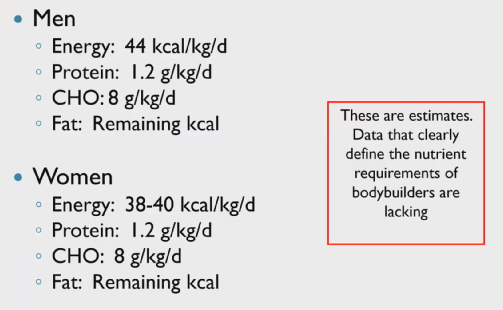
******What are the Maintenance phase DIET targets?
Men + women
NOTE: only E is diff
Women targets are in general less then men due to amount of E available
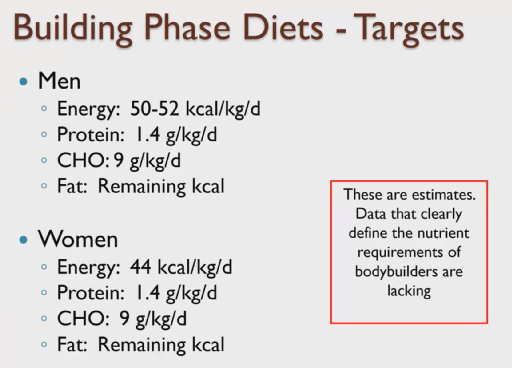
******What are the Building phase DIET targets?
General INCREASE in Kcal protein + carb
need calories to build things
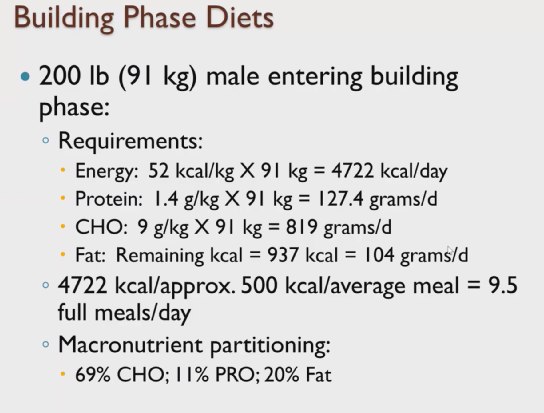
Example of Building phase diet
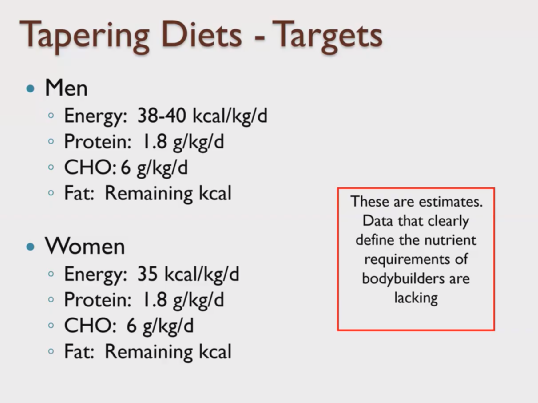
******What are the Tapering phase DIET targets?
decreasing kcal
Decreasing Fat + carb
increase in protein
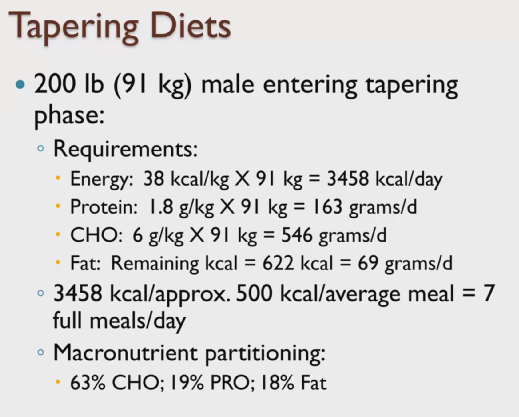
Tapering diet example
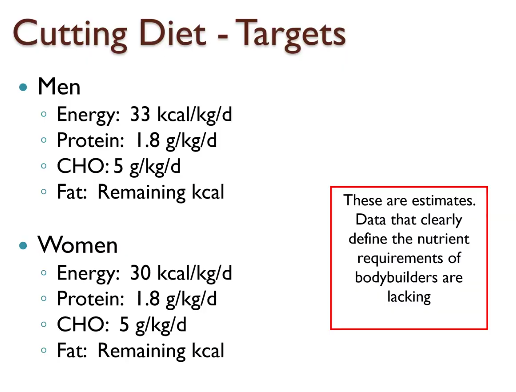
******What are the Cutting phase DIET targets?
Calories WAY down
proteins high to spare lean body mass
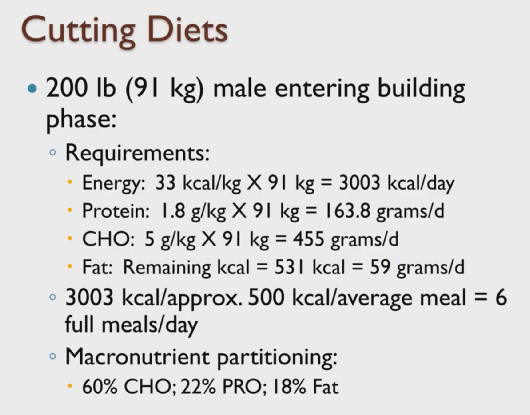
Cutting Diet example
Notice difference in macronutrient partitioning
****Cutting diet: what are typical food sources for:
CHO
PRO
FAT
CHO: oatmeal, brown rice, wheat bread, wheat noodles, sweet potatoes + fruits. Salad greens with (no dressing)
PRO: Lean beef, chicken breast, tuna, egg whites + cottage cheese
FAT: nuts, natural peanut butter, fish oils, flax oils, olive oil
*****Hypohydration and Body building
Goal?
Widely practiced by bodybuilders in days leading up to comp
Goal = Muscular definition
What are 3 things we need to caution the athlete about the con’s of hypohydration?
general health
Diminished sense of balance; inability to pose with confidence
Emaciation(the state of being unusually thin or weak) vs. Definition
****What are somethings to keep note of/ be aware of when working with bodybuilders?
Keen interest in nutrition BUT may be misinformed
Present strong evidence for recommendations
Know your stuff
be familiar with common ergogenic aids used by body builders
Be aware of training phases and diets
Decide when to SAY NO (do no harm)

