Chapters 5 (Temporomandibular Joint) & 7 (Glandular Tissue)
 Studied by 0 people
 Call Kai
 Learn
Learn Practice Test
 Spaced Repetition
 Match
Match Flashcards
 Knowt Play
1/50

There's no tags or description
Looks like no tags are added yet.
Name | Mastery | Learn | Test | Matching | Spaced |
|---|
No study sessions yet.
51 Terms
1.) Which ligament associated with the temporomandibular joint prevents excessive retraction or moving backward of the mandible?
a) Temporomandibular joint ligament
b) Sphenomandibular ligament
c) Stylomandibular ligament
d) Stylohyoid ligament
a) Temporomandibular joint ligament
b) Sphenomandibular ligament
c) Stylomandibular ligament
d) Stylohyoid ligament
2.) The temporomandibular joint allows for movement of the mandible during speech and mastication. Two basic types of movement are performed by the joint and its associated muscles: a gliding movement and a rotational movement.
a) Both statements are true.
b) Both statements are false.
c) The first statement is true; the second is false.
d) The first statement is false; the second is true.
a) Both statements are true.
b) Both statements are false.
c) The first statement is true; the second is false.
d) The first statement is false; the second is true.
3.) The gliding movement of the temporomandibular joint allows the lower jaw to move forward or backward. What movement of the mandible is involved when the lower jaw moves forward?
a) Retraction
b) Protrusion
c) Elevation
d) Depression
a) Retraction
b) Protrusion
c) Elevation
d) Depression
4.) What occurs with the dislocation of both of the temporomandibular joints on a patient?
a) Cellulitis
b) Paresthesia
c) Subluxation
d) Thrombus
a) Cellulitis
b) Paresthesia
c) Subluxation
d) Thrombus
5.) What is the fossa located on the temporal bone that articulates with the mandible?
a) Temporal fossa
b) Infratemporal fossa
c) Pterygomandibular fossa
d) Articular fossa
a) Temporal fossa
b) Infratemporal fossa
c) Pterygomandibular fossa
d) Articular fossa
6.) The resting position of the temporomandibular joint can be noted with teeth ______________________________ so as to allow a physiologic rest for the mandible.
a) biting gently together
b) apart at approximately 2 to 4 mm
c) resting firmly together
d) apart at approximately 6 to 10 mm
a) biting gently together
b) apart at approximately 2 to 4 mm
c) resting firmly together
d) apart at approximately 6 to 10 mm
7.) Which of the following nerves innervates the temporomandibular joint?
a) Facial nerve
b) Hypoglossal nerve
c) Glossopharyngeal nerve
d) Trigeminal nerve
a) Facial nerve
b) Hypoglossal nerve
c) Glossopharyngeal nerve
d) Trigeminal nerve
8.) Which of the following landmarks associated with the temporomandibular joint is located directly on the mandible?
a) Articular eminence
b) Condyle
c) Articular fossa
d) Postglenoid process
a) Articular eminence
b) Condyle
c) Articular fossa
d) Postglenoid process
9.) Which of the following muscles is involved in the lateral deviation of the mandible?
a) Masseter muscle
b) Medial pterygoid muscle
c) Lateral pterygoid muscle
d) Temporalis muscle
a) Masseter muscle
b) Medial pterygoid muscle
c) Lateral pterygoid muscle
d) Temporalis muscle
10.) Which of the following temporomandibular joint ligaments has the inferior alveolar nerve descending nearby in order to gain access to the mandibular foramen?
a) Sphenomandibular ligament only
b) Stylomandibular ligament only
c) Temporomandibular ligament only
d) Sphenomandibular and stylomandibular ligaments
a) Sphenomandibular ligament only
b) Stylomandibular ligament only
c) Temporomandibular ligament only
d) Sphenomandibular and stylomandibular ligaments
11.) Which of the following provides arterial branches for the most direct blood supply to the temporomandibular joint?
a) Internal carotid artery
b) External carotid artery
c) Common carotid artery
d) Aorta alone
a) Internal carotid artery
b) External carotid artery
c) Common carotid artery
d) Aorta alone
12.) Which of the following exocrine glands produces approximately 60% to 65% of the total volume of saliva for the oral cavity?
a) Sublingual gland
b) Submandibular gland
c) Parotid gland
d) Lacrimal gland
a) Sublingual gland
b) Submandibular gland
c) Parotid gland
d) Lacrimal gland
13.) Which of the following glands can be palpated as part of an extraoral examination by a clinician?
a) Lacrimal gland
b) Thyroid gland
c) Parathyroid gland
d) Thymus gland
a) Lacrimal gland
b) Thyroid gland
c) Parathyroid gland
d) Thymus gland
14.) Which of the following nerves innervates the minor salivary glands?
a) Fifth cranial nerve
b) Ninth cranial nerve
c) Twelfth cranial nerve
d) Fifth and seventh cranial nerves
a) Fifth cranial nerve
b) Ninth cranial nerve
c) Twelfth cranial nerve
d) Fifth and seventh cranial nerves
15.) Which of the following glands listed below is not an endocrine gland?
a) Lacrimal gland
b) Parathyroid gland
c) Thyroid gland
d) Thymus gland
a) Lacrimal gland
b) Parathyroid gland
c) Thyroid gland
d) Thymus gland
16.) Which of the following glands can be palpated within the sublingual space in the floor of the mouth during an extraoral examination by a clinician?
a) Parotid gland
b) Parathyroid gland
c) Sublingual gland
d) Submandibular gland
a) Parotid gland
b) Parathyroid gland
c) Sublingual gland
d) Submandibular gland
17.) Which of the following lymph nodes are initially involved when the patient has contracted mumps?
a) Superior deep cervical nodes
b) Deep parotid nodes
c) Superficial parotid nodes
d) Submandibular nodes
a) Superior deep cervical nodes
b) Deep parotid nodes
c) Superficial parotid nodes
d) Submandibular nodes
18.) Which of the following glands is associated with the Wharton’s duct?
a) Lacrimal gland
b) Parotid gland
c) Sublingual gland
d) Submandibular gland
a) Lacrimal gland
b) Parotid gland
c) Sublingual gland
d) Submandibular gland
19.) From the following list of descriptions, select which description does not describe the thymus gland.
a) Matures lymphocytes
b) Undergoes involution
c) Easily palpable in the mandibular region
d) Innervated by branches of the vagus nerve
a) Matures lymphocytes
b) Undergoes involution
c) Easily palpable in the mandibular region
d) Innervated by branches of the vagus nerve
20.) From the list of glands, select which gland directly drains into the submandibular lymph nodes.
a) Sublingual salivary gland
b) Thymus gland
c) Parotid salivary gland
d) Thyroid gland
a) Sublingual salivary gland
b) Thymus gland
c) Parotid salivary gland
d) Thyroid gland
21.) Which of the following nerves innervates both the submandibular and sublingual salivary glands?
a) Trigeminal nerve
b) Chorda tympani nerve
c) Hypoglossal nerve
d) Vagus nerve
a) Trigeminal nerve
b) Chorda tympani nerve
c) Hypoglossal nerve
d) Vagus nerve
22.) Which of the following nerves travels through the parotid salivary gland but is not involved in its innervation?
a) Trigeminal nerve
b) Facial nerve
c) Vagus nerve
d) Glossopharyngeal nerve
a) Trigeminal nerve
b) Facial nerve
c) Vagus nerve
d) Glossopharyngeal nerve
23.) Which of the following glands has a duct that usually opens on the inner surface of the cheek, opposite the maxillary second molar?
a) Thymus gland
b) Parotid gland
c) Sublingual gland
d) Submandibular gland
a) Thymus gland
b) Parotid gland
c) Sublingual gland
d) Submandibular gland
24.) Which oral landmark marks the opening of the submandibular duct?
a) Lacrimal punctum
b) Parotid papilla
c) Sublingual caruncle
d) Nasolacrimal duct
a) Lacrimal punctum
b) Parotid papilla
c) Sublingual caruncle
d) Nasolacrimal duct
25.) The lacrimal gland’s tears ultimately drain into the
a) lacrimal fossa
b) inferior nasal meatus
c) parotid salivary gland
d) internal carotid artery
a) lacrimal fossa
b) inferior nasal meatus
c) parotid salivary gland
d) internal carotid artery
26.) Which of the following can block the drainage of saliva from the duct?
a) excessive amounts of secretion
b) stone formation
c) lacrimal gland drainage
d) inflammation of blood vessels
a) excessive amounts of secretion
b) stone formation
c) lacrimal gland drainage
d) inflammation of blood vessels
27.) Which of the following statements concerning minor salivary glands is correct?
a) Minor glands are smaller and less numerous than the major glands.
b) Minor glands secrete only mucous saliva.
c) Minor glands have longer ducts than major glands.
d) Minor glands are located in the buccal, labial, and lingual mucosa.
a) Minor glands are smaller and less numerous than the major glands.
b) Minor glands secrete only mucous saliva.
c) Minor glands have longer ducts than major glands.
d) Minor glands are located in the buccal, labial, and lingual mucosa.
28.) Which of the following lesions is because of an enlarged thyroid gland?
a) Mucocele
b) Ranula
c) Goiter
d) Mumps
a) Mucocele
b) Ranula
c) Goiter
d) Mumps
29.) The sublingual salivary gland is located _____________________________.
a) anterior to the submandibular gland
b) inferior to the mylohyoid muscle
c) lateral to the body of the mandible
d) within the mandibular vestibule fornix
a) anterior to the submandibular gland
b) inferior to the mylohyoid muscle
c) lateral to the body of the mandible
d) within the mandibular vestibule fornix

30-31.) Identify structures A-D in the image.
Temporomandibular ligament
Joint capsule
External acoustic meatus
Stylomandibular ligament
Temporomandibular ligament
Joint capsule
External acoustic meatus
Stylomandibular ligament

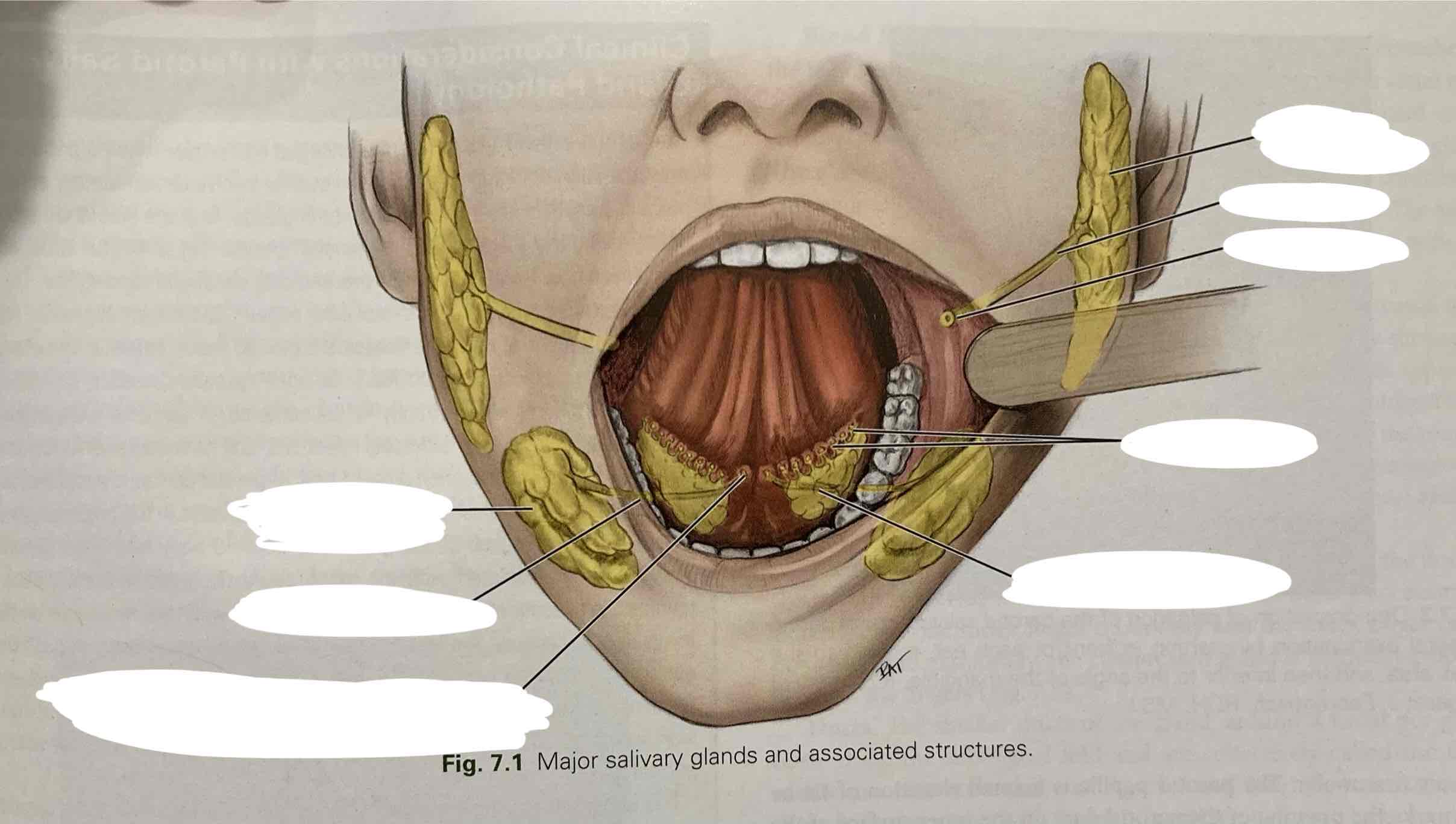
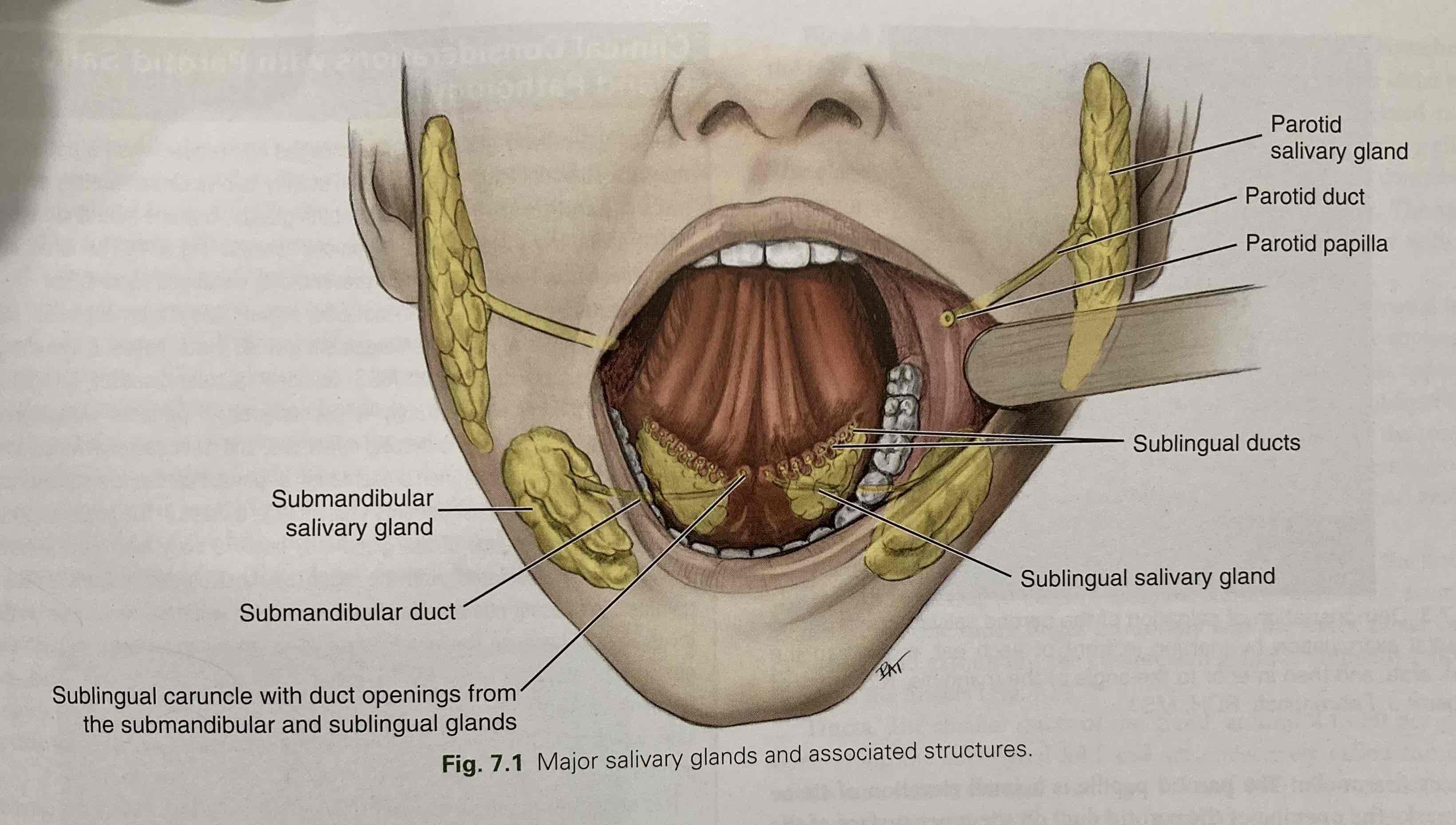
32-39.) Utilize the diagram and key to label the salivary glands and related anatomy-identifying structures.
Parotid duct
Parotid salivary gland
Parotid papilla
Sublingual ducts
Sublingual salivary gland
Submandibular duct
Submandibular salivary gland
Sublingual caruncle with duct opening from submandibular and sublingual glands
Parotid duct
Parotid salivary gland
Parotid papilla
Sublingual ducts
Sublingual salivary gland
Submandibular duct
Submandibular salivary gland
Sublingual caruncle with duct opening from submandibular and sublingual glands
Kahoot
1.) The gliding movement of the TMJ allows the lower jaw to move forward or backward. What movement of the mandible is this?
a) Retraction
b) Protrusion
c) Elevation
d) Depression
a) Retraction
b) Protrusion
c) Elevation
d) Depression
Kahoot
2.) Which of the following statements concerning minor salivary glands is CORRECT?
a) Minor glands are smaller and less numerous than the major
b) Minor glands only secrete only mucous saliva
c) Minor glands are located in the buccal, labial and lingual mucosa
d) Minor glands have longer ducts than major glands
a) Minor glands are smaller and less numerous than the major
b) Minor glands only secrete only mucous saliva
c) Minor glands are located in the buccal, labial and lingual mucosa
d) Minor glands have longer ducts than major glands
Kahoot
3.) Which of the following lesions is due to an enlarged thyroid?
a) Mucocele
b) Ranula
c) Goiter
d) Mumps
a) Mucocele
b) Ranula
c) Goiter
d) Mumps
Kahoot
4.) Which of the following nerve travels through the parotid salivary gland but is not involved in it innervation?
a) seventh cranial nerve, facial nerve
b) ninth cranial nerve, glossopharyngeal nerve
c) fifth cranial nerves, trigeminal nerve
d) Auriculartemporal nerve of mandibular nerve
a) seventh cranial nerve, facial nerve
b) ninth cranial nerve, glossopharyngeal nerve
c) fifth cranial nerves, trigeminal nerve
d) Auriculartemporal nerve of mandibular nerve
Kahoot
5.) R submandibular gland, notes a stony hard mass within it during EO; this always needs to be removed surgically.
a) True
b) False
a) True
b) False
Kahoot
6.) Which of the following has a duct that usually opens on the inner surface of the cheek, opposite the max. 2nd molar?
a) Thymus gland
b) Parotid gland
c) Sublingual gland
d) Submandibular gland
a) Thymus gland
b) Parotid gland
c) Sublingual gland
d) Submandibular gland
Kahoot
7.) Which of the following glands has both a superficial lobe and deep lobe?
a) Thymus gland
b) Thyroid gland
c) Sublingual gland
d) Parotid gland
a) Thymus gland
b) Thyroid gland
c) Sublingual gland
d) Parotid gland
Kahoot
8.) Which oral landmark marks the opening of the submandibular duct?
a) Lacrimal punctum
b) Sublingual caruncle
c) Parotid papilla
d) Nasolacrimal duct
a) Lacrimal punctum
b) Sublingual caruncle
c) Parotid papilla
d) Nasolacrimal duct
Kahoot
9.) What is the fossa located on the temporal bone that articulates with the mandible?
a) Articular Fossa
b) Temporal Fossa
c) Infratemporal Fossa
d) Pterygopalatine fossa
a) Articular Fossa
b) Temporal Fossa
c) Infratemporal Fossa
d) Pterygopalatine fossa
Kahoot
10.) The disc of the TMJ is att. to the lateral and medial poles of the mand. condyle. The disc is fully att. to the temporal
a) Both statements are true
b) The first statement is true, the second is false
c) Both statements are false
d) The first statement is false, the second is true
a) Both statements are true
b) The first statement is true, the second is false
c) Both statements are false
d) The first statement is false, the second is true
Kahoot
11.) Three paired ligaments are associated with the TMJ: temporomandibular, stylomandibular, and sphenomandibular ligaments.
a) True
b) False
a) True
b) False
Kahoot
12.) The knuckle shaped posterosuperior process of the mandibular ramus is the mandibular condyle.
a) True
b) False
a) True
b) False
Kahoot
13.) Which of the following provides arterial branches for the most direct blood supply to the to the TMJ?
a) Internal carotid artery
b) External Carotid Artery
c) Common Carotid artery
d) Aorta Alone
a) Internal carotid artery
b) External Carotid Artery
c) Common Carotid artery
d) Aorta Alone
Kahoot
14.) Protrusion of the mandible is an action that primarily involves:
a) opening the jaws
b) closing the jaws
c) bringing the lower jaw forward
d) bringing the lower jaw backward
a) opening the jaws
b) closing the jaws
c) bringing the lower jaw forward
d) bringing the lower jaw backward
Kahoot
15.) The joint capsule of the temporomandibular joint wraps around which structure?
a) Coronoid process
b) Mandibular notch
c) Mandibular Condyle
d) Zygomatic arch
a) Coronoid process
b) Mandibular notch
c) Mandibular Condyle
d) Zygomatic arch
Kahoot
16.) Which of the following is located posterior to the articular fossa within the region of the temporomandibular joint?
a) Articular eminence
b) Bony separation of the nasal septum
c) Zygomatic process of the temporal bone
d) Postglenoid process
a) Articular eminence
b) Bony separation of the nasal septum
c) Zygomatic process of the temporal bone
d) Postglenoid process
Kahoot
17.) The lacrimal gland’s tears ultimately drain into the:
a) lacrimal fossa.
b) parotid salivary gland.
c) inferior nasal meatus.
d) internal carotid artery
a) lacrimal fossa.
b) parotid salivary gland.
c) inferior nasal meatus.
d) internal carotid artery
Kahoot
18.) The primary lymphatic drainage of the sublingual salivary gland is by the:
a) submental nodes.
b) superior deep cervical nodes.
c) malar nodes.
d) submandibular nodes.
a) submental nodes.
b) superior deep cervical nodes.
c) malar nodes.
d) submandibular nodes.
Kahoot
19.) Parathyroid glands consist of 4 small endocrine glands that secrete hormone directly into the cardiovascular system
a) True
b) False
a) True
b) False
Kahoot
20.) Exocrine gland is a gland that has a duct associated with it. Salivary glands are an example of exocrine glands.
a) Both statements are false.
b) First statement is true. Second statement is false
c) First statement is false. Second statement is true.
d) Both statements are true.
a) Both statements are false.
b) First statement is true. Second statement is false
c) First statement is false. Second statement is true.
d) Both statements are true.
 Note
Note  Flashcards (32)