chem 1120- chem + math review
 Studied by 0 people
 Call Kai
 Learn
Learn Practice Test
 Spaced Repetition
 Match
Match Flashcards
 Knowt Play
1/9

Earn XP
Description and Tags
The exam will consist of 40 multiple choice questions with the approximate breakdown as follows: 3 questions per experiment. 3 questions about general lab safety. 4 questions about general lab/chemistry knowledge relevant to this course (e.g., units, sig. figs., etc.)
Name | Mastery | Learn | Test | Matching | Spaced | Call with Kai |
|---|
No study sessions yet.
10 Terms
Perform the calculation, rounding your answer to the proper number of significant figures.
2.74 – 0.00072 =
2.74
The mathematical operation in the question is subtraction so follow the significant figure rules for addition/subtraction, which look at the digits past the decimal point. The number 2.74 has the fewest digits past the decimal point, so the answer can have only two digits past the decimal point. When performing the calculation, the answer appears as 2.73928 but you should round it to 2.74.
Perform the calculation, rounding your answer to the proper number of significant figures.
0.867 + 3.72 + 18.0045 =
22.59
The mathematical operation in the question is addition so follow the significant figure rules for addition/subtraction, which look at the digits past the decimal point. The number 3.72 has the fewest digits past the decimal point, so the answer can have only two digits past the decimal point. When performing the calculation, the answer appears as 22.5915 but you should round it to 22.59.
Perform the calculation, rounding your answer to the proper number of significant figures.
0.982 x 4.71 x 8.3 =
38
The mathematical operation in the question is multiplication so follow the significant figure rules for multiplication/division, which look at the number of significant figures in each number. The number 8.3 has the fewest significant figures, so the answer can have only two significant figures. When performing the calculation, the answer appears as 38.389326 but you should round it to 38.
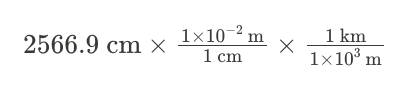
How many kilometers is 2566.9 cm?
Perform this conversion in two steps, by first converting to the base unit. Each conversion factor should be made from the equivalence between the two units involved. One centimeter (cm) equals meters and one kilometer (km) equals meters.
Each conversion factor should be set up so that the units of the starting measurement are on the bottom to cancel and give the new units on top. Then, perform the calculation by multiplying the starting value by the numbers on top of the conversion factor and dividing by the numbers on the bottom.
Note that the definitions of units are considered infinitely significant and do not affect significant figures.
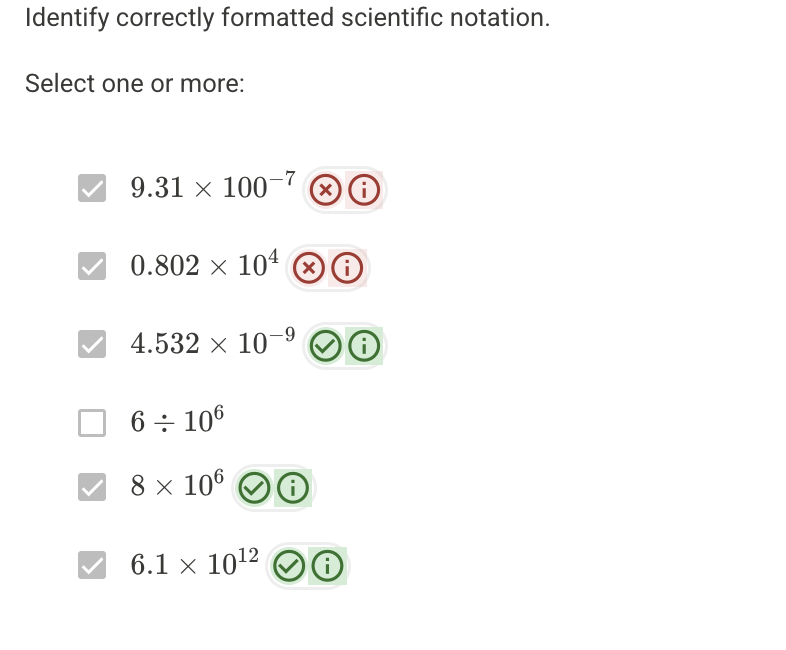
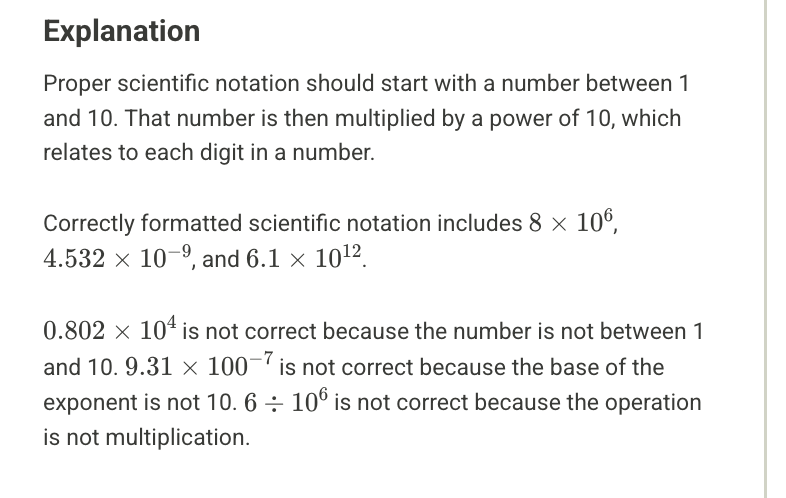
When performing a multiplication or division calculation, significant figures in the calculated result are dictated by the (Choose...decimal places, significant figures, absolute values) of the measured numbers. The calculated result should have
(Choose...one fewer significant figure than, the same number of digits past the decimal point as, the same number of significant figures as)
the measured number in the calculation with the fewest
significant figures
the same number of significant figures as
significant figures
When performing an addition or subtraction calculation, significant figures in the calculated result are dictated by the
(Choose...significant figures, absolute values, decimal places)
of the measured numbers. The calculated result should have
(Choose...the same number of digits past the decimal point as, the same number of significant figures as, one fewer significant figure than) the measured number in the calculation with the fewest
(Choose...digits past the decimal point, significant figures, zero digits)
decimal places
the same number of digits past the decimal point as
digits past the decimal point
Determine the relative order of the metric prefixes of kilo-, micro-, centi-, and milli-.

Perform the calculation, rounding your answer to the proper number of significant figures.
0.32610 ÷ 1.830 =
0.1782
The mathematical operation in the question is division so follow the significant figure rules for multiplication/division, which look at the number of significant figures in each number. The number 1.830 has the fewest significant figures, so the answer can have four significant figures. When performing the calculation, the answer appears as 0.178196172 but you should round it to 0.1782.
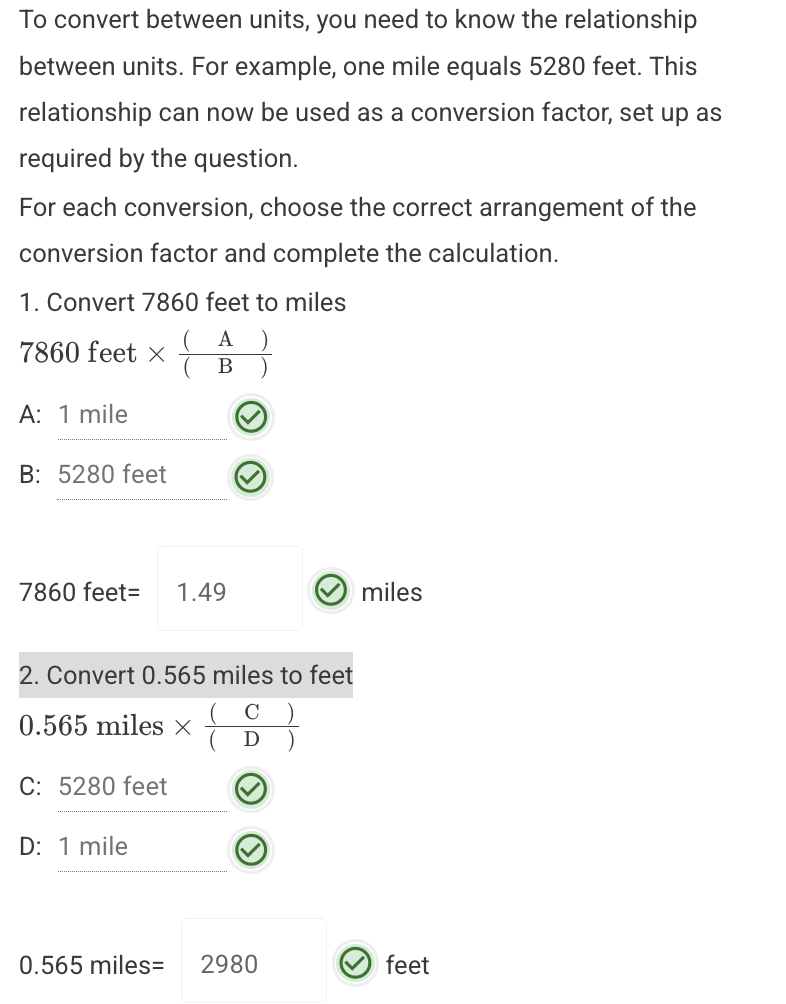
To convert between units, you need to know the relationship between units. For example, one mile equals 5280 feet. This relationship can now be used as a conversion factor, set up as required by the question.
For each conversion, choose the correct arrangement of the conversion factor and complete the calculation.
1. Convert 7860 feet to miles
2. Convert 0.565 miles to feet
 Note
Note  Flashcards (260)