Research Methods
 Call Kai
 Learn
Learn Practice Test
 Spaced Repetition
 Match
Match Flashcards
 Knowt Play
1/380

There's no tags or description
Looks like no tags are added yet.
Name | Mastery | Learn | Test | Matching | Spaced | Call with Kai | Chat |
|---|
No analytics yet
Send a link to your students to track their progress
381 Terms
Theory
Why? How?
Explanations and predictions - based on what happens in the past
Naive science
personal experience
Intuition (easy way out)
Authority (rely on what experts say)
Appeals to traditions, customs and faith
Magic, superstitions and mysticism
Insufficient/incomplete data
Either no or biased inquiry
Scientific method
systematic process→ increase chance conclusion is correct
Falsifiable theory
Replication
Reflective and self-critical approach
Cumulative and self-correcting process
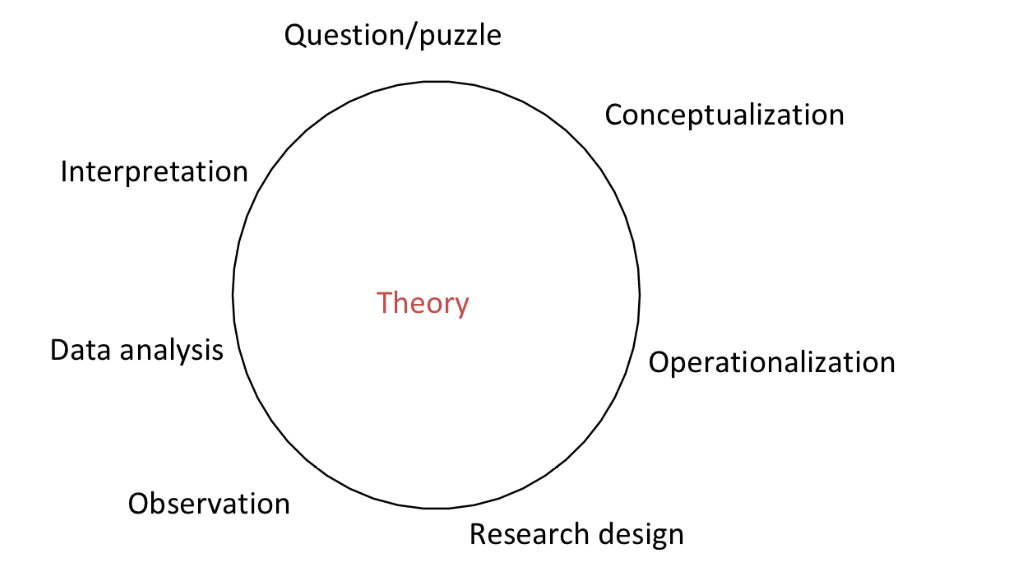
Cyclical process
Scientific research process
Question / puzzle
Conceptualization
Operationalization
Research design
Observation
Data analysis
Interpretation
Why research methods?
From intuitions and anecdotes to systematic evidence
Question and problem driven
Good research question is important
Research methods are useful tools
provide transparency and replicability
Methodological pluralism and diversity
Methods as constraints vs opportunities
Limit due to very clear guide lines
Advantage gives credibility through use
Ontology
What is the nature of the social world
Epistemology
What can we know about social phenomena
Methodology
How do we gain/ obtain knowledge
Positivism
Developed by French philosopher August Comte
search for the truth though systemic collection of observable facts
Sociology
Scientific study of the social world
What are the 3 positions of positivism?
classical
Logical
Falsification
Classic positivism: basic tenets
naturalism
Empiricism
Laws
Establish social laws that allow us to predict people behavior
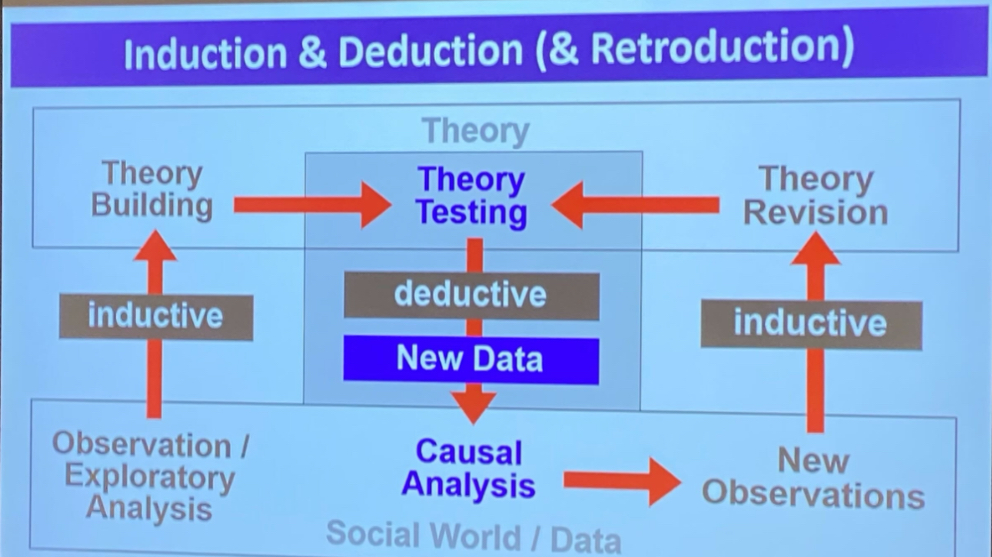
Induction (observation → theory)
Cause and effect relationship (observable ‘constant conjunction’ David Hume)
Science is objective and value free → establish facts
Naturalism
Social science = natural science
approach them in the same way
Observation is KEY
Empiricism
Knowledge of the wold is limited to what can be observed and measured (sensory experience)
Laws
Social world is subject to regular and systematic processes; laws are explanatory and predictive
Logic positivism: basic tenets
empiricism (observation) + logical reasoning
Deduction (theory → observation)
Retroduction (observation ←→ theory)
Verification (establishing truth claims) → find support for their reasoning
Induction & deduction & retroduction
Critique of logical positivism
Karl Popper
Rejection of induction: not a good way of creating/ testing a theory
Particular experience /→ general knowledge
One counter-observation and law is falsified → swan example
Rejection of verifiability: develop our theories with logical resonating , key is more to look for evidence that contradicts the theory
Verifying theory is pointless
Goal must be falsification
Deductive-Nomological model
Carl Gustav Hempel - logical positivist
observed phenomenon is explained if it can be deduced from a universal law-like generalization
Laws express necessary connections between properties, accidental generalization does not exist
Hypothetical-deductive model
test ability of law to predict events
Law → hypothesis → explicit prediction
Prediction correct→ hypothesis corroborated / supported
Prediction incorrect → hypothesis falsified/ not supported
Challenge 1 to positivism: Scientific Realism
Response: there is a lot going on that we can not observe objectively
Similarities to positivism:
social and natural worlds (sciences) are similar
Realism: ‘objective’ reality exists
Key differences:
Realist can consist on unobservable elements as well
Ex. Structural relationships, legitimacy
Assessment by observable consequences
Ex. Consider the gov legitimate - more likely to vote
Causal mechanisms instead of law-like generalizations
Don’t like to talk about laws- there are always exceptions
If a cause is present it makes the theory more likely
‘Best’ theory is the one that explains phenomena the ‘best’
Not correct but most likely (highest explanatory value)
Example scientific realism
Mechanism (Tilly)
Environmental: externally generated influences on conditions affecting social life
Contextual factors impact how political actors act
Cognitive: operate through alterations of individual and collective perception
Protestant mindset worked well with capitalism
Stereotypes
Relational: alter connections among people, groups and interpersonal networks
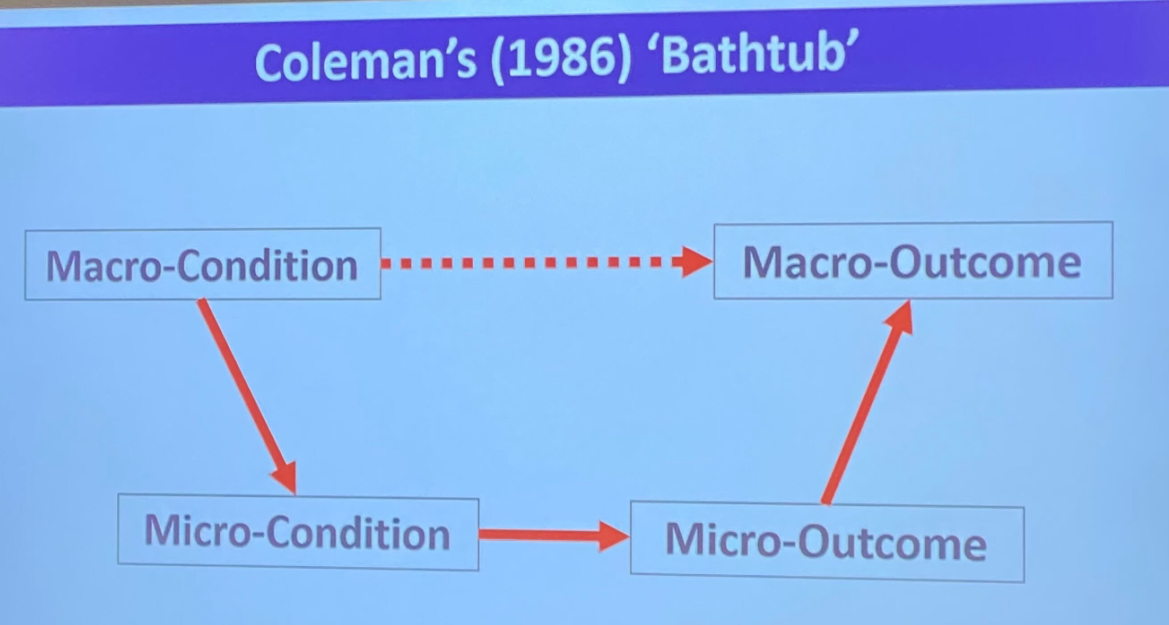
Individualism vs Holism
Individualism - break everything down to smallest unit of analysis
Individuals make up society, we have to study them to understand
Holism: states can make decisions —> more than just the individual that make up the state but as its own entity
More than the sum of its parts —> becomes the actor itself
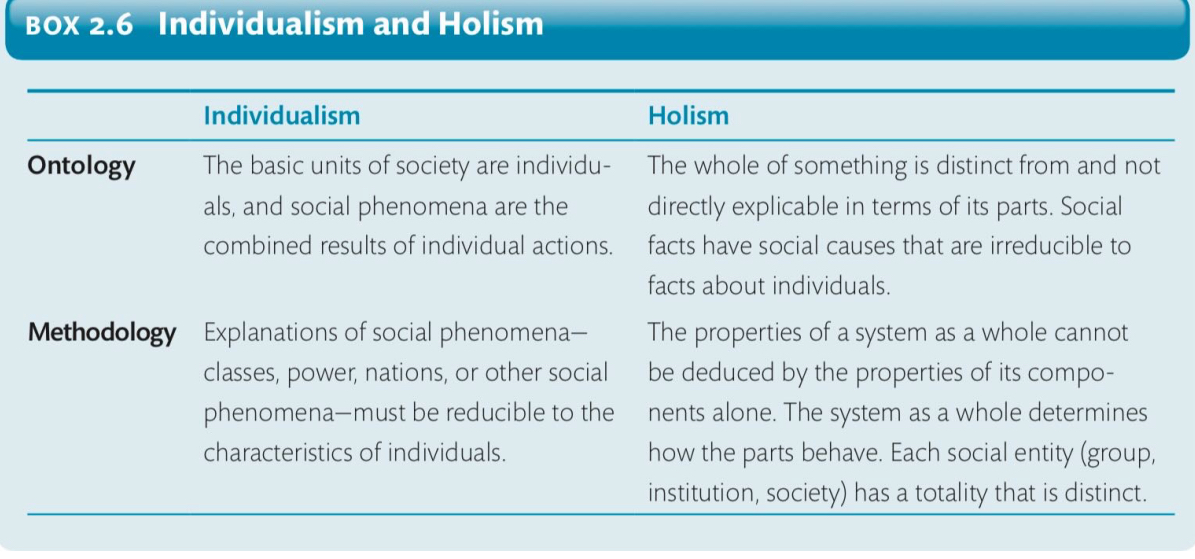
Coleman’s ‘Bathtub’
Start with general explanations, then go very specific, put all the individual decisions/outcomes together you come back to general outcomes
General= macro
Specific = micro
Ex. Democratic peace theory
Challenge 2 to positivism: Interpretivism
Fundamentally different from positivism
Social world and natural world are fundamentally different -> different methods needed
Social world
Subjectively created -> the only thing that matters is from the perspective of the research - how they see it
Understanding human behavior by interpretation of meaning of social behavior
Example of approaches: hermeneutical (reader perspective), critical theory, constructivism, post-colonialism, feminism
But: some similarities in collecting evidence and establishing causal relations (?)
Researchers have values→ source of bias?
Critical theory: yes, can’t be separated!
Positivism: well, let’s distinguish:
Normative theory (what ought or should be)
Empirical theory (what is)
Robert Cox: all theory is normative
Max Weber: distinguish, yes, but values cannot be ignored (what is seen as relevant, point of view)
How to separate facts and values
Transparency
Self-aware/disclosure
Critical examination by larger scientific community
If you are not aware of your bias, other people will be
Researchers expectations are hard to escape
Expectations shape perceptions
Image of bunny/duck
Observation can change (social) phenomena
Hawthorn effect
Everyone should be aware of how humans operate and take this into account during research
Hawthorn effect
if you know you are being observed you change your behavior
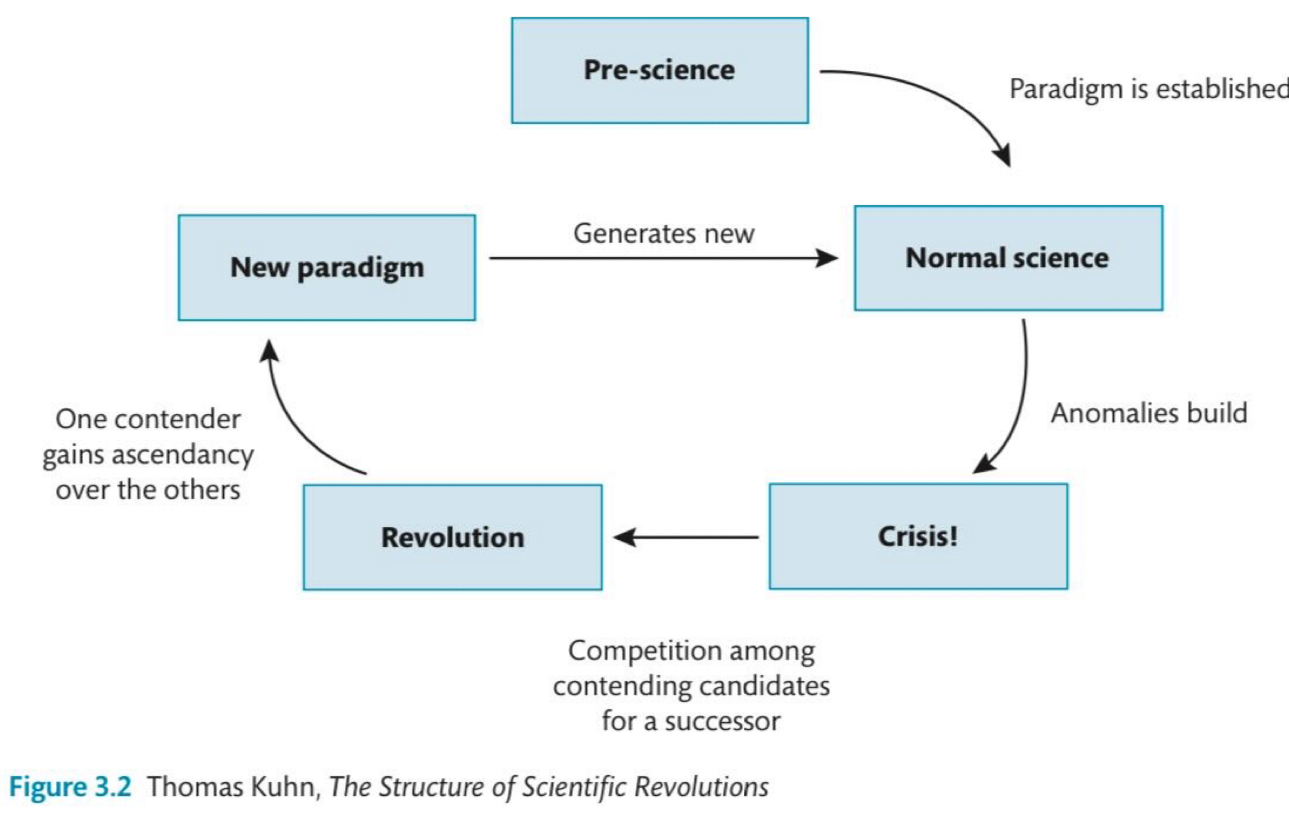
Thomas Kuhn - the Structure of Scientific Revolutions (1962)
Science is a social institutions
Scientific community subscribes to a common view, paradigm or conceptual scheme (=‘normal science’)
Defines objects, norms and methods of investigation
‘Truth’ is based on consensus in scientific community
Paradigm shifts: ‘Revolutionary’ change in paradigms
Scientific Revolution
People like to stick to what they believe- only when they have to admit that they are wrong is when new science can come about
Scientific research programs
Imre Lakatos - Falsification and the methodology of scientific Research Programs (1970)
Scientific research programs= incremental, cumulative, progressive articulation of scientific research programs lead to the growth of scientific knowledge
Hard core with a protective belt of auxiliary hypothesis
Novel facts: progressive (problem shifts) or degenerating research programs
Research question
Likes a puzzle
Problem, topic, puzzle → general RQ → specific RQ → scientific inquiry
Process is like a funnel- start wide then you narrow it down
Research process vs presentation
Process = narrow it down, find question
Presentation = journal, article
What makes a research question relevant?
Two criteria: does the answer to the question have…
Scientific relevance /importance
Social (real world) relevance/importance
What makes a RQ useful?
Should guide and structure the whole research process (’wheel of science’)
Be researchable (possible to answer)
New (not answered before)
Tension with relevance of RQ
Finding a good RQ?
Real world events and problems
Recent (& historic) events are good choices, but ongoing events are very risky (better avoided)
Existing literature
‘gaps’ and ‘controversies’
Caution: blind acceptance of ‘normal science’ might limit search for better understanding
“Puzzle” : unexpected contradictions
Replication (but not fully accepted yet)
Typical steps to research process
General RQ/ working hypothesis
Literature review
What do we already know?
What do we not know?
Theory/theoretical framework
Relevant concepts and factors
Expectations and hypotheses
Research design (data and sources)
Types of research questions
descriptive
Explanatory
Predictive
Prescriptive
Normative
Descriptive RQ
open ended
Collect information
Ex. Two factors, are they related to each other
Explanatory RQ
Make claim about causal relationship
Predictive RQ
If we do this, what are the implications in x years
Ex. Policy implemented to try and lower emissions, what will happen or emissions look like in x years
Prescriptive RQ
Goal oriented
Ex. We want to lower emissions→ what policy is needed to reach this
Normative RQ
Philosophical questions
Types of RQ preferred by academic audiences
Descriptive, explanatory, normative
Types of RQ preferred by applied research and consulting
Predictive and prescriptive
Literature search: sources
Core books in library (open stacks?)
Databases
Via library
Google scholar
Reviews/state-of-the-art articles
Handbooks/encyclopedias
Annual Review of Political Science
Then following references (”snowball sampling”)
(Wikipedia can be a good starting point)
ChatGPT
Analytical review
Summarize: outline the relevant existing research/knowledge/theories/methods/evidence (topical/thematic review)
Evaluate: identify the contributions (strengths) and limitations (weaknesses) of existing research
Conceptualist: use it to define key concepts
Literature review
not annotated bibliography or personal diary
Analytical review
Develop general into specific RQ/hypothesis
Theory definition
Simplified model of reality
Identifies key concepts/factors and their relationship
“A proposition which has been elaborated and/or has withstood repeated testing”
A theory is “a set of interrelated constructions, definitions, and propositions that present a systematic view of phenomena by specifying relations among variables, with the purpose of explaining and predicting the phenomena ”
Types of theories
Scope/level: grand theory vs middle-range theory (Merton 1968)
Process: inductive vs deductive
Nature of question: empirical vs normative
‘Ground theory’
Sounds like a theory but is actually a research method -> qualitative
Inductive and qualitative approach: method of inquiry and theory building
Process
Coding: close (tentative) coding of collected data
Sorting: compare, sort and synthesize the codes
Memo writing: were memos outlining/describing codes
How can theories be used?
Apply existing theory to new cases/data
Revise theory and test with old and new cases/data
Identify and define concepts/factors and their relationships, usually but not always in the form of hypothesis
Hypothesis
a proposed explanation for a phenomena
Usually by stating some kind of (testable) cause and effect relationship
Relationship
specify relationship between factors→ link two or more variables
Cause: explanatory factor/ independent variable
Outcome: dependent variable
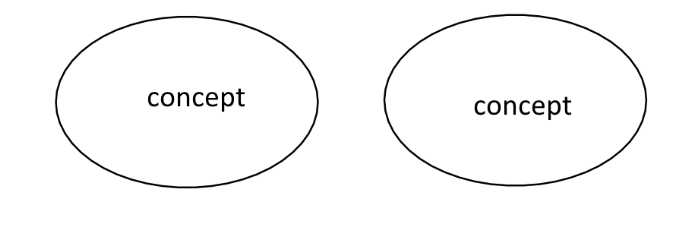
Null relationship
2 concepts not related
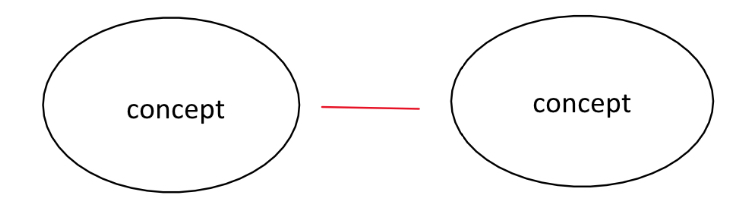
Covariance relationship (positive relations)
Concept A present, B present as well (occur at the same time)
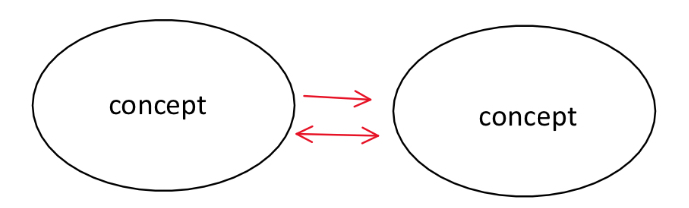
Causal relationship
A causes B
Can be reciprocal causation
Relationships ex Democratic Peace Theory
An empirical regularity - democracies don’t go to war with each other (macro level)
Hawks and Doves - tested the theory on a individual level
Explanations
Liberal norms (based on reason or culture/norms)
Institutional explanations
Institutional constraints (checks and balances)
Audience costs (casualties and re-election)
System-level explanations
Historical context (ex. Cold War)
Geographical proximity
Economic links/trade
Decision-makers (micro foundations)
Beliefs, interests, leadership style, etc
causality definition
Necessary conditions (after Stuart Mill)
Covariance (correlation)
Temporal Ordering (time order)
Spatial and Temporal contiguity/link (process)
Nonspurious connection (no confounds)
Important: covariance is a necessary but not sufficient condition for causality
Covariance (correlation)
X & Y
cause and effect happen at the same time = + go up at same time - one goes up and one goes down
Does not say anything about being linked only that they occur
Temporal ordering (time order)
Show that the cause changes before the effect takes place
have to prove that X moves first and Y just responds to changes in X
Crucial to establish causality
Spatial & Temporal contiguity/link (process)
Why and how the cause is linked to the effect
Spatial link- they can effect each other
Temporal link- makes sense that they can effect each other
Nonspurious connection (no confounds)
Rule out alternative explanations and 3rd factors
Causality limitations
Deterministic vs Probabilistic relationships
Natural laws- deterministic
Rarely happens in social sciences
Use caution with nomothetic causality (esp. in social sciences)
Complete causation -> unlikely
Exceptional cases -> possible
Majority of cases -> not required
Tends to speak very broadly (ex states/democracy) but might only apply to a small set of cases (ex. Western democracy)
Key question: intervening and/or anteceding factors?
Relationship(s) between factors: key terms
Cause: independent variable
Outcome: dependent variable
Intervening factors: moderation mediator
Antecedent factors: confound control
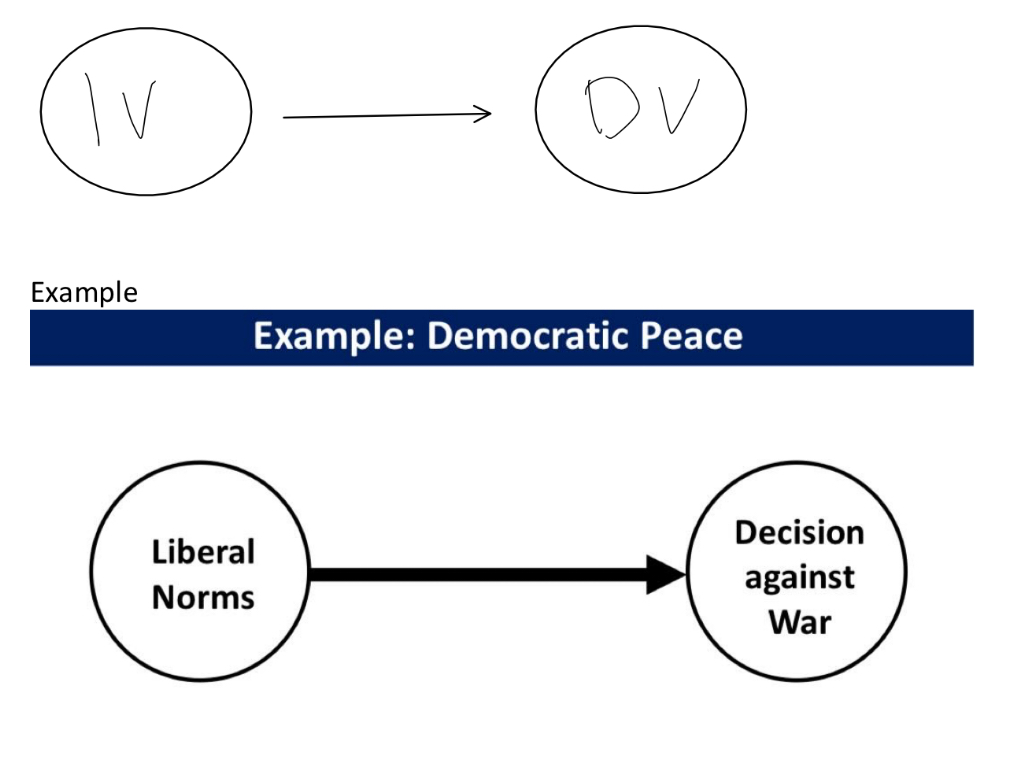
Zero-order relationship
independent variable → dependent variable
+ Example
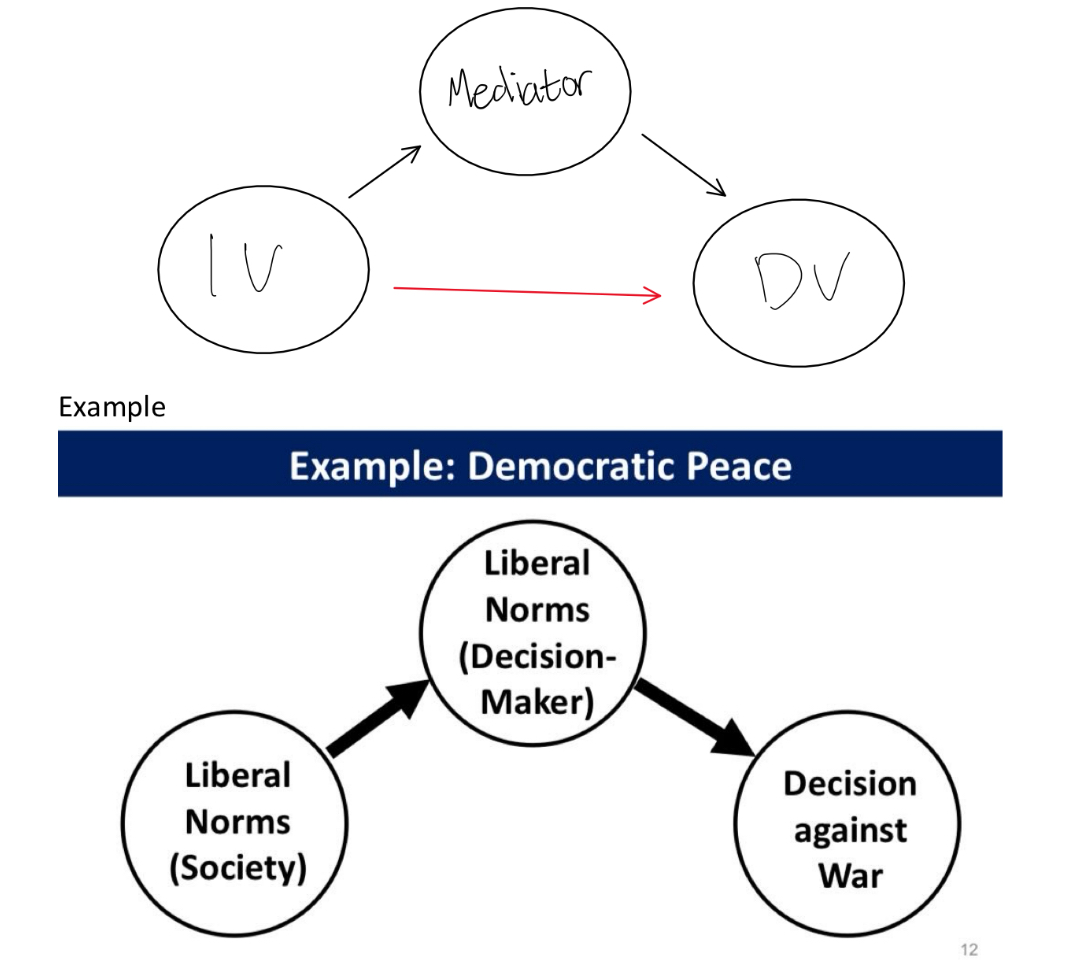
Mediator
Independent variable→ mediator→ dependent variable
IV and DV can have a partial relationship (red line)
+example
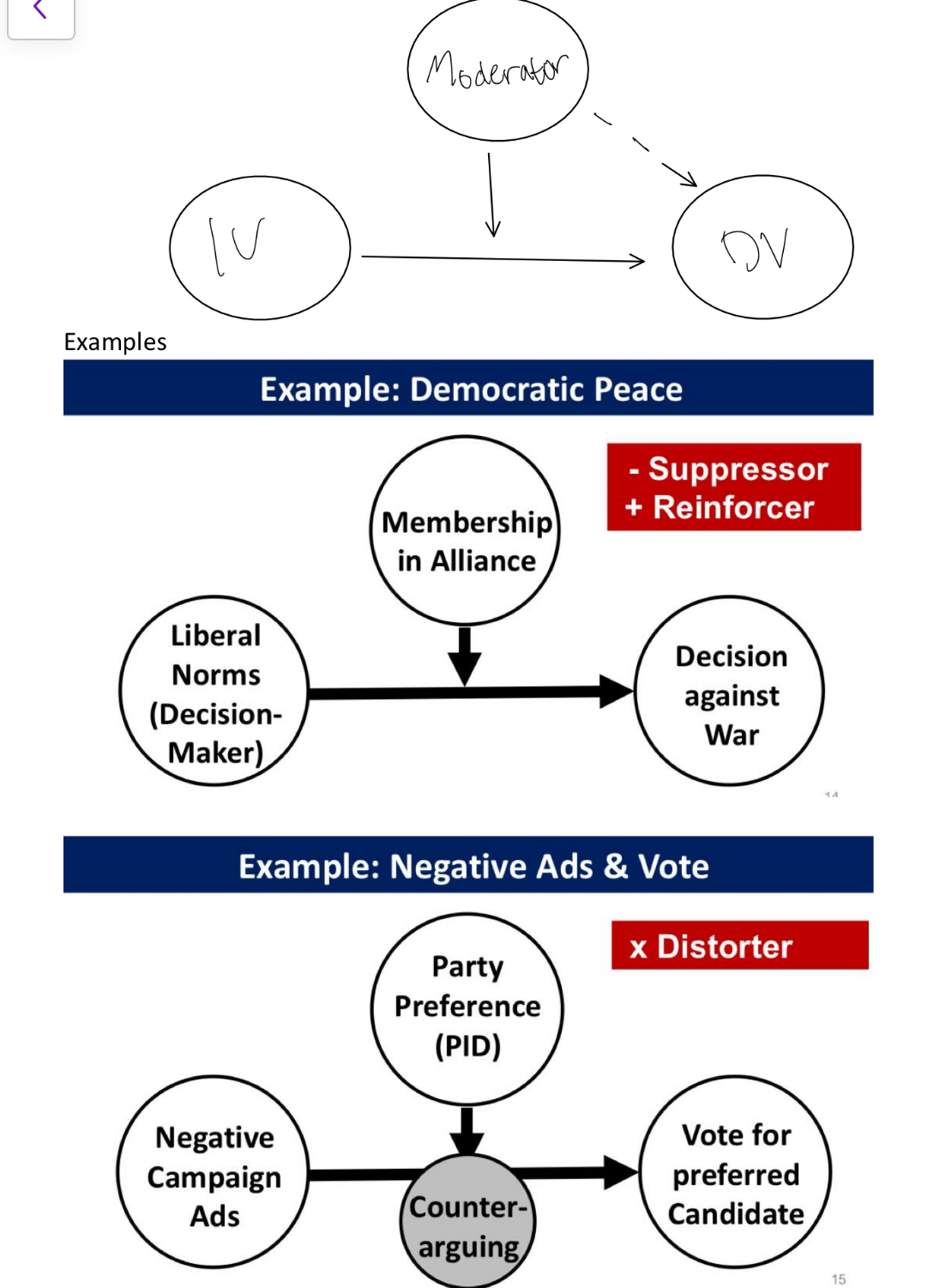
Moderator
Independent variable→ moderator→ dependent variable
Moderator: can reinforce (+) or suppress(-) relationships, even extreme cases distort(x) them
+example
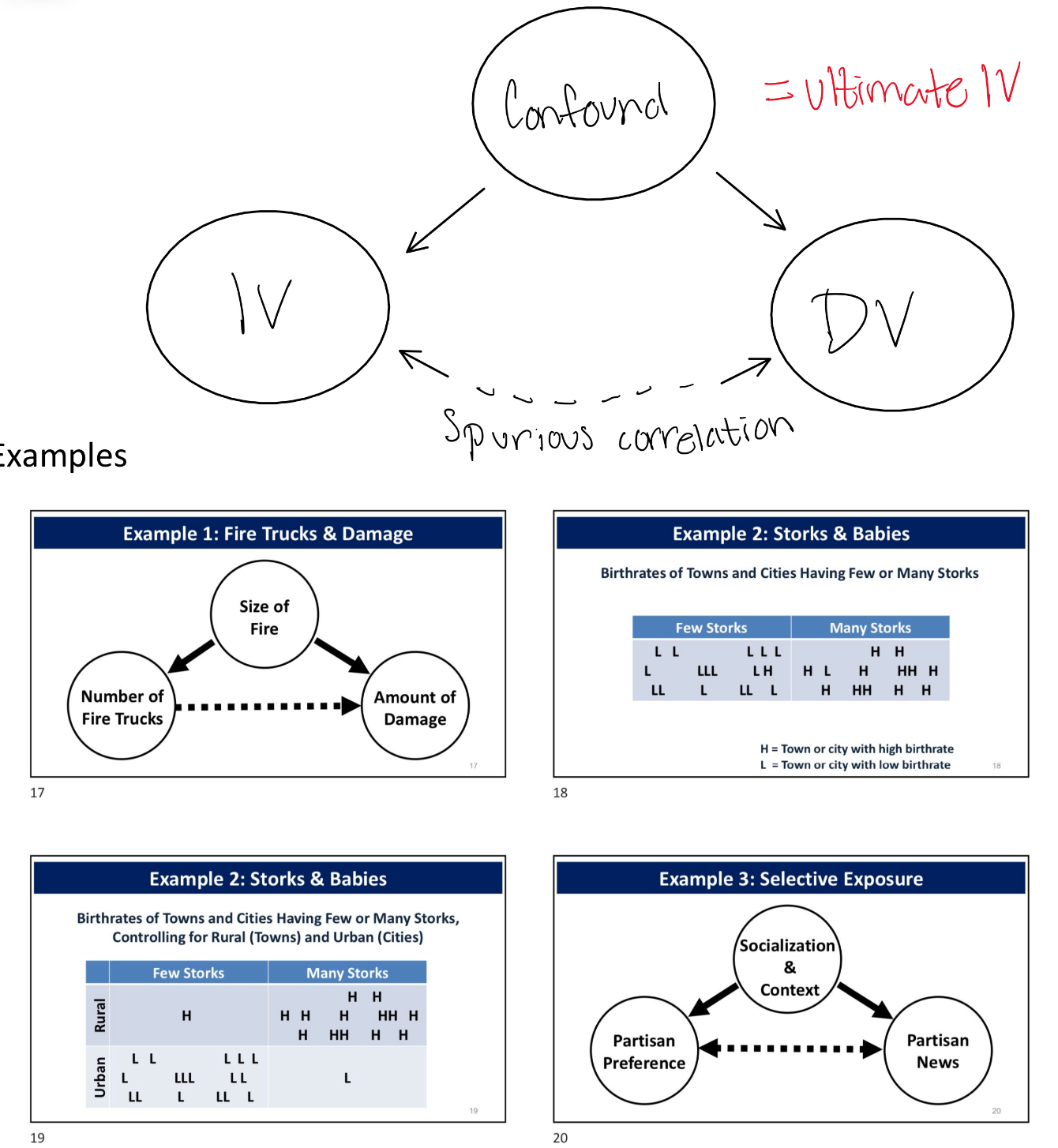
Confound
independent variable ← confound → dependent variable
Confound: completely explains relationship
+examples
Research design definition
A strategy (blueprint) for investigating the research question/hypothesis in a coherent and logical way, including what kind of data is needed, how the data is collected, and what methods of analysis will be used
Type of research
Evidence or data needed (for test, not confirmation)
Method of data collection
Modes of analysis (logic to draw inferences)
How threats to internal and external validity and measurement reliability and validity are minimized
Research designs major types
experimental
Cross-sectional and longitudinal
Comparative
Historical (paired with comparative)
Experimental design
Randomized intervention/treatment
Causal factor is randomly assigned (med experiments (placebo vs real))
No confounding variable
Lab, field & survey experiments (3 types)
Social science - traditionally field experiments
(Natural experiments) -> NOT an experiment
Does not include a randomized treatment, does not treat/manipulte anything
Cross-sectional and longitudinal designs
Observation
Cross-sectional - different cases
Longitudinal - over time
Large n research (counties, conflicts, individuals, etc)
Panel & Cohort Designs
Panel- select people/states and follow them over time
Cohort- use same survey (ex) but new people/sample taking it each time
Comparative design
Single n case study - in-depth process tracing (find out step by step of what happened)
Small n (2-4) and large n case study
Methods of data collection
Requires the definition of clear boundaries:
Time | place/space | units/actors | factors/variables
Data sources & quality: availability, reliability, validity
Common methods of data collection
Questionnaires/surveys
Interviews/focus groups
Participation observation/ ethnographic research (exception, does not happen often)
Textual/content/discourse analysis (existing documents)
Statistical data
Multi-method research
Combination of different designs & methods can be useful
Stanley Milgram - Obedience to Authority 1974
study occurred in 60s
Hypothesis: individuals will obey requests by authority even if requests is considered to be unethical
Cover story: ‘learning by punishment’
Participants in experiment:
experimenter (knew)
Teacher (volunteer)
Learner (knew)
Experiment: volunteers (teachers) were brought in to ask questions to learner, every time they got a question wrong the teacher would give them an electric shock (15-450 volts)
The experiment was fake and was actually to see how long people would go doing immoral activity when pressured from authority (experimenter)
2/3 went to the max voltage
Stanley Milgram - Obedience to Authority 1974 Background
Holocaust - Nazi officers after the war was over often used the excuse ‘i was just following orders’
Stanley Milgram - Obedience to Authority 1974: Procedure for learner
verbal protest
Knocking on wall
Refusal/silence
Stanley Milgram - Obedience to Authority 1974: procedure for experimenter
‘Please continue’
‘The experiment requires you to continue’
‘You have no other choice, you must go on’
Stanley Milgram - Obedience to Authority 1974 After experiment was over
Would have sever psychological damage-> after study completed they would get to know what was actually happening (full debriefing)
Followed up with them a year later -> claimed no problems had occurred
Philip Zimbardo - Stanford Prison experiment (1971) background
Personality traits of prisoners & guards are key to understanding abusive prison situations (situation vs personality)
Philip Zimbardo - Stanford Prison experiment (1971) procedure
2 week ‘prison simulation’ (planned)
24 participants (pre-screened)
Random assignment as “prisoner” or “guard” (in uniforms)
Philip Zimbardo - Stanford Prison experiment (1971) Results
Quickly spun out of control
Early termination after 6 days
1/3 of “guards” exhibit sadistic tendencies
Can be seen with peacekeepers today
Fraud with fake data Michael LaCour (2014)
Conduct study on effect of canvassing before referendum of legalization of same sex marriage -> large difference in results
Another group wanted to replicate-> did not work
LaCour had taken real data and used it with fake data to show referendum differences
Fraud with fake data Diederik Stapel (2011)
By 2015, 58 (co-) authored papers retracted
Went out to collect data alone-> came back with data and published together with others (co-authors did not know the data was fake)
Plagiarism (politician edition)
Plagiarized master thesis or PhD dissertation
Germany (2011): Karl-Theodor zu Gutenberg (defense Secretary)
Romania (2012): Victor Ponta (Prime Minister)
Germany (2013): Annette Schawan (Education Minister)
Spain (2018): Carmen Montón (Health Minister)
Norway (2024): Sandra Borch (Higher Education Minister)
When is research ethics relevant?
All stages of research
Data collection & storage: risks, privacy & fraud prevention
Data analysis: transparency & replication
Academic writing: plagiarism
3 (4) basic principles of research ethics
Do no harm: benefits much outweigh risks
Ex. Vaccines
Informed consent: voluntary participation
Protection of privacy/confidentiality
Transparency and documentation (good research practice)
Informed (or implied) consent: content
Topic and nature of questions (sensitive/intrusive)
Purpose/goal (incl. disclosure of financial interests/sponsors)
Use of information
Participation requirements/expectoration
Voluntary participation
Freedom to stop
Permission to record (audio/video) & to quote responses
Permission to use data
Risks involved
Informed (or implied) consent: further considerations
Competition & comprehension (marginalized/vulnerable population)
Incentives for participation?
(Unobtrusive) observation
Consent after observation?
Experimental manipulation
Concealment vs deception
Both of these cases need debriefing (explaining the truth)
Privacy/confidentiality: protection of participants/sources
Public information (’on record’) (rules also apply)
Confidential information (not always possible/in your control)
Anonymous information (ideal, but rarely possible)
In practice:
don’t make promises you can’t keep
When in doubt: make advance & explicit agreements
Ethical behavior of researchers
Avoiding bias
No incorrect reporting
No inappropriate use of information
Ethical behavior of sponsor
No restrictions imposed by the sponsor
No misuse of information
Formal procedures
Formal review of research projects:
USA: Institutional Review Board (IRB)
Leiden: Ethics Committee
More formal rules for documentation and archiving:
Pre-registration
Publicly committing to your research
EU General Data Protection Regulation (GDPR)
Data Access & Research Transparency (DART)
Data Management plans (Leiden)
Plagiarism
presenting, intentionally or otherwise, someone else’s words, thoughts, analysis, argumentation, pictures, techniques, computer programs, etc. as your own work
Internal validity
ability to draw causal inferences
Confidence in (observed) causal relationship
Ability to reuse out alternative explanations (confounds)
External validity
generalizability of research findings