Semantics/Pragmatics - Weidner
 Studied by 7 people
 Call Kai
 Learn
Learn Practice Test
 Spaced Repetition
 Match
Match Flashcards
 Knowt Play
1/15

Earn XP
Description and Tags
Important people and their contributions.
Name | Mastery | Learn | Test | Matching | Spaced | Call with Kai |
|---|
No analytics yet
Send a link to your students to track their progress
16 Terms
Ferdinand de Saussure
Semiotics - sign system, the relationship between a given sign and the object it represents
Sign - signifier (form of the sign), signified (concept it represents)
Langue (language) - system of signs, common knowledge of a given speech system
Parole (speaking) - the way in which knowledge is used by actual speakers
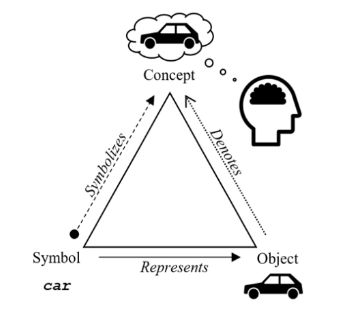
Pierce
Pierce’s semiotic triangle -
the representamen - form the sign takes
an interpretant - not an interpreter but the sense made of the sign
an object - to which the sign refers
3 types of signs -
1. icon - a relation of similarity between the sign and what it represents (portrait, onomatopoeia, imitative gestures)
2. index - a physical cause and effect relationship (smoke→fire, yawning→boredom)
3. symbol - arbitrary, conventional relationship between sign and meaning (red flag, punctuation marks, letters, traffic lights)
“Talking heads”
utterances are vehicles carrying concepts from one mind to another
Wittgenstein
Language games - children and adults, responses may have multiple meanings which need to be figured out
Wittgenstein’s example:
A brickie calls “Slab!” and his helper brings it
- assumptions
- speculations and jokes
Language and meaning
Lexicon - infinite body of knowledge, dynamic, contains semantic knowledge
Productivity - combining words into expressions and sentences, creative, coordinated, maluma/takete → more intuition based
Givon
?’s - do different languages conceptualise meaning differently. the relationship between linguistic meaning and context
Form follows function
- usage-based model of languageMeaning is divided into 3 levels:
Lexical semantics - meaning of words
Sentential semantics - meaning of sentences
Discourse semantics - how meaning is established contextually
Information / thematic structure
already known information and additional information
given / new
How:
New - indefinite nominals
Given - definite nominals
Salience
Once it’s known, it can be referenced
pronouns
Focus and topic
Focus
New info
alternative selection
Topic
subjects in English
Typically given info
Skinner
Language learning
Behaviourist perspectiveinfluence by classical conditioning and Pavlov
imitation and reinforcement
Learning
mechanism of simple imitation
Behaviourist perspective - language learning is like any other behaviour, can be trained
Chomsky
? - how is language learned and organised
Criticised Skinner’s behaviourism
input alone is not enough
Nativist theory of language learning (4 elements)
LAD
UG
Poverty of stimulus
Critical period
Language:
governed by rules and principles
we instinctively combine a finite number of elements - to create an infinite number of larger structures
Generative Grammar (GG):
set of rules and principles
shared by all languages in the world
enables us to understand sentences
unaware of them
Competence and Performance
Competence - the knowledge we possess about how to speak a language
Performance - the real-life linguistic output
Wierzbicka, Goddard, Leibniz
Natural Semantic Metalanguage (NSM)
common language of all people
Basic language:
one you can use to explain anything
intercultural communication
trial and error
NSM Semantic Primes: (64 semantic primes)
simple
innate/hardwired
mental language
used for practical purposes
→I, YOU, SOMEONE, SOMETHING, THIS, HAPPEN, MOVE, KNOW, THINK, DO, WANT, SAY, GOOD, WHERE, WHEN, NOT, MAYBE, BECAUSE, LIKE, KIND OF, PART OF, BIG, SMALL, MOTHER, FATHER
Stalnaker, Frege (+Sanford and Garrod?)
There is a triadic relation between speaker, intention, linguistic form and context.
Context - small dynamic part of discourse
situational context - what participants know about the object, event, circumstance
background knowledge context - what participants know about each other and the world
co-text context - what participants know from what has been said so far
Common ground (CG) - shared background knowledge, context
universal CG - assumptions about what the participants know
restricted CG - “to brime” (a reference to a thing only people who know the context will understand)
Inferences - what we infer, listener-generated meaning based on form and context (what the listener does)
Presuppositions - background assumptions taken for granted regardless of the speaker’s belief and can be created or destroyed
e.g. the bald king of France (he is still king of France, even if he isn’t bald)
they can be:
semantic - always present
existential - every definite noun phrases presupposes the existence of somebody or something
pragmatic - dependent on the context and CG
Presupposition types:
existential - existence of the entities: my dog is happy
active - true due to the presence of factive verbs: i regret its over
lexical - one word presupposes some other meaning
structural - wh- questions presuppose that the information following is already known
non-factive - what follows is not true
counterfactual - contrary to facts
Levinson and Verschueren
Discourse - refers to language in use, as a process which is socially stimulated
Discourse analysis
study of units of language and language use beyond isolated sentences
study of connected sequences of sentences
combines a diversity of approaches and methodologies
Adaptability, Negotiability, Variability
Adaptability Theory (Verschueren 1999)
interlocutors need to make hypotheses about what it is the other means or knows
propositions are marked as either referring to or departing from expectations
interlocutors choose resources (forms, patterns, strategies) from the adaptively developed repertoire
choice-making as the basic activity in using language
choice-making by S (production) and H (interpretation)
3 key notions
variability:
the range of options from which choices are made
not stable, adaptable, subject to change
negotiability
flexible strategies
practices that are both rational and reflective
adaptability
language use as choice-making from a variable range of options
processes that lead to marrying satisfactory communicative needs
Why conversation analysis now?
Sequence and analysis:
interaction is organised sequentially
speakers and recipients have a tacit grasp of the rules of sequencing
these rules indicate how to produce actions without having to account
these rules indicate how to influence others’ subsequent actions
Interaction is organised sequentially, by turns:
where’s bill?
there’s a yellow VW outside Sue’s apartment
huh? (repair, confusion)
oh. (informative)
oh really? (more than informative)
recipients will work to hear utterances as sequentially appropriate, as normatively expected responses
any departure that can’t be normalised will generate special inferences (tic tac toe rule breaking)
understanding is based not only on what speakers say, but also where they say it
Understanding different possibilities for understanding the same action:
why don’t you come and see me some time (invitation or complaint?)
I would like to OR i’m sorry, ive been terribly busy
Preference organisation
background - brown and levinson 1978
positive face, negative face
prefence in CA
treatment of certain actions as favoured, over other relevant alternative actions
does not refer to private feelings, but to conventional ways of enacting and responding to the alternative actions
a range of optional 2nd actions:
assessments → agreement / disagreement
invitations / offers → acceptances / declinations
requests → grantings / refusals
alternative 2nd actions - asymmetrical design
agreements / acceptances tend to be
prompt
unqualified
non-accountable
disagreements / rejections tend to be
delayed - by silences, prefaces, token agreements, appreciations, apologies
qualified - marked as uncertain, condition, indirect
accountable - include an explanation for the rejection
Grice
an underlying assumption that the participants are co-operating with each other
co-operative principle
four maxims
implicatures
co-operative principle - “make your conversational contribution such as is required, at the stage at which it occurs, by the accepted purpose or direction of the talk exchange in which you are engaged”
Gricean maxims:
Quantity
a. make your contribution as informative as is required
b. do not make your contribution more informative than is required
- what day is it?
- tuesday.Quality
a. do not say what you believe to be false
b. do not say that for which you lack adequate evidence
- where is John?
- at home.Relevance/relation
a. be relevant
- what are you doing tomorrow?
- i’m meeting my friends for dinnerManner
a. avoid obscurity of expression
b. avoid ambiguity
c. be brief
d. be orderly
- whats your favourite colour?
- blue
what are they?
description of the normal expectations we have in conversation
explain a number of regular features in the way people communicate
Maxims can be:
observed
violated (lying)
flouted
opted out from
Violation (not obeying maxims):
what time is it? → its early (quantity)
how was your weekend? → okay (relevance)
do you want some coffee? → considering that its already quite late and the fact bla bla (manner)
Flouting (intentional violation, for a reason):
i’ll never be late again, I promise → yeah, as always (quality)
what grade did you get from the test → look, a sparrow! (relevance)
Opting out (explicit information that a maxim cannot be satisfied):
how was your exam → I can’t tell you (quality)
where is John? → I don’t know, to be honest (quantity)
Implicatures - conventional and conversational
Conventional implicatures:
part of the linguistic meaning
sentence itself carries the implicature
detachable - it is possible to say the same thing in a way that does not occasion an implicature
impossible to deny something implicated in the words themselves
non-cancellable
→ this morning I had a cup of coffee and drove to the office
conventionally implicates that I had the coffee first and drove to the office next
detachable
I had a cup of coffee this morning; also, I drove to the office this morning
→ I was in Paris last spring too - CI: some other person was in Paris last spring
→ Even Bart passed the test - CI: Bart was among the least likely to pass the test
→ They aren’t here yet - CI: they are expected to be here later
Conversational implicatures:
it’s stuffy in here
can you hold the door for me?
meaning that is not the literal meaning of a sentence
related to co-operative principle and maxims
depend heavily on context, on how things are said
implicit
harder to detach
cancellable
conversational implicatures must be possible to calculate
in order to calculate/work out an implicature we need:
knowledge of the literal meaning
assumption that the speaker is obeying the conversational maxims
Grice’s modified Occam’s Razor Principle:
senses are not to be multiplied beyond necessity
not multiple senses but multiple contexts
Hedges:
words or phrases used to indicate that we are not really sure what we are saying is sufficiently correct
expressions that show that we are concerned about following the maxims while being co-operative
Hedges operate on the accuracy of our statements (quality maxim)
his hair was kind of black
the leaves are sort of yellow
as far as i know,
im not sure, but
Austin and Searle
Communicative acts
things what we DO
what speakers DO by uttering utterances
Communicative functions
Declarative sentence - used to constate
Imperative sentence - used to direct
Interrogative sentence - used to question
Austin
Speech acts - performatives
a performative utterance describes the act it performs
I pronounce you husband and wife
Direct and indirect speech acts
Direct SA
- syntactic structures used in accordance with their functions
did you eat the pizza?
eat the pizza!
you ate the pizzaIndirect SA
- syntactic structure associated with one function used for some different function
can you hold the plate
why didn’t you tell me?Analysis → two options
Can you hold this plate
direct act - a question about the hearer’s ability to hold it
indirect act - a request for the hearer to hold it
→indirect speech acts are more polite than direct speech acts
open that door
can you open that door
Types of speech acts
Locutionary act - saying something with a certain meaning
Illocutionary act
-significance in a conventional system of social interaction
-act-making utterance
-acts defined by social conventionsPerlocutionary act - the act of causing a certain effect on the hearer and/or others
→Illocutionary force of a speech act:
depends on the context of the utterance
the underlying purpose of the utterance
e.g. a reminder, a warning, a promise, a threat
Classes/categories of speech acts
Classes of illocutionary acts
assertives - describes the state of the world (its dark)
directives - the speaker trying to get the hearer to behave in some way (ordering, requesting)
commissives - commits the speaker to a course of action (promising, threatening
expressives - expresses the speaker’s attitude about something (likes, complimenting)
declaratives - brings about a change in something (i declare war, you are fired)
Felicity conditions
conditions that must be fulfilled in the situation in which the act is carried out if the act is to be said to be carried out properly, or felicitiously
social conventions and rules
Speech act theory
looks at the ways in which words can be used not only to present information but also to carry actions
attempts to explain how speakers use language to accomplish intended actions and how hearers infer intended meaning from what is said
Lakoff and Johnson
Metaphor
a phenomenon of thought
conceptual mappings across domains
Conceptual metaphor
Mapping between two conceptual domains
source domain - expressions we draw on to understand sth
target domain - what we want to describe and understand
conceptual metaphors are conventional
e.g. life as a journey
(target) - (source)
birth as arrival
death as departure
life’s problems as obstacles
Three types of conceptual metaphors
Orientational
- spacial structuring of concepts
e.g. target - source
happy is up (im in high spirits)
sickness and death are down (he’s sinking fast)
Ontological
- projection of features from one entity onto another entity
e.g. target - source
activities are containers (they put a lot of energy into this)
mind is a machine (my mind isn’t operating today)
Structural
- structuring one kind of experience or activity in terms of another kind of experience or activity
e.g. target - source
time is money (you’re wasting my time)
love is a journey (we’ve reached a dead-end in our relationship)
A is B formula BUT:
no metaphor can be comprehended or represented independently of its experiential basis
no single metaphor is final
Functions of conceptual metaphors
they hide more than they highlight
practical pragmatic usage
they rely almost entirely on factors like context
Goffman, Brown and Levinson
Politeness
Goffman - introduced facework, face is some social value a person claims for oneself
Brown and Levinson - first and second order politeness
how people understand and talk about politeness, common sense understanding, behaviours that are evaluated positively
a theoretical construct, theory of social behaviour in linguistics, linguistic forms reflecting/affecting people’s standing in relation to self and others
Face
Sociological motivation
how people interact in everyday life?
how others perceive us?
we create an identity for others to see
we act socially to maintain it
→positioning oneself in social interactions: “the public self-image that every member of society wants to claim for himself”(Brown and Levinson)
Positive face - the want of a person that his attributes, achievements, ideas, possessions, goals, should be desirable to at least certain others
Negative face - the want of a person not to be imposed upon by others
-face representation and politeness phenomena maintain the cooperative nature of interaction
Face-saving acts
Negative indirectness: a face-saving act that speaks to a negative face, shows concern about imposition
i know you’re busy but would it be okay for you to help me with this
it’s very hot in here
Positive indirectness: a face-saving act that speaks to a positive face, shows solidarity
I’m sorry to say this but I think you’re wrong
Face-threatening acts
-represent a threat to a person’s self-image
-speech acts that call for correction
threats to the H’s negative face (requests)
threats to the H’s positive face (disagreements)
threats to the S’s negative face (responses to thanks)
threats to the S’s positive face (apologies)
On record - clear intention, direct speech acts
→give me that book
Off record - not one clear intention, indirect speech acts, conversational implicatures, hints, metaphors
→are you reading that book?
Face threat verbal acts - different linguistic strategies that are conventionally used to mitigate the degree of face threat in verbal acts
How to do FTA’s?
baldly, on record
i want coffee
with positive indirectness
i know you make the most delicious tea on earth, but would it be ok if I had coffee instead?
with negative indirectness
isn’t it too much of a trouble for you to make me a cup of coffee
entirely indirectly, off-record
i wonder if the coffee machine is still working
→Brown and Levinson’s bald-on-record strategy is in conformity with Grice’s Maxims
Schiffrin and Fraser (-)
Garfinkel
Ethnomethodology
→ focuses on how objective reality is produced, understood and negotiated
→ objectives: document the methods through which social order is produced
→to investigate social practices of real people in real setting
Concepts/Notions/Principles:
Accountability - actors are to design their actions in such a way that their sense is clear right away or explicable on demand
intelligible, reportable, analysable, describable
e.g. standing in line:
people show that they are doing just that by the way they position their bodies
they are also able to understand and answer a question (are you standing in line?)
Accounts
ways in which people explain specific situations
accounts reflect how social order is possible
Sense-making procedures
situations with sharp discrepancies between existing expectations and practical behaviour
necessitate extraordinary sense-making efforts
naturally occurring - studies of transsexual behaviour
artificially created - breaching experiments
e.g. asking if people are standing in a line or not
Breaking experiments
attempts at discovering ‘perceived normality’ by turning to disrupt it
language is not the basis of communication - previous and present interactions are
e.g. tic tac toe (breaking/discovering new rules)
Goffman, Garfinkel, Sacks, Schegloff, Jefferson
Conversation analysis
Goffman - interaction order
Garfinkel - sense-making procedures, accountability
Sacks, Schegloff, Jefferson - integration, methodological innovation
Intro
interaction is orderly (openings, closings)
organised by complex rules and practices for implementing them
rules shape conduct, shared “definitions of the situation”
rules operate at every level of detail: sequence of action, individual actions, word choices, non-vocal behaviour
Sequence and action
sequential organisation: recurrent patterns in the relationship between some action and the next one
some patterns are tight (narrow range of next actions): greeting-greeting, question-answer
some patterns are loose (wide range of next actions): news announcements, storiesrules are a social norm→ accounts, sanctions
interpretation ← RULES → action
Adjacency pairs
opening/closing actions
question/answer
invitation/offer/request → accept/reject
announcement/response
they are normative
social norm
we are normatively accountable for our actions
departures are also accountable
Accountability QA sequences
Paxman vs Howard
“Did you threaten to overrule him?”
 Note
Note  Flashcards (131)