Lesson 8: Second Declension- Neuter nouns; Adjectives- First/Second Declension
 Call Kai
 Learn
Learn Practice Test
 Spaced Repetition
 Match
Match Flashcards
 Knowt Play
1/13

There's no tags or description
Looks like no tags are added yet.
Name | Mastery | Learn | Test | Matching | Spaced | Call with Kai |
|---|
No analytics yet
Send a link to your students to track their progress
14 Terms
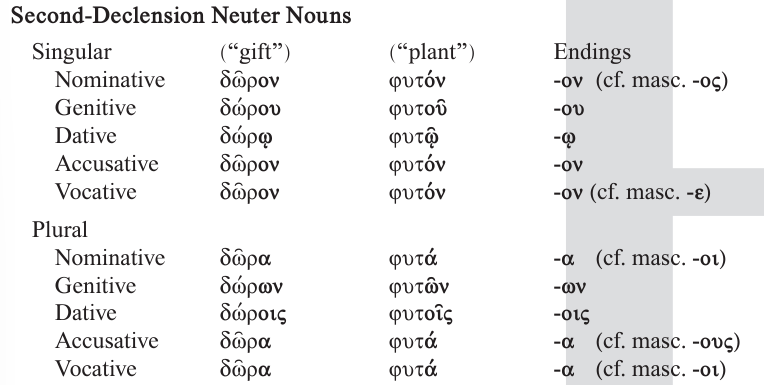
Second-Declension Neuter Nouns Paradigm:
like 2nd dec masc nouns, 2nd dec neuter nouns are o-stem; but they differ from masc only in the nom (sing+plur), the voc (sing+plur), and the acc plur
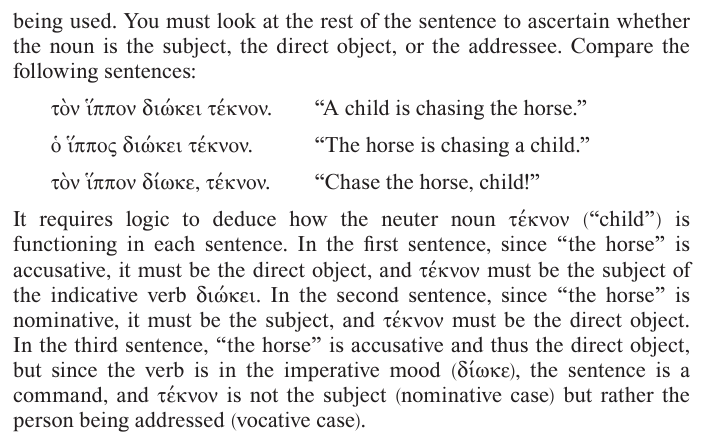
example of how to tell whether the noun is the subject, direct, object or the addressee (nom, acc, voc) when all have similar endings bc neuter and masc = very similar
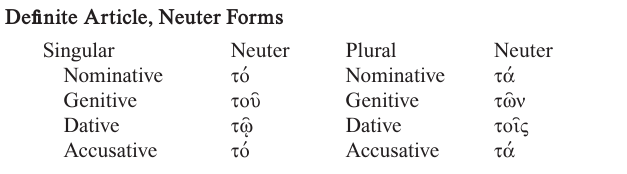
Paradigm for Neuter Definite Articles
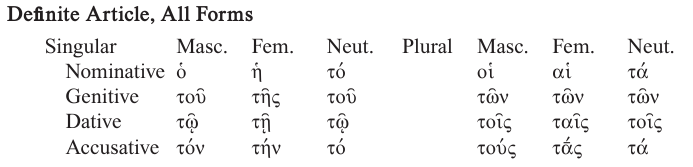
Complete Paradigm of all the Definite Articles (masc, fem, neut)
what happens with a neuter noun (subject) is plural but the verb is singular?
when a neuter noun (of any declension) is used in the plural as the subject of a sentence, Greek puts the main verb of the sentence into the singular.
often, a neuter plural subject is regarded as a single collective unit, requiring a singular verb.
when translating assume that a neuter plural subject and its verb don’t agree in number
how do adj’s in Greek work?
modify nouns
don’t have a gender; they are genderless stem that you can ad an ending to and give it gender, number, case (must agree w the noun they’re modifying in gender, number, case).
what are the 2 types of adj’s?
1st and 2nd dec (have same endings as those nouns)
3rd dec (“ “ “)
Paradigm of First/Second-Declension Adjectives:
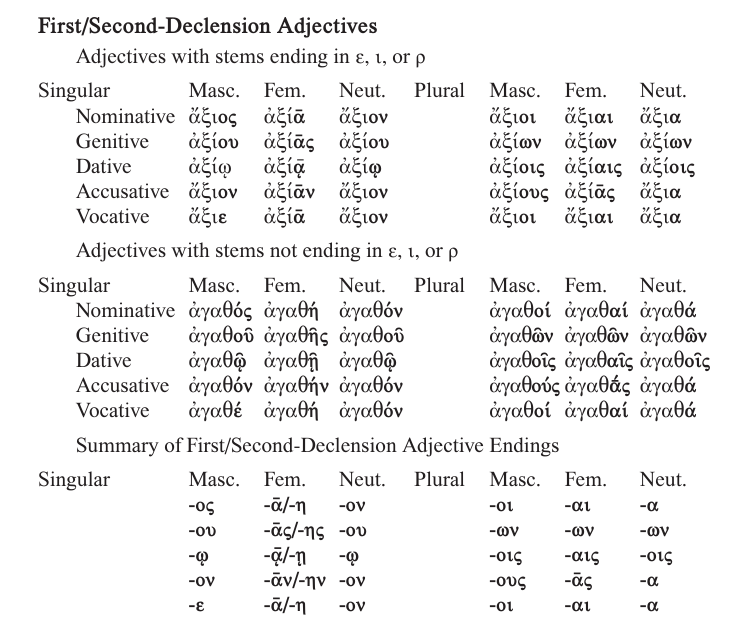
how are adj’s listed in a lexicon?
they are listed with it’s three nominative singular forms in an abrv way
ex: ἀγαθός, -ή, -όν
-ός (masc sing)
-ή (fem sing)
-όν (neut sing)
what is an attributive adj?
an adj is classified as attributive if it identifies an attribute, or trait, that noun already possesses.
ex: “the good child is sleeping”; here “good” is an attribute of the child, and the position o the adj between the definite article and the noun helps make that clear
an attributive adj and its noun = noun phrase (which functions as the subject or the object of the sentence, or any other way a noun functions by itself)
what is predicate adj?
a predicate adj differs from an attributive adj is being part of the verbal idea (what is being predicated) in the sentence.
predicate ad works with linking verb to describe the subject
ex: “the child is good”; here the linking verb “is” equates the subject with the predicate adj
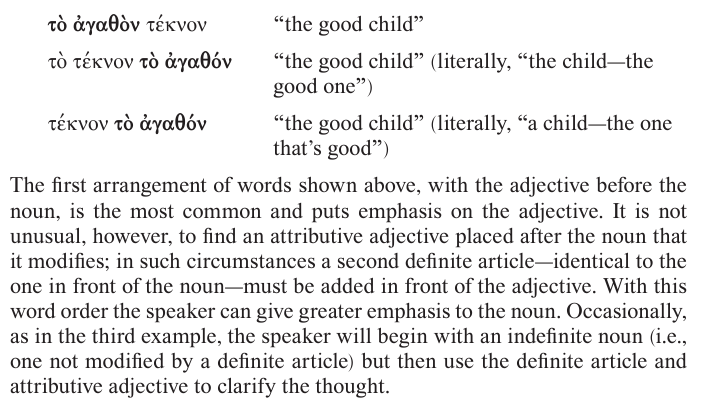
what is attributive position and how many are there in Greek?
describes if the person or thing in the speaker’s mind is definite or known
3 attributive positions (refer to picture)
what is predicate position?
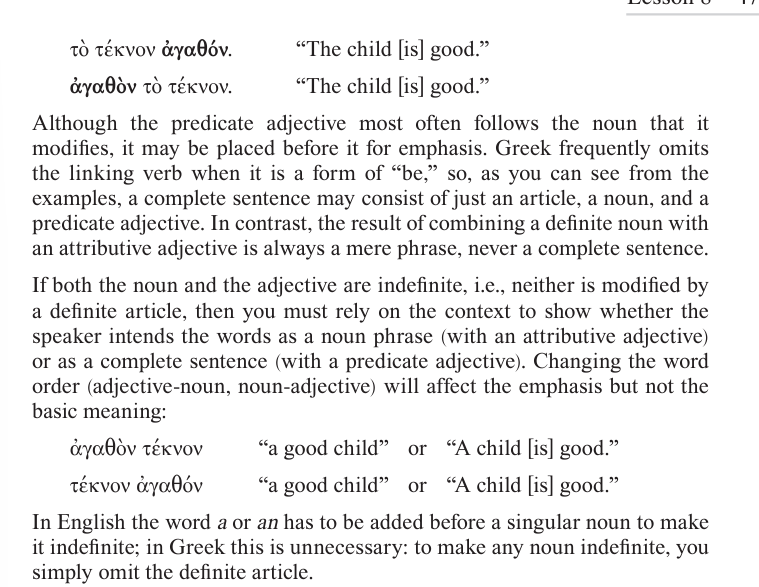
if an adj modifies a definite noun (i.e., a noun modified by one or more definite articles) and does not come immediately after any of the definite articles that agree with that noun, the adj has predicate position.
look at picture*
what are predicate nouns?
a linking verb may equate the subject with a predicate noun rather than a with a predicate adj.
predicate noun always has same case (nom) as the subj since the two are parallel to each other, but it keeps its own gender and number.
not customary in GK to use a definite article with predicate noun bc absence of article helps to distinguish the predicate noun from the subj but also leaves it ambiguous whether a def or indef person or thing is meant.

