ANTH Flashcards

0.0(0)
studied byStudied by 7 people
call kaiCall Kai
learnLearn
examPractice Test
spaced repetitionSpaced Repetition
heart puzzleMatch
flashcardsFlashcards
GameKnowt Play
Card Sorting

1/218

flashcard set

Earn XP

Description and Tags

ANTH 1001 Midterm Exam Flashcards

Last updated 5:22 PM on 10/3/23
Name
Mastery
Learn
Test
Matching
Spaced
Call with Kai

No analytics yet

Send a link to your students to track their progress

219 Terms

1
New cards
Scientific Method
A systematic approach involving making observations, formulating a hypothesis, conducting experiments, analyzing data, and drawing conclusions.
2
New cards
Hypothesis
Proposed explanation for observed phenomenon, scientifically testable
3
New cards
Prediction

logical consequence of what must be the case if hypothesis is true

“Assuming [hyp] is true, if [methods], then outcome will be […]“

4
New cards
Theory
If hypothesis is repeatedly true, can develop into a ____. Not facts, but explanations supported by evidence
5
New cards
Qualitative Data
Type of data collection, descriptions based on impressions from observations NOT measurement, ie the sun is bright
6
New cards
Quantitative Data
Tyoe of data collection, based on measurement, unbiased comparisons between objects, ie sun has a magnitude of -26.7
7
New cards

Evolution

change in the heritable characteristics of biological populations over successive generations

“descent with modification”

  • Evolution occurs at the population level over time

  • Traits vary between individuals, but only populations evolve

  • A change in allele frequency in a population over multiple generations

8
New cards
Genotype
An individual’s genetic makeup
9
New cards
Phenotype
Observable characteristics of an individual
10
New cards
Norm of Reaction
Phenotypic plasticity/range of phenotypes possible from same genotype due to variation in environment (ie height, weight)
11
New cards
Trait
Feature of organism’s phenotype (ie hair color, testosterone level)
12
New cards

Natural Selection

is differential reproductive success based on variations in heritable traits

  • some traits help organisms survive and/or reproduce better than individuals who lack those features

  • Those organisms will produce more offspring

  • Thus, beneficial features are passed on to offspring in greater proportion and become more frequent in the population

  • NOT goal oriented

Process by which biological traits change in frequency in population as a result of reproductive success, decreases the genetic variation *within* a population and can increase or decrease the genetic variation *between* populations

Within a pop: Dec. Var,

Between Pop: Inc. or Dec. Var, Randomness: Non-Random

13
New cards
Variation in a Trait
For any trait, more than one version present in a population, trait coded in each individual genotype and expressed in each individual phenotype
14
New cards
Inheritance of the Trait
Trait can be passed from parent to offspring
15
New cards
Differential Reproductive Success
Individuals differing from one another in their reproductive success

(more reproductive success = more common trait)
16
New cards
Adaptation

a change that allows an organism to survive in a given environment

Species change and adapt depending on their environmental context with no pre-determined goal or direction

(ie furry coat in ice age vs warm climate)

May be costly if they require extra energy to produce/maintain, but will be maintained if reproductively successful (ie humans have a large brain)

17
New cards

Sexual Selection

Traits that are selected to increase an organism’s ability to obtain a mate or copulate

EVEN if the same trait also carries greater risks for the individual’s long term survival

(ie male peacock feathers)

18
New cards

Stabilizing Selection

Mode of natural selection

individuals with extreme values of a trait have less reproductive success thatn with average traits, increases frequency of individuals with average traits

19
New cards

Directional Selection

Mode of natural selection

One extreme trait has a higher reproductive success than the average or other extreme, average trait changes over time moving closer to one extreme that has higher reproductive success

(ie if predators of birds leave, wings may become shorter and leave entirely to flightless bird because no longer a need to fly away from predators)

20
New cards

Disruptive Selection

Mode of Natural Selection

Average value of a trait is selected against and individuals at both extremes of distribution have greater reproductive success and increase in frequency, the two extremes separate from each other

(ie Galapagos finches)

21
New cards
Chromosome
A structure in cells that carries genetic information. Humans have 23 pairs of chromosomes, with each parent contributing one set. Chromosomes are made up of DNA and contain genes, which determine traits and characteristics.
22
New cards

Gene

the DNA sequence that influences a trait by coding for a protein.

(humans have 23000 genes)

Basic unit of heredity

A gene is a segment of DNA that contains instructions for a specific trait or function.

23
New cards
Mendel's principal of independent assortment
Mendel's principle of independent assortment states that during the formation of gametes, the alleles for different traits segregate independently of each other. This means that the inheritance of one trait does not influence the inheritance of another trait. It is one of the fundamental principles of genetics and helps explain the variety of traits observed in offspring.
24
New cards
Mitosis
Process of cell division in which a single cell divides into two identical daughter cells. It involves several stages: prophase, metaphase, anaphase, and telophase. Mitosis is important for growth, repair, and asexual reproduction in organisms.
25
New cards
Meiosis
Process of cell division that results in the formation of four genetically unique haploid cells. It involves two rounds of division, including crossing over and independent assortment, leading to genetic variation. Meiosis occurs in the reproductive cells (gametes) and is essential for sexual reproduction.
26
New cards
Zygote
The initial cell formed by the fusion of a sperm and an egg during fertilization, containing the full set of genetic information for the development of an organism.
27
New cards
Gamete
A reproductive cell with half the number of chromosomes as a regular body cell, involved in sexual reproduction.
28
New cards
Somatic Cell
A somatic cell is any cell in the body of an organism, except for reproductive cells (gametes). Somatic cells are diploid, meaning they contain two sets of chromosomes, one from each parent. They undergo mitosis to divide and replicate, contributing to the growth, development, and maintenance of the organism. Examples: skin cells, muscle cells, and nerve cells.
29
New cards
Allele
Different versions, or forms of a single gene

An allele is a variant form of a gene that determines a specific trait or characteristic. Genes exist in pairs, and each individual inherits one allele from each parent for a particular gene. Alleles can be dominant or recessive, The combination of alleles an individual possesses determines their genotype, which in turn influences their phenotype.
30
New cards
Homozygous (Homozygote)
A homozygote refers to an individual that has two identical alleles for a particular gene. This can be represented by either two dominant alleles (homozygous dominant) or two recessive alleles (homozygous recessive).
31
New cards
Heterozygous (Heterozygote)
An organism with two different alleles for a particular gene. It carries one dominant and one recessive allele, resulting in a hybrid genotype. Heterozygotes may exhibit a blend of traits or express the dominant allele's characteristics.
32
New cards

Dominant Allele

only one copy of the allele is needed to be expressed in the phenotype (usually written in capital letters: AA, SS, HH)

It determines the observable physical or biochemical trait in an organism.

33
New cards

Recessive Allele

two copies are needed to be expressed in phenotype (usually written in small letters: aa, ss, hh)

Only expressed when an individual has two copies of that allele. It is masked or overridden by the presence of a dominant allele.

34
New cards
Punnett Square
A Punnett square is a diagram used to visualize and predict the possible genotypes and phenotypes of offspring in a genetic cross between two individuals. It is commonly used in genetics to understand inheritance patterns. Alleles of mother on top and father on side.
35
New cards
Phenotype
The phenotype refers to the observable physical or biochemical characteristics of an organism, resulting from the interaction between its genetic makeup (genotype) and the environment. It includes traits such as eye color, height, and behavior.
36
New cards
Genotype
The genotype refers to the genetic makeup of an organism, specifically the combination of alleles for a particular trait. It is represented by letters or symbols that represent the different forms of a gene. For example, in humans, the genotype for eye color can be represented as BB (homozygous dominant), Bb (heterozygous), or bb (homozygous recessive). The genotype determines the potential range of phenotypes (observable traits) that an organism can exhibit.
37
New cards
Recombination
Recombination is a process in genetics where genetic material from two different sources combines to form new combinations of genes. It occurs during meiosis, specifically during the crossing over of homologous chromosomes. This process contributes to genetic diversity and plays a crucial role in evolution. Recombination can result in the shuffling of alleles and the creation of new genetic combinations in offspring. (New combinations of chromosomes)Diff
38
New cards
DNA
a self-replicating material that is present in nearly all living organisms as the main constituent of chromosomes. It is the carrier of genetic information.

the fundamental and distinctive characteristics or qualities of someone or something, especially when regarded as unchangeable.
39
New cards
Protein
Chain of amino acids that fold into a three dimensional structure that allow a cell to function in a variety of ways.
40
New cards
Amino Acid
Organic molecules that are the building blocks of protein. Each of the 20 different amino acids have their own unique chemical property. Amino acids are also chained together to form proteins.
41
New cards

Mutation

Evolutionary Mechanism 1

a change that occurs during the processes of DNA replication or protein synthesis.

Mutation is only evolutionary mechanism that produces new or novel alleles within a population. (primarily concerned with gamete mutations)

Mutations can be beneficial, neutral, or harmful. (ie cilantro flavor)

In isolation, mutation increases genetic variation *within* a population and *between* populations.

Within a pop: Inc. Var

Between Pop: Inc. Var

Randomness: Random

42
New cards
Hidden Variation
measures the amount of newly released genetic variation relative to the genetic variation that is expressed on the phenotype under the old conditions, i.e., the relative change in evolvability.
43
New cards

Genetic Drift

random change of allele frequencies in a population.

Random, short-term perturbations to the gene pool, with nonadaptive effects (ways that don’t track the environment)

Has the greatest effect on small populations (

  • ie stepping on some bugs or dino extinction)

  • Populations with small sizes are subject to random fluctuations leading to higher probabilities of allele loss or fixation

Within a pop: Dec. Var

Between Pop: Inc. Var

Randomness: Random

44
New cards

Gene Flow

Evolutionary Mechanism 2

  • Movement of genetic material from one population to another

  • Can occur due to migration between populations (ie neanderthals and homo sapiens)

random change of allele frequencies in a population. Random, short-term perturbations to the gene pool, with nonadaptive effects (ways that don’t track the environment)

Within a pop: Dec. Var

Between Pop: Inc. Var

Randomness: Random

45
New cards
Fixation
??? the preservation of biological tissues from decay due to autolysis or putrefaction. It terminates any ongoing biochemical reactions and may also increase the treated tissues' mechanical strength or stability.
46
New cards

Pleiotropy

several traits controlled by a single gene

the production by a single gene of two or more apparently unrelated effects.

47
New cards
Polygenic trait
a characteristic, such as height or skin color, that is influenced by two or more genes.
48
New cards
Monogenic Trait
 a trait produced by the effect of a single gene or an allele.
49
New cards
Co-Dominance
The effects of both alleles in a genotype can be seen in the phenotype.
50
New cards
Anthropology
the study of human societies and cultures and their development
51
New cards
Biological Anthropology
Biological anthropology, also known as physical anthropology, is a scientific discipline concerned with the biological and behavioral aspects of human beings, their extinct hominin ancestors, and related non-human primates, particularly from an evolutionary perspective.
52
New cards
Humans are:
Yea animals, mammals, primates, apes, and (genus & species) homo sapiens
53
New cards
Bipedalism
Locomotion (walking) on two feet
54
New cards
Facultative Bipedalism
Temporary locomotion on two feet
55
New cards
Habitual Bipedalism
Early human ancestors practiced, often walking on two legs, but not always
56
New cards
Obligate Bipedalism
Modern humans are the only living primate rhat engage in obligate bipedalism, walking on two legs all the time
57
New cards
What makes us human?
Obligate bipeds, complex language, reduced dimorphism, small teeth, enlarged brains, brains that grow slowly, fully opposable thumbs, interaction with objects, sweat more
58
New cards
Humans differ from each other
many different environments, diverse phenotypes, diverse behaviors
59
New cards
Complex language
Transmitted through social learning, all with complex grammar, syntax rules, and vocab
60
New cards
Dimorphism
Trait that occurs in distinct forms between members of the same species, humans have reduced sexual dimorphism compared to other animals and primates (females are not that much smaller than males)
61
New cards
Small teeth
32 teeth, canines can be sexually dimorphic, human canines are small
62
New cards
Enlarged brains
Primates have larger brains than other mammals, humans have largest brains among living primates
63
New cards
Slow brain growth
Humans have a slow pace of growth and development, especially our brains

Slow growth allow developing humans to absorb more information and achieve a larger size by adulthood compared to other apes

Larger brains allow us to thrive as an intelligent and social species
64
New cards
Fully opposable thumbs
* Opposable digits go in a different direction from other fingers
* Other primates have opposable thumbs (and even some toes)
* But human thumbs are longer, allowing us to grasp and manipulate objects with greater strength and precision
65
New cards
Objects (tools)
All human societies have material culture, the physical objects, tools and resources we use, modify and engage with
66
New cards
Sweat
* Humans are sweaty apes
* Humans have very fine body hair compared to other living primates
* We also have more sweat glands than other animals
* This allow us to use sweat and perspiration to effectively regulate our body temperature
* Other animals sweat too, but not as copiously as us!
67
New cards
Different Environments
* Humans are a globally distributed species
* We encountered and adapted to diverse environments
* People in different environments use different sets of complex tools
68
New cards
Diverse Phenotypes
Phenotypic diversity arises from the interaction of environment and genetics Examples of variation in human phenotypes:

* Skin, eye and hair color
* Size and physical form
69
New cards
Diverse behaviors
Human behavioral and cultural diversity:

○ Different ways of getting and preparing food

○ Different family, social and community structures

○ Different artistic expressions: song, dance, fashion, visual art
70
New cards
Evolution is NOT:
* Linear
* Progressive
* Pre-Determined
* A ladder with humans on top
71
New cards
Bicultural
Evolution not just biological, humans are Bicultural = biological and cultural

Our biology influences our culture and vice versa!
72
New cards
Evolution BY Natural Selection
Charles Darwin
73
New cards

Darwin and Wallace Criticism

A major criticism of Darwin and Wallace’s idea of evolution by natural selection was that at the time the exact mechanisms of inheritance were not yet known.

  • How is the variation on which evolution works inherited?

  • How are traits passed on from generation to generation?

74
New cards

Eukaryote

Humans are eukaryotic

Contains a nucleus, which houses nuclear DNA

Also contain mitochondrial DNA in the mitochondria

75
New cards

Chromosomes

discrete structures containing nuclear DNA; 23 pairs (46) in humans

76
New cards

Homologous Chromosomes

carry information for the same traits; 1 from father, 1 from mother

77
New cards

Diploid #

full complement of chromosomes; found in somatic cells

78
New cards

Haploid #

half set of chromosomes; found in gametes (sex cells)

79
New cards

Somatic cell

The cells that make up your bodily tissues (”soma”)

Each diploid somatic cell carries TWO copies of your genome

80
New cards

Gametic cell

Your reproductive cells; in humans, sperm or eggs

Each haploid gametic cell carries ONE copy of your genome

81
New cards

Structure of DNA

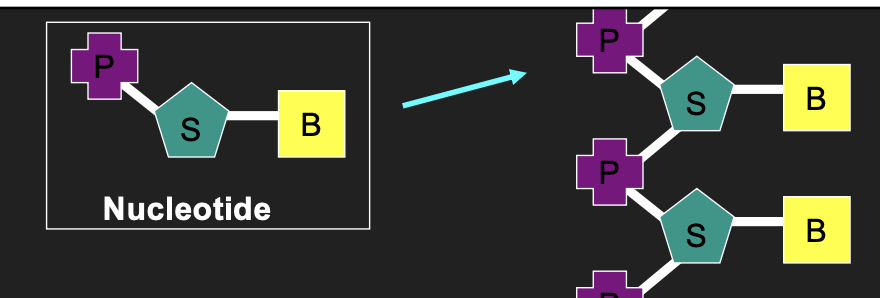
DNA molecule is composed of two chains of nucleotides

  • Nucleotide: phosphate, sugar, base

  • Bases: adenine (A), thymine (T), cytosine (C), guanine (G)

    • A with T, C with G

  • DNA “chain” is built with a complimentary chain attached

  • Twists to form a double helix

2 complimentary (A-T) strands of DNA join at the bases to form the DNA double stranded DNA molecule

Electro-chemical properties of the molecule cause it to twist into a double helix
82
New cards

Three Conditions for Natural Selection to Occur

  1. Variance in a trait

  2. Inheritance of a trait (heritable)

  3. Variants cause differential reproductive success

83
New cards

Nucleotide

Made from Phosphate, Sugar, Base

  • Nucleotides link into chains to form a single strand of DNA

  • Phosphate-sugar “backbone” provides structure for the molecule

  • Bases (A, T, C, G) are the units of genetic information

    • 2 complimentary strands of DNA join at the bases to form the DNA double stranded DNA molecule

    • Electro-chemical properties of the molecule cause it to twist into a double helix

<p>Made from Phosphate, Sugar, Base</p><ul><li><p>Nucleotides link into chains to form a single strand of DNA</p></li><li><p>Phosphate-sugar “backbone” provides structure for the molecule</p></li><li><p>Bases (A, T, C, G) are the units of genetic information</p><ul><li><p>2 complimentary strands of DNA join at the bases to form the DNA double stranded DNA molecule</p></li><li><p>Electro-chemical properties of the molecule cause it to twist into a double helix</p></li></ul></li></ul>
84
New cards

Functions of DNA (1)

Replication

  • Double strand “unzips” between bases

  • Complimentary nucleotides attach to the free bases

  • Original strands eventually separate completely, each component strand having a new complimentary strand

  • Afterward, enzymes “proofread” the new strands, there is an error rate of about 1 mistake per billion base pairs

    • Human genome has about 3 billion base pairs

85
New cards

Replication: Mitosis

Cell division (duplication) for growth and repair

  • cell division for somatic cells

  • results in two identical daughter cells

  • diploid condition is retained (full complement of chromosomes)

86
New cards

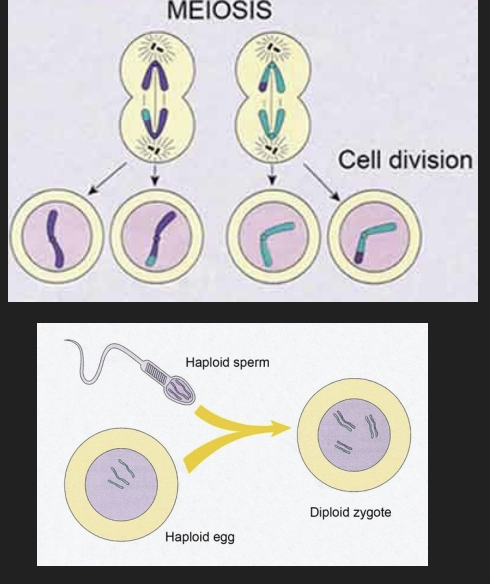
Replication: Meiosis

Cell division for gamete production

  • sex cells require only half the number of chromosomes

  • results in four daughter cells

    • For males: all continue to become sperm

    • For females: one of the four continues to becomes an ovum

  • gametes are haploid

  • only one chromosome from each parent is passed on to the offspring
<p>Cell division for gamete production</p><ul><li><p>sex cells require only half the number of chromosomes</p></li><li><p>results in <u>four daughter cells</u></p><ul><li><p>For males: all continue to become sperm</p></li><li><p>For females: one of the four continues to becomes an ovum</p></li></ul></li><li><p>gametes are haploid</p></li><li><p>only one chromosome from each parent is passed on to the offspring</p></li></ul>
87
New cards

Variation in DNA Replication

  • Occurs when homologous chromosomes crossover and exchange genetic information during meiosis

  • Generates new combinations of genetic variation to pass on to the next generation

88
New cards

Mutations

Type of variation in DNA replication

  • Mutations are errors in replication

  • Most, but not all, mutations are neutral (i.e., have no effect on physical traits)

  • Mutations can be passed on to offspring if they occur during meiosis cell division (in production of gametes)

Mutations are the primary source of new genetic variation, or alleles (Alleles are different versions, or forms, of a single gene)

A genetic site where more than one allele can occur is polymorphic (i.e.,can have many forms)

89
New cards

Polymorphic

A genetic site where more than one allele can occur is polymorphic (i.e.,can have many forms)
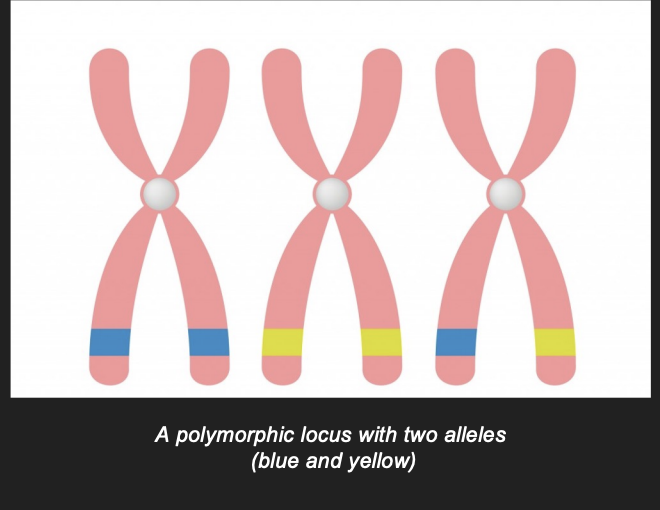
<p>A genetic site where more than one allele can occur is polymorphic (i.e.,can have many forms)</p>
90
New cards

Functions of DNA (2)

Protein Synthesis

  • If there is a job to be done in the molecular world of our cells, usually that job is done by a protein.

  • Examples

    • hormones: acting as messengers

    • enzymes: speeding up reactions

    • antibodies: fighting foreign invaders

    • structures: in muscles, hair, ligaments, fingernails, eyes

91
New cards

2 Steps to Protein Synthesis

1) Transcription: synthesis of messenger RNA (mRNA) from a DNA template, in the nucleus in the language of nucleotides

2) Translation: synthesis of an amino acid sequence (protein) from the mRNA template, in the ribosome in the language of proteins

DNA >> RNA >> protein
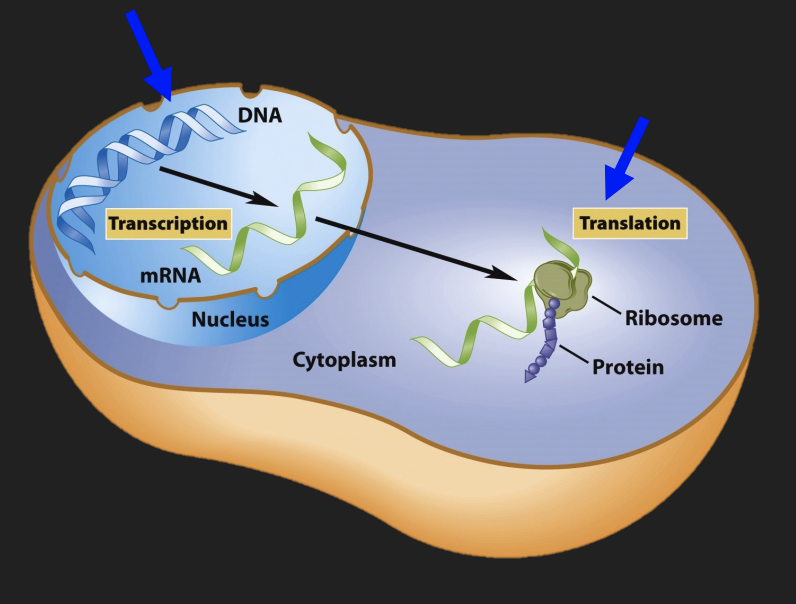
<p>1) <u>Transcription</u>: synthesis of messenger RNA (mRNA) from a DNA template, in the nucleus in the language of nucleotides</p><p>2) <u>Translation</u>: synthesis of an amino acid sequence (protein) from the mRNA template, in the ribosome in the language of proteins</p><p>DNA &gt;&gt; RNA &gt;&gt; protein</p>
92
New cards

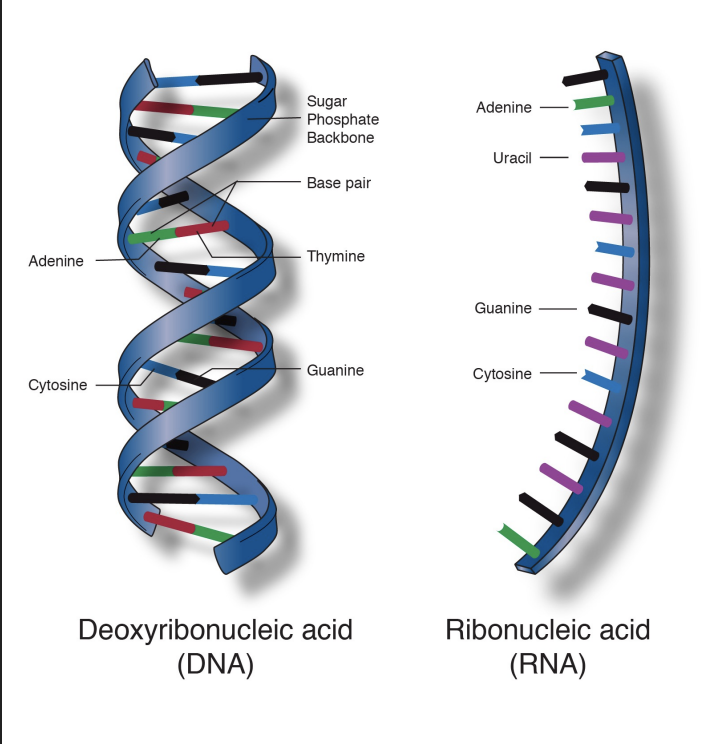
DNA vs RNA

  • DNA is double stranded

  • RNA is single stranded

  • DNA has thymine (T)

  • RNA has uracil (U)

  • DNA: A-T

  • RNA: A-U

<ul><li><p>DNA is double stranded</p></li><li><p>RNA is single stranded </p><p></p></li><li><p>DNA has thymine (T)</p></li><li><p>RNA has uracil (U)</p><p></p></li><li><p>DNA: A-T </p></li><li><p>RNA: A-U</p></li></ul>
93
New cards

Transcription (Protein Synthesis)

Transcription: synthesis of messenger RNA (mRNA) from a DNA template

  • 1st: DNA molecule denatures

  • 2nd: mRNA molecule is built by adding free-floating RNA nucleotides to the DNA strand

  • 3rd: mRNA strand then breaks away and DNA zips back up
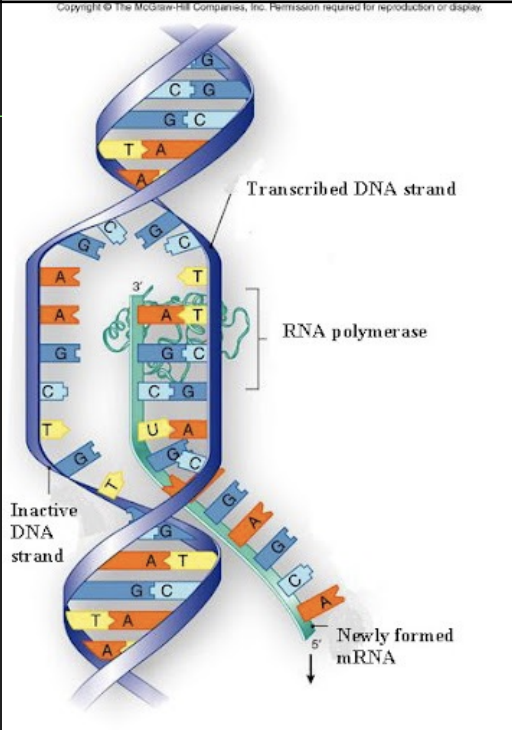
<p>Transcription: synthesis of messenger RNA (mRNA) from a DNA template</p><ul><li><p>1st: DNA molecule denatures</p></li><li><p>2nd: mRNA molecule is built by adding free-floating RNA nucleotides to the DNA strand </p></li><li><p>3rd: mRNA strand then breaks away and DNA zips back up</p></li></ul>
94
New cards

Translation (Protein Synthesis)

Translation: synthesis of amino acid sequence (protein) from mRNA template

  • 1st: mRNA strand is read in units of three bases (codons) that are matched to tRNA anti-codons

  • 2nd: Each anti-codon is attached to an amino acid

  • 3rd: mRNA strands are “read” to create amino acid chains (polypeptide) which join to form protein

*Create immunity in our bodies during the translation process
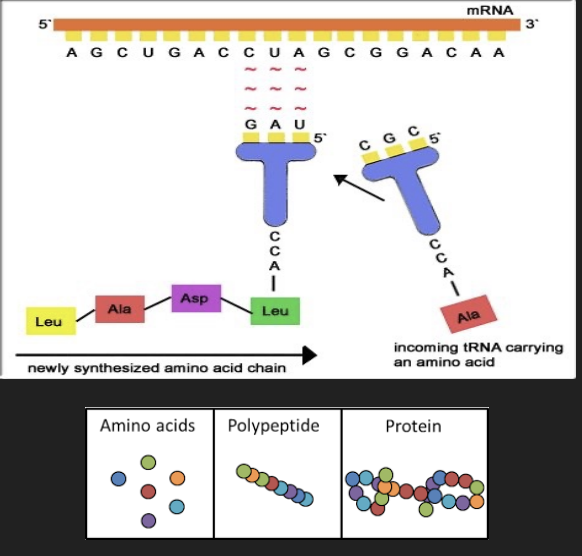
<p>Translation: synthesis of amino acid sequence (protein) from mRNA template</p><ul><li><p>1st: mRNA strand is read in units of three bases (codons) that are matched to tRNA anti-codons</p></li><li><p>2nd: Each anti-codon is attached to an amino acid</p></li><li><p>3rd: mRNA strands are “read” to create amino acid chains (polypeptide) which join to form protein</p></li></ul><p>*Create immunity in our bodies during the translation process</p>
95
New cards

Non-coding DNA

  • Only ~2% of the human genome contains protein coding genes

  • The rest is non-coding DNA which does not produce proteins

  • A lot of non-coding DNA is involved in gene regulation

96
New cards

Mechanisms of Evolution

Forces that will produce and redistribute variation in a population

  • Mutation

  • Gene flow

  • Genetic drift

  • Natural selection

97
New cards

Genetic Drift: Founder Effect

Kind of Genetic Drift

  • Difference in allele frequencies in a founding population compared to frequencies in the source population

  • ie Ellis-Van Creveld syndrome (6 toes) in Pennsylvania Amish community

Human genetic variation is shaped by a history of serial founder effects
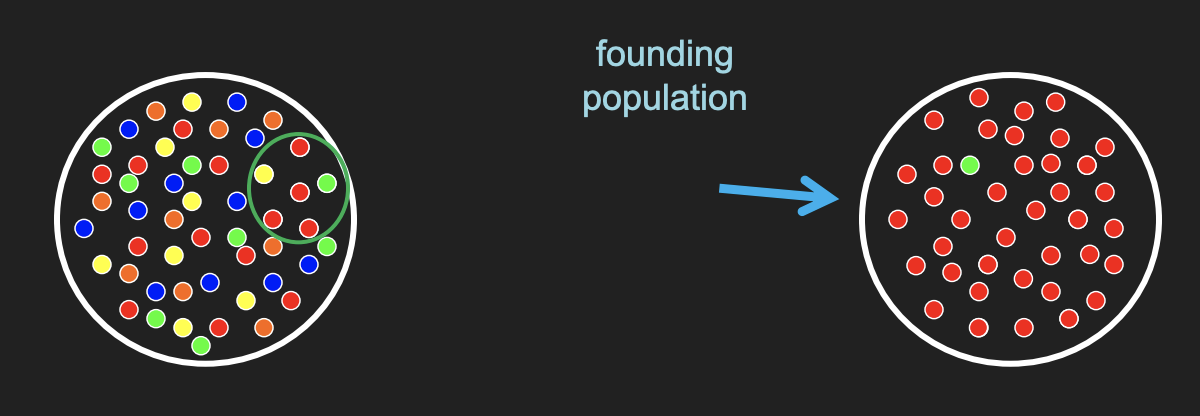
<p>Kind of Genetic Drift</p><ul><li><p>Difference in allele frequencies in a founding population compared to frequencies in the source population</p></li><li><p>ie Ellis-Van Creveld syndrome (6 toes) in Pennsylvania Amish community</p></li></ul><p>Human genetic variation is shaped by a history of serial founder effects</p>
98
New cards

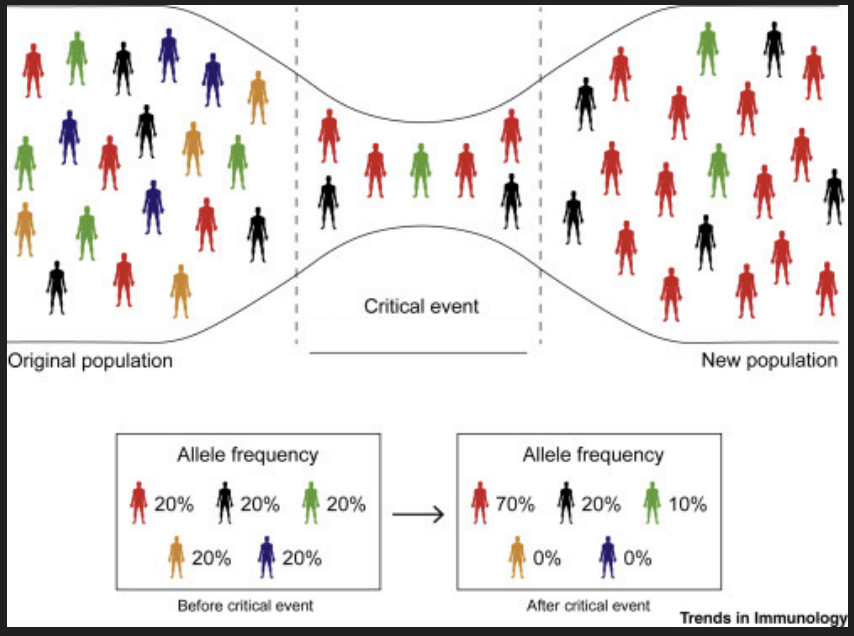
Genetic Drift: Pop. Bottleneck

knowt flashcard image
99
New cards

Artificial Selection

For more than 10,000 years humans have selected traits that we find desirable & purposefully influenced the breeding of domesticated organisms

(ie all dogs from wolves)

100
New cards

Primate Behavioral Biology

field of study that examines primate behavior in an evolutionary context.

use findings from primate field studies to understand how hominins may have behaved in the past, and to better understand modern human behavior.