CFA Level 2
0.0(0)
 Studied by 9 people
 Call Kai
 Learn
Learn Practice Test
 Spaced Repetition
 Match
Match Flashcards
 Knowt Play
Card Sorting
1/336

Earn XP
Description and Tags
Last updated 9:44 PM on 11/27/22
Name | Mastery | Learn | Test | Matching | Spaced | Call with Kai |
|---|
No analytics yet
Send a link to your students to track their progress
337 Terms
1
New cards
cap rate
discount rate - growth rate
(NOI_1)/Value
(NOI_1)/Value
2
New cards
Cost approach to value
Land value + Building replacement cost - Total depreciation
3
New cards
Calculate net operating income (NOI)
NOI = Rental income + Other income - Vacancy and collection loss - Property management costs
4
New cards
Debt Service Coverage Ratio
NOI_1/(Maximum Debt Service)
Loan amount (interest-only loan) = Maximum debt service/Mortgage rate
Loan amount (interest-only loan) = Maximum debt service/Mortgage rate
5
New cards
LTV (Loan to Value)
loan amount / appraised value
6
New cards
The maximum amount of debt that an investor can obtain on commercial real estate is usually limited by either the ratio of the loan to the appraised value of the property (loan-to-value, or LTV, ratio) or the debt service coverage ratio (DSCR), depending on which measure results in the lowest/highest loan amount.
lowest
7
New cards
Formula for Adjusted Funds From Operations (AFFO)
Funds from operations (FFO)
Less: Non-cash rents
Less: Recurring maintenance-type capital expenditures
Equals: AFFO
Less: Non-cash rents
Less: Recurring maintenance-type capital expenditures
Equals: AFFO
8
New cards
Effect of adding cash to information ratio vs sharpe ratio?
The sharpe ratio will remain unaffected while the information ratio will decrease because the numerator (active return) will decr and the active risk will remain the same
9
New cards
Explain Information ratio and provide formula
measure of the consistency of active returns
active return/active risk
active return/active risk
10
New cards
What is break-even inflation rate (BEI) and what is it composed of?
yield on non-inflation indexed bond - yield on inflation indexed bond
composed of expected inflation and a risk premium for uncertainty about actual inflation
composed of expected inflation and a risk premium for uncertainty about actual inflation
11
New cards
The highest squared Sharpe ratio of an actively managed portfolio is
(SR_P)^2 = (SR_B)^2 + IR^2
SR_P = sharpe ratio of portfolio
SR_B = sharpe ratio of benchmark
IR = information ratio
SR_P = sharpe ratio of portfolio
SR_B = sharpe ratio of benchmark
IR = information ratio
12
New cards
Total Value Added
Total Value Added = Asset Allocation + Security Selection
13
New cards
Value Added from Asset Allocation
Sum of (active weight x benchmark return)
14
New cards
Value Added from Security Selection
Sum of (absolute portfolio weight x active return)
15
New cards
Explain how adding cash to a portfolio will change information ratio but not sharpe ratio
The numerator in information ratio will change due to a lower active return by adding cash
16
New cards
Would an unconstrained portfolio's information ratio be affected by the aggressiveness of the active weights?
No, because if active weights are tripled, active return and risk both triple leading to no change
17
New cards
Effective spread (buy order)
2 x (+1)(transaction price - midpoint price)
18
New cards
Effective spread (sell order)
2 x (-1)(transaction price - midpoint price)
19
New cards
Difference between explicit and implicit trading costs
-Explicit trading costs include brokerage, taxes, and fees one would expect to receive for such costs
-Implicit costs are harder to measure and include bid/ask spread, market or price impact costs, opportunity cost and delay costs (slippage)
-Implicit costs are harder to measure and include bid/ask spread, market or price impact costs, opportunity cost and delay costs (slippage)
20
New cards
What is Information Coefficient (IC)?
-it is a measure of a manager's skill
-IC is the ex-ante, risk weighted correlation between active returns and forecasted active returns
-IC is the ex-ante, risk weighted correlation between active returns and forecasted active returns
21
New cards
What is Transfer Coefficient (TC)?
-transfer coefficient is the cross-sectional correlation between the forecasted active returns and the actual weights adjusted for risk
22
New cards
Explain Breadth
-number of independent active bets taken per year
-Example, if a manager takes active positions in 10 securities each month, then BR = 10x12 = 120
-Example, if a manager takes active positions in 10 securities each month, then BR = 10x12 = 120
23
New cards
The difference between the yield on a zero-coupon, default-free nominal bond and the yield on a zero-coupon, default-free real bond of the same maturity reflects:
A) investors' expectations about future inflation only.
B) a premium for the uncertainty of future inflation only.
C) both, investors' expectations about future inflation and a premium for the uncertainty of future inflation.
A) investors' expectations about future inflation only.
B) a premium for the uncertainty of future inflation only.
C) both, investors' expectations about future inflation and a premium for the uncertainty of future inflation.
C is correct. The difference between the yield on a zero-coupon, default-free nominal bond and the yield on a zero-coupon, default-free real bond of the same maturity is known as the break-even inflation rate. This break-even inflation rate will incorporate the inflation expectations of investors over the investment horizon of the two bonds, plus a risk premium to compensate investors for uncertainty about future inflation. Break-even inflation rates are not simply the market's best estimate of future inflation over the relevant investment horizon, because break-even inflation rates also include a risk premium to compensate investors for their uncertainty about future inflation.
24
New cards
Explain Intertemporal Rate of Substitution and provide formula
MU_tomorrow / MU_today
where MU = marginal utility of consumption
explains an investor's trade off between real consumption now and real consumption in the future
where MU = marginal utility of consumption
explains an investor's trade off between real consumption now and real consumption in the future
25
New cards
Explain inverse relationship between real rates and intertemporal rate of substitution
higher intertemporal rate of substitution, lower real interest rates
lower intertemporal rate of substitution, higher real interest rates
lower intertemporal rate of substitution, higher real interest rates
26
New cards
Formula for Optimal amount of active risk for an unconstrained portfolio
= [(IR)/(SR_B)] * (SD_B)
IR = information ratio
SR_B = benchmark sharpe ratio
SD_B - benchmark SD
IR = information ratio
SR_B = benchmark sharpe ratio
SD_B - benchmark SD
27
New cards
Formula for Sharpe Ratio of a portfolio with an optimal level of active risk
sqrt[(SR_B^2) + (IR^2)]
28
New cards
formula for IR for an unconstrained portfolio
IR = IC*sqrt(BR)
29
New cards
formula for expected value added by active management for an unconstrained portfolio
IC*sqrt(BR)*optimal level of active risk
30
New cards
formula for IR for a constrained portfolio
(TC)*IC*sqrt(BR)
31
New cards
formula for expected value added by active management for a constrained portfolio
(TC)*IC*sqrt(BR)*optimal level of active risk
32
New cards
Formula for Optimal amount of active risk for a constrained portfolio
= [(TC)*(IR)/(SR_B)] * (SD_B)
IR = information ratio
SR_B = benchmark sharpe ratio
SD_B - benchmark SD
TC = transfer coefficient
IR = information ratio
SR_B = benchmark sharpe ratio
SD_B - benchmark SD
TC = transfer coefficient
33
New cards
formula for Information Coefficient (IC)
IC = 2*(% correct) - 1
34
New cards
arbitrage gap
- the price band of the NAV that the ETFs trade within
- tends to be wider for ETFs with illiquid holdings
- also tends to be widers for ETF's on a foreign index due to time zone differences
- tends to be wider for ETFs with illiquid holdings
- also tends to be widers for ETF's on a foreign index due to time zone differences
35
New cards
ETF authorized participants create and redeem ETF shares in the (primary/secondary) market.
ETF secondary market trades are transactions between buyers and sellers of existing ETF shares. No new ETF shares are created by trades in the secondary market. ETF authorized participants create and redeem ETF shares in the primary market.
36
New cards
Assuming arbitrage costs are minimal, which of the following is most likely to occur when the share price of an ETF is trading at a premium to its intraday NAV?
a) New ETF shares will be created by the ETF sponsor.
b) Redemption baskets will be received by APs from the ETF sponsor.
c) Retail investors will exchange baskets of securities that the ETF tracks for creation units.
a) New ETF shares will be created by the ETF sponsor.
b) Redemption baskets will be received by APs from the ETF sponsor.
c) Retail investors will exchange baskets of securities that the ETF tracks for creation units.
A is correct. When the share price of an ETF is trading at a premium to its intraday NAV and assuming arbitrage costs are minimal, APs will step in and take advantage of the arbitrage. Specifically, APs will step in and buy the basket of securities that the ETF tracks (the creation basket) and exchange it with the ETF provider for new ETF shares (a creation unit). These new shares received by APs can then be sold on the open market to realize arbitrage profits.
37
New cards
ETF bid-ask spreads are generally less than or equal to the combination of the following:
± Creation/redemption fees and other direct costs, such as brokerage and exchange fees
+ Bid-ask spread of the underlying securities held by the ETF
+ Compensation for the risk of hedging or carrying positions by liquidity providers (market makers) for the remainder of the trading day
+ Market maker's desired profit spread
− Discount related to the likelihood of receiving an offsetting ETF order in a short time frame
+ Bid-ask spread of the underlying securities held by the ETF
+ Compensation for the risk of hedging or carrying positions by liquidity providers (market makers) for the remainder of the trading day
+ Market maker's desired profit spread
− Discount related to the likelihood of receiving an offsetting ETF order in a short time frame
38
New cards
Assumptions of Arbitrage Pricing Theory (APT)
- Unsystematic risk can be diversified away in a portfolio.
- Returns are generated using a factor model
- No arbitrage opportunities exist
- Returns are generated using a factor model
- No arbitrage opportunities exist
39
New cards
Probability of an up-move
U = (1 + rf - D)/(U - D)
40
New cards
Hedge Ratio
the fractional share of stock needed in the arbitrage trade
h = [C(+) - C(-)]/[S(+) - S(-)]
C(+)/(-) = call up/down move payoff
S(+)/(-) = stock up/down move payoff
h = [C(+) - C(-)]/[S(+) - S(-)]
C(+)/(-) = call up/down move payoff
S(+)/(-) = stock up/down move payoff
41
New cards
assumptions of the Black-Scholes-Merton option valuation model
1) underlying asset price follows a geometric brownian motion process
2) The (continuously compounded) risk-free rate is constant and known. Borrowing and lending are both at the risk-free rate.
3) The volatility of the returns on the underlying asset is constant and known.
4) Markets are "frictionless."
5) The (continuously compounded) yield on the underlying asset is constant
6) Options are European
2) The (continuously compounded) risk-free rate is constant and known. Borrowing and lending are both at the risk-free rate.
3) The volatility of the returns on the underlying asset is constant and known.
4) Markets are "frictionless."
5) The (continuously compounded) yield on the underlying asset is constant
6) Options are European
42
New cards
Compare and contrast delta for a call and out option
A call option's delta will increase from 0 to e^(-rt) as stock increases. For a non dividend paying stock, delta will increase from 0 to 1 as stock price increases.
A put option's delta will increase from -e^(-rt) to 0 as stock increases. For a non dividend paying stock, delta will increase from -1 to 0 as stock price increases.
A put option's delta will increase from -e^(-rt) to 0 as stock increases. For a non dividend paying stock, delta will increase from -1 to 0 as stock price increases.
43
New cards
Interpret a gamma of 0.04
A gamma of 0.04 implies that a $1 increase in the price of the underlying stock will cause a call option's delta to increase by 0.04 making it more sensitive to changes in the stock price
44
New cards
When is gamma at it's highest?
for at-the money options. Deep in the money or deep out of the money have low gamma.
45
New cards
number of short call options needed to delta hedge formula
= number of shares hedged / delta of call option
46
New cards
number of long put options needed to delta hedge formula
= - number of shares / delta of put option
47
New cards
Describe the goal of a delta neutral portfolio
to combine a long position in a stock with a short position in a call option so that the value of the portfolio does not change as the stock price changes
48
New cards
Describe gamma risk
Consider a delta hedge involving a long position in stock and short position in calls. If the stock price falls abruptly, the loss in the long stock position will not equal the gain in the short call position. This is the gamma risk of the hedge.
49
New cards
Describe how implied vol is used in options trading
1) can use implied vol to gauge market perceptions
2) can use implied vol to quote option prices since options with different exercise prices and maturity dates can be quotes using the same unit of measurement
2) can use implied vol to quote option prices since options with different exercise prices and maturity dates can be quotes using the same unit of measurement
50
New cards
Describe option delta
option delta is the relationship between changes in asset prices and changes in option prices
(+) for calls, (-) for puts
(+) for calls, (-) for puts
51
New cards
According to the Black model, the value of a payer swaption can be described as the
swap component minus the bond component
52
New cards
The two fundamental rules of the arbitrageur are
(a) do not use your own money
(b) do not take any price risk
The arbitrageur does not spend proceeds from short selling transactions but invests them at the risk-free rate. The arbitrageur does not take market price risk, even though each step of the transaction may individually involve price risk. Because the steps are undertaken simultaneously, however, the price risk is offset.
(b) do not take any price risk
The arbitrageur does not spend proceeds from short selling transactions but invests them at the risk-free rate. The arbitrageur does not take market price risk, even though each step of the transaction may individually involve price risk. Because the steps are undertaken simultaneously, however, the price risk is offset.
53
New cards
Valuation of a Swap
V(swap) = [r(fixed at time of initiation) - r(fixed at time we are valuing)] x sum of DF x notional
54
New cards
FP(on an equity index) with continuous dividends
S x e^(CCRF rate - CCDY)(T)
CCRF = continuously compounded risk free rate
CCDY = continuously compounded dividend yield
CCRF = continuously compounded risk free rate
CCDY = continuously compounded dividend yield
55
New cards
Explain carry arbitrage if the forward is overpriced to make a profit
borrow money => go long the spot asset => go short asset in the forward market
56
New cards
Explain reverse carry arbitrage if the forward is underpriced to make a profit
borrow asset => short spot asset => lend money => long forward
57
New cards
Explain the notation of a 2x3 FRA
a contract that expires in 60 days and the underlying loan is settled in 90 days. The underlying rate is 30 day LIBOR
58
New cards
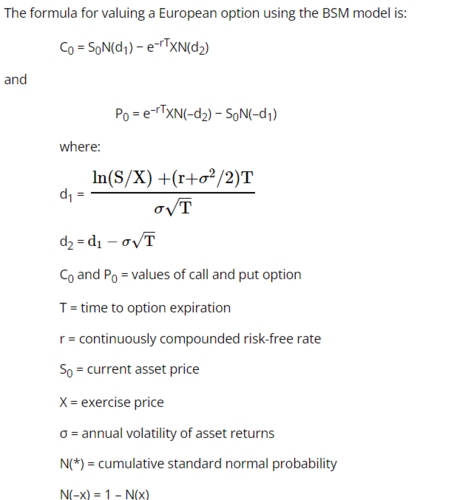
Formula for deriving European option using the BSM model
59
New cards
explain a call and put option using BSM
-a call option can be interpreted as a leveraged stock investment where N(d1) units of stock are purchased using e^(-rT)XN(d2) borrowed funds (short position in bonds)
-a put option consists of a long position in N(-d2) bonds and a short position in N(-d1) stocks
-a put option consists of a long position in N(-d2) bonds and a short position in N(-d1) stocks
60
New cards
Explain N(d2) and N(-d2)
N(d2) is the risk neutral probability that a call option will expire in the money
N(-d2) is the risk neutral probability that a put option will expire in the money
N(-d2) is the risk neutral probability that a put option will expire in the money
61
New cards
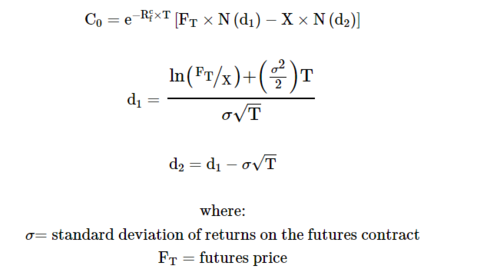
Formula for modeling options on forwards and futures using the Black model
62
New cards
Explain how options on futures can be modeled with the Black model
-The value of a call option on futures is equal to the value of a portfolio with a long futures position (the PV of the futures price multiplied by N(d1)) and a short bond position (the PV of the exercise price multiplied by N(d2)).
-The value of a put option is equal to the value of a portfolio with a long bond and a short futures position.
-The value of a call can also be thought of as the present value of the difference between the futures price (adjusted by N(d1)) and the exercise price (adjusted by N(d2)).
-The value of a put option is equal to the value of a portfolio with a long bond and a short futures position.
-The value of a call can also be thought of as the present value of the difference between the futures price (adjusted by N(d1)) and the exercise price (adjusted by N(d2)).
63
New cards
Capital gains yield Formula
In the Gordon growth model, Total return = Dividend yield + Capital gains yield
64
New cards
Sustainable Growth Rate (SGR)
ROE x (1 - payout ratio)
65
New cards
Explain the difference between return on invested capital and return on capital employed
ROIC is a return to both equity and debt and is preferable to ROE because it allows for comparisons across firms with different capital structures
Return on capital employed is similar to ROIC but uses pretax operating earnings in the numerator to allow comparison between companies that face different tax rates
Return on capital employed is similar to ROIC but uses pretax operating earnings in the numerator to allow comparison between companies that face different tax rates
66
New cards
ROIC formula
NOPLAT/Invested Capital
NOPLAT = EBIT x (1 - eff tax rate)
Invested Capital = operating assets minus operating liabilities
high ROIC is sign of competitive advantage
NOPLAT = EBIT x (1 - eff tax rate)
Invested Capital = operating assets minus operating liabilities
high ROIC is sign of competitive advantage
67
New cards
formula for PVGO
V = (EPS_1/r) + PVGO
value of company w/o reinvestment
value of company w/o reinvestment
68
New cards
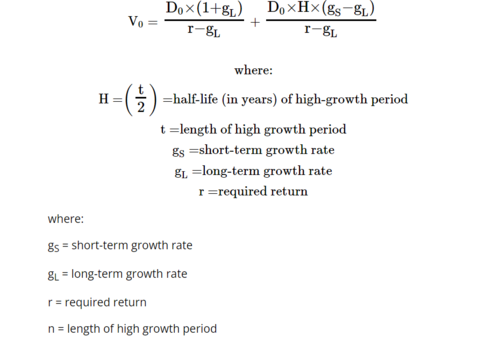
H-Model Formula
69
New cards
Calculating FCFF from NI
NI + NCC + [INT x (1-tax rate)] - FCInv - WCInv
70
New cards
FCInv formula
Equal to the difference between capital expenditures and the proceeds from the sale of long term assets
71
New cards
WCInv
Equal to the change in working capital, excluding cash, cash equivalents, notes payable, and the current portion of LT debt
72
New cards
Formula to calculate FCFE from FCFF
FCFF - [INT x (1 - tax rate)] + net borrowing
where net borrowing equals long and short term new debt issues - long and short term debt repayments
where net borrowing equals long and short term new debt issues - long and short term debt repayments
73
New cards
Value of the firm under FCFF?
Equity Value under FCFF?
Equity Value under FCFF?
(FCFF_1)/(WACC - g)
Equity value = Firm value - Market value of debt
Equity value = Firm value - Market value of debt
74
New cards
Formula for Value of equity under FCFE
(FCFE_1)/(r - g)
75
New cards
Formula FCFE using debt ratio
FCFE = Net income - (1 - DR) × (FCInv - Depreciation) - (1 - DR) × (WCInv)
76
New cards
Discount for Lack of Control (DLOC)
1 - (1 / (1 + control premium))
77
New cards
Total Discount for DLOC & DLOM
1 - ((1-DLOC)(1-DLOM))
78
New cards
Formula and explain PEG Ratio
ratio of P/E multiple to earnings growth rate
lower PEGs are more attractive than stocks with high PEGs, assuming that risk is similar
lower PEGs are more attractive than stocks with high PEGs, assuming that risk is similar
79
New cards
Fed model
considers the overall market to be overvalued (undervalued) when the earnings yield (i.e the e/p ratio) on the S&P 500 index is lower (higher) than the yield on 10 year US treasury bonds.
80
New cards
Yardeni Model
It incorporates the expected growth rate in earnings:
CEY = CBY - b x LTEG + residual
CEY: current EY on the market index
CBY: current Moody's A-rate corporate bond yield
LTEG: consensus 5-year earnings growth rate for the market index
b: the weight the market gives to five-year earnings projections
CEY = CBY - b x LTEG + residual
CEY: current EY on the market index
CBY: current Moody's A-rate corporate bond yield
LTEG: consensus 5-year earnings growth rate for the market index
b: the weight the market gives to five-year earnings projections
81
New cards
explain method of historical average EPS to find normalized EPS
average EPS over some recent period
82
New cards
method of average ROE to find normalized EPS
average ROE multiplied by current BVPS
83
New cards
How to calculate residual income from Net Income
NI = EBIT - interest expense - income tax expense
RI = NI - equity charge
where equity charge = equity capital x cost of equity
RI = NI - equity charge
where equity charge = equity capital x cost of equity
84
New cards
Single-stage residual income valuation model
V_0 = B_0 + [(ROE - r) x B_0 / (r-g)]
85
New cards
What is a persistence factor
the projected rate at which residual income is expected to fade over the life cycle of the firm (between 0 and 1)
86
New cards
high persistence factors are associated with...
-low dividend payout ratios
-historically high residual income persistence in the industry
-historically high residual income persistence in the industry
87
New cards
low persistence factors are associated with...
-high ROE
-significant levels of non-reoccurring items
-high accounting accruals
-significant levels of non-reoccurring items
-high accounting accruals
88
New cards
Economic value added (EVA®)
measures the value added for shareholders by management during a given year
NOPAT - (WACC x total capital)
NOPAT - (WACC x total capital)
89
New cards
FCInv
= CAPEX = Ending Net PPE - Beg Net PPE + Deprec
90
New cards
justified trailing P/E
[(1 - b)*(1 + g)]/(r - g)
b = Retention Ratio
1 - b = DPR
b = Retention Ratio
1 - b = DPR
91
New cards
justified leading P/E
(1 - b)/(r - g) = (D_1/E_1)/(r - g)
1 - b = DPR
1 - b = DPR
92
New cards
Justified P/B
(ROE - g)/(r - g)
93
New cards
Justified P/S
= Net Profit Margin x Justified Trailing P/E
94
New cards
Justified P/CF
Two Step Process:
1. Calc P using DCF model
2. Divided result by CF
Justified P/CF will increase, all else equal, if:
-CF increases (numerator increases more than denomiator)
- Growth rate increases
- Required return decreases
- same relationship as all other ratios
1. Calc P using DCF model
2. Divided result by CF
Justified P/CF will increase, all else equal, if:
-CF increases (numerator increases more than denomiator)
- Growth rate increases
- Required return decreases
- same relationship as all other ratios
95
New cards
Justified EV/EBITDA multiple
-Positively related to the growth rate in FCFF and EBITDA
-Negatively related to the firms overall risk level and WACC
-Negatively related to the firms overall risk level and WACC
96
New cards
Justified Dividend Yield Formula
(r - g) / (1 + g)
97
New cards
Explain the Fed Model
considers the overall market to be overvalued (undervalued) when the earnings yield (E/P) on the SP500 is lower (higher) than the yield on 10yr US Treasury Bonds
98
New cards
Interpret the PEG ratio
P/E ratio / g
-P/E per unit of expected growth
-lower PEGs more attractive than stocks with higher PEGs, assuming risk is the same
-does not account for risk
-relationship between P/E and g is not linear
-doesn't reflect duration of high growth period for a multi-stage model
-P/E per unit of expected growth
-lower PEGs more attractive than stocks with higher PEGs, assuming risk is the same
-does not account for risk
-relationship between P/E and g is not linear
-doesn't reflect duration of high growth period for a multi-stage model
99
New cards
earnings plus non-cash charges (CF)
= net income + amortization + depreciation
-used as proxy for cash flow
-used as proxy for cash flow
100
New cards
Enterprise Value
Market Value of Equity + Debt - Cash and Investments
 Note
Note  Flashcards (31)