Chapter 1; Medical Terms
 Call Kai
 Learn
Learn Practice Test
 Spaced Repetition
 Match
Match Flashcards
 Knowt Play
1/72

There's no tags or description
Looks like no tags are added yet.
Name | Mastery | Learn | Test | Matching | Spaced | Call with Kai |
|---|
No analytics yet
Send a link to your students to track their progress
73 Terms
abdominocentesis
a medical procedure involving the surgical puncture of the abdomen with a needle or catheter to remove fluid (peritoneal fluid) from the peritoneal cavity
acute
condition that has a rapid onset, a severe course, and a relatively short duration.
angiography
process of producing an x-ray, or radiographic study, of blood vessels after the injection of a contrast medium to make these blood vessels visible.
appendectomy
surgical removal of the appendix.
arteriosclerosis
abnormal hardening of the walls of an artery or arteries.
arthralgia
pain in a joint or joints.
colostomy
a surgical operation in which a piece of the colon is diverted to an artificial opening in the abdominal wall so as to bypass a damaged part of the colon
cyanosis
blue discoloration of the skin caused by lack of adequate oxygen in the blood.
dermatologist
a physician who specializes in diagnosing and treating disorders of the skin.
diagnosis
the identification of a disease.
diarrhea
the frequent flow of loose or watery stools.
edema
swelling caused by an abnormal accumulation of fluid in cells, tissues, or cavities of the body.
endarterial
pertaining to the interior or lining of an artery.
eponym
a disease, structure, operation, or procedure named for the person who discovered or described it first.
erythrocyte
a mature red blood cell.
fissure
a groove or crack-like sore of the skin; this term also describes normal folds in the contours of the brain.
fistula
an abnormal passage, usually between two internal organs or leading from an organ to the surface of the body.
gastralgia
also known as a stomachache, means pain in the stomach.
gastritis
inflammation of the stomach.
gastroenteritis
inflammation of the stomach and small intestine.
gastrosis
any disease of the stomach.
hemorrhage
the loss of a large amount of blood in a short time.
hepatomegaly
abnormal enlargement of the liver.
hypertension
higher-than-normal blood pressure.
hypotension
lower-than-normal blood pressure.
infection
invasion of the body by a pathogenic (disease-producing) organism.
inflammation
a localized response to an injury or to the destruction of tissues.
interstitial
between, but not within, the parts of a tissue.
intramuscular
within the muscle.
laceration
a torn or jagged wound or an accidental cut.
lesion
a pathologic change of the tissues due to disease or injury.
malaise
word of French origin referring to a feeling of general discomfort or uneasiness that is often the first indication of an infection or other disease.
mycosis
any abnormal condition or disease caused by a fungus.
myelopathy
any injury, degeneration or disease in the spinal cord.
myopathy
any pathologic change or disease of muscle tissue.
natal
pertaining to birth.
neonatology
the study of disorders of the newborn.
neurorrhaphy
suturing together the ends of a severed nerve.
otorhinolaryngology
study of the ears, nose, and throat.
palpation
an examination technique in which the examiner’s hands are used to feel the texture, size, consistency, and location of certain body parts.
palpitation
a pounding or racing heart.
pathology
the study of all aspects of diseases.
phalanges
the bones of the fingers and toes.
poliomyelitis
a viral infection of the gray nerve tissue of the spinal cord.
prognosis
a prediction of the probable course and outcome of a disease.
pyoderma
any acute, inflammatory, pus-forming bacterial skin infection such as impetigo.
pyrosis
also known as heartburn, is discomfort due to the regurgitation of stomach acid upward into the esophagus.
remission
the temporary, partial, or complete disappearance of the symptoms of a disease without having achieved a cure.
sign
objective evidence of disease, such as a fever.
supination
the act of rotating the arm so that the palm of the hand is forward or upward.
suppuration
the formation of pus.
supracostal
above or outside the ribs.
symptom
subjective evidence of a disease, such as pain or a headache.
syndrome
a set of signs and symptoms that occur together as part of a specific disease process.
tenorrhaphy
surgical suturing of a tendon.
tonsillitis
inflammation of the tonsils.
trauma
wound or injury.
triage
the medical screening of patients to determine their relative priority of need and the proper place of treatment.
viral
pertaining to a virus.
Cyanosis
blue discoloration of the skin caused by lack of adequate oxygen in the blood
erythrocyte
a mature red blood cell
leukocyte
a white blood cell
Melanoma
a type of skin cancer
Poliomyelitis
a viral infection of the gray nerve tissue of the spinal cord
differential diagnosis
(D/DX), also known as a rule out (R/O), is an attempt to determine which one of several possible diseases is causing the signs and symptoms that are present.
chronic condition
is of long duration. Although such diseases can be controlled, they are rarely cured.
disease
is a condition in which one or more body parts are not functioning normally. Some diseases are named for their signs and symptoms. For example, chronic fatigue syndrome is a persistent, overwhelming fatigue of unknown origin
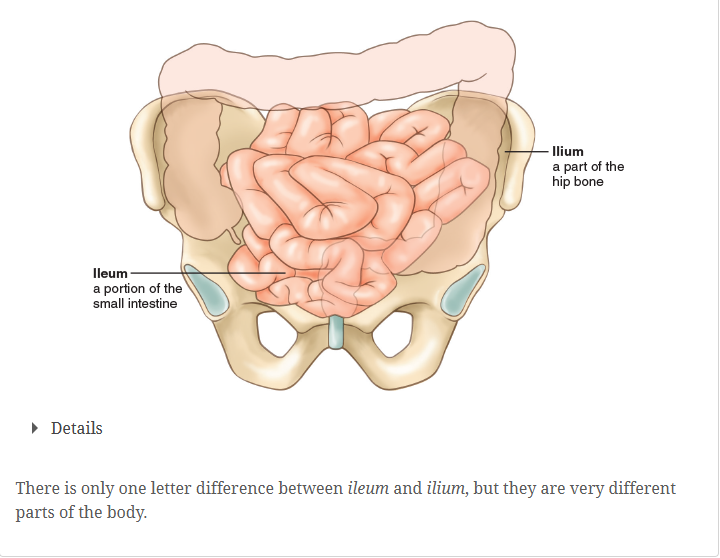
ileum
the last and longest portion of the small intestine. Memory aid: Ileum is spelled with an e as in intestine
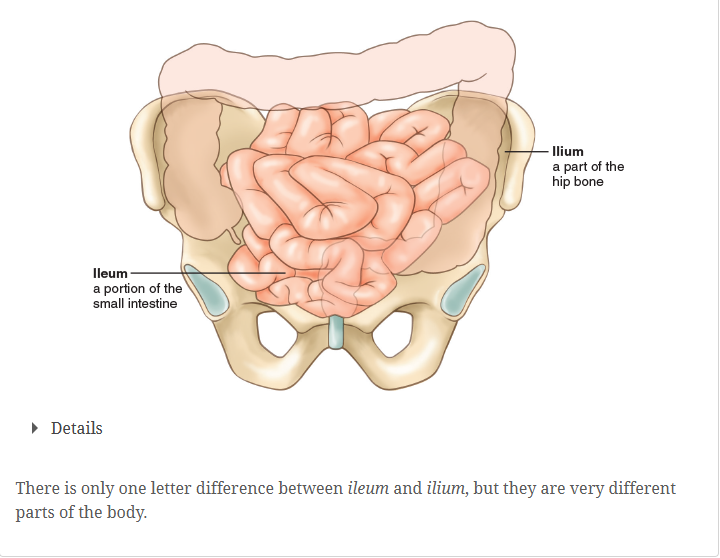
ilium
is part of the hip bone. Memory aid: Ilium is spelled with an i as in h i p
mucous (adjective)
describes the specialized membranes that line the body cavities
mucus (noun)
refers to the fluid secreted by these mucous membranes
Virile
having the nature, properties, or qualities of an adult male.
Exudate
Fluid, such as pus, that leaks out of an infected wound

