Communication, Collaboration, Informatics and Documentation
 Studied by 0 people
 Call Kai
 Learn
Learn Practice Test
 Spaced Repetition
 Match
Match Flashcards
 Knowt Play
1/18

There's no tags or description
Looks like no tags are added yet.
Name | Mastery | Learn | Test | Matching | Spaced | Call with Kai |
|---|
No study sessions yet.
19 Terms
Communication in Nursing
Purpose: Builds trust, promotes healing, ensures safety, improves care.
Therapeutic: Intentional, ethical, helps not harms.
Relationships: Based on empathy, respect, authenticity.
Nurse’s Role: Assess, educate, counsel, advocate.
Critical Thinking: Use curiosity, confidence, integrity, humility.
Culture: Avoid bias, clarify meaning.
Levels of Communication: Intrapersonal
Self-talk; builds confidence, self-awareness, and control
Levels of Communication: Intrapersonal
One-on-one; foundation of nursing—validate meaning (teach-back).
Levels of Communication: Small-group
Team meetings or care conferences; organized, goal-focused.
Levels of Communication: Public
Speaking to groups; adapt tone, gestures, and media.
Levels of Communication: Electronic
Secure messaging/patient portals; professional tone, clear language.
Phases of the Helping Relationship: Pre-interaction
Prepare, gather info.
Phases of the Helping Relationship: Orientation
Build trust, define goals.
Phases of the Helping Relationship: Working
Implement care, achieve goals.
Phases of the Helping Relationship: Termination
Evaluate, closure.
Elements of Professional Communication
Appearance & Behavior: Clean, calm, confident, and prepared.
AIDET: Acknowledge, Introduce, Duration, Explain, Thank
Courtesy: Knock, greet, use manners, explain purpose.
Use of Names: Always introduce yourself.
Trustworthiness: Be honest, reliable, and consistent.
Autonomy: Take responsibility, advocate for patients.
Assertiveness: Express yourself respectfully and confidently using “I” statements.
Techniques of Communication: Therapeutic
Active listening
Sharing observations, empathy, hope, humor, and feelings
Use of touch
Silence
Providing information
Clarifying
Focusing
Paraphrasing
Validation
Asking relevant questions
Summarizing
Self-disclosure
Confrontation
Techniques of Communication: Non-Therapeutic
Asking personal questions
Giving personal opinions
Changing the subject
Automatic responses
False reassurance
Sympathy
Asking the explanation
Approval or disapproval
Defensive responses
Passive or aggressive responses
Arguing
NCLEX TIP!
Avoid asking “why” questions when communicating with patients.
Reason: “Why” questions can sound judgmental or accusatory, making patients defensive. They do not promote therapeutic communication because they focus on justification rather than understanding.
Instead: Use open-ended, therapeutic questions that encourage sharing feelings or thoughts.
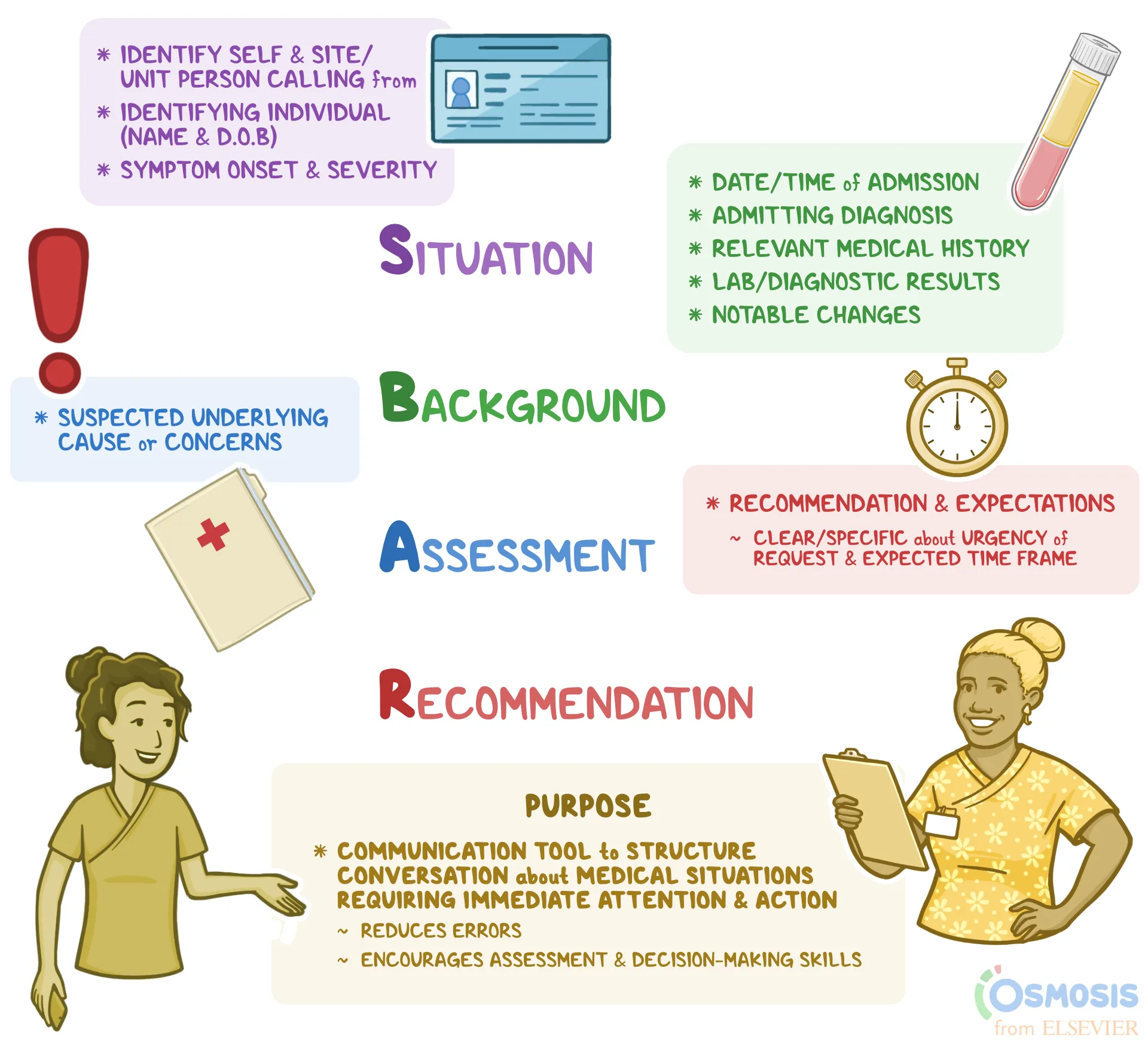
SBAR
Types of Collaboration:
Types of Collaboration:
Types of Collaboration:
Types of Collaboration:
 Note
Note  Flashcards (25)