Crop Production Exam 3
 Studied by 9 people
 Call with Kai
 Learn
Learn Practice Test
 Spaced Repetition
 Match
Match Flashcards
 Knowt Play
1/48

There's no tags or description
Looks like no tags are added yet.
Name | Mastery | Learn | Test | Matching | Spaced | Call with Kai |
|---|
No study sessions yet.
49 Terms
How do you ID vegetative Soybeans
Count the number of fully formed trifoliate leaves
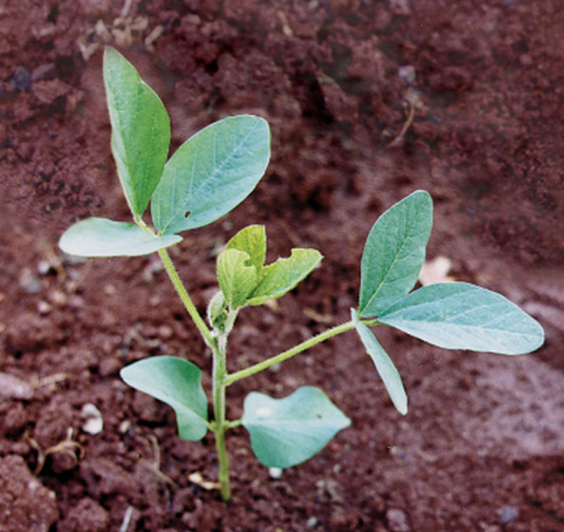
what stage is this soybean?
V2
Standard weight of 1 bushel of Corn weighs?
56 LBS
Standard weight of 1 bushel of Soybeans weighs?
60 LBS
Standard weight of 1 bushel of Wheat weighs?
60 LBS
What does a bushel measure?
Bushels are a measure of volume.
What does test weight measure?
Density of the grain. Density = mass/volume, so lbs/bushels
Test weight increases as moisture content decreases
Soybeans are typically harvested at what moisture?
13% (also market Moisture Content)
What are the three types of harvest loss?
Lodging (The stems fall over and can’t be picked up by the combine.), Shatter (The combine rotor is running too tight, causes the kernel to break), and Separator (Grain goes out the back of the combine rather than in the tank)
How many soybeans in one square foot represent a bushel of harvest loss
5 beans/ft squared = 1bu/acre
How many corn kernels in one square foot represent a bushel of harvest loss
2 kernels/ft squared=1bu/acre
How many kernels of wheat in one square foot represent a bushel of harvest loss
22 kernels/ft squared = 1bu/acre
Common causes of grain loss during storage:
Fungus, Insects, Rodents
Most common cause of grain loss:
Fungi (cause mycotoxins)
When is it unsafe to enter grain bins?
While unloading equipment is operating, when grain is moist and some has been taken out, when there is a huge wall of grain.
What is physiological maturity?
When maximum accumulation of dry matter in the seed occurs ex: black layer in corn and sorghum and pod color change in soybean. MC of corn at physiological maturity is 30-35%, soybeans are 45-55%.
What is harvest maturity?
Moisture content of the crop when grain CAN be combined. Corn CAN be harvested at 25% moisture, soybeans at 18%. Doesn’t mean it should be, but it CAN be.
What is threshing?
the process of separating the grain from the other parts of the crop.
What is stover?
The leaves and stalk of the harvested field crops, it is what is “left over”.
what is organic farming?
system of farming that relies on natural processes and avoids synthetic inputs.
What inputs are allowed in organic farming?
green manure, livestock manure, compost, blood meal, alfalfa meal, cottonseed meal, feather meal, fish meal, soybean meal, bone meal, rock phosphate, fish emulsions, kelp, rock powders and lime
What inputs are NOT allowed in organic farming?
no synthetic fertilizer, no manure from non-organic livestock, synthetic pesticides/herbicides, GMOs
What is in the certification process?
3 years no synthetic fertilizers, pesticides, or GMOs. inspected every year by the NOP (national organic program), must keep detailed records of cropping plan and records (called OSP, completed at start of the certification process and is updated annually).
What are the biggest challenges in organic production?
More time intensive, more management, must follow lots of rules, weed control, need creative soil fertility inputs, pest control, disease control
When does primary tillage occur
in the fall, after the growing season is over
When does secondary tillage occur
in the spring, before the crop is in the ground, also outside the growing season
Which cultivator would you use in-season? inter-row or field cultivators?
inter-row
what are mechanical weed control practices and some examples?
use of some kind of machine to disturb or kill the weeds. examples: tillage and flame weeding (sometimes flame and laser are included in this category)
What is cultural weed control and some examples?
using management decisions to prevent weeds. examples: crop rotation with perennials, smother and cover crops that are competitive with weeds (buckwheat, Sudan grass, winter rye), delayed planting (allows for more mechanical weed control prior to crop planting).
What is a specialty crop?
agricultural products that are cultivated or managed and used by people for food, medicinal purposes, or aesthetic enjoyment. This includes fruits, vegetables, tree nuts, dried fruits, horticulture crops, and nursery crops. really anything other than commodity crops
Which specialty crops would be easiest to incorporate into a corn-soybean operation?
Dry edible beans/pulse crops, sunflowers, sweet corn, fresh beans, fresh peas.
How much can asparagus grow in one day
10 cm
what are the 5 soil health principles?
Minimize disturbances, keep the soil covered, living roots, plant diversity, integrate livestock, context
Why is grazing livestock on cover crops beneficial?
Increased ROI, manure as fertilizer, utilizes available feed, exercise
Benefits to planting a cover crop
Suppress weeds, absorb water, protect soil from wind and rain, turnips break up compaction, add organic matter to soil, livestock grazing, provides a living root for microbes
What is a major consideration when raising potatoes commercially?
Water levels and disease pressure are major considerations
How are potatoes stored?
large vertical silo looking thing
what variables are controlled in potato storage?
Temp, humidity, CO2 concentration, air distribution, mold/insect control, shrink
What are some qualities of switch grass?
warm-season perennial grasses, native to US, lots of biomass, has potential as a biofuel, is well adapted to many regions in the US.
Lupine qualities
native to mediterranean, white, yellow, and blue lupines are grown as crops, high protein (32-38%), can be fed to poultry, swine, and cattle, not widely grown as soybeans are more productive, is a legume.
Cassava
AKA manioc, tapioca, and yucca, tropical perennial woody shrub, sweet/bitter types, harvested for roots (fleshy tuber), contains 30% starch, processed into many different steamed, fried, boiled, and dried foods.
biggest threat in sugar beets?
leaf spot, will tank sugar content. leads to 7 rounds of fungicide being applied.
an uneven stand in edible beans leads to what
“bloopers” which you get docked for
what is desiccation, and why do you do it?
It is applying a herbicide to kill the crop so that it can be quickly and easily harvested.
What are some specialty crops that caught your attention and why?
dry edible beans, sunflower, sweet corn, fresh bean and peas, sugar beets, potatoes, onions, carrots, cabbage, squash, peppers, leafy greens, cut flowers, asparagus, rhubarb, cranberries, strawberries, cane berries, tree fruit, grapes
What is being demonstrated on the slake test?
A slake test demonstrates a soil’s ability to hold together in water. The longer the soil takes to break down the more stable it is. Stability is crucial for soil health as it affects erosion resistance, water infiltration, and the ability to support plant growth and soil biota.
How can the soil health principles be applied on a commercial farm?
Minimize disturbances- introduce no-till options, soil organisms can thrive, maintain soil structure
Living Roots- cover crops feed the microbes, so they don’t die and continue to break down organic matter, enhances water infiltration, reduces erosion
Reduce erosion- no till and cover crops anchor the soil and reduce wind/water erosion
keep the soil covered- cover crops and no till always provide a soil cover, retains moisture, and provides habitat, prevents degradation
plant diversity-crop rotation, intercropping, and cover crops can introduce diversity into your operation, mimics natural ecosystem
integrate livestock- provide nutrient cycling, increase organic matter, control weeds, and improve soil structure
preseason potato operations
1: Fumigation- kills all insects, diseases, nematodes, and unwanted microbes
2: Fertilizer- heavy amounts of P&K are spread preseason
3: Tillage- depending on previous crop, series of passes are made
Which of these three crops are the hardest to raise: carrots, sugar beets, dry edible beans,
Carrots
 Note
Note  Flashcards (116)