Consumer & Producer Surplus
 Studied by 0 people
 Call Kai
 Learn
Learn Practice Test
 Spaced Repetition
 Match
Match Flashcards
 Knowt Play
1/8

There's no tags or description
Looks like no tags are added yet.
Name | Mastery | Learn | Test | Matching | Spaced | Call with Kai |
|---|
No analytics yet
Send a link to your students to track their progress
9 Terms
consumer surplus
Consumer surplus is a measure of the welfare that people gain from consuming goods and services
It is the difference between the total amount that consumers are willing and able to pay for a good or service (shown by the demand curve) and the total amount they actually pay (i.e. the market price).
CS = WTP - P
consumer surplus diagram
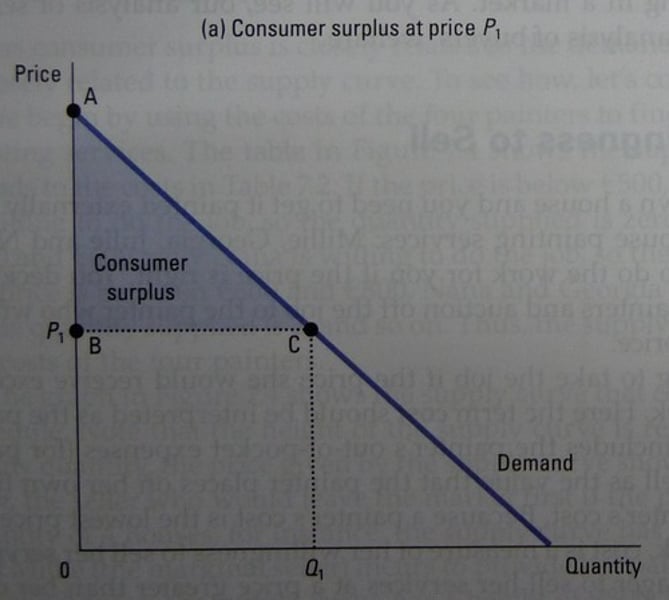
Showing CS
Consumer surplus is indicated by the area under the demand curve and above the market price.
producer surplus
Producer surplus is a measure of producer welfare that people gain from the sale of a good
It is the difference between the total amount the producers actually receive (i.e. the market price) and total amount that they would have been willing and able to sell a good or service for (shown by the supply curve)
PS = P - WTS
producer surplus diagram
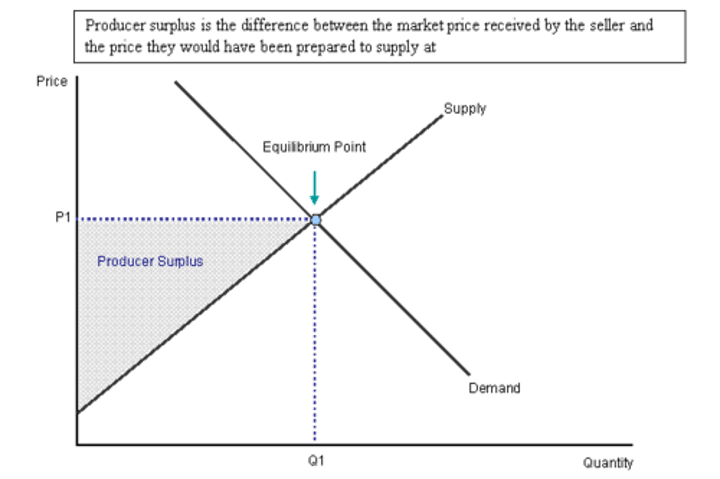
Showing PS
Producer surplus is indicated by the area above the supply curve and below the market price.
Relevance of CS & PS
Consumer and producer surplus are important concepts in examining society's welfare.
Allocative efficiency
Occurs where total satisfaction is maximised in the consumption and production of G&S.
Society is producing goods to match the needs of consumers. This happens where supply equals demand.
For a given supply and demand, total welfare (CS +PS) is maximized, and allocative efficiency occurs, at equilibrium
Disequilibrium
The total level of Welfare (CS+PS) is not maximized.
Though one party may be better off than at equilibrium.
 Note
Note  Flashcards (34)