1.1-Meeting customer needs
 Studied by 0 people
 Call Kai
 Learn
Learn Practice Test
 Spaced Repetition
 Match
Match Flashcards
 Knowt Play
1/63

There's no tags or description
Looks like no tags are added yet.
Name | Mastery | Learn | Test | Matching | Spaced |
|---|
No study sessions yet.
64 Terms
What is a local market?
A market where customers are short distance from suppliers
What is a national market?
The same product or service is offered to customers who are spread around the country
What is a physical market?
Brings buyers and sellers together in the same location
What is an electronic market?
Transactions are completely electronically with a delivery method depending on the nature of the product sold
What is mass marketing?
A firm will try to accommodate as much of the market as possible
What is mass marketing characterised by?
Low prices
Wide range of sales outlets and widely available
Extensive promotion
High turnover
What are the benefits of mass marketing?
Greater number of customers in the market
Businesses can produce large quantities at a lower unit cost by exploiting economies of scale
Greater brand awareness
What are the drawbacks of mass marketing?
Firms face tough competition
Large capital investment needed. Products are often standardised, which makes it difficult to tailor products to cater for all needs
What is economies of scale?
The reductions in average unit costs enjoyed by a business as output increases
What is niche marketing?
Where firms concentrate on selling to a small segment of the market
What are the benefits to niche marketing?
It is easier to focus on the needs of the consumer in this market
Small firms can often survive by supplying niche markets
May avoid competition
If there is less competition, firms can charge higher prices
What are the drawbacks to a niche market?
Little or no benefits for economies of scale
Limited potential for sales growth and large orofits
If a niche business is successful it may face competition from bigger firms
What is a brand
A feature of a business or product that is recognised by customers and distinguishes it from competitors
What are the 6 forms of brand?
Images
Colour
Logo
Shape
Symbols
Celebrity endorsement
What are the benefits to a business of building a brand?
Adds value to the business
Greater customer awareness
Helps achieve greater market share
Justifies increase in price
What is a dynamic market?
A market that is buject to rapid and fundamental change over a short period of time
What is a stable market?
A market which the pace is slow, market size and share is fairly consistent with little variation
What see the positive impacts of operating in a dynamic market?
New product development
Innovation
Quick to react - > first mover advantage and competitive advantage
Improved customer service
What are the negative impacts of operating in a dynamic market?
Rapid change increases uncertainty and forecasting is difficult
Constant pressure to innovate
Products can become obsolete very quickly
Increased competition
What are the different strategies that a firm can use to adapt to change?
Flexibility
Increased advertisement
Continuous improvement of all aspects of the firm
Investment
Develop a niche within the market
Conduct market research
What are the advantages to online retailing?
What are the disadvantages of online retailing?
High set up costs
Increased competition
Concerns about privacy and security
Inconvenience of returning unwanted items
Technical issues
What ways can competition affect the market?
Changes in prices
Barriers to entry
Drives forward innovation
Increased choice, quality and convinience
What factors affect the car market?
Demographics
Economy
Social
Ethucs
Environment
Competition
Technology
What is market size?
Measured by the number of units sold in a market ( sales volume)
OR
Measured by the value of all sales in the market (sales value)
How do you calculate market growth?
Percentage change = (change ÷ original) x 100
What is market share?
(sales of firm÷ sales of market) x 100
What is product orientation?
Instead of focusing on what the customers want, a firm will focus on what they do well - business puts most of their efforts into developing and making products which it believes consumers want and which will sell
What are advantages of product orientation?
Businesses gain a first mover advantage in the industry if they produce products or features that are new to a market
The business focuses their resources on internal research and innovation
Less time and money is spent on market research
What are the disadvantages of product orientation?
Products become quickly obsolete
Disconnect from customer needs and wants
Missed opportunities
High research and development costs
High risk of a short life cycle
What is market orientation?
An outward looking approach to new product development where the key focus is on the market
What ar the advantages of market orientation?
Higher chance that customers will accept and be satisfied with your products
Customer loyalty
Help businesses to improve existing products
What ar the disadvantages of market orientation?
High costs
Short term focus
Overdependence on customer feedback
Risk of imitation
Market changes - quickly outdated
Limited innovation
What is market research?
The collection, analysis and collation of data which enables businesses to identify what customers want and need in order to inform their marketing strategy
Why is market research important for businesses?
To adapt the product to the market
To find gaps in the market
Increased brand awareness
Helps to retain a loyal customer base
Financial stability
What is primary research?
Collecting data first hand - information that didn’t exist before the research began
What are methods of primary research?
Interviews
Observation
Focus group
Test marketing
What are the advantages and disadvantages of primary market research?

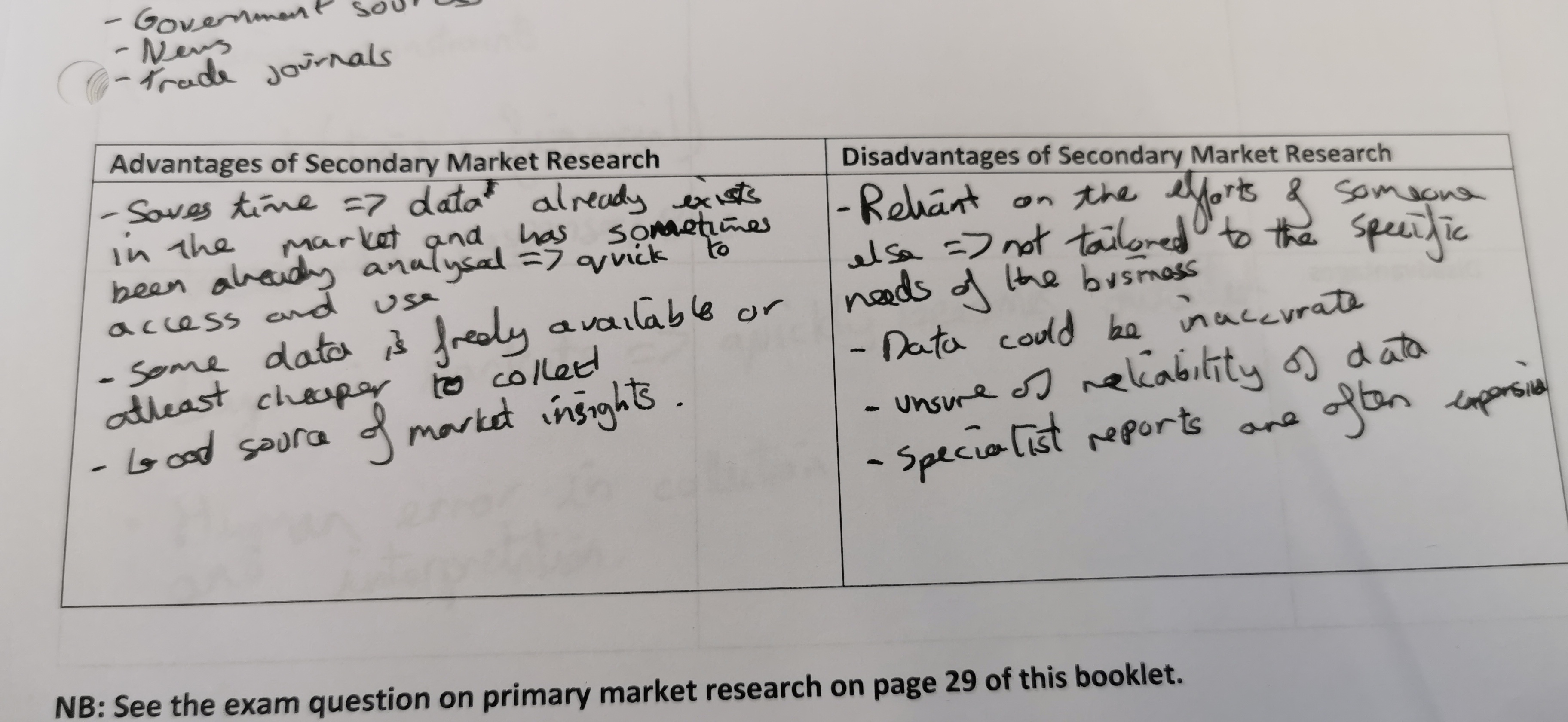
What is secondary research?
The use of information that has been collected already for a different purpose
What are methods of secondary research?
Annual reports
Internal data
Government sources
News
Trade journals
What are the advantages and disadvantages of secondary market research
What is quantitative research?
Research based larger sames, which is more statistically valid. Often in numerical form
What is qualitative research?
Based on opinions, attitudes, beliefs and intentions
What is a sample?
A small group of people who must represent a proportion of a total market when carrying out market research
The correlation between sample size and reliability is….
Positive
What will the usefulness of sampling depend upon?
Sample size
Quality of data
What does the sample size depend on?
Time constraints
Mass or niche market
Budget
Staff available
Limitations of market research :
Time constraints
Cost
Bias
Dynamic markets
Human error
How can ict be used to collate market research?
Company websites ( cookie trackers / databases)
Social networking ( feedback, comments,purchases, trends)
Databases( store and organise the data)
What are the advantages and disadvantages of ict to support market research?

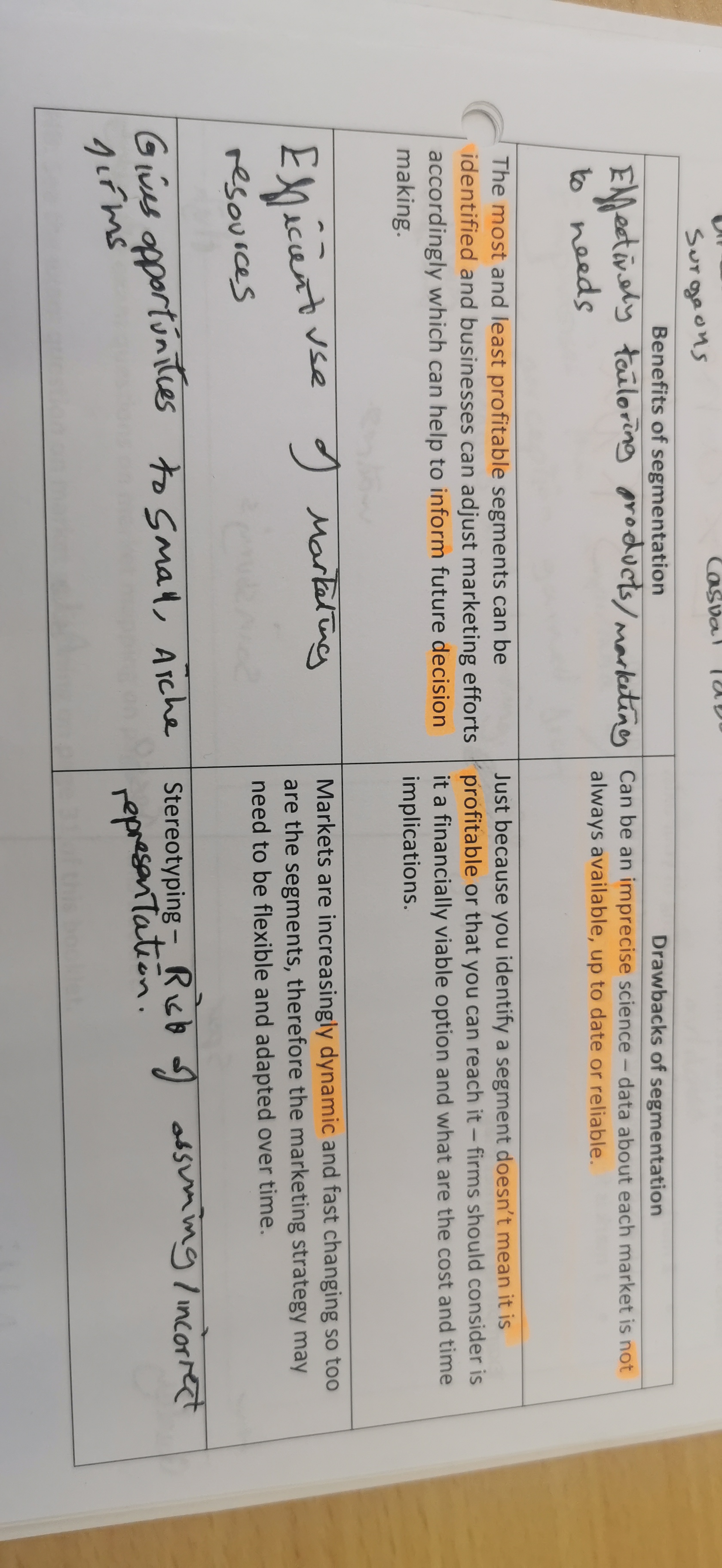
What is market segmentation?
Diving markets into consumers that have similar needs/wants
What ar the 3 types of segmentation?
Demographic - age / gender / income / education
Geographic - location
Income group
What are the benefits and drawbacks of market segmentation?
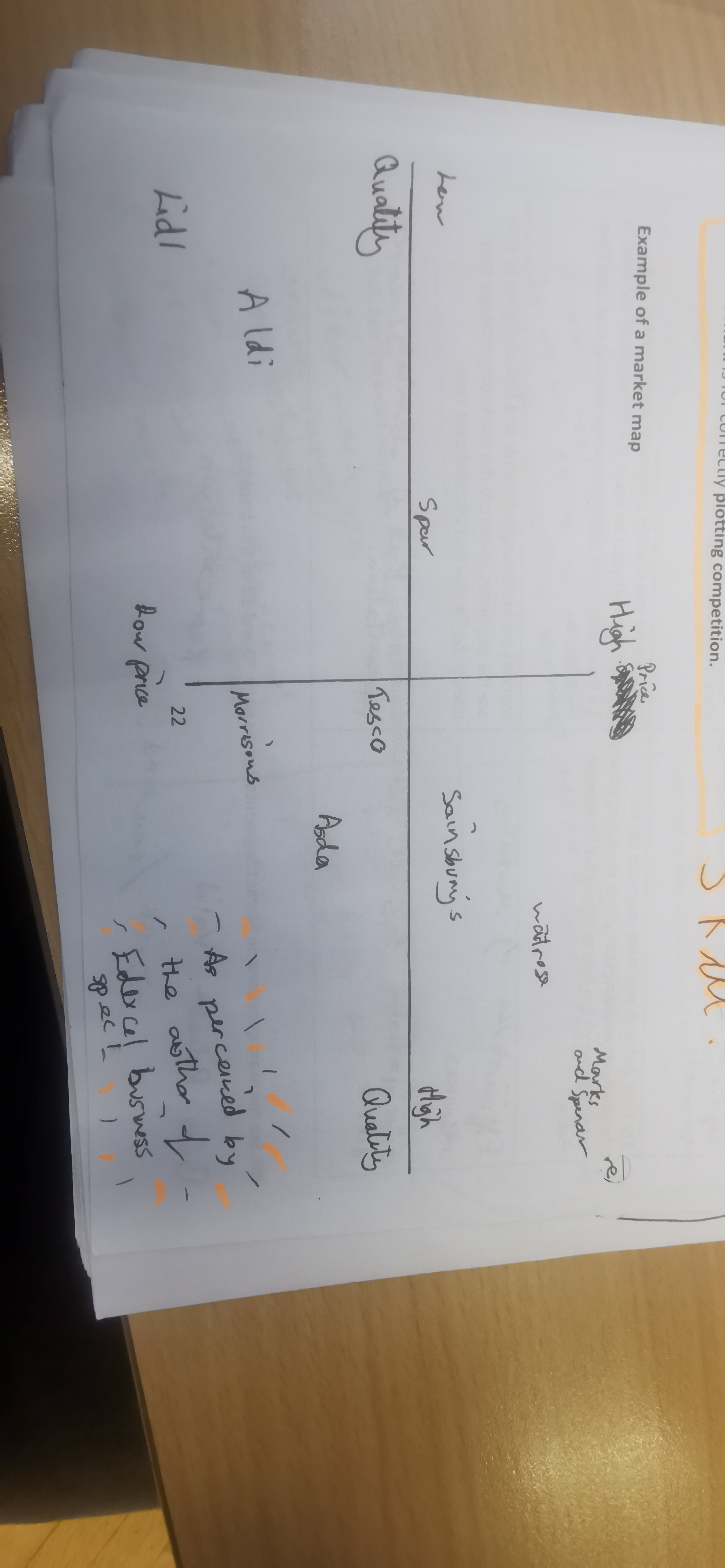
What is market mapping?
A grid showing different features that matter to customers, such as price, quality etc
What does a market map look like?
What are the benefits and drawbacks of market positioning?

What is competitive advantage?
A feature of a product / brand that allows it to compete more successfully than it’s competitors operating in the same market
What is product differentiation?
Having unique features that make a product stand out
What are the different examples between actual product differentiation and perceived product differentiation
What is the value and the limitations of product differentiation?

What is adding value?
When a business increases the worth customers place on a product by improving it
How do you calculate adding value?
Sales price - direct costs
Benefits of adding value :
Charge higher price
Differentiation from competitors
Low prices can retain customer base
Can focus on market targets
Drawbacks of adding value :
Increases costs
Increased time to market
Will need to regularly update to remain competitive and respond to changes in the market
 Note
Note  Flashcards (21)