Biology
 Call Kai
 Learn
Learn Practice Test
 Spaced Repetition
 Match
Match Flashcards
 Knowt Play
1/122

Name | Mastery | Learn | Test | Matching | Spaced | Call with Kai |
|---|
No analytics yet
Send a link to your students to track their progress
123 Terms
What is a prokaryotic cell
Plant & Animal, Membrane enclosed nucleus, Paired (diploid) chromosome, Unicellular or multicellular, Sexual reproduction, Linear DNA, Mitosis cell division
What structures make up the endomembrane system
nucleus, ER, Golgi apparatus, vesicles, plasma membrane
What is the endosymbiotic theory
What similarities do prokaryotic and eukaryotic cells share
Plasma membrane, Cytoplasm, DNA, Ribosomes, Reproduction
Bacteria and Archaea consist of which type of cell
prokaryotic
In what order are these eggs largest to smallest
Ostrich egg, chicken egg, frog egg, human egg, plant and animal cell, mitochondria and bacteria, virus, protein, lipids
What is a eukaryotic cell
Bacteria and Archaea, No nucleus, Single (haploid) chromosome, Unicullular, Asexual or sexual reproduction, Circular CNA, Binary fission cell division
Protists, fungi, animal and plants consist of which type of cell
eukaryotic
What are the basic features of all cells
plasma membrane, cytosol, DNA/chromosomes, ribosomes
Which cell is larger than the other
eukaryotic is larger than prokaryotic
What organelle uses information from the DNA to make proteins
ribosomes
The DNA and proteins of chromosomes together are called what
chromatin
Membranes and proteins produced by _____ move via transport vesicles to the _____
ER, Golgi
_____ pinches off transport vesicles and other vesicles that mature into _____, specialized vesicles and vacuoles
Golgi, lysosomes
The ______ is available for fusion with another vesicle for digestion
lysosome
A ______ carries proteins to the plasma membrane for secretion
transport vesicle
The ____________ is continuous with
the nuclear envelope
ER membrane
_________ carry out protein synthesis in the cytosol and on the outside of the ER
Ribosomes
During protein synthesis of mRNA, ________ assemble amino acids into proteins
ribosomes
What does the smooth ER do
Synthesizes lipids, Metabolizes carbohydrates, Detoxifies drugs and poisons, Stores calcium ions
What does the rough ER do
secrete glycoproteins, Distributes transport vesicles, Is a membrane factory for the cell
____________ consists of flattened membranous sacs called cisternae
Golgi apparatus
What does the Golgi apparatus do
Modifies products of the ER, Manufactures certain macromolecules, Sorts and packages materials into transport vesicles
A __________ is a membranous sac of hydrolytic enzymes that can digest macromolecules
lysosome
What are the three types of endocytosis,
Phagocytosis- cellular eating, Pinocytosis- cellular drinking, Receptor-mediated endocytosis
Diffusion transports what
small molecular material
osmosis transports what
water
facilitated diffusion transports what
Na, K, Ca, glucose
primary active transport transports what
Na, K, Ca
secondary active transport transports what
amino acids glucose
phagocytosis transports what
large molecules
pinocytosis and potocytosis transports what
small molecules
receptor mediated phagocytosis transports
large quantities of molecules
__________ are the sites of cellular respiration, a metabolic process that uses oxygen to generate A T P
Mitochondria
___________ found in plants and algae, are the sites of photosynthesis
Chloroplasts
The inner membrane of mitochondria creates two compartments: the ____________ and the ___________
intermembrane space, mitochondrial matrix
Chloroplast structure includes
Thylakoids (membranous sacs) stacked to form a granum and Stroma, the internal fluid
The chloroplast is one of a group of plant organelles called _______
plastids
components of the cytoskeleton
microtubules, microfilaments, intermediate filaments
components of the extracellular matrix
collagen, elastin, fibronectin, integrin
The _________l is an extracellular structure that distinguishes plant cells from animal cells, its composed of the __________, _________, _________
cell wall, primary cell wall, middle lamella, secondary cell wall
__________ are channels that perforate plant cell walls
Plasmodesmata
Neighboring cells in an animal or plant often adhere, interact, and communicate through direct physical contact, what types of intercellular junctions facilitate this
Plasmodesmata, Tight junctions, Desmosomes, Gap junctions
Animal cells have what three main types of cell junctions
Tight junctions, Desmosomes, Gap junctions
Gap junctions (animal plasmodesmata) do what
Small channel allow for cellular communication
Tight junctions do what
“water proofing” of epithelia, Prevent leaking of extra cellular fluids
________ ________ release energy by breaking down complex molecules into simpler compounds
Catabolic pathways
_______ _______, called biosynthetic pathways, consume energy to build complex molecules from simpler ones
Anabolic pathways
________ is the capacity to cause change
Energy
________ ________ is energy associated with motion
Kinetic energy
_______ _______ is kinetic energy associated with random movement of atoms or molecules
Thermal energy
______ is thermal energy in transfer from one object to another
Heat
According to the first law of thermodynamics
Energy can be transferred and transformed, but it cannot be created or destroyed
According to the second law of thermodynamics
Every energy transfer or transformation increases the entropy of the universe
An ______ ________ proceeds with a net release of free energy and is
spontaneous; ΔG is negative
exergonic reaction
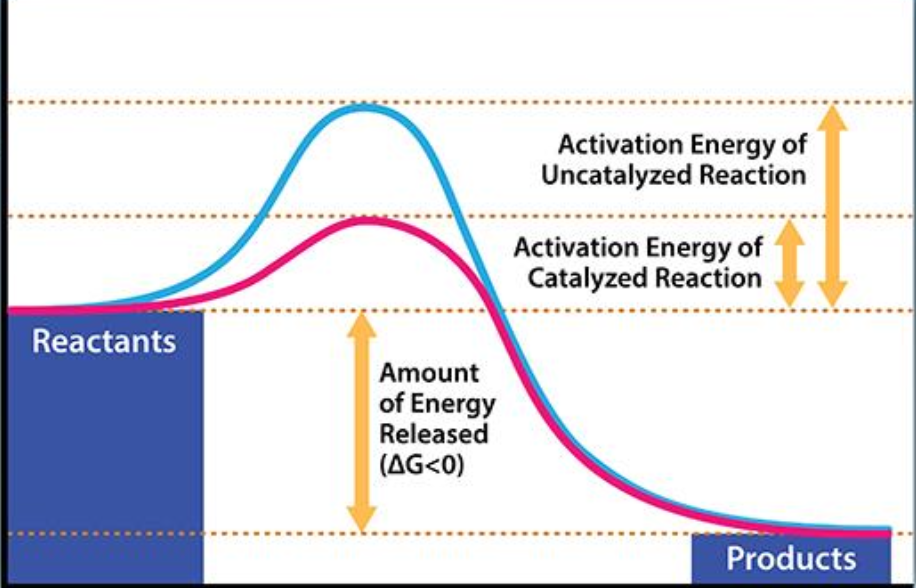
Exergonic reaction
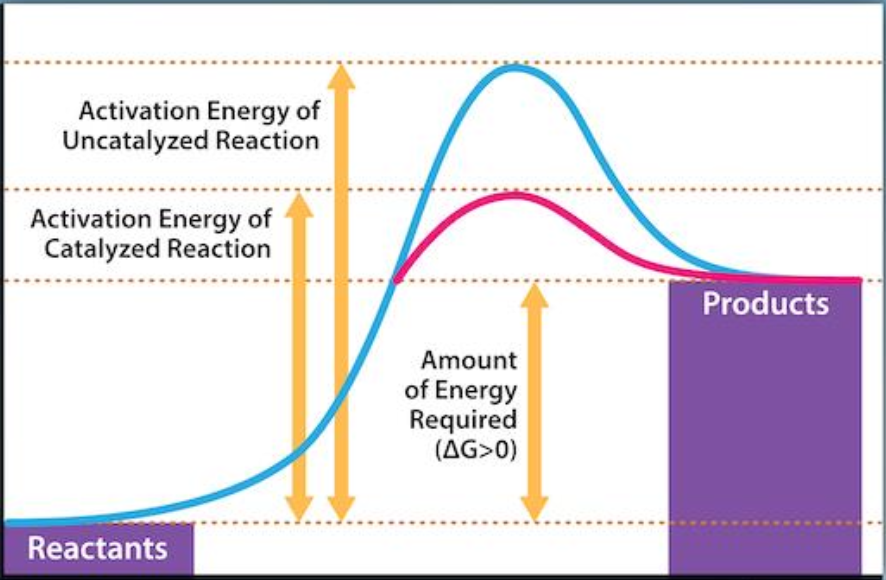
endergonic reaction
catabolic pathway includes
breakdown reactions, release of energy, spontaneous reaction, exergonic, make ATP, ordered and unstable
anabolic pathway includes
building reactions, requires energy, non-spontaenous reaction, endergonic, uses ATP, disordered and stable
negative delta G equates to what type of reactions
catabolic, exergonic
positive delta G equates to what type of reactions
anabolic, endergonic
delta G equation is
products - reactants
cells manage energy resources by _______ ______, the use of an exergonic process to drive an endergonic one
energy coupling
________ ________ is when ATP binds non-covalently to motor proteins
and then is hydrolyzed, causing a shape change that walks the motor protein forward.
Mechanical work
________ ________ is when ATP phosphorylates transport proteins, causing
a shape change that allows transport of solutes.
Transport work
Enzymes catalyze reactions by ________ the activation energy barrier without being consumed
lowering
Enzymes _____ affect the change in ΔG, they only speed up reactions that would eventually occur without them
don’t
________ ________ bind to the active site of an enzyme and prevent the substrate from binding
Competitive inhibitors
________ ________ bind to an alternate site on the enzyme, causing the active site to change shape and become less effective
Noncompetitive inhibitors
________ and ________ are often irreversible enzyme inhibitors
Toxins and poisons
In ________, the binding of one substrate molecule to the active site of one subunit locks all other subunits into the active shape
cooperativity
________ ________ may either inhibit or stimulate an enzyme’s activity
Allosteric regulation
________ ________ prevents a cell from wasting chemical resources by synthesizing more product than is needed and the end product is shutting down the pathway
Feedback inhibition
In ________, a substance loses electrons, or is oxidized
oxidation
In ________, a substance gains electrons, or is reduced
reduction
Chemical reactions that transfer electrons between reactants are called ________ ________ or ________ _______
oxidation-reduction reactions, or redox reactions
carbon atom has partially lost electrons because the oxygen atom is more electronegative than the carbon atom
oxidation
oxygen atom has partially gained electrons because the oxygen atom is more electronegative than the hydrogen atom
reduction
________ ________ is when glucose is oxidized and O2 is reduced
Cellular respiration
Glucose molecule can be broken down through the following metabolic pathways
Glycolysis, Citric Acid Cycle, Electron Transport Chain and Oxidative Phosphorylation
ATP is a type of _____ _____ containing a base, sugar and 3 phosphates
nucleic acid
________ ________ is done in animal and plant cells (eukaryotic cells)
cellular respiration
cellular respiration breaks down ________ to create ATP as a product
glucose
what are the steps of cellular respiration and where do they occur
glycolysis conversion into pyruvate in cytoplasm, transport pyruvate to mitochondrial matrix, pyruvate oxidized into acetyl CoA (CO2 released and produce NADH), Krebs cycle (mitochondrial matrix), produce 2 ATP, 6 NADH, 2 FADH (release CO2), Electron transport chain in inner mitochondrial membrane
the anaerboic form of ATP synthesis
fermentation
A ________ ________ begins with a specific molecule and ends with a product, each step is catalyzed by a specific enzyme
metabolic pathway
________ (disorder) may decrease in a system, but the total ________ of the universe increases
Entropy
________ ________ is a measure of a system’s instability (G), its tendency to change to a more stable state
Free energy
________ ________ is when free energy decreases and the stability of a system increases
Spontaneous change
At ________ ________, forward and reverse reactions occur at the same rate; it is a state of maximum stability
chemical equilibrium
Transport and mechanical work in the cell are powered by ________ _______, _______ ________ leads to a conformational change in a protein
ATP hydrolysis, ATP hydrolysis
________ is a chemical agent that speeds up a reaction without being consumed by the reaction
Catalyst
________ is a macromolecule that acts as a catalyst; most enzymes are proteins
Enzyme
________ ________ is the energy required to start a reaction by
breaking bonds in the reactant molecules
Activation energy (EA)
________ reactant molecule on which an enzyme acts
Substrate
________-________ ________is formed when the enzyme binds to its substrate
Enzyme-Substrate complex
________ ________ region on the enzyme to which the substrate binds
Active site
steps of cellular respiration
glycolysis, pyruvate oxidation, citric acid cycle, oxidative phosphorylation (electron transport chain)
Glycolysis (In the Cytosol) products
Products: 2 ATP (net), 2 NADH.
Intermediate: 2 Pyruvate (these move to the next step).
Pyruvate Oxidation (Entering the Mitochondria) products
Products: 2 NADH.
Intermediate: 2 Acetyl CoA (the "tickets" for the Krebs Cycle).
Byproducts: 2 CO2 (this is the first bit of carbon you exhale)

