Chapter 1 - Key Terms - Neuroscience 7th - Augustine et al.
 Studied by 0 people
 Call Kai
 Learn
Learn Practice Test
 Spaced Repetition
 Match
Match Flashcards
 Knowt Play
1/89

There's no tags or description
Looks like no tags are added yet.
Name | Mastery | Learn | Test | Matching | Spaced | Call with Kai |
|---|
No analytics yet
Send a link to your students to track their progress
90 Terms
Exon
DNA sequences that are transcribed into a messenger RNA and subsequently a protein.
Intron
Sequences between exons. These further influence transcription but are not explicitly for producing protein.
Where must most "brain specific" genetic information lie?
Regulatory sequences and introns. These control the timing, quantity, variability, and cellular specificity of gene expression.
Neurons (Nerve Cells)
Cells specialized for electrical signaling over long distances.
Neuroglia (glia)
supporting tissue cells of the nervous system
Gap Junction (Electrical Synapse)
Specialized intercellular contacts formed by channels that directly connect the cytoplasm of two cells. (Relatively rare).
Transmits information via the direct flow of electrical current.
Features of Neuronal Cell Body
Nucleus
High frequency of Mitochondria
Endoplasmic Reticulum (protein synthesis)
Golgi Apparatuses (protein trafficking)
Synaptic Cleft
Interval of extracellular space between pre- and postsynaptic elements. The site of extracellular proteins that influence the diffusion, binding, and degradation of molecules secreted by the presynaptic terminal.
Dendrites
Primary target for synaptic input from other neurons. Distinguished by their high content of ribosomes as well as specific cytoskeletal proteins that reflect their function in receiving and integrating information
Axon
The portion of the nerve cell specialized for signal conduction to the next site of synaptic interaction.
Arbor
The network of branches issued by a dendrite or an axon.
Central Nervous System (CNS)
consists of the brain and spinal cord
Peripheral Nervous System (PNS)
All nerves and neurons that lie outside the brain and spinal cord; the network of neurons and axon pathways distributed throughout an animal's body.
Terminal Field
The spatial and cellular extent of synaptic endings made by an axon once it reaches its targets. The terminal field of an axon can include multiple neuronal or peripheral (muscle/gland) target cells, or it can be restricted to a single target cell.
Interneurons
Local Circuit Neurons. Types of Neurons with Short Axons
Projection Neurons
A neuron with long axons that project to distant targets.
Action Potential
The electrical event that carries signals. Self-regenerating wave of electrical activity that propagates from its point of initiation at the cell body to the terminus of the axon where synaptic contacts are made.
Axon Hillock
The point of initiation of the action potential at the cell body.
Synaptic Transmission
The chemical and electrical process by which the information encoded by action potentials is passed on at synaptic contacts to the next cell in a pathway.
Chemical Synapse
A type of synapse at which a chemical (a neurotransmitter) is released from the axon of a neuron into the synaptic cleft, where it binds to receptors on the next structure (either another neuron or an organ). The most abundant type of synapse in the nervous system.
Synaptic Vesicles
The secretory organelles in the presynaptic terminal of chemical synapses. Spherical, membrane-bound organelles in presynaptic terminals that store neurotransmitter molecules and associated molecular machinery that facilitates exocytosis.
Neurotransmitters
Molecules released from synaptic vesicles that modify the electrical properties of the target cell by binding to neurotransmitter receptors
Neurotransmitter Receptors
Also called receptors. Large protein molecules, embedded in the cell membrane, to which neurotransmitters can bind. Localized primarily at the postsynaptic specialization.
Roles of Glia
Maintaining the ionic milieu of nerve cells.
Modulating the rate of nerve signal propagation.
Modulating synaptic action by controlling the uptake of neurotransmitters at or near the synaptic cleft.
Providing a scaffolding for some aspects of neural development.
Aiding in or impeding recovery from neural injury.
Providing an interface between the brain and the immune system.
Facilitating the convective flow of interstitial fluid through the brain during sleep.
Astrocytes
Glia restricted to the brain and spinal cord.
Have elaborate local processes that give these cells a starlike appearance.
A major function of theirs is to maintain an appropriate chemical environment for neuronal signaling.
They also form the blood-brain barrier.
Secrete substances that influence the construction of new synaptic connections.
A subset of them are apparently stem cells.
Oligodendrocytes
Glial cell restricted to central nervous system.
Lay down myelin around some, but not all axons.
Myelin
A laminated, lipid-rich wrapping around some axons.
Have important effects on the speed of the transmission of electrical signals.
Schwann cells
Supporting cells of the peripheral nervous system responsible for the formation of myelin.
Microglia
Share many properties with macrophages.
Scavenger cells that remove cellular debris from sites of injury or normal cell turnover.
Secrete signaling molecules (cytokines) that modulate local inflammation and influence cell survival or death.
Neuropil
The region between nerve cell bodies where most synaptic connectivity occurs.
Afferent Neurons
Nerve cells that carry impulses towards the central nervous system (or further centrally within it).
Efferent Neurons
Nerve cells that conduct impulses away from the central nervous system (or away from the circuit in question).
Excitatory Neurotransmitter
Chemical neurotransmitters released at presynaptic terminals which activate postsynaptic excitatory neurotransmitter receptors and generate signals that enhance electrical activity in the target neuron. This makes it more likely that the target neuron will relay signals to additional neurons in the circuit.
Inhibitory Neurotransmitter
Chemical neurotransmitters released at presynaptic terminals which activate postsynaptic inhibitory neurotransmitter receptors and generate signals that diminish electrical activity in the target neuron far below the threshold necessary for it to transmit electrical signals to additional neurons in the circuit.
modulatory neurotransmitters
Modify thresholds in target neurons, changing the effectiveness of either excitatory or inhibitory signals.
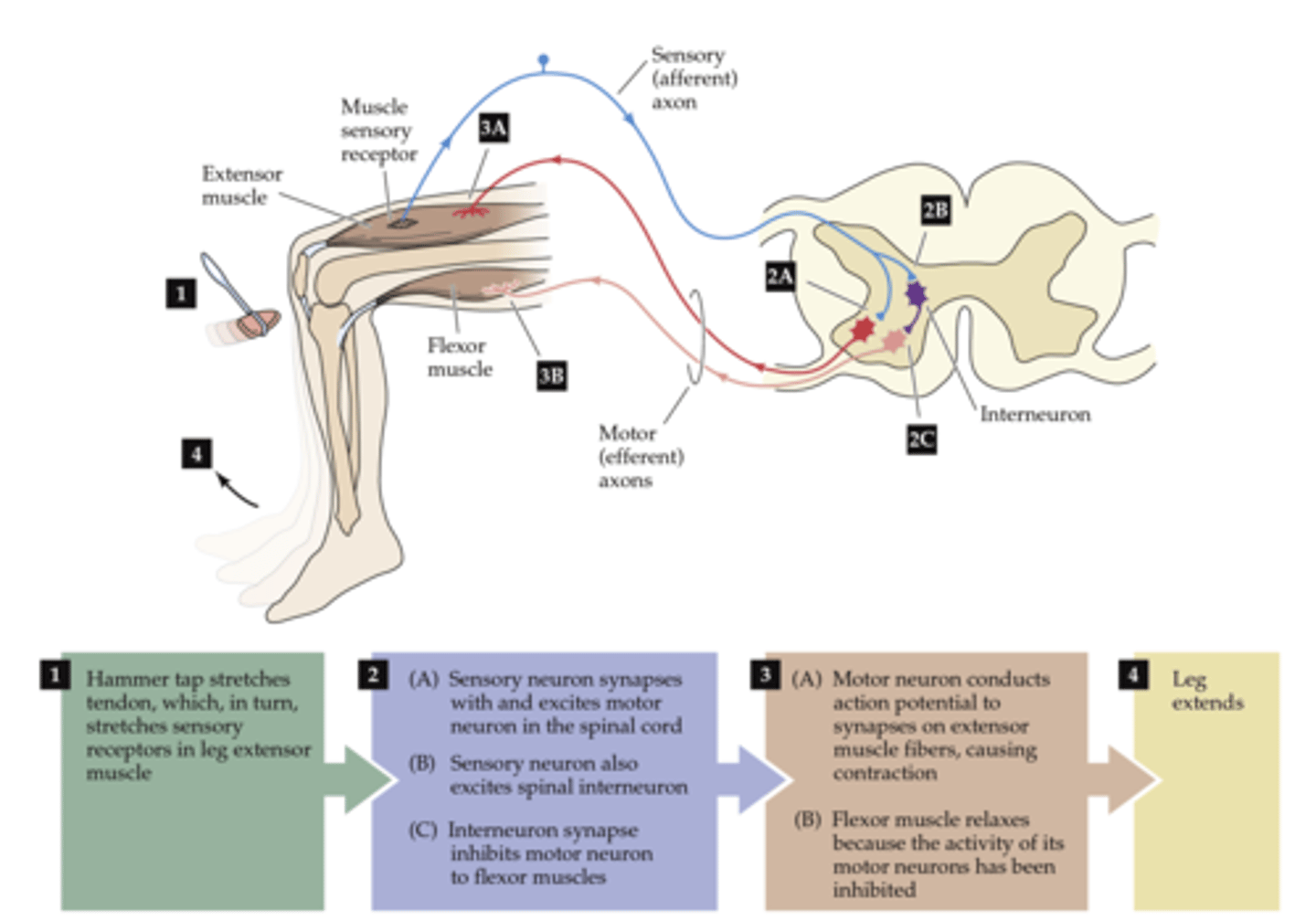
Myotatic Spinal Reflex
"Knee-Jerk Reflex"
Afferent Neurons are sensory neurons whose cell bodies lie the dorsal root ganglia and whose peripheral axons terminate in sensory endings in skeletal muscles.
The central axons of these afferent neurons terminate on central neurons concerned with the regulation of muscle tone.
Motor neurons constitute the efferent and interneurons of the circuit.
Spinal cord interneurons modulate the input-output linkage.
Extracellular Recording
Electrode is placed near the nerve cell of interest to detect its activity.
Primarily detects actions potentials.
Useful for detecting temporal patterns in action potential activity and how it relates to stimuli.
Intracellular Recording
Electrode is placed inside the cell of interest.
Detect smaller graded potential changes that trigger action potentials.
Receptor Potentials
Graded triggering potentials arising at sensory receptors
Synaptic Potentials
Graded triggering potentials arising at synapses.
calcium imaging
records the transient changes in intracellular concentration of calcium ions that are associated with action potential firing.
Optogenetics
control of neurons by creating light-responsive ion channels (bacterial opsins) in the cell membrane
Three Bacterial Opsins
bacteriorhodopsin - hyperpolarizing; conducts H+ ions from inside to outside
halorhodopsin - hyperpolarizing; conducts Cl- ions from outside to inside
channelrhodopsin - conducts cations and anions, providing either depolarizing or hyperpolarizing modulation depending on the variant and frequency of light.
Neural Systems
Circuits that process similar types of information considered as a whole.
Sensory Systems
acquire and process information from the environment
Motor Systems
respond to sensory information by generating movements and other behavior
Associational Systems
mediate the most complex and least well characterized brain functions
Topographic map
Representation of neural information that distinguishes differences between neighboring points in external space. Point-to-point correspondence between the sensory periphery and neighboring neurons within the central components of the system.
Computational Map
Representation of information where the timing and pattern of inputs, the responses they elicit in neighboring cells, and the coordination of outputs are integrated to extract key information.
Lesion Studies
Correlating behavioral deficits to damaged brain structures to infer function.
Anterograde
Signals or impulses that travel "forward," e.g., from the cell body to the axon terminal, from the presynaptic terminal to the postsynaptic cell, or from the CNS to the periphery.
Retrograde
Signals or impulses that travel "backward," e.g., from the axon terminal toward the cell body, or from the postsynaptic cell to the presynaptic terminal, or from the periphery to the CNS.
in situ hybridization
Probes for specific messenger RNA (mRNA) transcripts that detect the presence of that message and thus the expression of a particular gene.
Receptive Field
The region of a receptive surface (e.g., the body surface, or a specialized structure such as the retina) within which a specific stimulus elicits the greatest action potential response from sensory cells.
somatic motor division
The components of the motor system that support skeletal movements mediated by the contraction of skeletal muscles that are derived from embryonic somites or somitomeres.
Visceral Motor Division
The components of the nervous system (peripheral and central) concerned with the regulation of smooth muscle, cardiac muscle, and glands; organized anatomically and physiologically into sympathetic, parasympathetic, and enteric divisions. Also known as the autonomic nervous system or autonomic motor division.
Ganglia
Collection of hundreds to thousands of neurons and supporting cells found outside the CNS along the course of peripheral nerves.
Nerves
A collection of peripheral axons that are bundled together and travel a common route.
grey matter
Regions of the CNS rich in neuronal cell bodies and neuropil; includes the cerebral and cerebellar cortices, the nuclei of the brain, and the central portion of the spinal cord.
White Matter
A general term that refers to regions of the brain and spinal cord containing large axonal tracts; the phrase derives from the fact that axonal tracts have a whitish cast when viewed in the freshly cut material due to the abundance of myelin.
Nucleus (grey matter)
Collection of nerve cells in CNS that are anatomically discrete, and which serve a particular function.
Cortex
The superficial mantle of grey mater (a sheet-like array of nerve cells) covering the cerebral hemispheres and cerebellum, where most of the neurons in the brain are located.
Tracts
Bundles of fasciculated axons in the CNS that are gathered into compact structures and typically share a common origin and termination; more or less analogous to nerves in the periphery.
Commissures
Axon tracts that cross the midline of the brain or spinal cord.
Columns
sensory tracts of the dorsal spinal cord
Autonomic Ganglia
Collections of autonomic motor neurons outside the CNS that innervate visceral smooth muscles, cardiac muscle, and glands.
sympathetic division
A division of the visceral motor system in vertebrates comprising, for the most part, adrenergic ganglion cells located relatively far from the related end organs and central preganglion that innervate them. They are close to the spinal column.
parasympathetic division
Ganglia further removed from the spinal column and typically embedded in or very near the end organs they innervate.
Enteric System
A subsystem of the visceral motor system, made up of small ganglia and individual neurons scattered throughout the wall of the gut; influences gastric motility and secretion.
Parts of a gene
Coding DNA sequences - templates for mRNA that will be translated into a protein
Regulatory DNA sequences (promoters and introns) - control whether and in what quantities a gene is expressed in a given cell type
Splice Variants
useful for autosomal recessive traits in populations where consanguinity is common
genome-wide association studies
A statistical correlation of likely associated genes drawn from analyses of large cohorts of individuals with the same phenotype or clinical diagnoses.
copy number variation
the phenomenon of duplication or deletion of segments of DNA within a genome, so that different individuals have different numbers of copies of a particular DNA segment
orthologous genes
Genes expressed in model organisms that are identical or similar to target genes (typically expressed in humans and associated with disease) based on sequence and chromosomal location.
genetic engineering
A methodological means for inducing mutations in genes or otherwise editing or altering the structure and\or the function of targeted genes for experimental or therapeutic benefit. Also called reverse genetics.
reporter protein
A protein from one species, encoded by a gene not found in the genome of another that can be inserted into the genome of a host (that does not have the gene in its genome) and expressed under the control of the host's regulatory gene sequences to identify cells in which the regulator sequences normally control expression of the endogenous gene.
homologous recombination
An endogenous cellular mechanism for DNA replication and repair involving DNA polymerases and ligases; may be used in genetic engineering to replace ("recombine") a native sequence of nucleotides in a gene with an exogenous sequence.
Conditional Mutations
A genetic engineering approach, typically reliant upon the Cre/lox system, whereby an exogenous recombinase enzyme recognizes unique DNA excision sequences (loxP sequences) introduced at the 5' and 3' ends of an endogenous gene and eliminates the intervening sequence.
organoid
Brainlike aggregates made by pleuripotent stem cells
EEG
electroencephalogram. The study of electrical potentials generated in the brain recorded from electrodes placed on the scalp
ERP
Event-related potential. Averaged EEG recordings measuring time-locked brain responses to repeated presentations of a stimulus or repeated execution of a motor task.
TMS
Transcranial magnetic stimulation. Localized, noninvasive stimulation of cortical neurons through the induction of electrical current by the application of strong, focal magnetic fields.
CT
Computerized tomography. Radiographic procedure in which a 3-dimensional image of a body structure is constructed by computer from a series of cross-sectional X-ray images.
PET
positron emission tomography. A technique of examining brain function following injection of unstable, positron-emitting isotopes that are then incorporated into bioactive molecules or metabolites; the emission of positrons are detected by gamma ray detectors and tomographic images are computed that indicated the localization and concentration of the isotopes.
MRI
Magnetic resonance imaging. A noninvasive technique that uses magnetic energy and radiofrequency pulses to generate images that reveal structural and/or functional information in the living brain.
DTI
Diffusion tensor imaging. A type of MRI used in live humans that allows for the selective visualization of large axon tracts in the brain based upon the alignment of the water molecules in myelinated axons bundled together and extending in the same direction.
fMRI
Functional MRI. MRI that detects changes in blood flow and therefore identifies regions of the brain that are particularly active during a given task. Lacks temporal resolution due to averaging over time.
BOLD
blood oxygen level-dependent contrast; the signal measured in fMRI
MEG
magnetoencephalography. A passive and noninvasive functional brain-imaging technique that measures the tiny magnetic fields produced by active neurons, in order to identify regions of the brain that are particularly active during a given task.
MSI
magnetic source imaging. A non-invasive means for localizing brain activity that combines magnetoencephalography with structural MRI.
 Note
Note  Flashcards (131)