PSYU2235 Exam Preparation
0.0(0)
 Studied by 4 people
 Call Kai
 Learn
Learn Practice Test
 Spaced Repetition
 Match
Match Flashcards
 Knowt Play
Card Sorting
1/243

Earn XP
Description and Tags
Last updated 10:18 PM on 11/8/22
Name | Mastery | Learn | Test | Matching | Spaced | Call with Kai |
|---|
No analytics yet
Send a link to your students to track their progress
244 Terms
1
New cards
What are Baltes (1987) Seven Assumptions about Development?
1. Lifelong process
2. Multidirectional
3. Gains and losses at every age
4. Lifelong plasticity
5. Historically embedded (cohort effects)
6. Contextualisms as a paradigm (cultural effects)
7. Deveopment requires multiple disciplines
2. Multidirectional
3. Gains and losses at every age
4. Lifelong plasticity
5. Historically embedded (cohort effects)
6. Contextualisms as a paradigm (cultural effects)
7. Deveopment requires multiple disciplines
2
New cards
What are the three main influences, Baltes (1987)
1. Aged-graded (puberty, menopause, school)
2. History-graded (WW1, 9/11, COVID)
3. Non-normative life events (major accident, winning lottery)
2. History-graded (WW1, 9/11, COVID)
3. Non-normative life events (major accident, winning lottery)
3
New cards
What is chronological age?
Numbers of years since birth
4
New cards
What is physical/biological age?
Age in terms of biological health
5
New cards
What is psychological age?
An individuals adaptive capacities compared to others of the same chronological age
6
New cards
What is social age?
Social roles and expectations related to a person's (look at Neugarten's "Social Clock"
7
New cards
What is Bronfenbrenner's Integrative Ecological Systems Theory?W
Looks at how different levels can affect an individuals life
8
New cards
What is the microsystem?
Systems that have direct contact and influence on the child (school, family, peers). The child can also influence the system.
9
New cards
What is the mesosystem?
The mesosystem acknowledges that components of the microsystem can interact with each other.
10
New cards
What is the exosystem?
Things that can affect the child by affecting the microsystem. (Extended family, school boards, government agencies, media)
11
New cards
What is the macrosystem?
Attitudes and ideologies of the culture. The child grows up within it and cannot control it. (stay at home orders, disciplinary strategies)
12
New cards
What is the chronosystem?
Environmental changes that occur across the lifespan (moving to a new house because of financial insecurity)
13
New cards
How many chromosomes do we have?
We have 46 chromosomes (22 pairs of autosomes and 1 pair of sex chromosomes [XX or XY])
14
New cards
What is Turner Syndrome (XO)?
Missing or partially formed X chromosome, only affects women
15
New cards
What is a reaction range?
A range of possible phenotypes for each genotype. For example, an IQ could be 80 in a restricted environment or 150 in an enriched environment.
16
New cards
Why are X-linked disorders expressed in males?
Males only receive one X chromosome, so there is no chance of another X chromosome cancelling out the disorder.
17
New cards
What is chorionic villus sampling?
Sampling the villi uaround the wall of the uterus to check for genetic and structral anomalies in early pregnancy
18
New cards
What is a nuchal translucency ultrasound scan?
Tests the fluid at the back of the neck. Has 90% certainty.
19
New cards
What is pre-implantation genetic diagnosis?
During IVF, two cells from a blastomere are tested for genetic disorders. If a genetic disorder is detected, the embryo is discarded. If no genetic disorder is detected, the embryo is implanted.
20
New cards
What are benefits of prenatal diagnosis and genetic counselling?
allows for early treatment, facilitates informed decision making and facilitates planning for a child with a health problem
21
New cards
What are methods of studying gene-environment contributions in humans?
Kinship studies, adoption studies, and twin studies.
22
New cards
What are kinship studies?
Kinship studies compare different types of relatives to unrelated people
23
New cards
What are twin studies?
Look at how monozygotic (identical) twins are more similar than dizygotic (fraternal) twins. Also look at identical twins when separated at birth.
24
New cards
How much genes do different types of twins share?
Monozygotic twins share 100% of genes. Dizygotic twins share 50% of genes (similar to siblings).
25
New cards
What factors other than genes could explain similarities between identical twins?
Rearing of children, same environment, same activities
26
New cards
What early factors might mean there are different environments for monozygotic twins?
One twin might benefit more from placenta. Birth order could also affect development.
27
New cards
What are limitations of twin studies?
Can't systematically vary the environment. Can't randomly allocate to different environemnts. Can't remove one twin experimentally. Parents might treat monozygotic twins the same because they look similar, compared to dizygotic twins.
28
New cards
What is a passive gene-environment correlation? (Scarr & McCartney, 1983)
child passively receives correlated genes and environment. (musical parents provides both genes and musical environment)
29
New cards
What is an evocative gene-environment correlation?
Child elicits reactions from parents that lead them to provide environments correlated with the child's genes. (Parent's notice musical ability in child and respond by providing input that fosters that ability)
30
New cards
What is an active gene-environment correlation?
Child's genes lead them to actively seek out correlated environmental expeirences (Seeks to go to a conservatorium for high school)
31
New cards
What are some pre-pregnancy environmental risks?
Maternal chronic illness, history of drug use or toxin exposure, family genetic history, mutations during gamete formation, age of parents during conception, inadequate nutrition in childhood or adolescence
32
New cards
What are the three phases of Prenantal development?
Germinal period - conception
Embryonic period - implantation -> 8 weeks
Fetal period - 8 weeks -> term
Embryonic period - implantation -> 8 weeks
Fetal period - 8 weeks -> term
33
New cards
At how many weekss can a fetus swallow, digrest amniotic fluid, urinate, and move fingers.
14 weeks
34
New cards
From how many weeks can thumb sucking be present?
12 Weeks
35
New cards
From how many weeks can kicking be present?
18-20 weeks
36
New cards
At how many weeks can a fetus hear sounds and open and close their eyes?
24 weeks
37
New cards
At how many weeks are circadian rhythms established?
28 weeks
38
New cards
What is a teratogen?
Any agent that causes a birth defect (e.g. radiation, pollutatnts, AIDS, rubella, drugs)
39
New cards
What is prenatal stress associated with?
Heightened anxiety, reduced play, social withdrawal, elevated corticosterone levels
40
New cards
What is the barker hypothesis?
Adult disease (obesity, cardiovascular disease, diabetes) is linked to prenatal and early postnatal life)
41
New cards
How does the maternal psychological state affect infant stress?
Maternal psychological state affects the maternal HPA axis, which affects infant stress reactivity and regulation
42
New cards
What are ways that can enhance the prenatal environment?
Talking to or thinking about the unborn baby
Health promoting behaviours (mother's diet, relaxation)
Avoiding potentially harmful environments
Perhaps music
Health promoting behaviours (mother's diet, relaxation)
Avoiding potentially harmful environments
Perhaps music
43
New cards
What are physical risk factors for newborns?
Prematurity, low birth weight, respiratory distress (anoxia)
44
New cards
What are some risk factors within the child or environment that could impair a child's functioning
Mental illness in a parent, alterations to the uterine environment, difficult birth, premature labour, difficult temperament
45
New cards
What are some protective factors for stress?
Good nutrition, economic advantage, good schools, supportive responsive parenting, child with easy temperament, specific genetic code
46
New cards
What are the three stages of locomotor development?
Orthogenetic - gross (global) -> fine (differentiated), e.g. grasp (palmer - pincer grip)
Cephalocaudal - head control/trunk control first
Proximo-distal - core stability supports fine motor capacity
Cephalocaudal - head control/trunk control first
Proximo-distal - core stability supports fine motor capacity
47
New cards
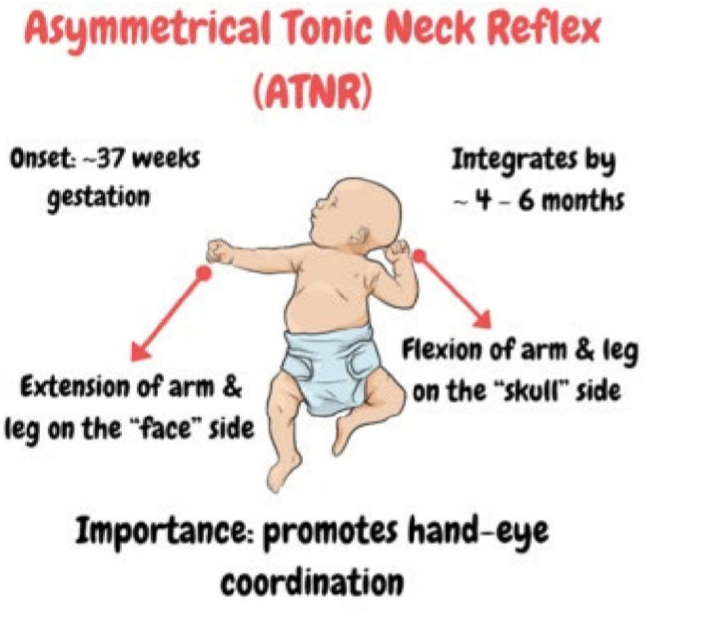
What does a child need to achieve in order to roll over?
need to overcome the Asymmetric Tonic Neck Reflex
48
New cards
What is the maturationist view of development?
Development is genetically programmed and universal unfolding
49
New cards
What is inter/cross modal perception?
Different sensations are combined to inform perceptions
50
New cards
Which modes are combined for postural reflexes?
kinaesthetic, visual and vestibular. Visual is fundamental
51
New cards
What are different methods of assessing infant perceptual abilities?
Preferential looking paradigms
Habituation paradigms
Visual cliff paradigm
Conditioning paradigms
Habituation paradigms
Visual cliff paradigm
Conditioning paradigms
52
New cards
At what age do infants develop a preference for natural faces?
2 months
53
New cards
At what age can infants distinguish between facial expressions?
3-6 months
54
New cards
What are examples of newborns being able to distinguish the human voice?
Unborn fetuses can hear their mother's voice
Neonates show preference for mother's voice by 4 days of birth
Newborns can recognise familiar stories that they were exposed to during pregnancy
Neonates show preference for mother's voice by 4 days of birth
Newborns can recognise familiar stories that they were exposed to during pregnancy
55
New cards
What are examples of the development of sound in newborns?
Newborns can learn any language
Newborns can localise sounds
Newborns prefer patterned sounds at the frequency range of the human voice
Newborns can distinguish between sounds by 1 month
Newborns can localise sounds
Newborns prefer patterned sounds at the frequency range of the human voice
Newborns can distinguish between sounds by 1 month
56
New cards
What are some examples of the development of olfaction?
Olfaction is highly acute at birth
6 day olds preferred the smell of their mother
6 day olds preferred the smell of their mother
57
New cards
What are some examples of the development of taste?
Newborns can discriminate among basic taste qualities
Food preferences may relate to early taste exposure
Food preferences may relate to early taste exposure
58
New cards
What are some examples of the development of touch, temperature, and pain?
Initially oral exploration, but by 4 moths, tactile exploration is developing.
After 4 moths, tactile exploration takes over
Newborns are sensitive to warm and cold and can register pain
After 4 moths, tactile exploration takes over
Newborns are sensitive to warm and cold and can register pain
59
New cards
How many hours does a young infant sleep for?
16 hours. Spend more time in REM sleep
60
New cards
What are ways that parents interact with their babies?
In a synchronised manner. In terms of the timing of speech. Loudness, body movements, and facial expressions are matched.
61
New cards
What is the cumulative stress model?
Stressors add together until a threshold is reached above which problem outcomes occur
62
New cards
What is the additive main effects model?
Developmental outcome is the result of the combined effects of stressors and protective factors
63
New cards
What is piaget's theory of cognitive development?
The child is an explorer that constructs their own learning from what they explore. Maturation determines what the child seeks out and takes in from the environment
64
New cards
What is assimilation?
New information is assimilated into existing schemas
65
New cards
What is accommodation?
Schemas are updated to accommodate new information
66
New cards
What is organisation?
internal rearranging and linking of schemas when prompted by unsettling development
67
New cards
What are Gesell's stages of development
There are stages of equilibrium and disequilibrium that children cycle in and out of. (Terrible Twos - disequilibrium). Disequilibrium during transitions
68
New cards
What causes movement to the next stage?
Maturation, experience and social interaction
69
New cards
What is the order of Piaget's Four Stages of Cognitive Development?
1. Sensori-motor (Birth - 2)
2. Pre-operational (2-6)
3. Concrete Operational (7-11)
4. Formal Operations (12+)
2. Pre-operational (2-6)
3. Concrete Operational (7-11)
4. Formal Operations (12+)
70
New cards
What are the features of the sensorimotor stage?
1. Reflexive Schemas - exercising and adapting/integrating reflexes
2. Primary Circular Reactions - repetition of actions centred on infant's own body
3. Secondary Circular Reactions - infant more object oriented
4. Coordination of Secondary Schemas - emergence of goal directed behaviour
5. Tertiary Circular Reactions - Sensorimotor problem solving: experiments (messing with objects, trial and error)
6. Symbolic or Representational Thought - mental manipulation of "course/effect relationships/mental representations
2. Primary Circular Reactions - repetition of actions centred on infant's own body
3. Secondary Circular Reactions - infant more object oriented
4. Coordination of Secondary Schemas - emergence of goal directed behaviour
5. Tertiary Circular Reactions - Sensorimotor problem solving: experiments (messing with objects, trial and error)
6. Symbolic or Representational Thought - mental manipulation of "course/effect relationships/mental representations
71
New cards
What is object permanence?
Describes the ability to know that objects continue to exist even though they can no longer be seen or heard
72
New cards
What is the significance of the impossible event? (Baillargeon, 1988)
Child will look more at the impossible event than the possible event. Shows that child knows that it shouldn't be there.
73
New cards
What is the Pre-operational stage?
Gains in mental representation (make-believe play, symbols represent the concrete world, drawing)
74
New cards
What are the limitations of the pre-operational stage
Egocentrism
Conservation
Hierarchal Classification - grouping objects into categories, dividing into sets and subsets. (Dad can be your dad and mum's husband)
Conservation
Hierarchal Classification - grouping objects into categories, dividing into sets and subsets. (Dad can be your dad and mum's husband)
75
New cards
What is animism?
The mistaken belief that non-living things are alive or have attributes of people
76
New cards
What is realism?
attributing tangible qualities to events of the mind
77
New cards
What is artificialism?
The belief that all natural phenomena are products of human engineering
78
New cards
What is magical thinking?
Attributing experiences and perceptions to unnatural phenomena
79
New cards
What is the Concrete Operational Stage?
Children can perform mental operations on objects but only belonging to concrete experience. Conservation and egocentrism develop.
80
New cards
What is the Formal Operations Stage?
Abstract, idealistic and logical thinking
81
New cards
What are some critiques of the formal operations stage?
Formal operations may be achieved when relevant
We may only use formal reasoning for problems that we have high level of interest, familiarity or expertise
We may only use formal reasoning for problems that we have high level of interest, familiarity or expertise
82
New cards
What is adolescent egocentrism?
belief that others are as interested in them as they are in themselves
Sense of personal uniqueness and invincibility
Sense of personal uniqueness and invincibility
83
New cards
What are some limitations of piaget's theory of development?
1. Stages are less coherent
2. Children can be trained to reason at higher levels
3. There's a difference between what children understand and what they can demonstrate
4. Underestimation of abilities of infants and preschoolers
5. Overestimation of adolescent cognitive capacities
6. Methodologies are culturally biased
7. Insufficient attention to social and emotional aspects of development
2. Children can be trained to reason at higher levels
3. There's a difference between what children understand and what they can demonstrate
4. Underestimation of abilities of infants and preschoolers
5. Overestimation of adolescent cognitive capacities
6. Methodologies are culturally biased
7. Insufficient attention to social and emotional aspects of development
84
New cards
What are emotions expressed during infancy?
Happiness, Surprise, Sadness, Fear, Anger, Disgust
85
New cards
What are more complex emotions expressed in preschoolers?
Shyness, Pride, Shame/Guilt, egocentric comfort
86
New cards
What are examples of voluntary control of emotional expression in preschoolers?
Ability to pose increases from 2-5 years of age. Getting better at polite facial expressions
87
New cards
What is temperament?
Individual differences in the balance of positive and negative emotions, frequency of specific emotion displays, intensity of emotion expressions, speed of emotional onset. They are biologically based and relatively independent of learning
88
New cards
Is temperament stable?
Temperament remains relatively stable
89
New cards
What is up regulation?
Increasing components of an emotional response
90
New cards
What is down regulation?
Decreasing components of an emotional
91
New cards
What are the biological mechanisms of emotion regulation?
Amygdala - reactivity
Prefrontal cortex - regulation
Prefrontal cortex - regulation
92
New cards
What are the consequences of being emotionally under-regulated?
Conduct disorders, oppositional, defiant, explosive (externali
93
New cards
What are the consequences of being emotionally over-regulated?
Inhibited, anxious, peer relationship problems (internalising)
94
New cards
What are arguments for the influence of temperament?
Differences among children reared by the same parents
95
New cards
What are the dimensions of temperament associated with reactivity? (Thomas & Chess, 1950s)
1. Activity level
2. Approach/withdrawal
3. Threshold of responsiveness
4. Intensity
5. Quality of mood/negative affectivity
6. Distractibility
2. Approach/withdrawal
3. Threshold of responsiveness
4. Intensity
5. Quality of mood/negative affectivity
6. Distractibility
96
New cards
What are the dimensions of temperament associated with self-regulation? (Thomas & Chess, 1950s)
Rhythmicity, adaptability, attention span and persistence
97
New cards
What are the four temperament classifications?
1. Easy Child
2. Slow to Warm Child - mild, but may be understimulated because they don't communicate their feelings as much as an easy child
3. Difficult Child
4. Difficult to Classify
2. Slow to Warm Child - mild, but may be understimulated because they don't communicate their feelings as much as an easy child
3. Difficult Child
4. Difficult to Classify
98
New cards
What are contributors to temperament stability?
Heredity (as seen in twin studies), parenting (bidirectional; parenting may influence temperament and temperament may influence parenting)
99
New cards
What are moderators of the relationship between temperament and parenting?
Age, gender, parenting characteristics, social and cultural factors
100
New cards
What is goodness of fit?
The extent to which the individual's capacities, abilities, motivations, and temperament are matched to parent/cultural demands and expec
 Note
Note  Flashcards (71)