TOPIC 3
 Studied by 0 people
 Call with Kai
 Learn
Learn Practice Test
 Spaced Repetition
 Match
Match Flashcards
 Knowt Play
1/63

There's no tags or description
Looks like no tags are added yet.
Name | Mastery | Learn | Test | Matching | Spaced | Call with Kai |
|---|
No study sessions yet.
64 Terms
Preanalysis
All the complex steps that MUST take place BEFORE a sample can be analyzed.
Preanalysis
32-75% of testing errors happens here
32-75%
Percentage of preanalysis that testing errors usually happens in this stage.
Preanalysis
Careful attention is necessary in this phase to ensure meaningful results.
Preanalysis
This emphasizes, errors = extra work; diagnosis delayed; extra cost.
PRE-ANALYTIC FACTORS
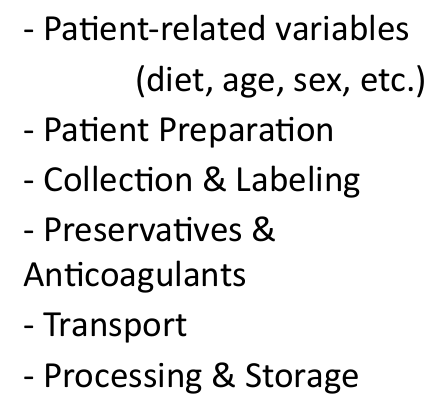
POTENTIAL ERRORS (PRE-ANALYTICAL)
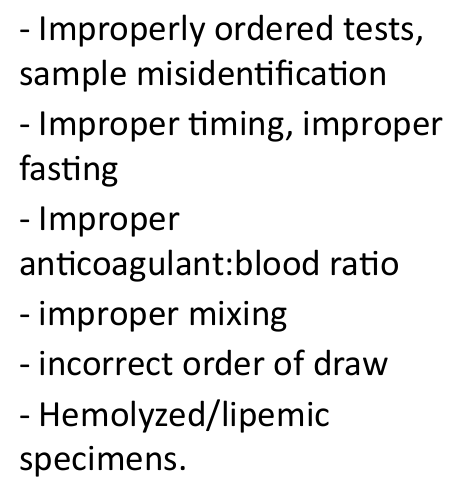
IN VIVO

IN VITRO
Online computer input
the most error-free in test order
Verbal requests
are made only in emergency situations and should be documented on a standard form
PATIENT DEMOGRAPHICS
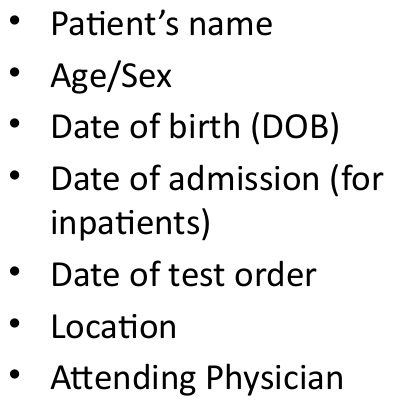
LAB INFO SYSTEM (LIS)
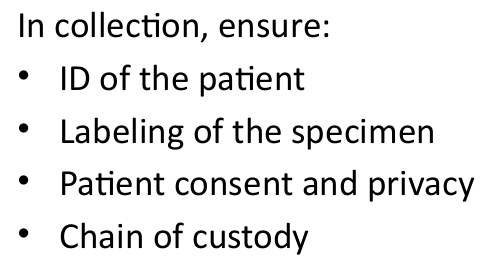
MORTAL SIN: MISIDENTIFICATION
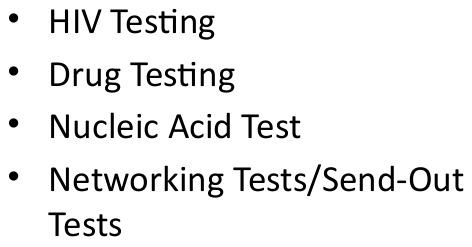
TEST REQUIRING COC
STAT
“immediately” and is highest priority
as soon as possible
ASAP
IPSG#1
IDENTIFY PATIENTS CORRECTLY
Blood (WB, SERUM/PLASMA)
Most common specimen.
Blood (WB, SERUM/PLASMA)
performed using a needle/adapter assembly attached to a syringe/evacuated glass
Blood (WB, SERUM/PLASMA)
transferred to the appropriate specimen container
PROBLEMATIC SITES
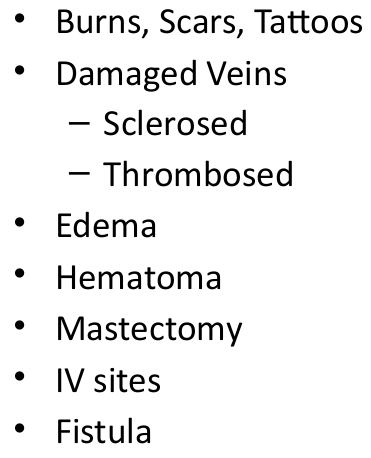
Sclerosed vein
vein is hardened or thickened
Thrombosed vein
vein contains a blood clot
Edema
Area has excess fluid swelling
Hematoma
Collection of blood under the skin
Mastectomy
Removal of breast tissue (often with lymph nodes)
Fistula
Surgical connection between an artery and vein (for dialysis)
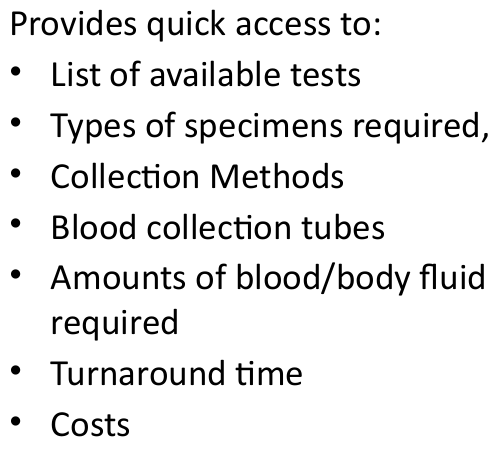
Blood Collection Tubes
color-coded
pre-determined internal vacuum
converted from glass to plastic collection tubes to minimize exposure to biohazards and broken glass
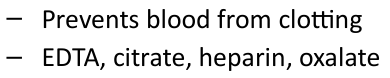
ANTICOAGULANTS
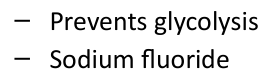
ANTIGLYCOLYTIC AGENTS
CLOT ACTIVATORS

THIXOTROPIC GEL
– Separates serum/plasma from cells
SPS
anticoagulant, anticomplement
ARD
antibiotic removal device
EDTA (Ethylenediaminetetraacetic acid)
Anticoagulant of choice for hematologic counts and morphology.
EDTA (Ethylenediaminetetraacetic acid)
Has two salts: K2 EDTA and K3 EDTA
CITRATES
Commonly used for coagulation studies and sedimentation rates
CITRATES
Very sensitive about anticoagulant:blood ratio
Black, Blue
CITRATE
1:4 (?), 1:9(?)
CITRATES
0.105 M or 0.129 M (3.2% or 3.8%)
HEPARIN
effective anticoagulant in small quantities without significant effect on many determinations
HEPARIN
Inhibits thrombin
LiHep & NaHep
HEPARIN has 2 forms which are
SODIUM FLUORIDE-OXALATE
generally used for glucose measurements because they contain a antiglycolytic agent which prevents glycolysis for 3 days
3 days
SODIUM FLUORIDE-OXALATE generally used for glucose measurements because they contain a antiglycolytic agent which prevents glycolysis for ___
SEPARATOR TUBES
Either contains clot activators and/or thixotropic gels
SEPARATOR TUBES
During centrifugation, the gel undergoes a change in viscosity lodges between the cells and the top layer.
URINE
Next most common specimen
URINE
Usually requires a timed specimen and/or complete collection
Creatinine
is often used to assess completeness of a collection (in urine)
Lumbar punctures
performed to collect CSF
3rd and 4th & 4th and 5th
most common site for an LP is between the ___ and ___ lumbar vertebrae or between the ___ and ___ lumbar
Chemistry or Immuserology
CSF: Tube #1
Microbiology
CSF: Tube #2
Hematology
CSF: Tube #3
SYNOVIAL FLUID
Ultrafiltrate of plasma found in the joints
arthrocentesis
an aspiration of the joint using a syringe, moistened with an anticoagulant
SYNOVIAL FLUID
collected by arthrocentesis, an aspiration of the joint using a syringe, moistened with an anticoagulant
Microbiology
SYNOVIAL FLUID: Sterile Tube:
Hematology
SYNOVIAL FLUID: EDTA Tube:
Chemistry
SYNOVIAL FLUID: Red Tube:
SPECIMEN TRANSPORT
accounts for approx. 1/3 of the total TAT
45 mins & 1 hr
Routine: delivered <___ after collection & centrifuged <___
 Note
Note  Flashcards (50)