Lecture 13 - Cooperation and Peacemaking
 Studied by 0 people
 Call Kai
 Learn
Learn Practice Test
 Spaced Repetition
 Match
Match Flashcards
 Knowt Play
1/25

There's no tags or description
Looks like no tags are added yet.
Name | Mastery | Learn | Test | Matching | Spaced |
|---|
No study sessions yet.
26 Terms
Define conflict.
A perceived incompatibility of actions or goals.
Define genuine peace.
The state low hostility and aggression in a mutually beneficial relationship.
Hence, it is more than just the suppression of open conflict, but the outcome of managing conflict.
What creates conflict?
Competition
Social Dilemmas
Perceived injustice
Misperceptions
Explain a study that illustrates how competition creates conflict.
Sheriff (1966)
He conducted a study where a group of young boys attended a summer camp for 3 weeks. The boys did a bunch of team bonding exercises and got super close, they were called the Rattlers. Then, while they were still at the camp, they were told that there were another group of boys across the lake, they were called the Eagles.
The two groups of boys then began competing in different competitions, and conflict arose very quickly. In fact, the conflict got so intense that some boys wet their beds, got homesick and even threw up.
Therefore, illustrating the effect of competition on conflict.
*this is the realistic group conflict theory
Define social dilemmas.
The dilemma between choosing our own self-interest over communal well-being.
What are the 2 laboratory games that exhibit social dilemmas?
Prisoner’s dilemma
Tragedy of the Commons
Explain the Prisoner’s Dilemma.
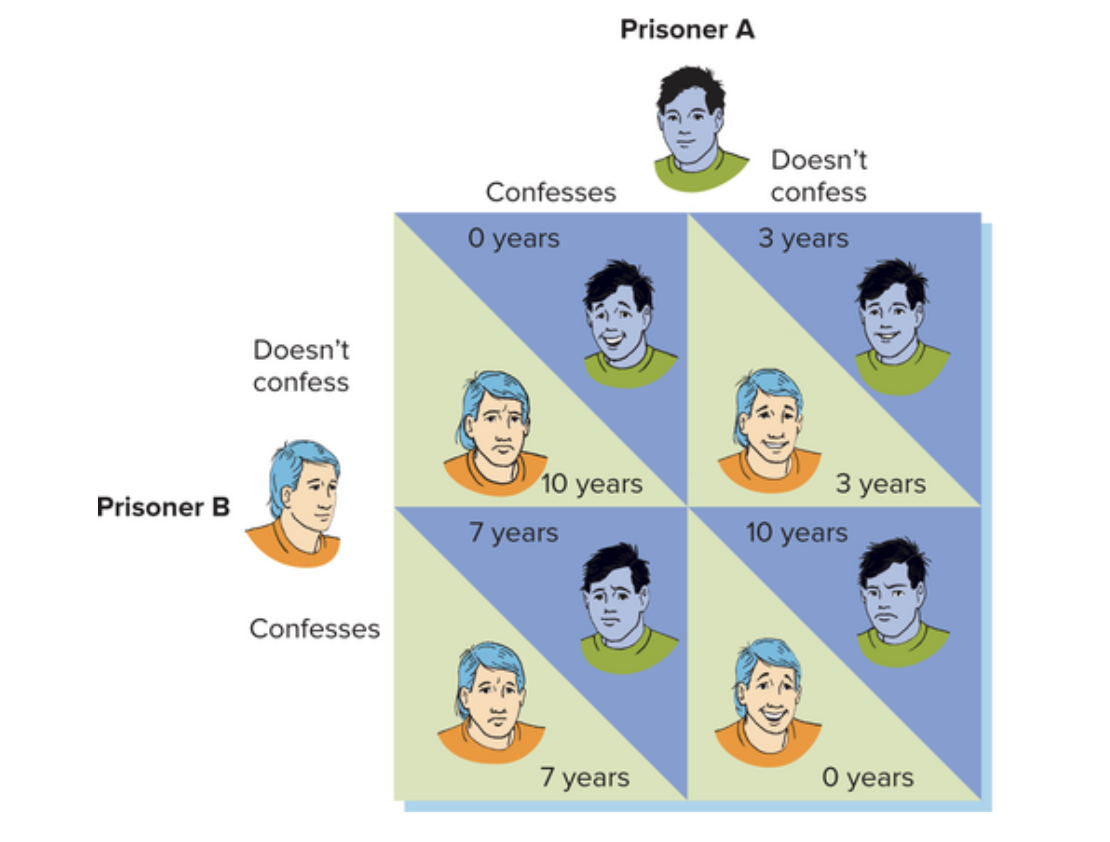
Two people are brought into a lab and are each put in separate rooms. They are then asked questions by the experimenter. If they both stay silent, they each get an equal amount of tokens. However, if one person speaks they get double the amount of staying silent, and the other person gets nothing. Lastly, if both speak, both get nothing. Therefore, illustrating the social dilemma to help oneself or help the group. It was found that people responded so that they could get more tokens.
This can be mirrored to prisoner interactions as two suspects are brought in and are interrogated in separate rooms, as there is not enough evidence to convict them (but they don’t know that). If prisoner A and B stay silent, none of them go to jail. If prisoner A confesses, then they get out scot free but Prisoner B gets more jail time, and vice versa. Therefore, highlighting the conflict of looking out for oneself, or the group.
Explain the tragedy of the commons.
Imagine 100 farmers surrounding a commons capable of sustaining 100 cows. When each farmer grazes one cow, the common feeding ground is optimally used.
But if a farmer thinks to put a second cow in the pasture to double my output, and all the other farmers do this, the commons will be overgrazed, and cows will be famished—this is the tragedy of the commons.
Hence, this is the idea that people take advantage of resources in order to benefit themselves, which eventually leads to everyone suffering in the end.
What’s the difference between social dilemmas in individualistic vs. collectivistic cultures?
Individualistic cultures tend to prioritise themselves and their own well-being.
However, collectivistic cultures tend to prioritise in-group harmony over personal gain. Therefore, social dilemmas occurring less often than in individualistic cultures.
What are the similarities between the prisoner’s dilemma and tragedy of the commons?
The fundamental attribution error occurs in both, as people attribute their opponents behaviour to internal attributes, such as being ‘greedy’ or ‘selfish’ and their behaviour being due to external forces—such as being forced to protect oneself due to how they expect others to behave. However, most don’t realise that their opponents are thinking the same thing about them with the same fundamental attribution error.
People’s motives both change over time
Both are not zero sum games, where you winning does not mean the other person loses. However, social dilemmas make people feel like it is a zero sum game.
How do people resolve social dilemmas?
Regulation
Smaller groups because there’s less deindividuation and diffusion of responsibility. Therefore, everyone identifies with the wins of the group, and feels more connected to the people.
Communication because when people communicate it prevents misunderstandings
Changing payoffs
When people are reminded of the benefits of behaving altruistically
Define equity.
The distribution of rewards in proportion to people’s contributions.
Define equality.
An equal distribution of rewards to all individuals.
Define fulfilment of needs.
The distribution of rewards based on people’s needs.
What causes misperceptions?
Mirror image perceptions: This is when each side views themself as moral and peaceful while seeing the other side as immoral and aggressive.
Simplistic thinking: This is when tension rises and people start to oversimplify things and use stereotyped judgments, leading to misperceptions.
Shifting perceptions: People’s perceptions can change very abruptly and very drastically, so misperceptions can easily arise.
How do we achieve peace?
Contact
Cooperation
Communication
Conciliation
How does contact help us achieve peace?
Increased contact leads to:
reduce anxiety
increase empathy
humanise others
decrease perceived threats
towards out-group members, which promotes peace.
When does contact not help achieve peace?
Contact does not help achieve peace when people self-segregate—meaning they want to keep themselves and their group exclusive.
Can imagining being in contact with people still help achieve peace?
Yes!
How does cooperation promote peace?
This because, when people cooperate to face superordinate goals, this builds cohesiveness and improves people’s racial attitudes.
Define superordinate goals.
Shared goals that require cooperative effort: goals that override people’s differences from one another.
Explain a study that illustrates the effects of cooperation on achieving peace.
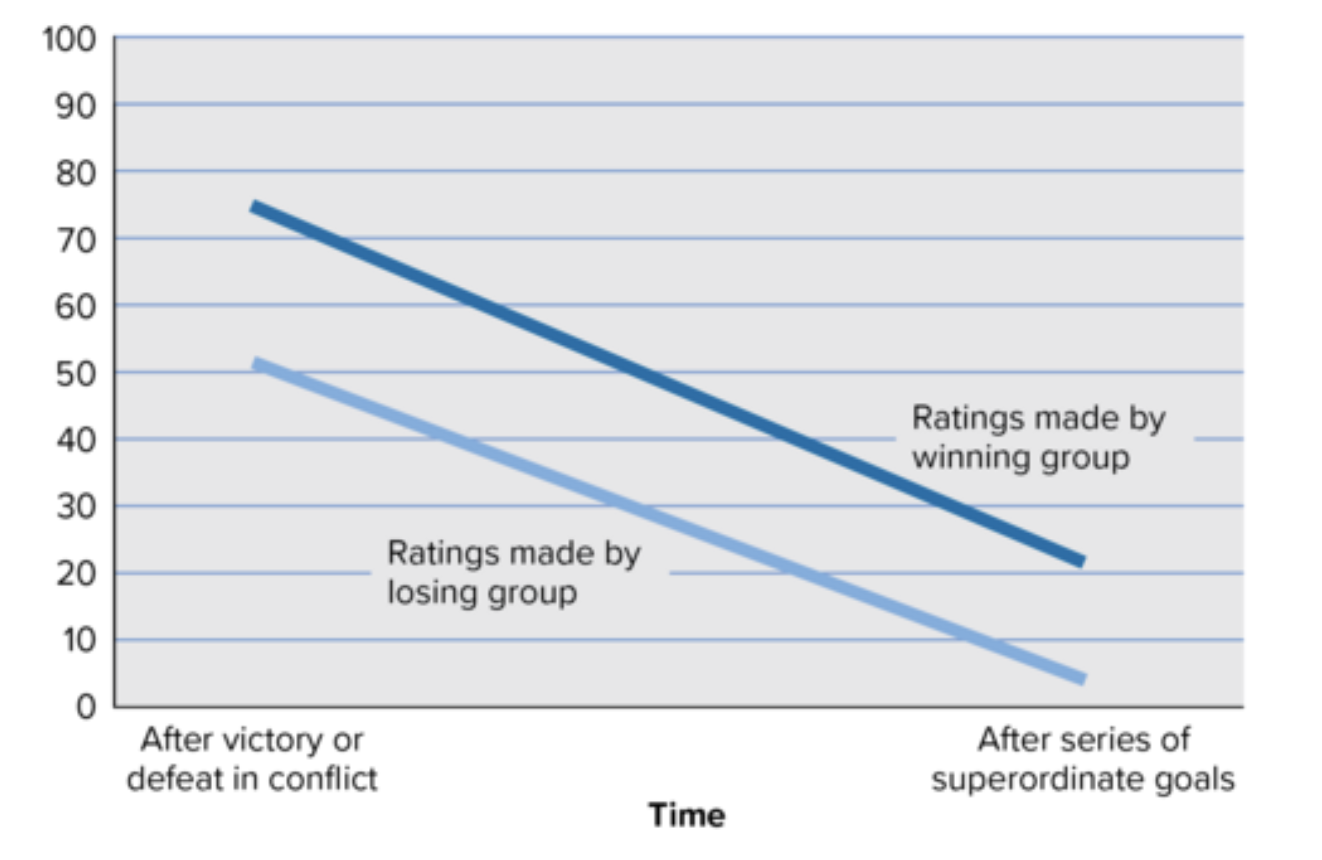
Sheriff (1966)
After competition, the Eagles and the Rattlers rated each other unfavourably. After they worked cooperatively to achieve superordinate goals, hostility dropped sharply.
Explain the different ways people identify themselves according to what is and is not accepted in society.
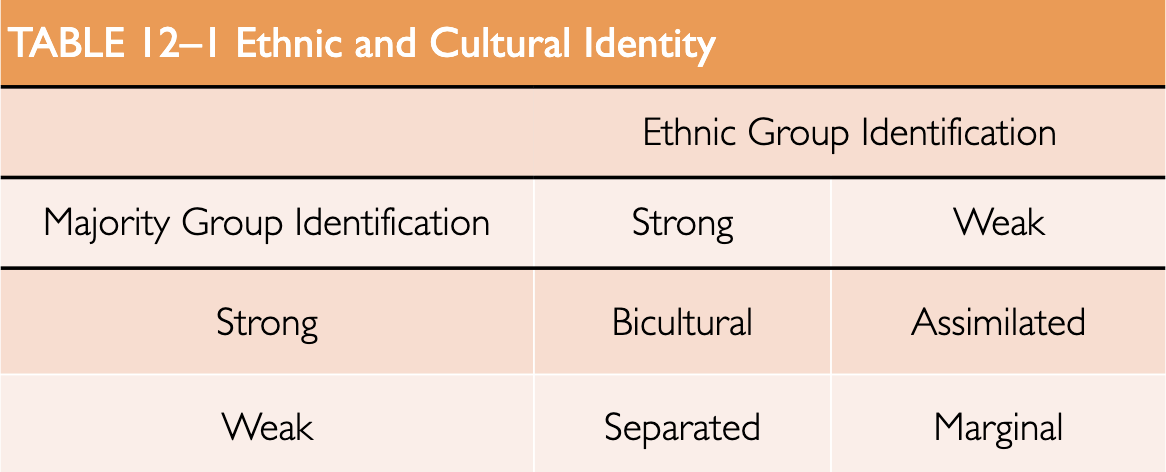
Explain the 3 different identity negotiation models.
Integration - when people’s different identities are mixed, with one or the other more prominent at times
Alternation - when people’s different identities are always kept separate and ‘frame-switching’ takes place
Synergy - when people’s different identities completely mix to form something else
What are the 3 communicative methods people use to help achieve peace?
Bargaining - direct negotiation between parties
Mediation - when a neutral third party helps obtain a ‘win-win’ solution between the parties
Arbitration - when a neutral third party makes the final decision and the parties don’t have a say
How does conciliation help achieve peace? What is done specifically?
When one side initiates de-escalatory actions after announcing the intent to conciliate (the action of stopping someone from being angry).
This is done through Graduated and Reciprocated Initiatives in Tension Reduction (GRIT).
 Note
Note  Flashcards (32)