Unit 6 - Gravity and SHM
 Studied by 0 people
 Call with Kai
 Learn
Learn Practice Test
 Spaced Repetition
 Match
Match Flashcards
 Knowt Play
1/10

There's no tags or description
Looks like no tags are added yet.
Name | Mastery | Learn | Test | Matching | Spaced | Call with Kai |
|---|
No study sessions yet.
11 Terms
What is Newton’s Law of Gravity?
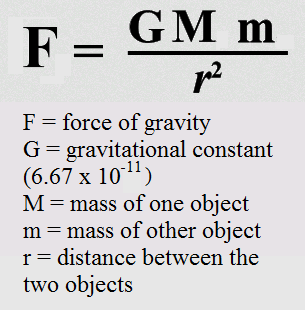
Every body in the universe attracts every other Boyd with a force of gravity whose magnitude is given by the formula in the image:
G = 6.67 × 10⁻¹¹ (Nm²/kg²)
What is very important to know about:
Gravitational Field?
Gravitational Force?
Gravitational Field DOES NOT = Gravitational Force
Gravitational Field uses the symbol g
The gravitational field describes the force that a mass would experience at any given point in spac. (THINK: the formula only has one mass and one radius)
Gravitational Force uses the symbol Fg
Newton’s law of universal gravitation states that every mass in the universe attracts every other mass with a force that is:
Directly proportional to the product of their masses.
Inversely proportional to the square of the distance between their centers of mass.
What is a Gravitational Field?
What is the magnitude of the Gravitational Field?
The gravitational field describes the force that a mass would experience at any given point in space due to another mass.
|
The magnitude of the gravitational field created by a mass at a point in space is defined as the ratio of the gravitational force on a test mass to the magnitude of that test mass: g = Fg/m
What is the formula for:
The gravitational field strength of M to another object m?
The gravitational field of M to another object m which is a distance r from the centre of M?
If asking w/o giving distance then use the 1st formula.
One formula uses the Force of gravity and divides it by the other mass m to get the ratio or “field“ of M
the other formula uses the gravitational constant but stems off the 1st equation where m is cancelled out.

What are 3 things to remember about the Gravitational Field Strength of an object?
The direction of the field (g) is ALWAYS towards the mass (cus gravitational field strength = strength in pulling another object closer)
If the only force acting on an object is the force of gravity (Fg), then the acceleration of the object is equal to the numerator value of g at that point
Given the value of g at a point, Fg = mg is called thw weight of the object
What 3 things are important to know about Apparent Weight compared to Weightlessness?
The magnitude of Apparent Weight is equal to the magnitude of Normal Force if the object is stationary
If the obj is ACCELERATING, then Apparent weight DOES NOT = The Force of gravity (Fg) (like elevator going UP 🤯)
If an object has no forces acting on it or the only force acting on it is gravity, we say the object is WEIGHTLESS (like a ball at the peak after getting kicked up 🤯)
What is Newton’s Shell Theorem?
What are the 3 cases?
Newton’s Shell Theorem describes how gravity behaves for spherically symmetric objects (such as planets or stars).
Cases
INSIDE the shell: Force of gravity is always ZERO.
Outside the shell: The force of gravity on objects is calculated by placing all the mass of the shell at the center of the Sphere (this means you need mass of both the object and the shell.)
Inside a shell of UNIFORM DENSITY (earth?) ( 100% infill concrete sphere): Force of gravity is due to only a portion of the sphere’s mass
—> We will need to get density and then use normal Gmm/r² formula
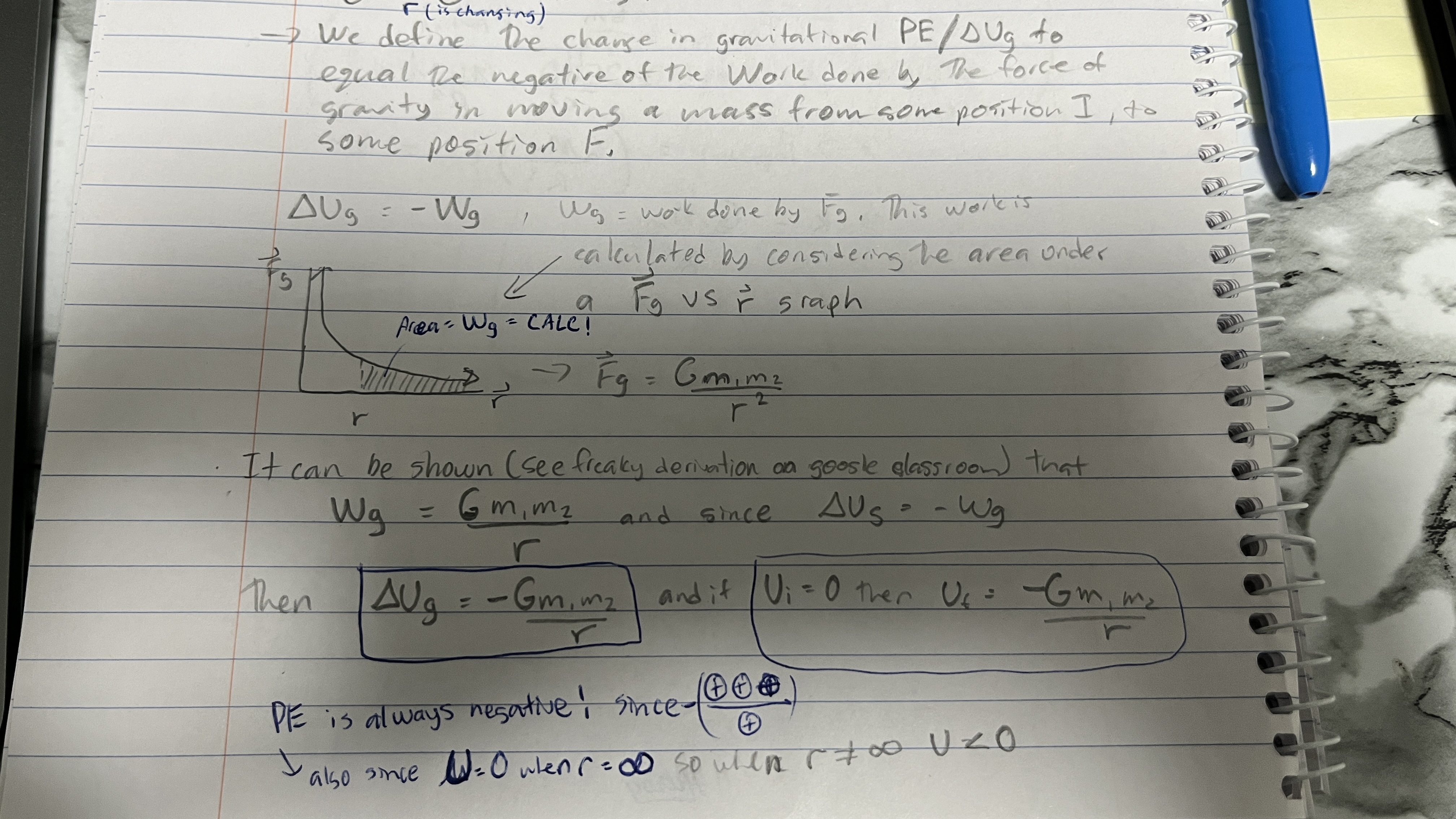
What is important about Gravitational PE?
When is grav PE zero between two masses?
Gravitational PE ALWAYS needs a 2 mass system (kinda like a frame of reference)
—> our old way of PE was always comparing with the earth
gravitational PE is ZERO between two masses when the distance between them is INFINITY 😳
Look at the picture to see what the formula ends up being
What is Escape KE or Escape Velocity?
What does it mean for total system energy?
Escape KE or Velocity is the minimum amount of KE needed for the object to escape the gravitational pull due to another mass M
—> We assume that since it escapes the pull of another, over time, the distance between the 2 objects will become infinite and with that we say Ef = 0
Ei = Ef
Ei = 0
PE MUST ALWAYS be negative (to take away from KE)
What are Kepler’s 3 laws? (Which is the most important?)
Planets move around the Sun in a ELLIPTICAL orbit with the sun at one focal point
Planets travel around the Sun in such a way that they sweep out equal areas in equal times (basically if change in time is the same at two different positions in orbit, then the areas swept out will be the same even though it doesn’t look like it)
Most important - ASSUME CIRCULAR ORBIT - If two different planets are orbitting around the same central mass (like the sun) then (T1/T2)² = (r1/r2)3
What must you remember about Satellites?
ALWAYS ASSUME circular paths for satellites (so you can use Kepler 3rd law)
For all unpowered satellites, the net force of gavity is Fg = GMm/r² (just the good ‘ol formula)
 Note
Note  Flashcards (24)