Bio 1B Midterm 1: Evolution
 Studied by 0 people
 Call Kai
 Learn
Learn Practice Test
 Spaced Repetition
 Match
Match Flashcards
 Knowt Play
1/152

There's no tags or description
Looks like no tags are added yet.
Name | Mastery | Learn | Test | Matching | Spaced | Call with Kai |
|---|
No analytics yet
Send a link to your students to track their progress
153 Terms
5 properties that led Darwin and Wallace to conclude that we would expect species to change with time?
Struggle for existence
Phenotype Variable
Existence depends (at least a little bit) on Phenotype
Phenotypic Attributes are (at least a little bit) Heritable
Then... we expect Descent with Modification (which we call evolution)
Why is inheritance important to the evolutionary process?
It allows successful/favorable traits to be passed down. Without inheritance, it does not matter what effect selection had in one generation, because it would have no impact on the following generation, and hence, descent with modification would not occur.
What drives evolution?
Overly successful reproduction creates the pressure of selection
Evolution can be viewed as repeated rounds of a two-step process. What are the two steps?
1. Variation
2. Selection
repeat every generation
How can evolution be re-cast in terms of development and ecology?
Variation arises through development/ Natural selection plays out in the arena of ecology. Evolution can be viewed as repeated rounds of the filtering of development by ecology. (Ecology: the study of organisms and how they interact with the environment around them.
The sickle cell anemia allele is a genetic disease, yet the allele can also be selected for. Explain.
Sickle cell anemia also leads to resistance against malaria which is good. Despite selection against the allele as a blood disease, selection for its presence as a protection from malaria also works to keep the allele being selected for. "Balancing Selection"
In what ways is variation random?
Variation does not anticipate the needs of organisms, evolution is a process of trial and error.
Why are snout proportions in dogs more evolvable than in cats?
For cats, you need to wait for the genes to arise through mating or mutation to get a significant change in snout length whereas for dogs you do not thanks to the way that cat and dog skulls develop.
Phenotype
physical characteristics of an organism
Heredity
Passing of traits from parents to offspring
Ecology
Scientific study of interactions among organisms and between organisms and their environment
Sickle Cell Anemia
a genetic disorder that causes abnormal hemoglobin, resulting in some red blood cells assuming an abnormal sickle shape
Allele
Different forms of a gene
Balancing Selection
occurs when natural selection maintains stable frequencies of two or more phenotypic forms in a population
Why can it be difficult to identify the target(s) of selection?
Discuss both balancing selection and evolutionary hitchhiking
Evolutionary Hitchhiking
In practice it can be very hard to work out which traits were the targets of selection because traits are often correlated with each other, thus non-selected traits can "hitchhike" along with the selected traits. (ex: selecting for larger body size in dogs also results in larger snouts)
Can natural selection occur without evolution? Give an example.
Yes, if there is selection against extreme phenotypes, generation individuals with extreme phenotypes will be selected against but there will be no descent with modification.
What are three types of selection on traits?
1. Stabilizing selection: the dominant mode of selection in which extreme phenotypes are selected against.
2. Directional selection: specific "side" of a trait is selected for.
3. Disruptive selection: more rare, when the extreme phenotypes are selected for
What is the name for selection when it concerns access to mates?
Sexual selection. Directly related to access to mates.
What are three ways that evolution can occur without selection (can you explain how they work)?
Drift: Completely due to random chance.
Bottlenecks: Population randomly changed (i. E. major natural disaster wipes out a major portion of the population)
Founder Effect: Small subset of individuals establish new colony.
What is genetic drift? How does it work?
Variation in the relative frequency of phenotypes of a population from one generation to the next due to random chance. Bottleneck and Founder effect are examples of genetic drift.
Can you list the various mechanisms that can lead to evolutionary change?
Adaptive change driven by selection & Non-adaptive change driven by chance
How do most mutations arise in the genome?
Most mutations arise due to replication errors during DNA replication.
Why do fast rates of mutation enable drug resistance to evolve?
Rapid rate of mutation in viruses mean they can respond to the natural selection imposed by drugs and vaccines by becoming immune.
The Hardy-Weinberg model is very simple, yet its simplicity enables us to determine whether or not one or more mechanisms of evolution has occurred. Explain how.
Hardy-Weinberg model describes how allele frequencies translate into genotype frequencies in one generation if only random mating is going on between diploid sexual organisms.
Evolutionary hitchhiking
Selection "for" versus Selection "of". In practice it can be very hard to work out which traits were the targets of selection, because traits are often correlated with each, that is non-selected traits can hitchhike along with the selected traits. Ie: Large dinos tend to have smaller arms. Are tiny arms correlated with selection for larger body size, or were tiny arms themselves selected for?
Stabilizing selection
Directional selection
Disruptive selection
Balancing selection (see also Lecture 2)
Sexual selection
Stabilizing: Natural selection that favors intermediate variants by acting against extreme phenotypes
Directional: Entire curve moves towards one end of the distribution
Disruptive: favors the extremes
sexual selection: A form of natural selection in which individuals with certain inherited characteristics are more likely than other individuals to obtain mates.
Genetic Drift
A change in the allele frequency of a population as a result of chance events rather than natural selection.
Non-adaptive change
Driven by chance, does not increase fitness of a population. (think genetic drift)
Gene Flow
movement of alleles from one population to another
Genotype
An organism's genetic makeup, or allele combinations.
What is the Biological Species Concept? Give an example where it is hard to apply.
A species consists of populations of organisms that can reproduce with one another and are reproductively isolated from other populations.
Example: Hard to apply: Ring species in which populations can interbreed one way around the ring but not the other.
What are cryptic species? What type of data are used to identify them?
A cryptic species is one of two or more morphologically indistinguishable populations that can't interbreed. DNA data isn't always helpful because sometimes we don't know if DNA differences are due to the fact that populations cannot interbreed or just that they haven't
DNA data suggest there are two species of living elephant in Africa. Why do we think they are different enough to call different species?
We use the known Asian elephant's dna as a measuring stick to determine how different two species "should" be genetically to compare the two.
What is the Morphological Species Concept? Why do we think there should be good agreement with species defined using the Biological Species Concept?
Species are groups of individuals that are morphologically similar to one another but morphologically distinct from other groups. Individuals that don't interbreed will have diverging phenotypes, so generally will have different morphologies from other species.
Chronospecies
Two species that are part of a continuum of change. A species that changes over time to the point where it becomes a different species from what it once was.
Type Specimens
the particular specimen to which the scientific name is formally attached.
Type specimens are specimen names that allow us to name new species. (Holotype, paratype, etc.)
What is a Synonymy? Why are synonymies needed?
Documents name changes. Important because new data occurs that often will change species names.
Why are species especially hard to diagnose in the fossil record?
Hard to distinguish male or females. Hard to determine whether observed differences are due to fossils being from different species or just growth stages. In general - less data, we cannot see the specimens behave, a lot less specimens, and much of the phenotype is not preserved.
Why in practise do we typically use the Morphological Species Concept rather than the Biological Species Concept?
It's difficult to test every species to see if they interbreed. Morphological differences are clearly visible, can be seen with the naked eye.
Parthenogenesis
Asexual reproduction in which females produce offspring from unfertilized eggs.
Bacteria
single-celled organisms that lack a nucleus; prokaryotes
Archaea
Archaea is a domain of single-celled organisms. These microorganisms lack cell nuclei and are therefore prokaryotes.
Eukaryotes
Cells that contain nuclei
What are the two primary mechanisms of allopatric speciation. Can you provide examples?
Allopatric speciation - populations become separated by dispersal (population disperses to a new place) and/or vicariance (change in environment)
Origin of Dodo bird - a pigeon dispersed to an island near madagascar (founder effect) and then the lack of predators led to the loss of flight and a large body size
Vicariance example: river formation splits up a population
What is parapatric speciation? Can you give an example?
New niche in the environment creates reproductive isolation. Like the mice on the lava/non-lava ground
What is sympatric speciation? Can you give an example?
Reproductive isolation within the population. Rare because if two populations live in the same place it's hard to disrupt gene flow. No physical barriers preventing mating, within close proximity. Could occur based on different food source, or spontaneously.
Example: Fruit flies were eating different fruits and became reproductively isolated.
Why do we think sympatric speciation is an uncommon mode?
No physical barriers prevent gene flow and they live within close proximity, so it's more rare.
What is the difference between prezygotic and postzygotic barriers to reproduction? Can you give some examples?
Prezygotic: Before fertilizaiton. Behavioral, temporal, or habitat
Postzygotic: Can mate, but offspring is not viable. Horse/Donkey can mate but they create Mules which are sterile
In the context of hybrid zones, what is reinforcement?
Hybrid zones occur when two incident species are only partially reproductively isolated. Reinforcement occurs when there is strengthening of mating isolation in response to the selection against unfit hybrids. Reinforcement/selection for those that prefer to mate with their own kind.
How does the development of reproductive barriers increase fitness to local environments?
Heterogeneous environment local populations will adapt to local conditions, migration/interbreeding but it is hard to maintain those local adaptations.
On longer timescales, why is there a tension between widespread generalists and geographically restricted specialists?
Trade-off between generalists with lower fitness but lower rates of extinction and specialists with higher rates of extinction
Why do we think allopatry is the most common mode of speciation?
Speciation requires disrupting gene flow which is easiest and most common when populations are physically separated.
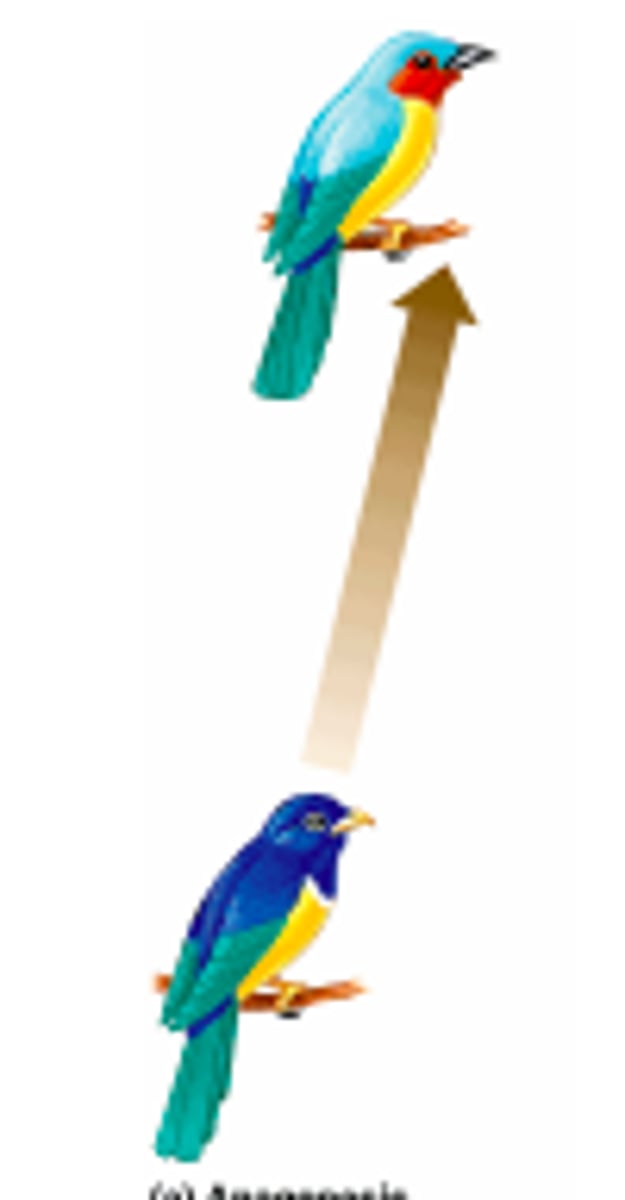
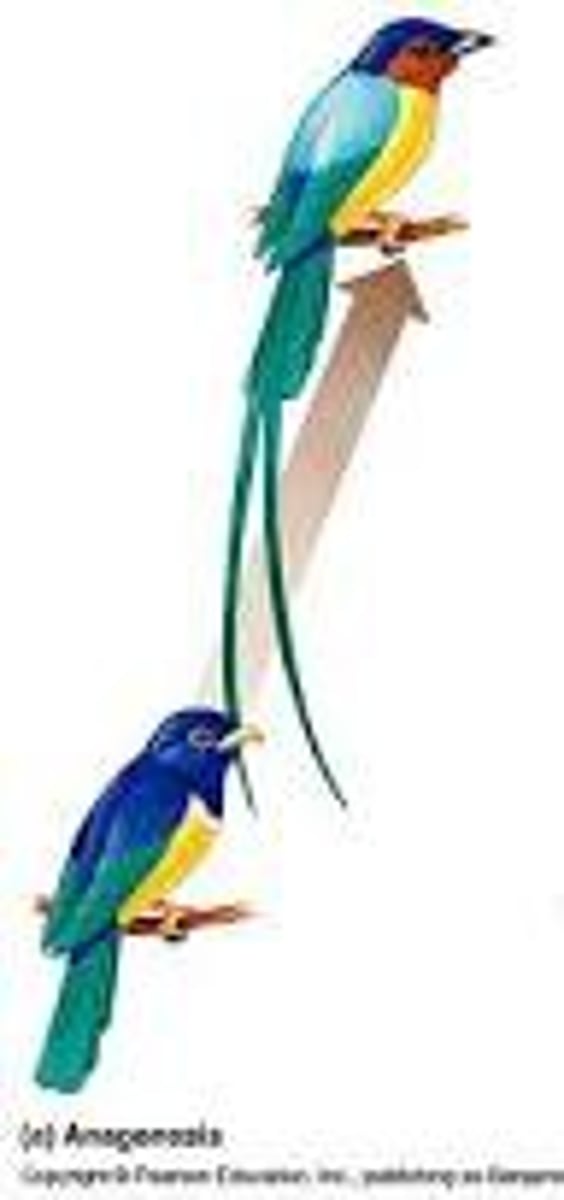
Phyletic change
change within a single lineage of organisms. directional selection causes new species to arise
Anagenesis
species formation without branching of the evolutionary line of descent.
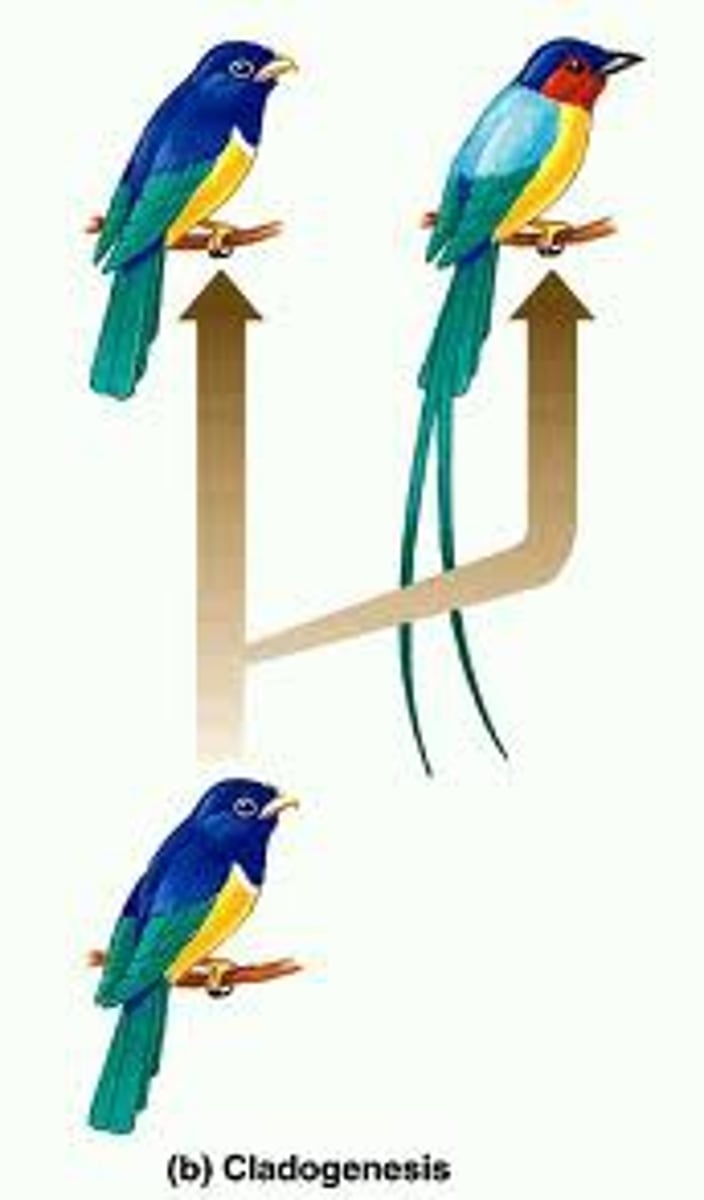
Cladogenesis
Branching evolution occurs when a new species branches out from a parent species
Vicariance
The physical splitting of a population into smaller, isolated populations by a geographic barrier.
Polyploidy
condition in which an organism has extra sets of chromosomes
can cause speciation
Zygote
fertilized egg
Gametic isolation
Sperm of one species may not be able to fertilize eggs of another species
Hybrid zone
a geographic region in which members of different species meet and mate, producing at least some offspring of mixed ancestry
What are the 3 goals of systematics? Be sure to mention phylogenetics.
Identifying and naming species
Establishing the evolutionary relationships between taxa (phylogenetics)
Developing classifications
What is a cladogram?
Cladogram: A diagram depicting the relative relatedness between taxa, and nothing more
Branch lengths have no meaning, time goes up the branches.
How are cladograms made?
by figuring out which derived characters are shared by which species
Based on synapomorphies (shared evolutionary innovations like "fur")
Principle of parsimony in the construction of cladograms
The parsimony principle is basic to all science and tells us to choose the simplest scientific explanation that fits the evidence. In terms of tree-building, that means that, all other things being equal, the best hypothesis is the one that requires the fewest evolutionary changes.
Role of Outgroup
Outgroup is the primitive character state that lacks the innovations of the other branches
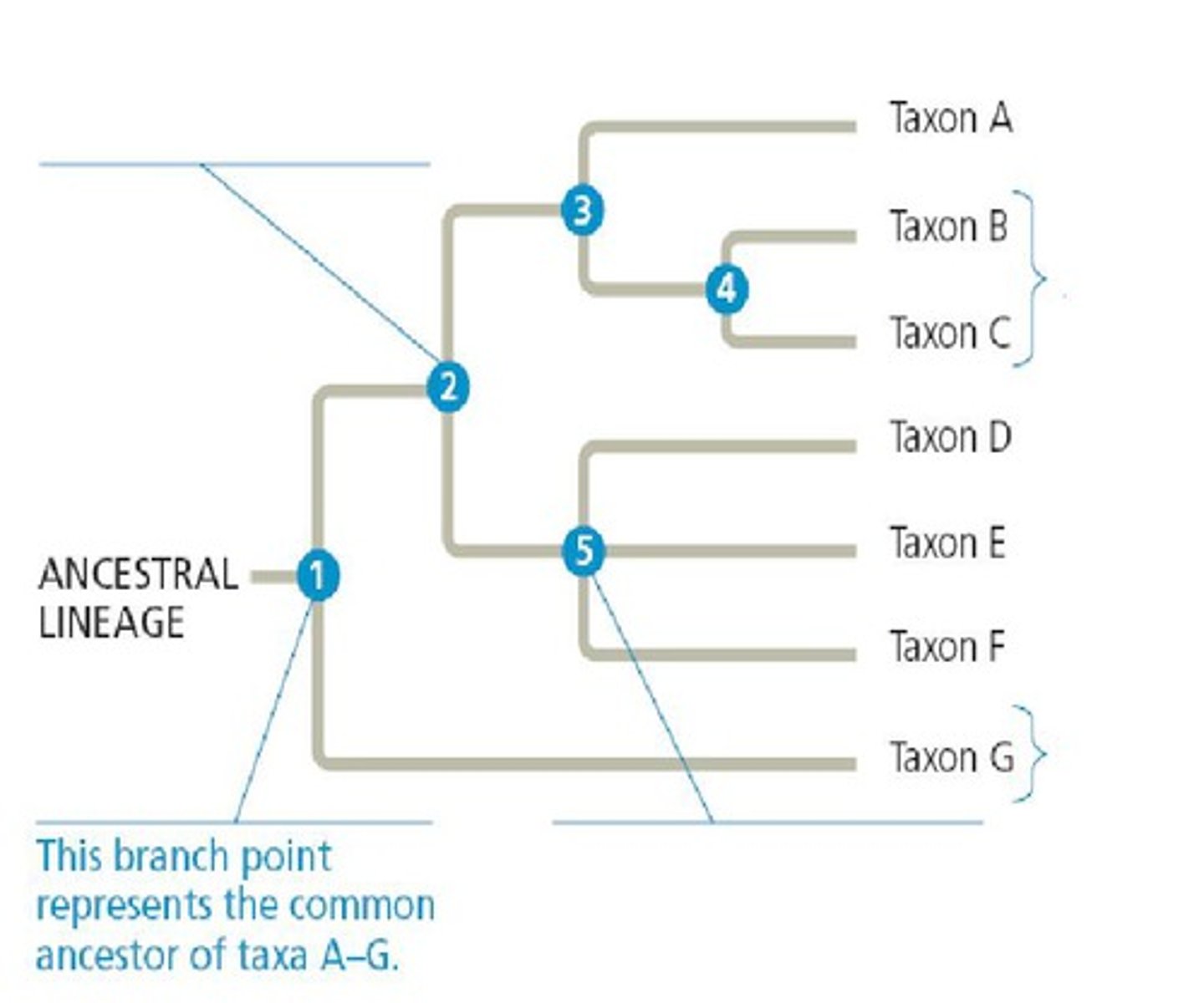
Node
Branch point which represents the most recent common ancestor
Sister Group
The two clades resulting from the splitting of a single lineage.
Apomorphy
derived character state (example: feathers)
Plesiomorphy
ancestral character state (example, scales, from which feather evolved)
Synapomorphy
shared derived character. Shared evolutionary innovation like feathers shared by birds
basis of cladograms
Symplesiomorphy
Shared ancestral trait, like scales among reptiles
Autamorphy
Evolutionary innovation present on only one branch on a cladogram
Homoplasy
A character state that evolved more than once on a cladogram, or is evolved and lost
How can evolutionary relationships be masked by evolutionary change?
Subsequent change can mask underlying relationships, fooling parsimony. If one taxon has unique evolutionary changes that masks its true relationships, it may be confusing. I.e. if a species is so changed from their terrestrial ancestors that we can't use the morphology of living species to identify their closest relatives.
• How can the fossil record help (what do mean when we say the fossil record can be evolution's time machine)? Given an example.
Fossil record serves as evolution's time machine to give us a sequence to ancestral morphologies. Ankle bones in whales tells us that they evolved from four legged land mammals and are sisters to hippos.
• How can parsimony be fooled, that is, what is long-branch attraction? How is it related to statistical inconsistency?
Since the characters of DNA are so simple (ATGC), parsimony is okay most of the time. Parsimony is fooled, aka long-branch attraction occurs, when two lineages evolve rapidly, and are thought to be closely related. Statistical inconsistency is the property of increasing data increasing the support for the wrong answer.
How (qualitatively) does Likelihood analysis deal with the problem of long-branch attraction?
For each pair of DNA sequences, the more different they are the greater chance that shared synapomorphies between species arose by chance. Likelihood analysis down weights each "candidate synapomorphy" in the data matrix by the probability that it was generated by chance given the amount of evolution observed.
Taxon
a group of organisms in a classification system
Maximum Likelihood
A principle that states that when considering multiple phylogenetic hypotheses, one should take into account the one that reflects the most likely sequence of evolutionary events, given certain rules about how DNA changes over time.
What distinguishes phylograms and phylogenies from cladograms?
In cladograms, branch lengths have no meaning. Phylogram branch lengths are proportional to the strength of support (number of changes on the branch) and phylogeny branch lengths are proportional to time.
What are monophyletic, paraphyletic, and polyphyletic groups? Can you give examples?
Monophyletic groups: contains an dancestral species and all of its descendents. Also called clades. (dog / human / mouse / etc.)
Paraphyletic group: contains an ancestral species and some but not all of its descendents. (reptiles, don't include snakes which evolved from within lizards)
Polyphyletic group: contains distantly related species but not their most recent common ancestor. Example: (rare, marine mammals, vultures)
What are the relationships between synapomorphies, homologies, homoplasies, and convergences (parallelisms)?
Synapomorphies are equivalent to homologies, and homoplasies are equivalent to convergences (which are also called parallelisms). (Homoplasies are traits that appear to be homologs but may not be given other evidence)
Can you give some examples of convergences?
Convergent evolution of stem succulence. Non-succulent ancestor gives off two separate stem-succulents that evolved convergently. Convergent evolution of anteaters across the world.
What is the Phylogenetic Species Concept?
A species is the smallest monophyletic group (lineage) distinguishable by a unique set of either genetic or morphological traits (synapomorphies)
Why might the Phylogenetic Species Concept lead to the recognition of more species than the Biological and Morphological Species Concepts
Biological/Morphological species concept pick up on reproductive isolation and morphological divergence, however, if morphological divergence has not yet happened, these concepts would miss these "cryptic species" that may be seen with DNA data.
What is the relationship between homology, synapomorphy and homoplasy?
Synapomorphies are homologs, ie. the limbs of tetrapods. Homoplasies are characters that look like homolgs but are actually convergences.
How were phylogenies used to make better flu vaccines?
Flu viruses evolve rapidly each year and our immune system selects for them, so now the CDC picks the longest branch viruses for vaccines.
How were phylogenies used to determine where the HIV virus came from, and how many times it crossed over into humans?
Phylogeny of human and primate sequence for HIV shows that the human virus origin is polyphyletic (many separate origins). Phylogenies also track the timing and geographic paths of HIV infection in the US (think molecular clock).
How were phylogenies used to determine whether a dentist infected his patients with HIV?
Phylogenetic tree of HIV sequences of patients showed that the virus in patients was most closely related to the dentist's virus, providing evidence of transmission.
How were phylogenies used in a law case where a doctor was accused of injecting his girlfriend with HIV?
The "paraphyly" of the patient's sequences implied transmission from pateint to victim.
Paraphyly
the state that a group has when it includes a common ancestor and some, but not all, of its descendants
What was the hypothesis of the molecular clock?
Molecular Clock was the hope that the differences in DNA between species accumulate at a universal rate, so DNA differences between species could be used to date their time of divergence. This actually isn't true but branch lengths from phylograms can estimate divergence times.
How did the molecular clock change our view of human origins?
Held us back into thinking that humans were much more different from other species than we are.
neutral rates of evolution
neutral changes are those that are not subject to selection
What is the difference between synonymous and non-synonymous mutations?
Synonymous changes don't change the amino acid (change from one base to another, but don't affect the amino acid result) while non-synonymous changes do.
What is the difference between a mutation and a substitution?
Mutation: changes in the DNA
Substitution: mutations that become fixed in the population
Can we use DNA distances to estimate divergence times even if there is no universal clock? What technique is used to do this?
Yes! We take a phylogram (cladogram with branch lengths measured in DNA changes) and convert it to a phylogeny (timetree/chronogram)
Why has the SSU rRNA been such a valuable phylogenetic tool? What did it reveal about the origin of mitochondria & chloroplasts?
SSU rRNA: a universal phylogenetic tool. It is a part of the machinery that makes protein and all organisms have it since it is very conserved. Thus, we can recognize it in all species. It revealed teh 3 Great domains in the tree life (bacteria, archaea, eucarya). Revealed that mitochondria and chloroplasts have a root ancestor.
Phylogram
A phylogenetic tree in which the lengths of the branches reflect the number of genetic changes that have taken place in a particular DNA or RNA sequence in the various lineages
 Note
Note  Flashcards (78)