8.2) Inorganic solids: non-close packing structures
 Studied by 0 people
 Call with Kai
 Learn
Learn Practice Test
 Spaced Repetition
 Match
Match Flashcards
 Knowt Play
1/7

There's no tags or description
Looks like no tags are added yet.
Name | Mastery | Learn | Test | Matching | Spaced | Call with Kai |
|---|
No study sessions yet.
8 Terms
Describe the structure of CsCl
primitive cubic; Cl at corners and Cs at centre (or vice versa); not body centred as centre and corner atoms are different; not cp as CN=8 (cp requires 12) as atoms are connected octahedrally
What two groups of materials crystallise with the CsCl structure
halides of large monovalent cations (CsI, CsBr, NH4Cl); intermetallics (CuZn, AuMg, AlNi)
Describe the structure of most silicates
cation + complex silicate anion; based on SiO4 tetrahedra sharing corners only; no more than two SiO4 share one corner (oxygen); Si/O ratio can vary
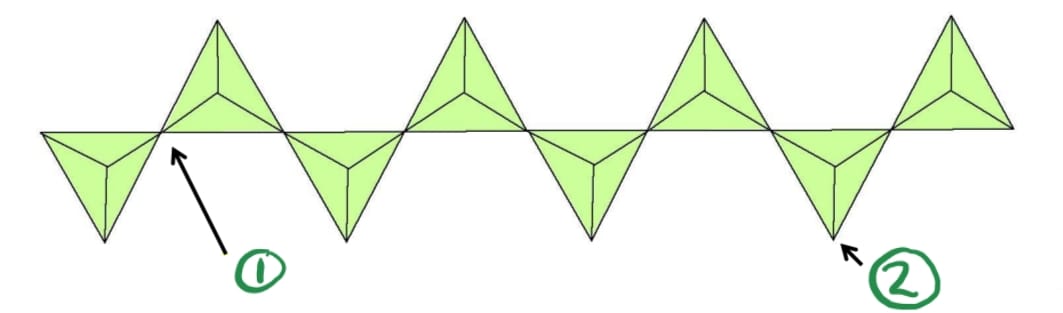
Label the oxygen atoms in a silicate
bridging; non bridging
SiO2 (eg quartz or cristobalite) structure
1:2 ratio; four bo per Si (zero nbo); diamond network of Si with O inserted onto each linkage
Mg2SiO4 (eg olivine)
1:4 ratio; zero bo per Si (four nbo); 3d solid based on hexagonal close packed O ions with Si occupying 1/8 of tetrahedral sites and Mg occupying ½ octahedral sites
Chain and sheet silicates
formed by intermeditae Si:O ratios; eg 1:3 with 2 bo and 2 nbo
What are the trends in oxide bonding? Use Group IV oxides as an example (MO2)
going down the group (C→Si→Pb) go from molecular covalent to polymeric 3d structures (not cp) to ionic 3d structures mostly based on cp; CN also increases down the group
 Note
Note  Flashcards (116)