Reward pathways and dopamine
 Studied by 0 people
 Call with Kai
 Learn
Learn Practice Test
 Spaced Repetition
 Match
Match Flashcards
 Knowt Play
1/24

There's no tags or description
Looks like no tags are added yet.
Name | Mastery | Learn | Test | Matching | Spaced | Call with Kai |
|---|
No study sessions yet.
25 Terms
Define reinforcing
When a stimulus causes an animal to perform a behaviour in order to obtain the stimulus
What is the difference between something that is reinforcing vs rewarding?
Rewarding is mainly a human phenomenon and is subjective whereas reinforcing is objective and can occur in all animals.
Rewarding stimuli often are linked to euphoria and therefore can lead to addiction.
What is psychological dependence?
This is when people have a "craving" for a drug. It described addiction.
What is physical dependence?
When stopping a drug causes a withdrawal syndrome e.g. opioids and and alcohol.
What is tolerance?
When continued use of a drug results in the need for increasing doses for equivalent effect
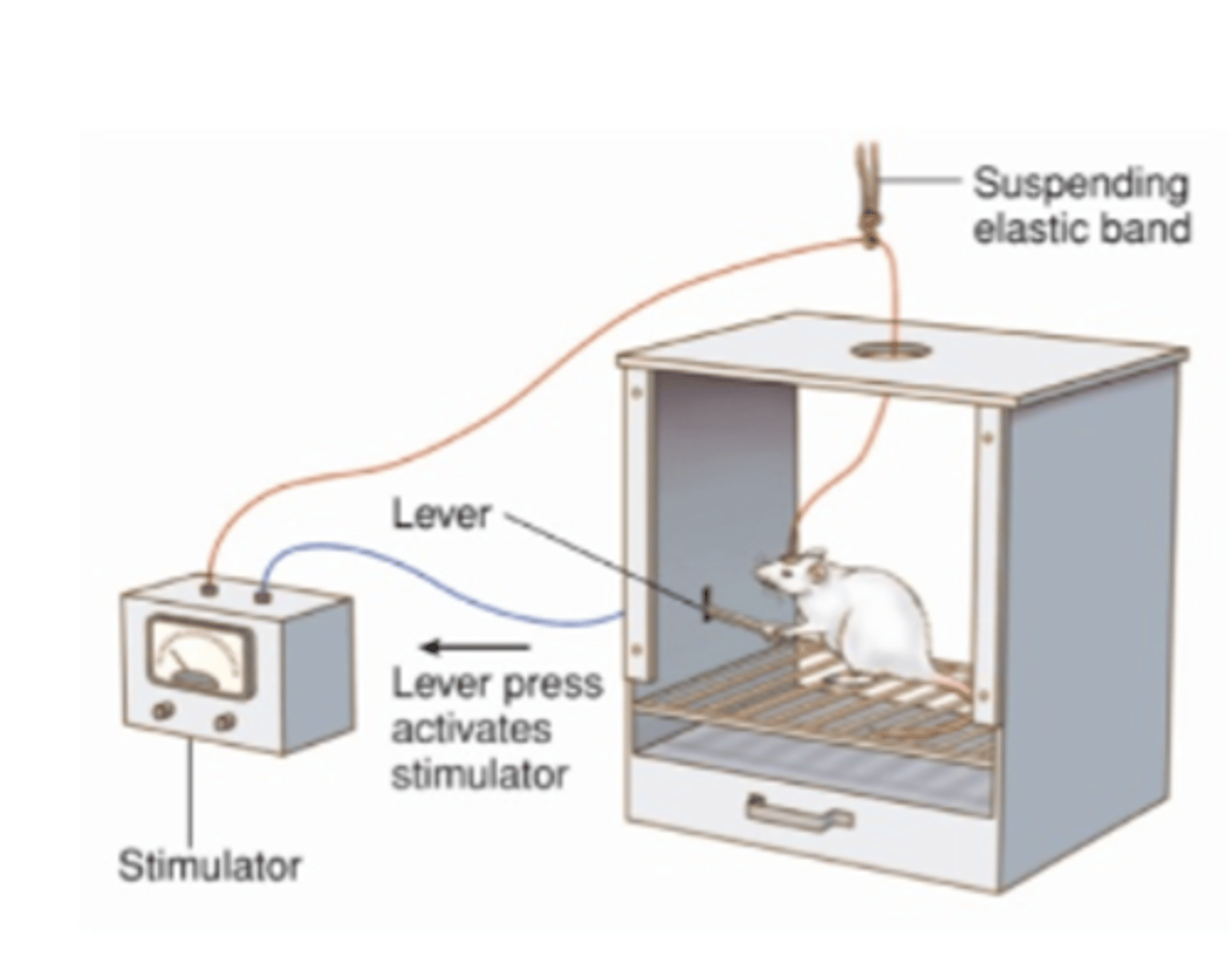
What is intra-cranial self-stimulation (ICSS)?
This describes when an electrode is placed in different parts of a rats brain. The rat is given a lever, which (when pressed) can stimulate different regions of the brain through electrical stimuli.
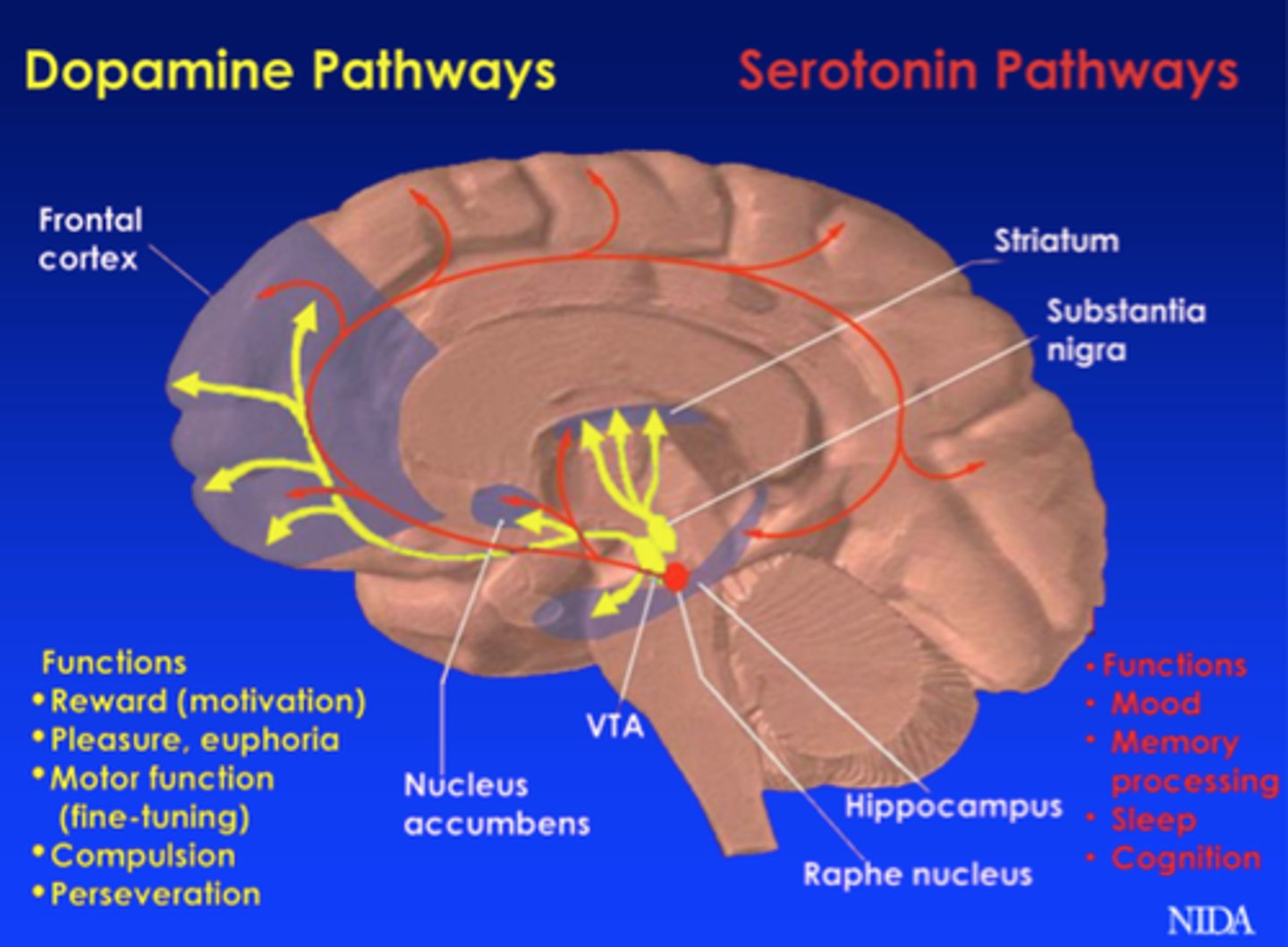
What is the name for the reward pathway in the brain?
Mesolimbic pathway
What are the different areas of the brain involved in the reward pathway?
Ventral tegmental area
Nucleus accumbens
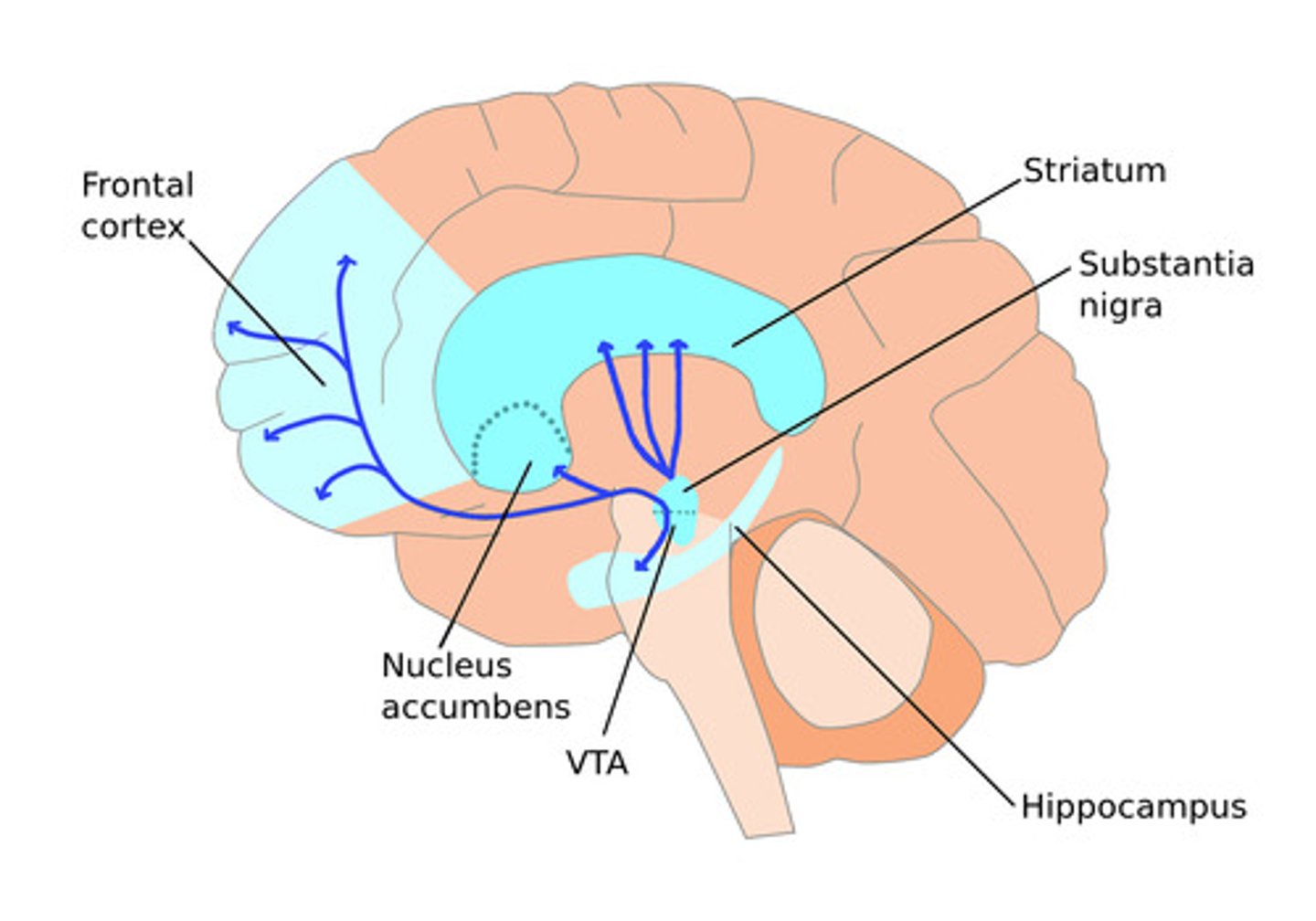
Describe the mesolimbic pathway
It is a dopaminergic pathway.
The cell body of the neurons is in the ventral tegmental area and the nerve terminal is in the nucleus accumbens .
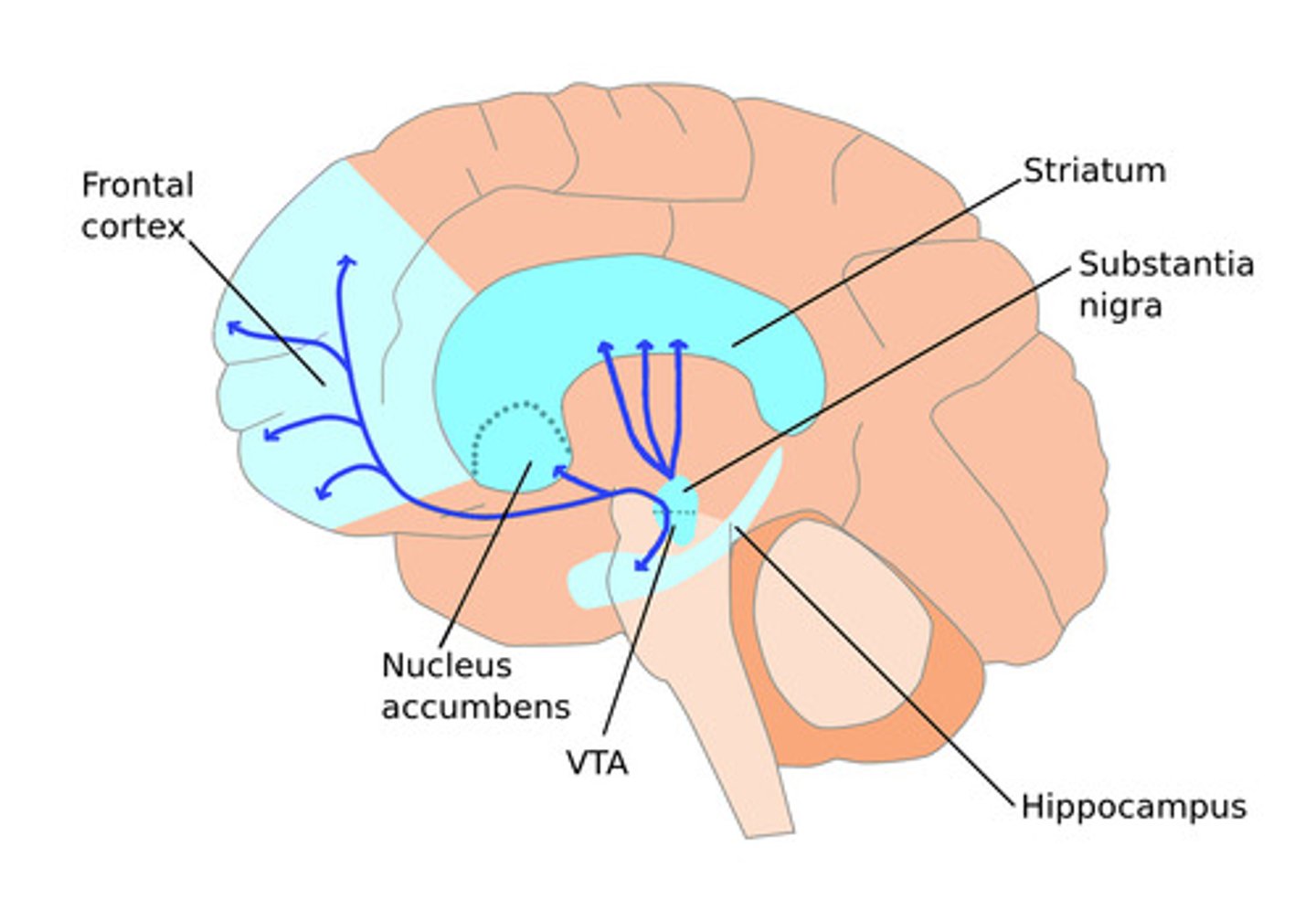
What are the 4 dopaminergic pathways in the brain?
1. Mesolimbic
2. Mesocortical
3. Nigrostriatal
4. Tuberoinfundibular
How was the neurotransmitter involved in the mesolimbic "reward" pathway discovered?
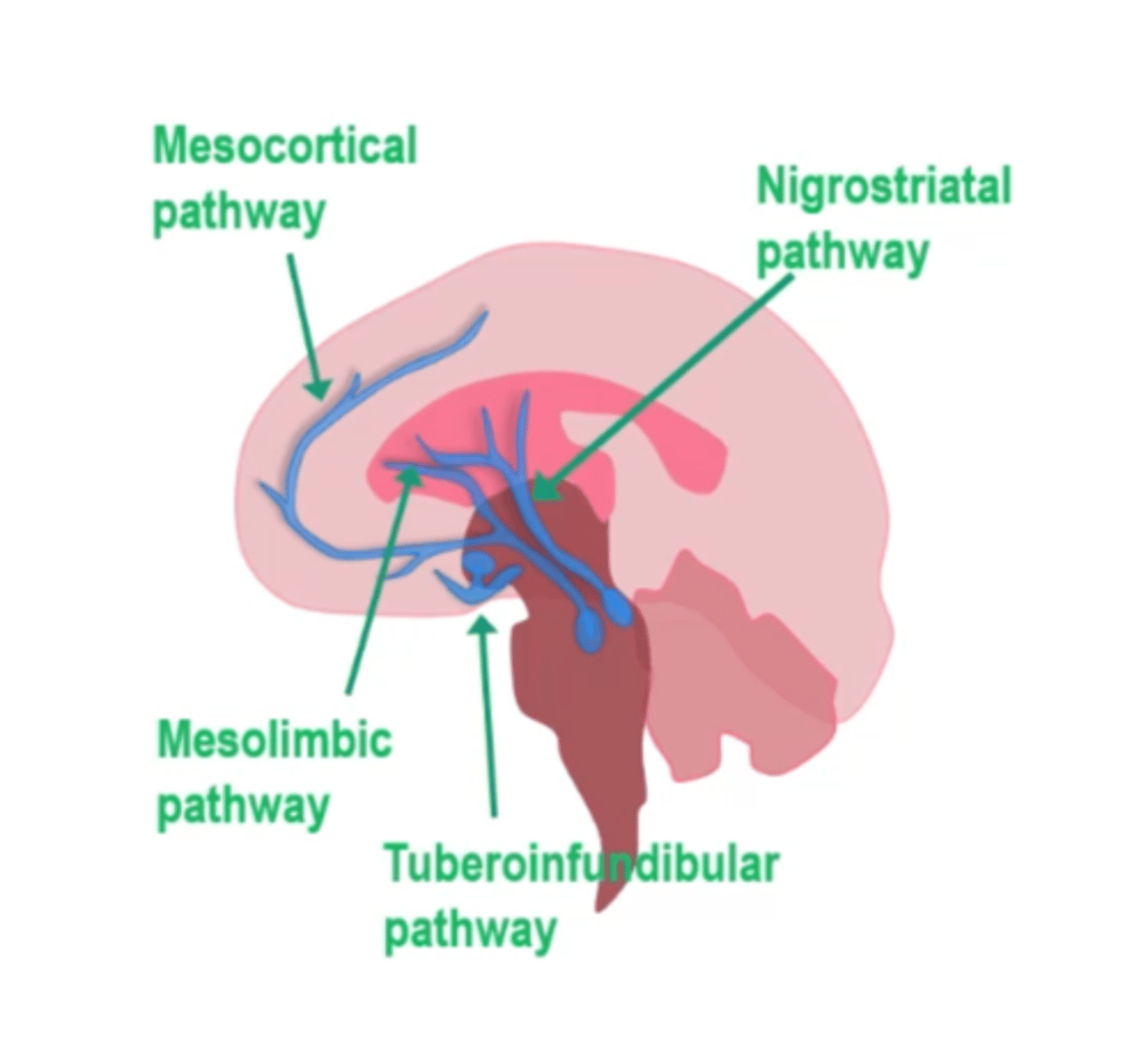
ICSS (intracranial self-stimulation) was done in the the VTA (ventral tegmental area) in rats and an electrode planted in the nucleus accumbens - microdialysis was done here.
At the tip of the node there is dialysis tubing which allows small molecules to pass through. Therefore neurotransmitter involved in mesolimbic pathway is collected
The neurotransmitter is then analysed through a HPLC machine.
What is the neurotransmitter involved in the reward pathway?
Dopamine (DA)
What evidence was there that dopamine was the neurotransmitter involved in the mesolimbic pathway?
When dopamine D1 OR D2 antagonists were administered directly into nucleus accumbens it reduced ICSS.
What is the effect of drugs of abuse in relation to the mesolimbic/ reward pathway?
Drugs of abuse increase dopamine release in the nucleus accumbens
What evidence was there that the mesolimbic pathway was involved with the use of recreational drug?
1. When animals are injected with drugs of abuse (such as cocaine, heroine, amphetamines and morphine) in the nucleus accumbens, there is a huge release in dopamine.
2. 6-OHDA destroys dopaminergic neurons. When it is administered in rats, it prevents them from self-administering drugs of addiction.
3.D1 and D2 receptor antagonists inhibit drug self-administration (prevent dopamine binding).
What is the effect of kappa agonists on the mesolimbic pathway?
Kappa agonists cause a decrease in dopamine release in the nucleus accumbens.
Hence why they are not used in clinic because they make patients feel dyseuohoric.
What drugs of abuse do not increase dopamine in the nucleus accumbens? Why?
LSD and diazepam
- LSD is a psychedelic, it works on a different pathway causing a dissociation from reality. Apart from humans, no other animal wants to dissociate from reality.
- Diazepam is self-administered in animals (unlike LSD) but rather than acting on the reward pathway and achieving a euphoric benefit, it alleviates an underlying health condition (e.g. anxiety).
Rank these drugs in most to least abuse liability:
Codeine, loperamide, heroin, buprenorphine, morphine
1. Heroin - crosses BBB quicker than morphine
2. Morphine
3. Buprenorphine
3. Codeine - as we increase the potency at the mu receptor, there is an increase in liability for addiction.
4. Loperamide - doesn't cross the BBB. Levels in brain are essentially 0.
What drugs are psychostimulants?
Amphetamines and cocaine
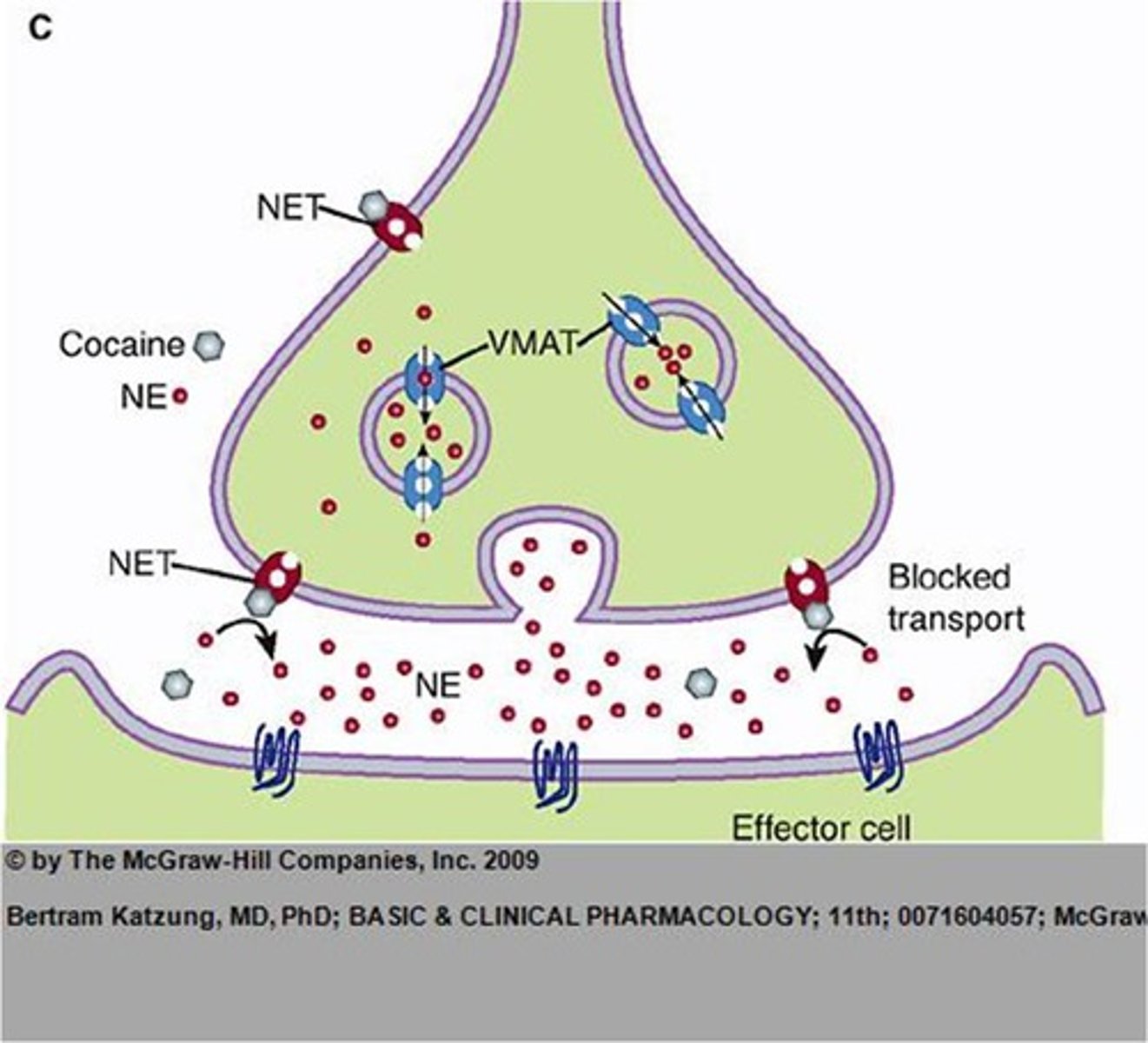
Describe how amphetamines and cocaine activate the reward pathway
Normally, when an action potential is released from the VGT, dopamine is released in the nucleus accumbens. After its release, it is taken back into nerve terminals by specific transporter proteins to reduce the amount of dopamine in the synaptic cleft.
Cocaine and amphetamines inhibit dopamine re-uptake transporters. Therefore when DA released, it is left in the synaptic cleft for longer because the re-uptake transporters are blocked.
Amphetamines also cause dopamine release in their own right - this is likely due to "reverse transport". There may be leakage of DA from nerve terminals through re-uptake channels, but this is only hypothesised.
Describe how opiates activate the reward pathway
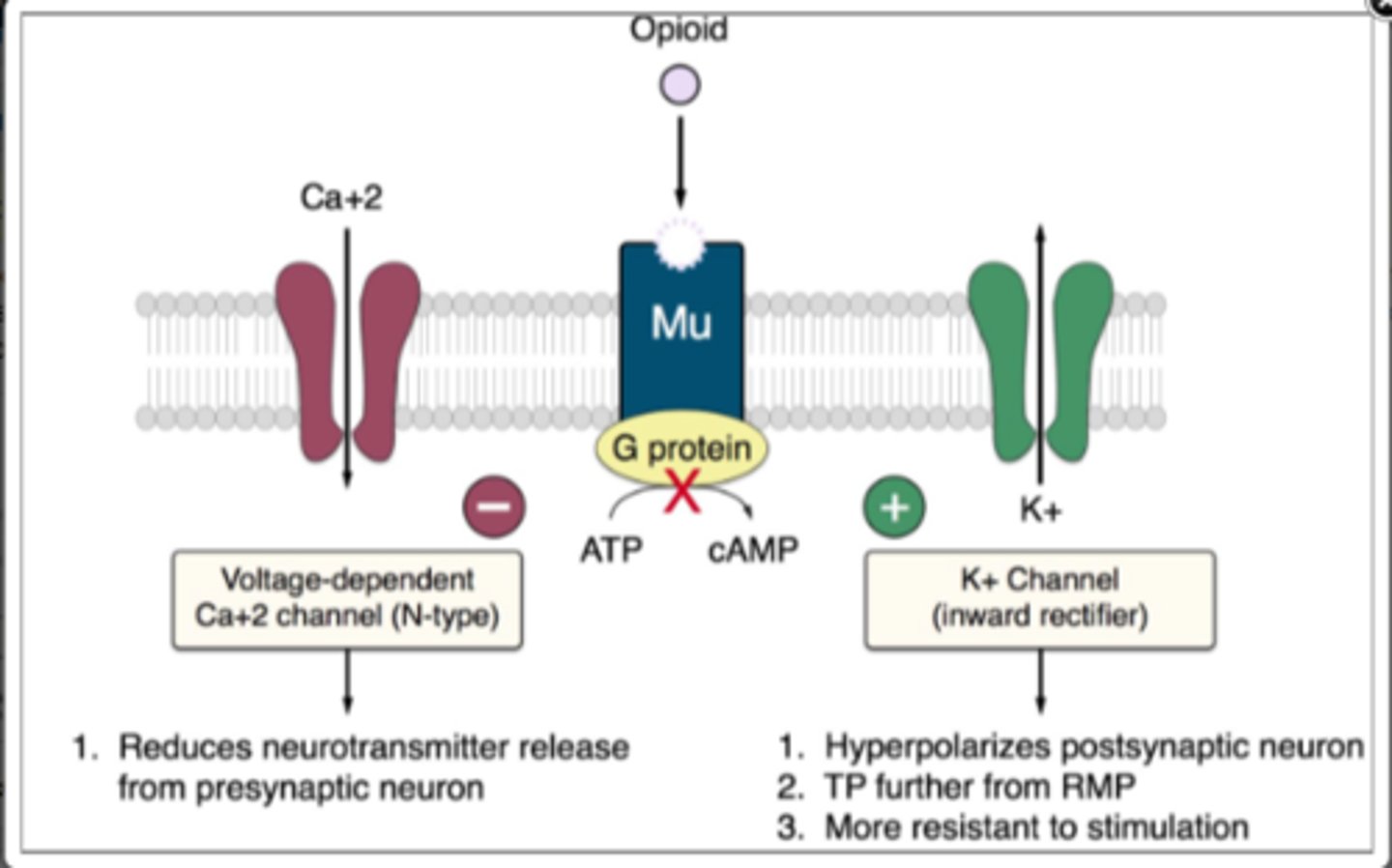
They all are relatively selective to Mu receptors.
In the VGT there are GABAergic receptors with mu receptors on the cell bodyand nerve terminal.
Opiates mechanism of action is an example of disinhibition.
Opioid receptors inhibit a neuron when activated. Therefore, there is less inhibitory input from GABAergic neurones.
Therefore, more APs are fired from the VGT to the nucleus accumbens resulting in more dopamine release.
The opioid receptor is Gi/go coupled.
The beta and gamma sub-unit cause:
- opening of K+ channels
- inhibition of Ca2+ channels. Hyperpolarisation of neuron as a result from K+ channel opening and inhibition of neurotransmitter release from Ca2+ channel closing.
Describe how ethanol activates the reward pathway
Ethanol decreases the "after hyperpolarisation"
This is the hyperpolarisation after an AP has been fired.
After hyperpolarisation occurs because Ca2+ channels remain open a little longer.
Ethanol blocks the Ca2+ channel resulting in a shorter "after hyperpolarisation" phase. Therefore, another AP can be fired quicker
Describe how nicotine activates the reward pathway
Nicotine is an active agonist in the dopaminergic pathway.
There are many nicotinic Ach receptors on dopaminergic cell body neurons.
If activated by nicotine it results in an increase in Na+ influx into the cell. This causes an AP release and causes release of neurotransmitter (DA).
Describe how cannabis activates the reward pathway
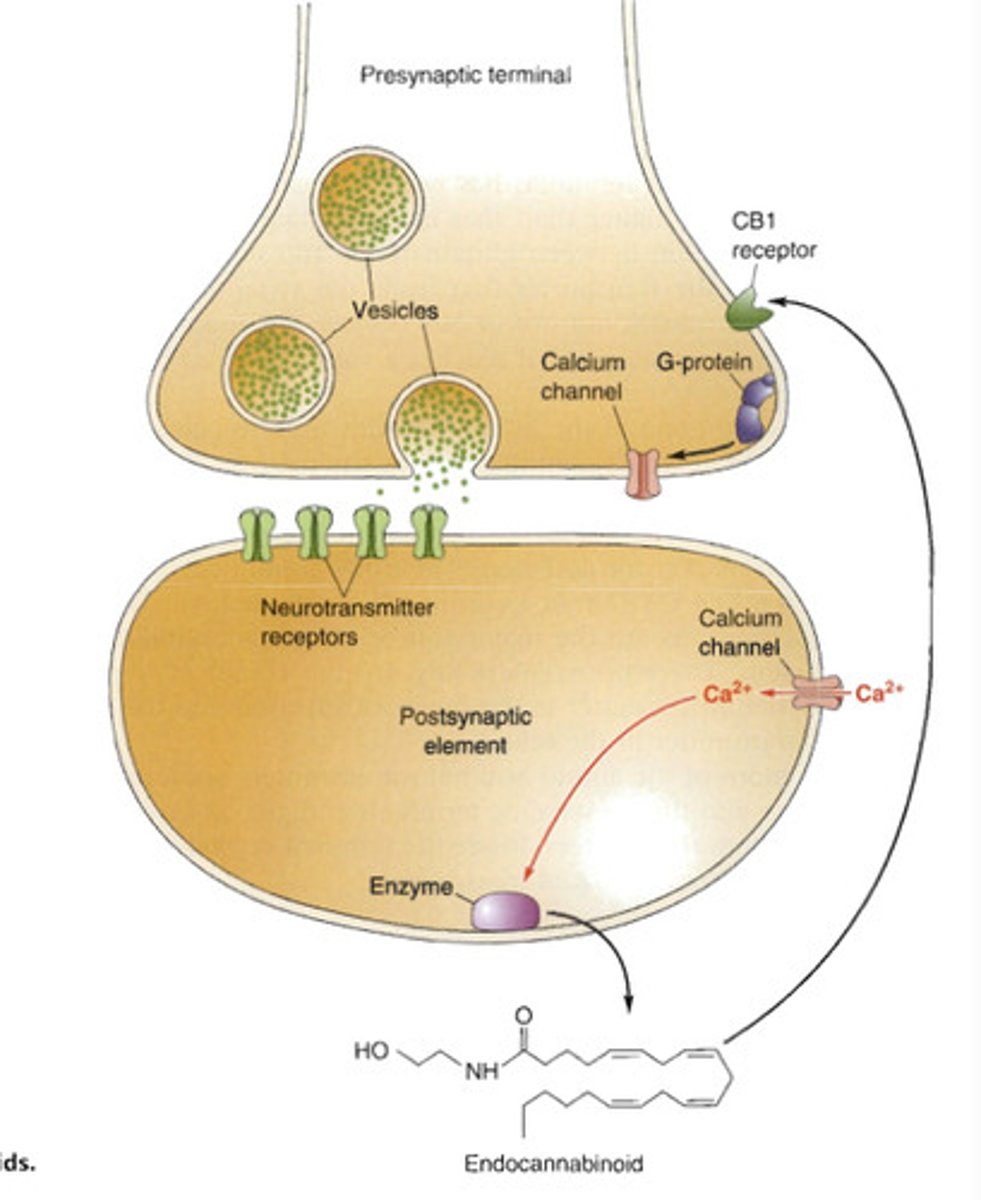
Cannabis acts as an agonist on CB1 receptors.
CB1 receptors are Gi/go coupled.
If THC (the active ingredient in cannabis) activates the CB1 receptor, then it has an inhibitory effect.
CB1 receptors are on the cell body and nerve terminal.
The mechanism of action of THC is disinhibition - just like opioids.
CB1 receptors inhibit a neuron when activated. Therefore, there is less inhibitory input from GABAergic neurones.
Therefore, more APs are fired from the VGT to the nucleus accumbens resulting in more dopamine release.
The CB1 receptor is Gi/go coupled.
The beta and gamma sub-unit cause:
- opening of K+ channels
- inhibition of Ca2+ channels. Hyperpolarisation of neuron as a result from K+ channel opening and inhibition of neurotransmitter release from Ca2+ channel closing.
Why have we evolved to have the reward pathway?
To encourage humans to obtain "natural rewards". These are stimuli which require us to feel good in order to increase our desire to obtain them. For example, food and sex.
 Note
Note  Flashcards (23)