Producer theory
 Studied by 0 people
 Call with Kai
 Learn
Learn Practice Test
 Spaced Repetition
 Match
Match Flashcards
 Knowt Play
1/26

There's no tags or description
Looks like no tags are added yet.
Name | Mastery | Learn | Test | Matching | Spaced | Call with Kai |
|---|
No study sessions yet.
27 Terms
Firm definition
An organisation that transforms inputs into outputs (production definition) to meet consumer demand and generate profit
Producer theory assumptions
The firm produces a single good
The firm has already chosen which product to produce
Firms minimise costs associated with every level of production (necessary condition for profit max.)
Only two inputs are used in production: capital and labour
Distinguish between short run (when one or more inputs are fixed, typically capital is assumed to be fixed and amount of labour can be changed) and long run (when all inputs are variable and fully adjustable)
The more inputs a firm uses the more output it makes
Inputs are characterised by diminishing returns e.g. if capital is fixed then each additional worker eventually produces less incremental output than the last
Firms are NOT budget constrained
Production function: Q = f (K,L)
Production function:
Specifies the maximum output that can be produced with a given quantity of inputs, it’s defined for a specific state of engineering and technical knowledge
Different combinations of inputs can generate the same output - because labour and land come from different markets so have different costs, so same input combinations could come at a different price - but firms choose the least costly method to produce the target output level they want
Total product
Total output (Q) produced with a given level of input
Upward sloping concave shape graph - increases steeply at first then flattens
Average product
Total output divided by number of units of input (APL = Q/L) for average product of labour
Marginal product
The extra output generated from one additional unit of input, holding all other inputs constant (MPL=\frac{\Delta Q}{\Delta L}) this is marginal product of labour
Diminishes with each additional input - downward sloping convex shape graph
Returns to scale
Examines how output responds when all inputs change proportionally
Constant returns to scale
Output increases by the same proportion e.g. inputs doubled outputs doubled
Seen in small-scale manufacturing, handcrafting
Increasing returns to scale
Output increases more than proportionally e.g. inputs doubled outputs triple
Driven by specialisation, automation and fixed costs spread over larger output
Decreasing returns to scale
Output increases LESS than proportionally e.g. double all inputs output rises only by 50%
Often due to coordination issues or resource constraints
Isoquant
Curve that shows all combination of inputs that produce the same level of output - including fractional input levels e.g. 3.7 hectares - describe the trade-offs between inputs
(Show all input bundles with the same output - similar to indifference curve that show all bundles with the same utility and has similar shape - convex)
Isoquants close together reflect increasing returns to scale, and more dispersed isoquants reflect decreasing returns to scale
Marginal rate of technical substitution
Equivalent to the slope of the isoquant curve - describes the rate at which labour must be substituted for land in this case, to hold the quantity produced constant
MRTSLA = − ∆A (Land) /∆L (Labour)
OR
MRTSLA = − MPL/MPA
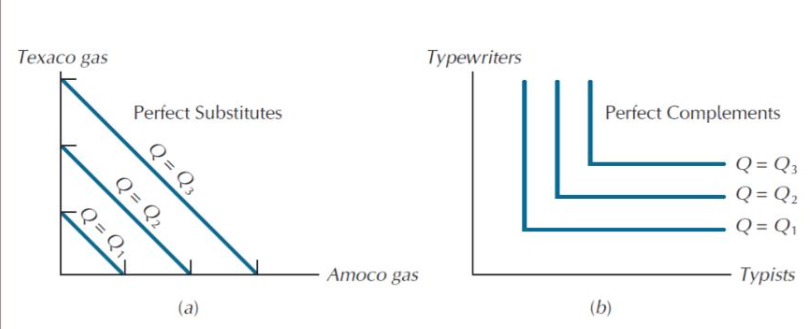
Shape of isoquants - graphs perfect substitutes/complements
If inputs are perfect substitutes isoquants would be straight lines
If inputs are perfect complements isoquants would be L shaped
Isocost line
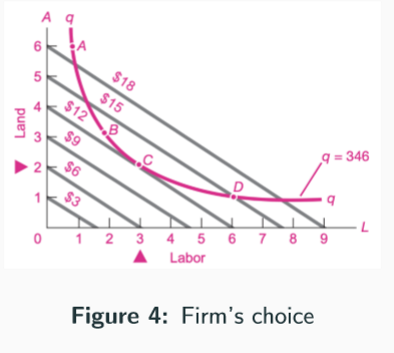
Shows all input combinations that result in the same total cost given a fixed level of output
Higher isocost lines represent higher levels of cost
Cost minimisation - isoquant and isocost
The optimal input choice is where the ISOQUANT is tangent to the lowest possible ISOCOST line - slope of isoquant = slope of isocost
In this picture it is clear point C is the optimal choice
Firms minimise costs when the marginal product per dollar spent is EQUAILISED across inputs - equimarginal principle
Total costs formula
TC = TFC + TVC
Fixed costs
Cost that is constant regardless of output produced e.g. rent
FC = TC - TVC or FC = AFC x Q
Variable costs
Costs that change in direct proportion to output e.g. raw material costs
VC = TC - FC or VC = AVC x Q
Graph showing relationship between TC, TVC and TFC - and shape of TC and TVC explain

They are influenced by the law of diminishing marginal returns, as initially there is a decrease in cost as a variable factor of production is added to the fixed factors which increase output, until a certain point where output then falls as the fixed factors are overcrowded causing the costs to then start to increase
Average fixed cost formula
AFC = FC/Q or AFC = ATC - AVC
Average total cost formula
ATC = TC/Q or ATC = AFC + AVC
Average variable cost formula
AVC = VC/Q or AVC = ATC - AFC
Graph showing relationship between MC, ATC, AVC and AFC

Long run vs short run - cost-efficient
Long-run choices are always more cost-efficient because in the short run there is input inflexibility
Relationship between short run and long run average total cost curves
Short run cost curves are U shaped due to law of diminishing marginal returns where average costs initially decrease until a point where they start to increase. Then, in the long run all FoP are variable, and firms want to produce with the lowest cost method of production, so they will rearrange them to minimise cost - lowest point of all SRAC curves make up the LRAC curve (LRAC curve U shaped due to size of business + economics of scale)
Diseconomy of scale
As output rises average cost also rises
Economies of scale
As output increases average cost falls
 Note
Note  Flashcards (90)