Independent Subjective Refraction
 Studied by 0 people
 Call with Kai
 Learn
Learn Practice Test
 Spaced Repetition
 Match
Match Flashcards
 Knowt Play
1/11

There's no tags or description
Looks like no tags are added yet.
Name | Mastery | Learn | Test | Matching | Spaced | Call with Kai |
|---|
No study sessions yet.
12 Terms
How do you refine BVS without a retinoscopy starting point?
> Occlude left eye
> Measure unaided vision
> if possible estimate ametropia
> in myopia position of true far point can be used to estimate refractive error
> e.g person with -8.00D myopia sees clearly if target placed at approx 12.5cm from eye
Relationship between acuity and refractive error
6/6 → <0.25 DS
6/9 → <0.50DS
every line on chart equal to 0.25DS or more
for 6/18 or 6/24 use pinhole to see if vision improved
Steps for refining BVS without ret starting point?
add +1.00D sphere
is vision worse
NO → add more plus spherical power until vision blurs , from blur point reduce by +0.25DS
BVS should be max plus that eye can tolerate without causing blur on letter chart
if YES (vision is worse) → add MINUS spherical power until best line resolved
make sure each addition does increase and letters not just smaller
adjust final sphere on letter chart and/or duo chrome using ±0.25DS
Record VA
Occlude right eye & repeat procedure for left eye
How would you refine BVS for patients with poor VA?
px with poor VA may have difficulty in determining small changes in lens power + clarity
often necessary to make large power changes → bracketing techniques e.g use a +2.00DS trial lens and compare this with -2.00DS trial lens
if px able to differentiate between the two, lens giving better vision can be added and technique repeated using a +1.00DS and a -1.00DS lens
may be necessary to refract patient with chart placed at 3m or less
if done result is over-plussed as chart acts as near object and adds vergence of about -0.30D + correction should be made
use of PINHOLE essential when vision poor, in order to attempt to differentiate refractive error from active pathology
Duochrome
only monocular
duo chrome is of no real value until ametropia has been corrected to point where acuity is at least 6/12
+0.25/-0.25 spheres are used, usually mounted on a handle
Targets equal : add +0.25 DS → targets on red clearer
Targets equal :add -0.25 DS → targets on green clearer
How to use the Stenopeic Slit to Identify Astigmatic Axis?
Stenopeic slit: narrow 1-2mm slit in an occluder used in trial frames
functions like elongated pinhole, allowing only narrow band of light through
helps identify astigmatic axis by aligning with the meridian of clearest vision
px views through slit; image sharpest when slit aligns with one of the principle meridians of the Conoid of Sturm
useful for isolating & refining c
Set up for determining astigmatic axis with stenopeic slit
px wears trial frames with stenopeic slit over test eye
occlude other eye
display 6/18 or 6/24 snellen line
> Patient’s role:
rotate stenopeic slit using trial frame knob
stop when image is sharpest
> Outcome:
slit aligns with one principle meridian of the Conoid of Sturm → astigmatic axis
other meridian is at 90 deg to first
What is the procedure of the Fan and Block?
begin with px monocular BVS in place
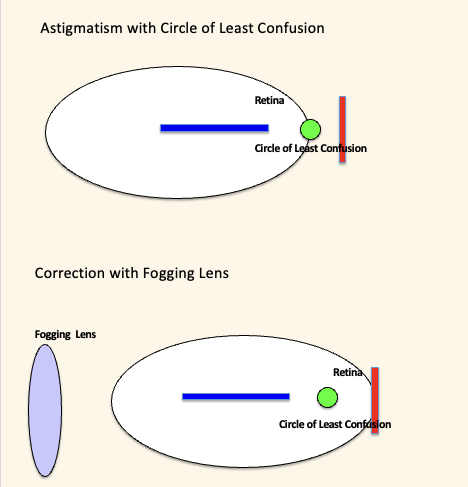
Add FOGGING lens to eye being tested (depends on cyl size → if patient estimated 1D of cyl then +0.50DS should suffice) to slightly blur image & prevent over-minus responses
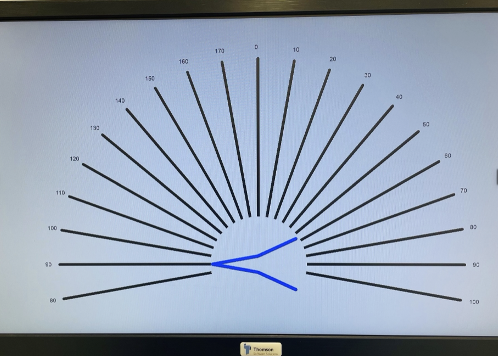
display fan dial chart at 6 metres
Ask patient which group of lines apparent clearest or darkest
Astigmatism with Circle of Least Confusion
> fogging lens moves circle of least confusion in front of retina
prevents over minus
relaxes accommodation
Understanding Fan Chart Axis Interpretation
when px views Fan Chart , orientation of lines they see more clearly will appear 180 degrees opposite to what practitioner observes
e.g if px reports clearest lines at 65 degrees, one meridian is:
adjustment accounts for reversed perspective between px + practitioner
cyl axis inserted perpendicular to this, so inserted at 25 deg
so 180-65=115
115-90 =25

What is the Procedure of Fan Chart
insert a trial cylinder (commonly -0.50DC) at calculated axis
observe if vision improves → if line clarity becomes more equal , on correct axis
if distortion worsens, axis may need further adjustment
rotate axis in 5-10 deg steps & ask px which orientation yields the most uniform clarity
Refine Cyl power & Axis :
if blur remains on certain lines , increase cyl power in -0.25 DC steps
after each change in cyl apply spherical compensation to maintain circle of least confusion → adding +0.25DS for every -0.50DC added
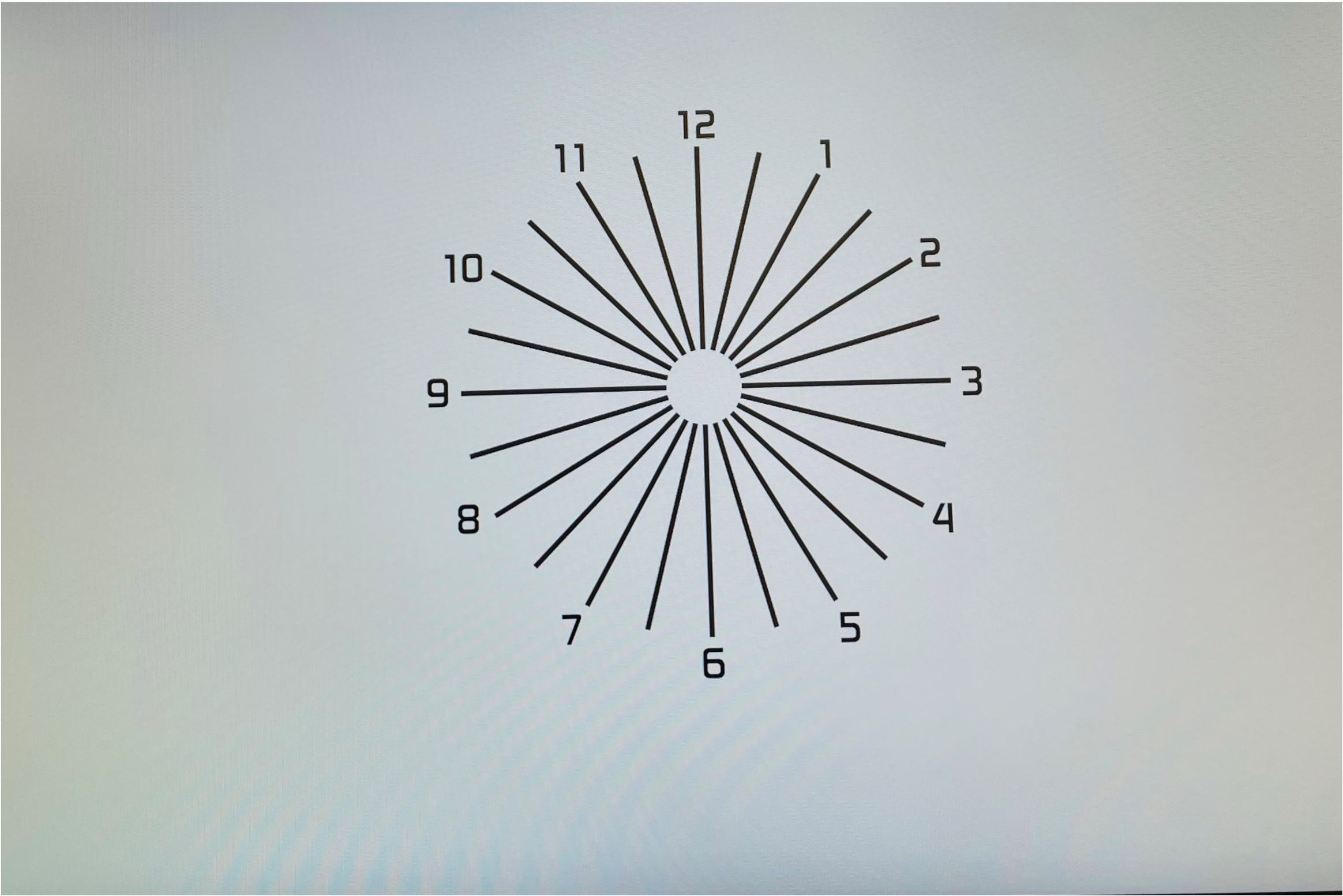
What is the Clock Dial Technique for Detecting and Refining Astigmatism (Elite Chart)?
used in subjective refraction to determine both axis + presence of astigmatism
visual analogue of the fan method , but stimulus more closely resembles face of a clock
allows optoms to localise the clearest + blurriest meridians by using px perception of line clarity , serving as effective tool in refining cyl correction
if clearer at 1 times by 30
7 corresponds to 1 so times by 30 up to 6
 Note
Note  Flashcards (22)