Lecture 9: Food Reward and Food Addiction
 Call Kai
 Learn
Learn Practice Test
 Spaced Repetition
 Match
Match Flashcards
 Knowt Play
1/66

Earn XP
Description and Tags
: Basic mechanisms of Food reward - Non-homeostatic (reward-based) accounts of eating and overeating - The role of food cues, availability, palatability and wanting system - Can food be addictive.
Name | Mastery | Learn | Test | Matching | Spaced | Call with Kai |
|---|
No analytics yet
Send a link to your students to track their progress
67 Terms
Can we love food too much?
Eating behaviour plays key role in maintain our physical health and wellbeing.
Parsing eating behaviour —> food intake is underpinned by
Reward system (‘physiological system’)
Homeostatic system (‘biological sytstem)
Homeostasis system underpins food intake; governs energy balance via complex interplay between….
neural control structures (brainstem, hypothalamus) and hormonal signals -> gut hormones secreted in response to ingested nutrients.
Homeostasis system underpins food intake —> mostly operates through
through mechanisms (negative feedback loop) that end meal – operates once the meal is done (satiety signals), to lesser extent through meal initiation mechanisms -> fullness vs hunger. Rogers and Hardman (2015), Rui (2013).
How does the reward system underpin food intake —> it is an
Evolutionary old system of distinct neural structures (midbrain, ventral striatum, OFC) that promote approach and consummatory behaviour.
How does the reward system underpin food intake —> responds to primary (e.g., food, sex) and
secondary rewards (e.g., money)
How does the reward system underpin food intake —> reward =
stimuli that are positive reinforcers because of their incentive properties (elicit pleasures or the desire to approach/consume them). Based on Schultz (2015), Anseleme, (2009)
Good evidence that suggest that we can and we should distinguish between a
wanting and a liking component when we look at the reward system
wanting and liking in the reward system —> in terms of eating
- Liking refers to the pleasure/enjoyment of eating or palatability.
- Wanting – desire/motivation to eat – food cravings.
wanting and liking in the food system are strongly influenced by external factors….
e.g., social norms, dieting —> can shape food lntake/
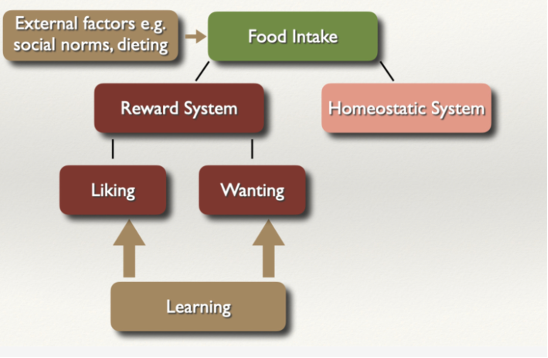
The need for reward-based accounts of eating and overeating: WHY are purely biological explanations not enough? —> obesity epidemic cannot be explained by
by biological changes but only by environmental or psychological factors (i.e. non-homeostatic).
The need for reward-based accounts of eating and overeating: WHY are purely biological explanations not enough? —> only a small proportion of obesity cases are attributable to
biological factors (such as genetic variations causing resistance to satiety signalled by leptin; Kenny, 2011).
The need for reward-based accounts of eating and overeating: WHY are purely biological explanations not enough? —> weight reduction interventions —> if iy was just bio it would be simple (just reduce food intake)
Weight reduction (and maintaining weight loss) through interventions is extremely difficult to achieve --> Turk et al., 2009: (1) 30-35% of weight loss regained during first year after treatment; (2) only 20% of treatments lead to sustained success. If it was just biology – it would be simple (reduce food intake and increase physical activity). ……… are weight loss ‘pills’ a game changer?
Food as a powerful reward…. satiated rats will endure harsh environments for sugar.
Satiated rats voluntarily expose themselves to extreme cold (-15 C heat) or shocks, (Cabanac & Johnson, 1983) in order to obtain access to soft drinks or chocolate. Something about high fat food that is too hard to resist?
Reward-based accounts: Overview
1. Conditioned food cues in environment
2. Availability and ease of access to food (e.g., effects portion size)
3. Palatability (food liking, pleasure of eating)
4. Food wanting and mesolimbic system.
Reward-based accounts of eating – the role of food cues: The role of conditioned cues: Weingarten (1983) w satiated rats
1. Rats learned that buzzer/light (conditioned stimulus) was followed by food.
2. Rats then fed to satiety
3. CS still elicited eating.
Reward-based accounts of eating – the role of food cues: The role of conditioned cues: Weingarten (1983) w satiated rats —INTEPRETATION
→ Learned cues associated with food can elicit eating in the absence of metabolic need: Food reward can override homeostatic signals. We are bombarded with food cues – e.g., food ads – cant escape food cues in our environment.
→ Cue induced ‘hyperphagia’.
Reward-based accounts of eating – the role of food cues: The role of conditioned cues: food cues in humans - Lab studies with humans can interfere with other cog processing
- Font-colour naming in the ‘food stroop task’ e.g., Channon & Hayward, 1990.
- Detection of a target dot after a food picture (dot-probe paradigm) e.g., Mogg et al., (1998)
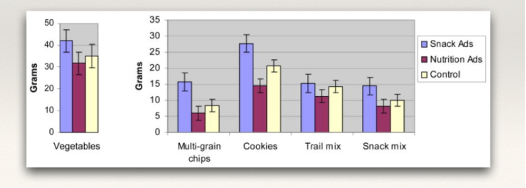
Reward-based accounts of eating – the role of food cues: The role of conditioned cues: food cues in humans —> Food advertising - does it work? —> Harris (2010) - ex 1 - METHOD
- School children (9 years) watched 15-min cartoon with food ads (high sugar cereals or crisps) or control cartoon.
While watching kids allowed to snack from bowl of ‘goldfish’ crackers.
Reward-based accounts of eating – the role of food cues: The role of conditioned cues: food cues in humans —> Food advertising - does it work? —> Harris (2010) - ex 1 - results
Experiment 1 – children who watched food ads consumed on average 9 more grams of crackers -> if behaviour would be maintained everyday for 1 year, increased snacking would lead to weight gain of 10 pounds.
Reward-based accounts of eating – the role of food cues: The role of conditioned cues: food cues in humans —> Food advertising - does it work? —> Harris (2010) - ex 2 - METHOD
- Adult p’s watched TV show (a) ads for snacks/fast food (b) ads for more healthy, nutritious food of (c) no food ads.
- Subsequent taste test and evaluation of range of healthy and unhealthy food.
Reward-based accounts of eating – the role of food cues: The role of conditioned cues: food cues in humans —> Food advertising - does it work? —> Harris (2010) - ex 2 - results
watching TV ads for snack food increased intake of food from ALL food categories (vice versa for nutritious ads)
Reward-based accounts of eating – the role of food cues: The role of conditioned cues: food cues in humans —> The ‘Obesogenic’ environment: — definition
Obesogenic environment (= environment that produces obesity; Swinburn et al., 2009
Reward-based accounts of eating – the role of food cues: The role of conditioned cues: food cues in humans —> The ‘Obesogenic’ environment: — risk of cue induced….
hyperphagia, and an availability induced hyperphagia
Reward-based accounts of eating – The role of Availability: Tordoff (2012)
- Rats allowed to eat freely from three different cups of food (cafeteria diet: carbs, fat, protein food) -> some rats received one extra cup of either fat or carbs.
- Result in experimental group: extra cup of carbs/fat led to life-threatening under-consumption of protein (even though protein was freely available).
Reward-based accounts of eating – The role of Availability: Tordoff (2012) —- intepretation
- Fats/carbs reward just being there – triggered desire to consume it, the more attractive food type just being there already triggers desire to consume.
Reward-based accounts of eating – The role of Availability: Tordoff (2012) —- intepretation in relation to HUMANs
- Food is available 24/7
- Many restaurants offer self-serving buffets.
- Over past decades sharp increase in typical ‘serving size – super sized food –( Rolls, 2003)
Reward-based accounts of eating – The role of Availability: PORTION SIZES —> Levitsky et al., 2004. - method
- First week – p’s allowed to take as much or as little as they wished from a buffet lunch -> before consumption researchers determined individual portion size by weighing the food.
- Second week – p’s were served lunch with different portion sizes (100%, 125%, 150% of week 1’s portion size) or the exact same as the previous week.
Reward-based accounts of eating – The role of Availability: PORTION SIZES —> Levitsky et al., 2004. - results
When larger amounts were served, sig larger amounts of food were consumed…. Even though their internal portion size in week 1 was established
Reward-based accounts of eating – The role of Availability: PORTION SIZES —> Wansink and Kim (2005) - ‘bad popcorn in big buckets - do we only overeat when we like the food?…..
- moviegoers given either a medium (120g) or large (240g) container of popcorn that was either fresh or stale.
- Fresh popcorn group: Ate 45.3% more from larger bucket
- Stale: still ate 33.6% more from larger bucket
Reward-based accounts of eating – The role of Availability: PORTION SIZES —> Wansink and Kim (2005) - ‘bad popcorn in big buckets - do we only overeat when we like the food?….. novel application
Portion size could also be used to increase the consumption of disliked healthy food (vegetable)
Reward-based accounts of eating – The role of palatability (pleasure of eating) - palatability means
‘agreeable to the plate’
Reward-based accounts of eating – The role of palatability (pleasure of eating) - is a…..
hedonic aspect of food reward (pleasure, enjoyment, and liking)
Reward-based accounts of eating – The role of palatability (pleasure of eating) - potent factor in eating —> when given a choice most rats will prefer…
intensely sweet (but nutrition free) saccharin solution over cocaine (Lenoir et al., 2007).
Reward-based accounts of eating – The role of palatability (pleasure of eating) - does chocolate really make you happy? —> Macht and Mueller (2007)
- P’s underwent a mood induction procedure – either sad, happy or neutral film sequence.
- P’s the received either a piece or choc or some water.
- Mood ratings taken before movie, after movie, after choc/water sample.
- Main results – eating choc, compared to drinking water, decreased negative mood in the sad film sequence group, no effects in happy or neutral mood induction groups.
Reward-based accounts of eating – The role of palatability (pleasure of eating) - does chocolate really make you happy? —> Macht and Mueller (2007) —→ theoretical explanation
- Prevailing belief that mood enhancement is caused by nutrients or psychoactive ingredients in cacao (e.g. tryptophan, caffeine or theobromine)
- But – Psychopharmacological effects occur slowly (1-2 hours) and would require large amounts of cocoa to be consumed.
- More plausible psychological account: chocolate is a strong reward, involving both unconditioned responses (so sweetness) and conditioned reward responses.
Reward-based accounts of eating – The role of palatability (pleasure of eating) - comfort food and emotional eating ….. emotional eating is used to…
- to cope with stress or alleviate negative emotions (Macht and Simmons, 2000) -> individual differences assessed with the emotional eating scale (EES; Arnow et al., 1995)
Reward-based accounts of eating – The role of palatability (pleasure of eating) - comfort food and emotional eating ….. Dallman (2003) review… comfort food reduce stress by….
stress by acting on hypothalamo-pituitary-adrenal-axis (HPA).
Reward-based accounts of eating – The role of palatability (pleasure of eating) - comfort food and emotional eating ….. Dallman (2003) review… HOWEVER —- other effects for momentary emotions
Self-regulation of negative emotions by food intake may only exist for longer affective sates (negative mood, feeling low)
Edgar & Ihssen --- trial by trial snack intake --- is increased after receiving positive vs negative feedback on quick answers --- people tended to snack more when positive feedback was given, if neg = less snacking.
The role of the wanting system: Link between palatability and overeating not so straightforward as it seems: — the French paradox
consuming a highly palatable French/ Mediterranean cuisine is less likely to produce obesity than other diets (Berthoud, 2012).
Explanation: Main factor for overeating may not be liking but wanting; wanting of energy-dense foods high in sugar/fat but low in vitamins/minerals.
Liking vs wanting mental process
L = hedonic experience during reward receipt
W = motivation to pursue a future reward (often triggered by cues) - desires, urges, cravings
Liking vs wanting —> Neural systems — liking
‘Hedonic hot spots’ within the ventral striatum
Mainly opioid based (but dopamine also involved)
Liking vs wanting —> Neural systems — wanting
mesolimbic system = neurons connecting ventral segmental area (VTA) with nucleus accumbens in ventral striatum
Mainly dopamine based
role for the wanting system (MESOLIMBIC system) —> Berridge and Robinson (1998) - methods
rats induced with lesions of the mesolimbic system tested for eating behaviour (wanting) and sucrose taste reactivity (liking)
role for the wanting system (MESOLIMBIC system) —> Berridge and Robinson (1998) - results for WANTING
W - rats developed aphagia (complete loss of eating), even though food was available.
→ rats could still perform movements but just did not use them to eat
role for the wanting system (MESOLIMBIC system) —> Berridge and Robinson (1998) - results for LIKING
normal hedonic responses to sucrose
role for the wanting system (MESOLIMBIC system) —> Berridge and Robinson (1998) - conclusions
rats liked the food but simply did not want it —> no attribution of ‘incentive salience’ to the reward (= motivational deficit)
Wanting system and obesity
Dysfunction of wanting system has been considered a key function for overeating.
Changes of the wanting system in obesity assume to be like as those in drug addition.
s Obesity = food addition?
Wanting system and obesity —> some facts on obesity
Obesity = BMI over 30
Proximal cues – calorific imbalance (energy intake > expenditureMajor risk factor for cardiovascular disease, cancer, type 2 diabetes’s, and mood related disorders -> second leading cause of preventable death after smoking.
Individuals often suffer from social stigmatisation.
Wanting system and obesity —> myth or truth in obesity as an addiction
Often used in public discourse and media
Led to the development of Yale Food addition scale based on DSM criteria for drug addiction (Gearhardt et al., 2009)
But: obesity only recognised as medical disease since 2013 and currently no diagnosis of obesity as a mental or psychiatric disorder.
Wanting system and obesity —> myth or truth in obesity as an addiction —> implication of the food addiction model?
Drug addiction is a chronic condition requiring close monitoring and lifelong management to prevent relapse.
If obesity = food addition, we would need lifelong management of eating behaviour.
Effects on social stigmatisation difficulty to predict: increase of stigmatisation by ‘labelling’ people? Decrease of stigmatisation by reducing attribution of controllability?
which of the diagnostic markers of drug addiction are present in obesity?
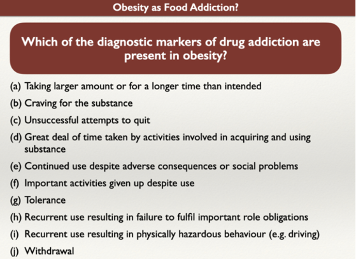
Wanting system and obesity —> myth or truth in obesity as an addiction —> diagnosing food addiction?
There is an overlap of many ‘behavioural syptoms’ of drug addiction and obesity (e.g., craving)
What seems to distinguish the conditions are tolerance and withdrawal (Alonso-Alonso et al., 2015)
However, obesity and drug addiction have also been linked to similarities in neural processing or brain responses.
Wanting system and obesity —> myth or truth in obesity as an addiction —> neural similarities between addiction and obesity - theories — hypersensitive reward system
hypersensitive reward system —> actives in response to food cues —> increased brain response —> increased wanting, craving, reward seeking —> theory = sensitisation of the mesolimbic reward system
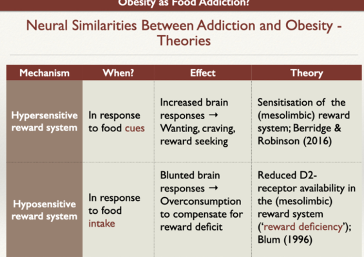
Wanting system and obesity —> myth or truth in obesity as an addiction —> neural similarities between addiction and obesity - theories — hyposensitive reward system
hyposenstive reward system —> in response to food intake —> blunted brain responses —> overconsumption to compensate for reward deficit —> reduced D2 receptor availability in the mesolimbic reward system (reward deficiency)
Wanting system and obesity —> myth or truth in obesity as an addiction —> neural similarities between addiction and obesity - the hypersensitive reward system and drug addictions and drug cues (pictures)
Individuals with drug addictions show stronger brain responses to drug cues (pictures) than controls. (MacNiven et al., (2018) – fMRI study of drug cue responses in patients with stimulant addiction (cocaine)
However, individuals with obesity do not show stronger brain responses to food cues (pictures) than controls (Morys et al., 2023)
Wanting system and obesity —> myth or truth in obesity as an addiction —> neural similarities between addiction and obesity —> brain responses to food and drugs ….. across obese vs non-obese individuals… the brain responses to
- food cues resemble those seen in addiction (e.g., smokers when exposed to smoking cues; see Tang et al., 2012). – same activity in amygdala, insula, OFC, striatum.
—> does this mean we are all addicted to food; probably not —> indicates that the theory may be wrong!
Wanting system and obesity —> myth or truth in obesity as an addiction —> neural similarities between addiction and obesity —> hypersensitive reward system during food intake…..
Relatively clear evidence for hyposensitive reward system in drug addiction (e.g., Volkow et al., 1997) but mixed evidence in obesity (Darcey et al., 2025)
In summary – the changes of the brain’s reward system that we see in drug action (sensitisation and reward deficiency) CANNOT be clearly identified in obesity.
Differences between Obesity and Addiction: —→ drug reward is caused by direct….
pharmacologic effects in the brain, food reward is NOT.
Differences between Obesity and Addiction: food reward results from an interaction between
homeostatic (e.g., satiety) and non-homeostatic factors, drug reward does NOT (Volkow, 2013)
Differences between Obesity and Addiction: food is necessary for survival…..
Drugs are not --> evolutionary overeating is adaptive; only today’s environment makes it maladaptive (Barry et al., 2010).
Differences between Obesity and Addiction - withdrawal and tolerance
Tolerance and withdrawal do NOT exist for eating behaviour (Alonso- Alonso et al., 2015).
Differences between Obesity and Addiction —> food cravings are….
extremely common and NOT necessarily pathological (Alonso-Alonso et al., 2015
Should obesity be added to DMS-5 as an addiction
- Concept of food addiction remains controversial and should be treated with caution.
- Delvin (2007) – ‘obesity’ is currently and rightly considered a medical rather than a psychiatric disorder.
- Alonso-Alonso et al., 2015 – it might be more useful to consider the notion of food abuse rather than food addiction (i.e. implying dependence)
reconciling view – we should highlight the ‘addictive dimension’ of food but not equate obesity and addiction (e.g., Volkow et al., 2013).
- Both conditions share certain (Psychological/neurobiological) processes but also involve unique processes.
Is only certain food addictive? —>. Gerhaertd & Schulte (2021
point out some striking similarities between drugs of abuse and ultra-processed foods (UPFs = industrially synthesised food using food extracts/constituents).
Is only certain food addictive? —>. Gerhaertd & Schulte (2021) —> both drugs and UPFs
- Are substances modified to enhance those constituents that are especially rewarding (e.g., nicotine, refined sugar)
- Act rapidly on the body/brain
- Do not occur naturally and do not promote survival.
Most foods that individuals perceive as problematic (‘addictive) are
UPFs (Schulte et al. (2015).

