research methods unit 2
 Call Kai
 Learn
Learn Practice Test
 Spaced Repetition
 Match
Match Flashcards
 Knowt Play
1/101

Earn XP
Description and Tags
chapters 7-12
Name | Mastery | Learn | Test | Matching | Spaced | Call with Kai |
|---|
No analytics yet
Send a link to your students to track their progress
102 Terms
chapter 6
surveys and observations
survey
a method of posing questions to people on the telephone, in personal interviews, on written questionnaires, or via the Internet
poll
a method of posing questions to people on the telephone, in personal interviews, on written questionnaires, or via the Internet
forced-choice questions
a survey question format in which respondents give their opinion by picking the best of two or more options
likert scale
a survey question format using a rating scale containing multiple response options anchored by the specific terms strongly agree, agree, neither agree nor disagree, disagree, and strongly disagree. a scale that does not follow this format exactly is called a i Likert-type scale .
semantic differential format
a survey question format using a response scale whose numbers are anchored with contrasting adjectives.
open-ended questions
a survey question format that allows respondents to answer any way they like
heading questions
a type of question in a survey or poll that is problematic because its wording encourages one response more than others, thereby weakening its construct validity
double-barreled question
a type of question in a survey or poll that is problematic because it asks two questions in one, thereby weakening its construct validity
negatively worded questions
a question in a survey or poll that contains negatively phrased statements, making its wording complicated or confusing and potentially weakening its construct validity
response sets
a shortcut respondents may use to answer items in a long survey, rather than responding to the content of each item
acquiescence
answering yes or strongly agree to every item in a survey or interview (also known as yea-saying)
fence-sitting
playing it safe by answering in the middle of the scale for every question in a survey or interview
observational research
the process of watching people or animals and systematically recording how they behave or what they are doing.
observer bias
a bias that occurs when observer expectations influence the interpretation of participant behaviors or the outcome of the study
observer effects
a change in behavior of study participants in the direction of observer expectations. (also called expectancy effect)
masked design
A study design in which the observers are unaware of the experimental conditions to which participants have been assigned. (also called blind design)
a method of asking people questions about their attitudes, beliefs, or behaviors using questionnaires or interviews.
survey research
advantages of surveys?
efficient, inexpensive, can measure thoughts/attitudes directly, large samples
disadvantages of surveys?
people may lie, misunderstand questions, or show response bias
watching behavior in a real-world setting without interfering
naturalistic observation
researcher becomes part of the group being studied
participant observation
structured observation
watching behavior in a controlled or structured situation
when to use participant observation?
when studying group behavior or culture from the inside
the degree to which two or more observers agree
interrater reliability
guidelines explaining how to identify and record behaviors
coding manuals
clearly defining a variable so it can be measured
operationalization
chapter 7
sampling: estimating the frequency of behaviors and beliefs
population
a larger group from which a sample is drawn; the group to which a study’s conclusions are intended to be applied
sample
the group of people, animals, or cases used in a study; a subset of the population of interest
census
a set of observations that contains all members of the population of interest
biased sample
A sample in which some members of the population of interest are systematically left out and, therefore, the results cannot generalize to the population of interest
unbiased sample
a sample in which all members of the population of interest are equally likely to be included (usually through some random method), and therefore the results can generalize to the population of interest
convenience sampling
choosing a sample based on those who are easiest to access and readily available; a biased sampling technique
self selection
a form of sampling bias that occurs when a sample contains only people who volunteer to participate
probability sampling
a category name for random sampling techniques, such as simple random sampling, stratified random sampling, and cluster sampling, in which a sample is drawn from a population of interest so each member has an equal and known chance of being included in the sample
nonprobability
a category name for nonrandom sampling techniques, such as convenience, purposive, and quota sampling, that result in a biased sample
chapter 11
more on experiments: confounding and obscuring variables
one group pretest/posttest design
an experiment in which a researcher recruits one group of participants; measures them on a pretest; exposes them to a treatment, intervention, or change; and then measures them on a posttest.
maturation threat
a threat to internal validity that occurs when an observed change in an experimental group could have emerged more or less spontaneously over time.
history threat
a threat to internal validity that occurs when it is unclear whether a change in the treatment group is caused by the treatment itself or by an external or historical factor that affects most members of the group.
regression threat
a threat to internal validity related to regression to the mean, a phenomenon in which any extreme finding is likely to be closer to its own typical, or mean, level the next time it is measured (with or without the experimental treatment or intervention).
regression to the mean
a phenomenon in which an extreme finding is likely to be closer to its own typical, or mean, level the next time it is measured, because the same combination of chance factors that made the finding extreme are not present the second time.
attrition threat
in a pretest/posttest, repeated-measures, or quasi-experimental study, a threat to internal validity that occurs when a systematic type of participant drops out of the study before it ends.
testing threat
in a repeated-measures experiment or quasi-experiment, a kind of order effect in which scores change over time just because participants have taken the test more than once; includes practice effects.
instrumentation threat
a threat to internal validity that occurs when a measuring instrument changes over time.
selection-history threat
a threat to internal validity in which a historical or seasonal event systematically affects only the participants in the treatment group or only those in the comparison group, not both.
selection-attrition threats
a threat to internal validity in which participants are likely to drop out of either the treatment group or the comparison group, not both.
observer bias
a bias that occurs when observer expectations influence the interpretation of participant behaviors or the outcome of the study.
demand characteristics
a cue that leads participants to guess a study’s hypothesis or goal, a threat to internal validity.
double-blind study
a study in which neither the participants nor the researchers who evaluate them know who is in the treatment group and who is in the comparison group
masked design
a study in which observers are unaware of the experimental conditions to which participants have been assigned
placebo effect
a response or effect that occurs when people receiving an experimental treatment experience a change only because they believe they are receiving a valid treatmen
null effect
a finding that an independent variable did not make a difference in the dependent variable; there is no significant covariance between the two.
ceiling effect
an experimental design problem in which independent variable groups score almost the same on a dependent variable, such that all scores fall at the high end of their possible distribution.
floor effect
an experimental design problem in which independent variable groups score almost the same on a dependent variable, such that all scores fall at the low end of their possible distribution.
manipulation check
in an experiment, an extra dependent variable researchers can include to determine how well a manipulation worked.
noise
unsystematic variability among the members of a group in an experiment, which might be caused by situation noise, individual differences, or measurement error. also called error variance, unsystematic variance.
measurement error
the degree to which the recorded measure for a participant on some variable differs from the true value of the variable for that participant. Measurement errors may be random, such that scores that are too high and too low cancel each other out; or they may be systematic, such that most scores are biased either too high or too low.
power
the likelihood that a study will show a statistically significant result when an independent variable truly has an effect in the population.
what are three possible threats to internal validity?
design confounds, selection effects, and order effects
design confound
there is an alternative explanation because the experiment was poorly designed
another variable happened to vary systematically with the intended independent variable
design confound
selection effect
a confound exists because the different independent variable groups have systematically different types of participants
order effect
there is an alternative explanation because the outcome might be caused by the order in which the levels were presented
what is the actual name of the really bad experiment?
one-group pretests/posttest design
what are six potential internal validity threats (in one-group pretest/posttests)?
maturation effects, history effects, regression threats, attrition effects, testing threats, and instrumentation threats
what are two obscuring factors that might occur when there is a null result in an experiment?
not enough between-groups difference or too much within-groups variability
what are two changes that can be made in a within-groups experiment to correct for individual differences?
change the design or add more participants
chapter 12
experiments with more than one variable
interaction effect
a result from a factorial design, in which the difference in the levels of one independent variable changes, depending on the level of the other independent variable; a difference in differences.
factorial design
a study in which there are two or more independent variables, or factors.
cells
a condition in an experiment; in a simple experiment, a cell can represent the level of one independent variable; in a factorial design, a cell represents one of the possible combinations of two independent variables.
participant variable
a variable such as age, gender, or ethnicity whose levels are selected (i.e., measured), not manipulated.
main effect
in a factorial design, the overall effect of one independent variable on the dependent variable, averaging over the levels of the other independent variable.
marginal means
in a factorial design, the arithmetic means for each level of an independent variable, averaging over the levels of another independent variable.
participant variable
a variable such as age, gender, or ethnicity whose levels are selected (i.e., measured), not manipulated.
what do experiments with multiple independent variables show?
interactions
when we say we are looking for a difference in differences what are we asking/testing?
we are asking if the the effect of one IV depends on the level of another IV
“it depends”
crossover interaction
“especially when..”
spreading interaction
crossover interaction
a type of statistical interaction where two independent variables have opposite effects on a dependent variable, resulting in an "X-shaped" graph where lines cross
spreading interaction
a statistical interaction in factorial designs where the effect of one independent variable exists at one level of a second independent variable, but is significantly weaker or nonexistent at the other level
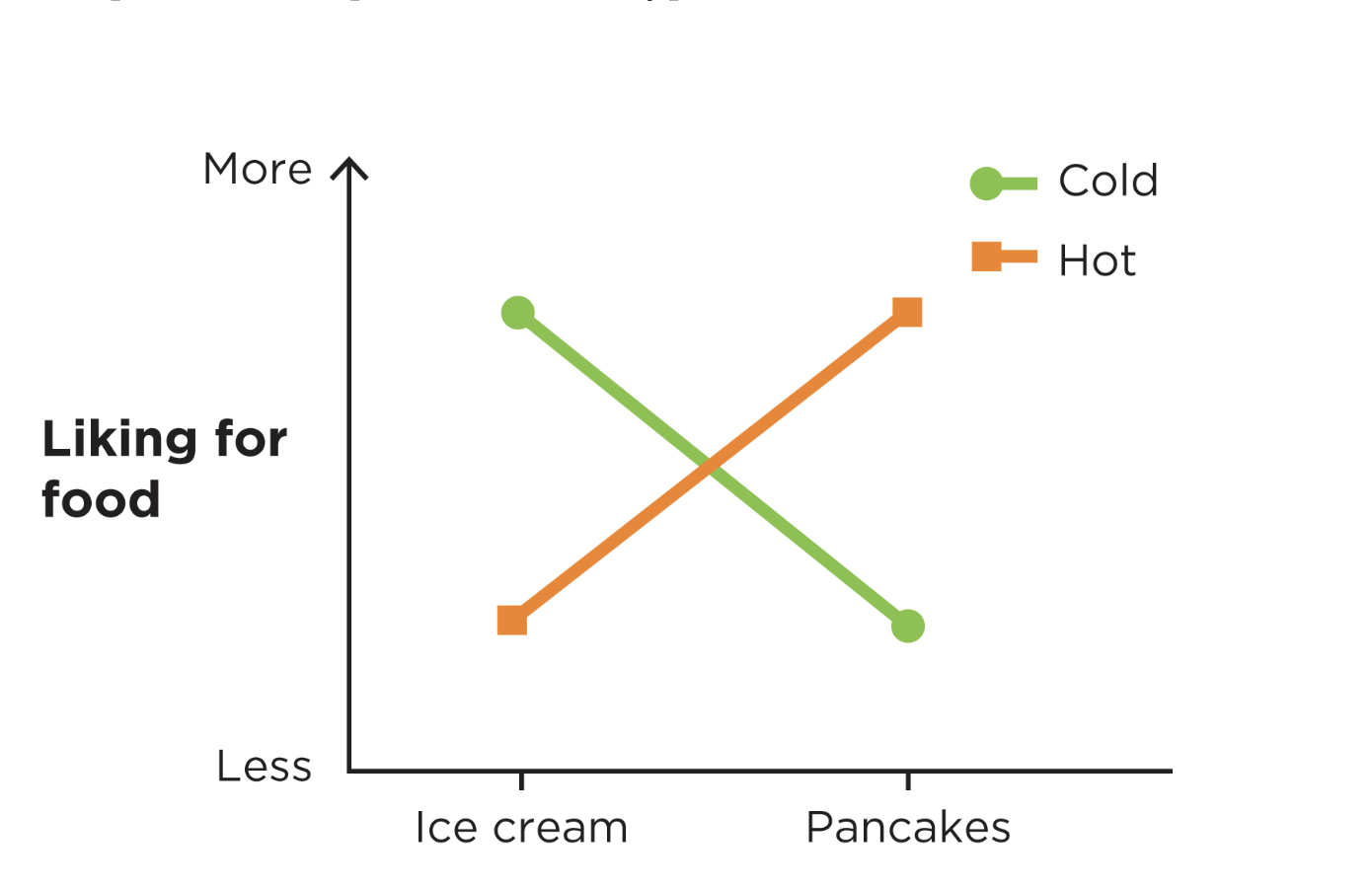
what type of interaction is this?
crossover
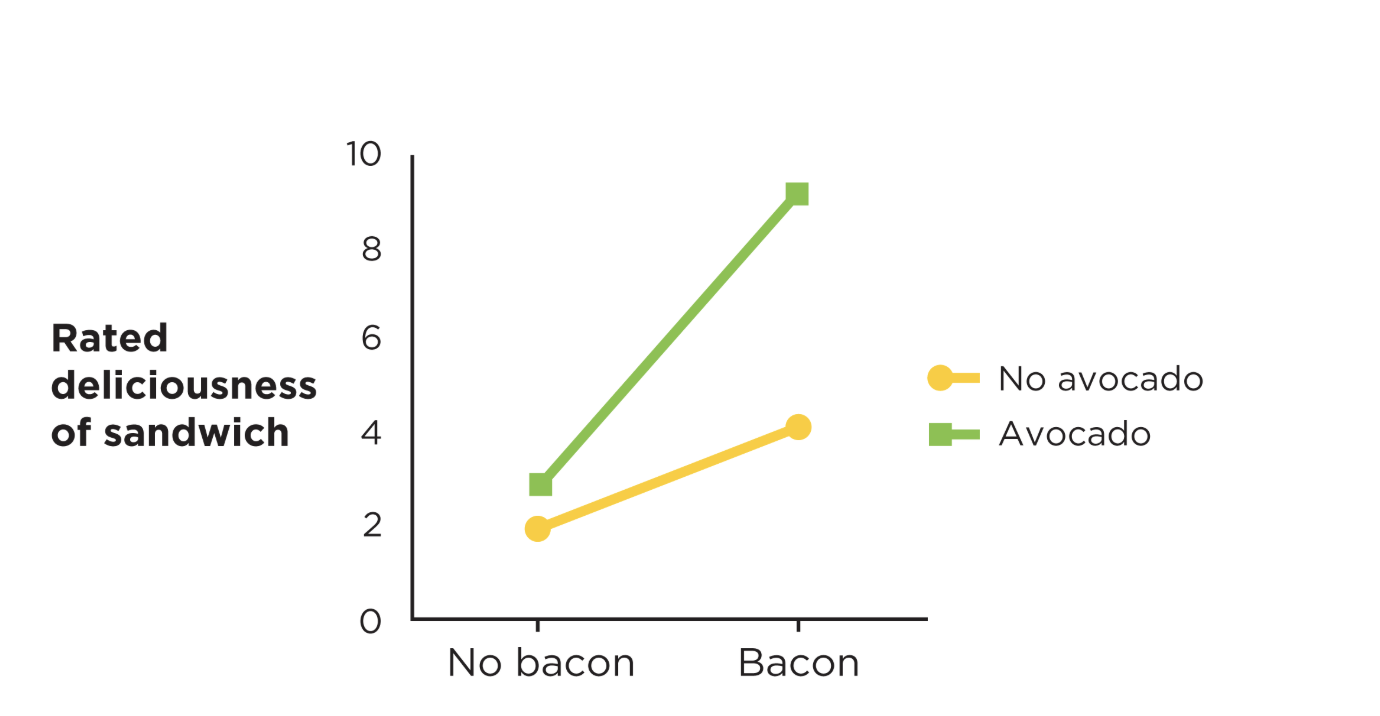
what type of interaction is this?
spreading
two or more independent variables (or factors)
factorial design
moderator
a variable that changes the relationship between 2 other variables
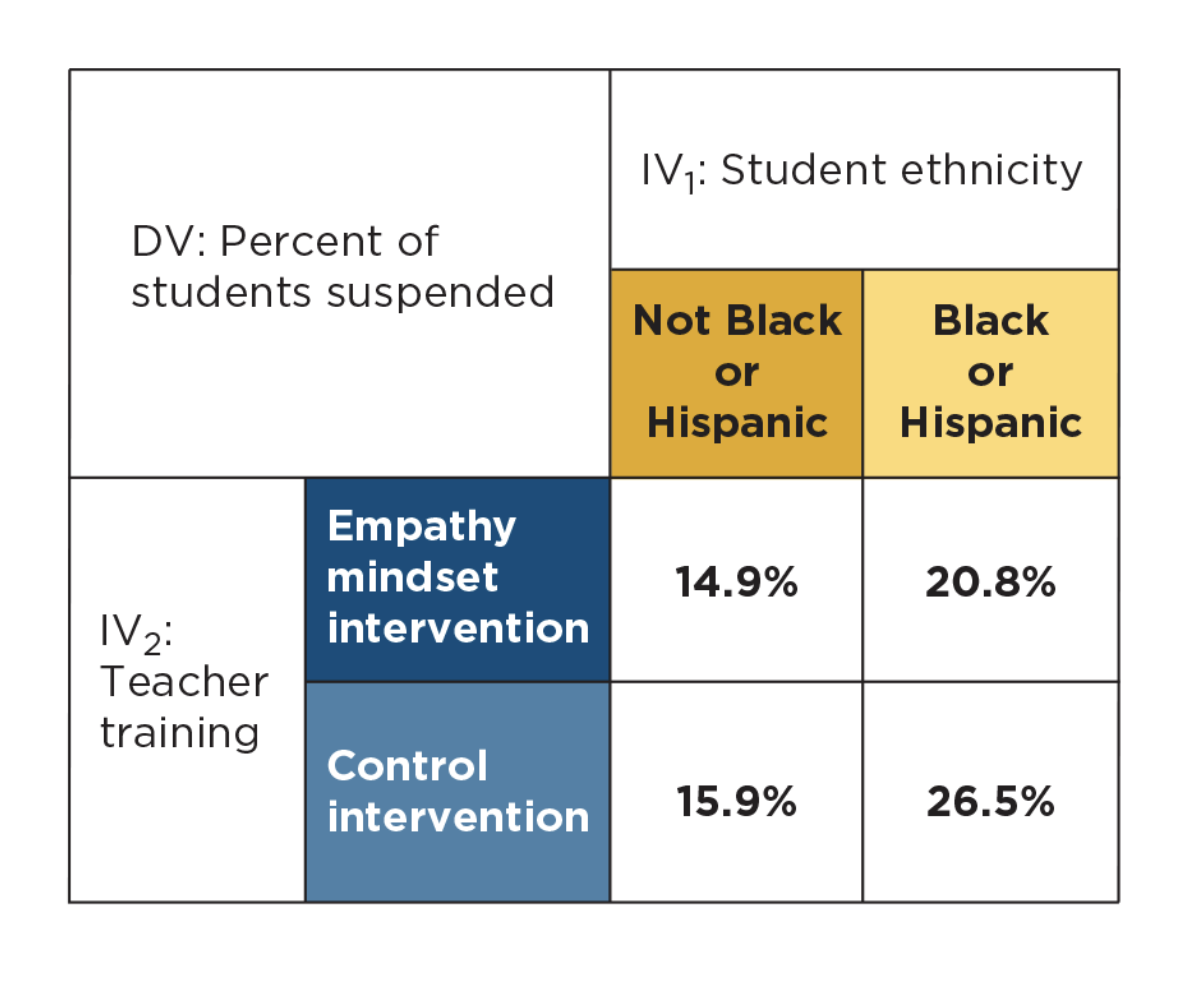
what type of factorial design is this?
2 × 2 (two by two)
factorial designs test the generalizability of a causal variable AND
theories about how variables interact with one another
factorial designs test theories about how variables interact with one another AND
the generalizability of a causal variable
which is more important when interpreting results, a main effect or an interaction?
the interaction
an independent factorial design is also known as
a between subjects factorial
a within groups factorial design is also known as
a repeated measures factorial
independent groups factorial design
both independent variables are studied aqs independent groups
within groups factorial design
both independent variables are manipulated as within groups
mixed factorial design
one independent variable is manipulated as independent groups and another is manipulated as within groups
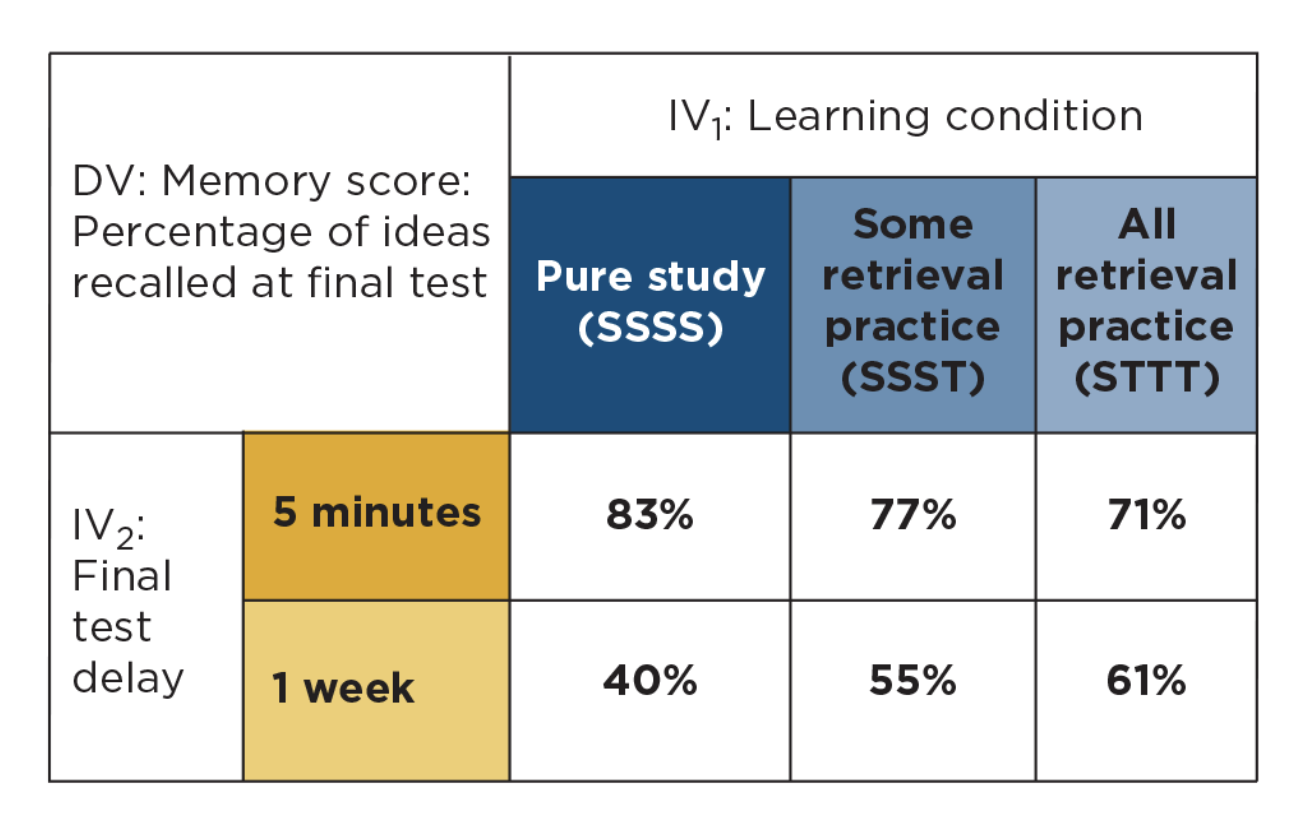
what type of factorial design is this?
2 × 3 (two by three)
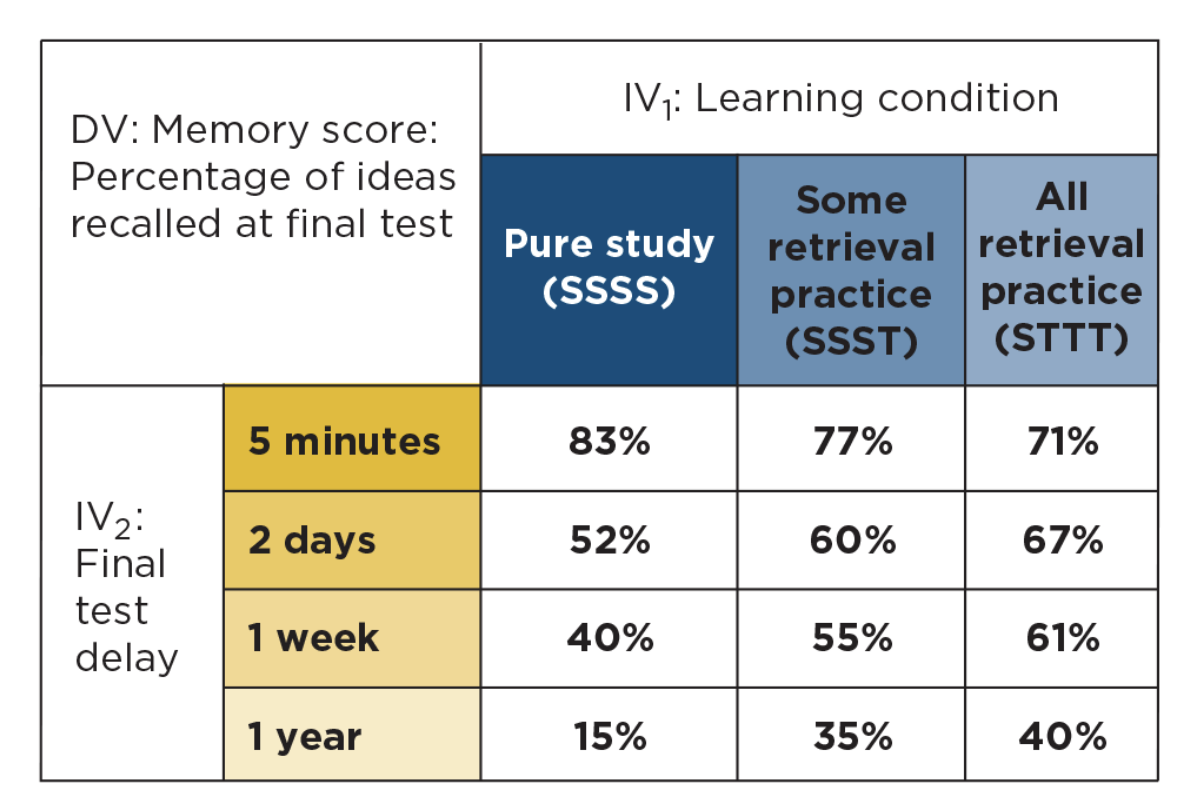
what type of factorial design is this?
3 × 4 (three by four)
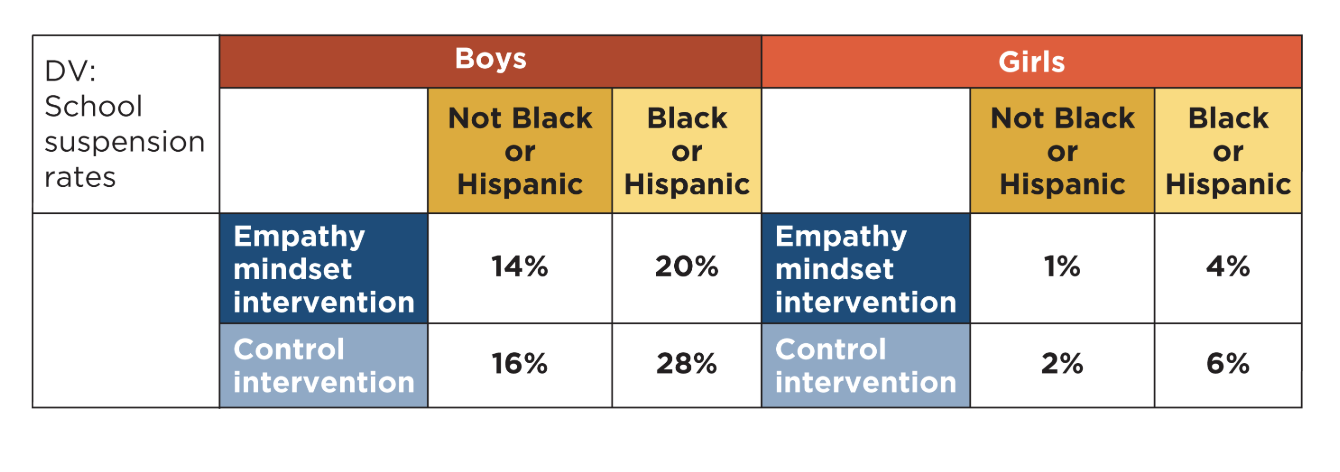
what type of factorial design is this?
three way design or 2 × 2 × 2 (two by two by two)
in a three way design how many differences are we looking for?
three main effects (one for each independent variable), plus three separate two-way interactions and a three-way interaction

