Passive Care - Exam 1 (Terminology + RQ)
 Call Kai
 Learn
Learn Practice Test
 Spaced Repetition
 Match
Match Flashcards
 Knowt Play
1/71

There's no tags or description
Looks like no tags are added yet.
Name | Mastery | Learn | Test | Matching | Spaced | Call with Kai |
|---|
No analytics yet
Send a link to your students to track their progress
72 Terms
Electrical current
flow of electrons from an electron source (through wires)
Resistor
a material opposes current flow
Capacitor
a device that stores electrical energy
Impedance
opposition of biological tissues to the flow of electrical current
Direct current
flow of current in one direction (neg or pos)
Alternating current
flow of current first in one direction then in the other (bidirectional)
Monophasic
synonymous with direct current
Biphasic
synonymous with alternating current
Phase
current flow in one direction
Phase duration
time period from beginning to end of one phase (leave isoelectric line until it returns)
Interphase duration
time btw phases (interphase interval)
Phase rise time
time for isoelectric line until maximum amplitude
Phase decay time
time from maximum amplitude until back at isoelectric line
Pulse duration
equal to phase duration for DC current
2x phase duration for AC current
Burst
series of successive pulses or cycles over a period of time
Burst duration
time btw beginning of 1st and end of last cycle or pulse
Interburst duration
time btw two successive bursts
Beat
resulting current waveform when 2 or more sinusoidal eaves intersect (interfere) with each other
Frequency
number of times per second that a pulse, cycle, burst, or beat occurs
Amplitude
magnitude of current relative to the isoelectric line measured in amperes (amps)
usually in micro-milliamperes
can be peak, peak-to-peak, average, or root mean square
Train
continuous series of pulses, cycles, bursts, or beats over time (usually seconds)
Duty cycle
ratio of on/off expressed as a percentage
Ramp up
time period where current amplitude is increasing from 0 to max
Ramp down
time period where current amplitude is decreasing from max to 0
Modulation
changes in amplitude, pulse duration, pulse frequency, or a combination of these to prevent nerve accommodation to stimulation
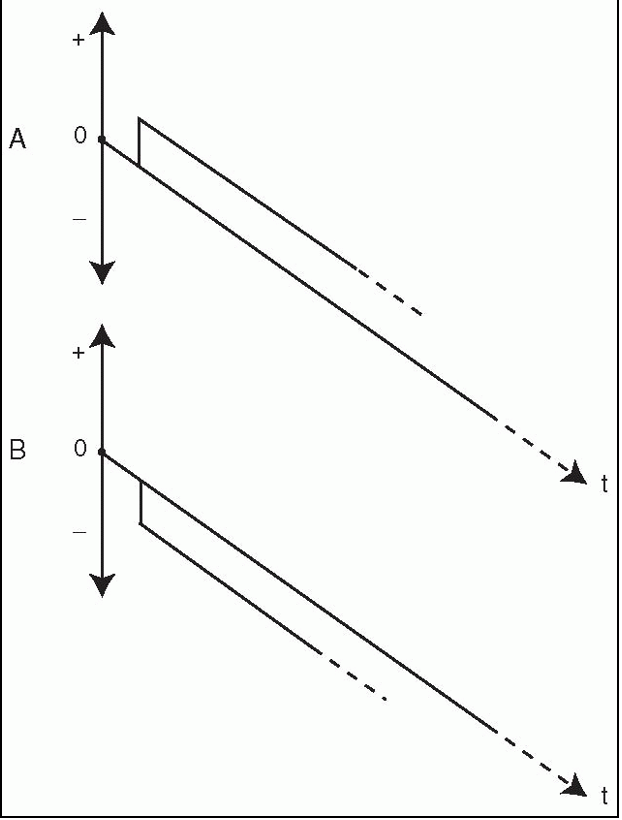
What type of current are A and B (2 descriptors)
monophasic current
direct current
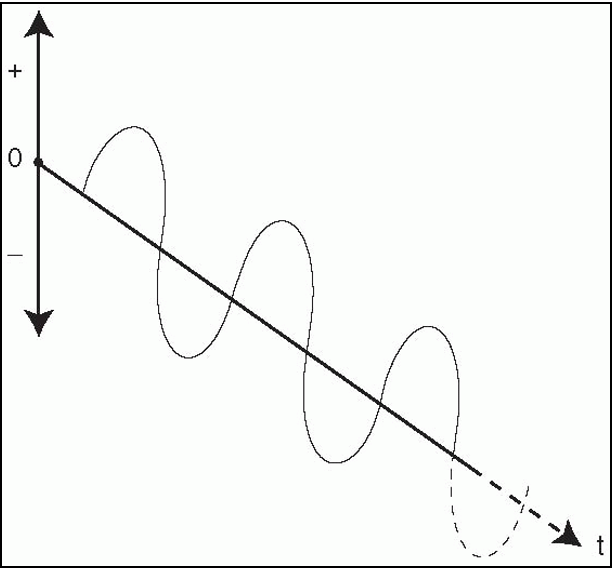
What type of current is this (2 descriptors)
biphasic current
alternating current
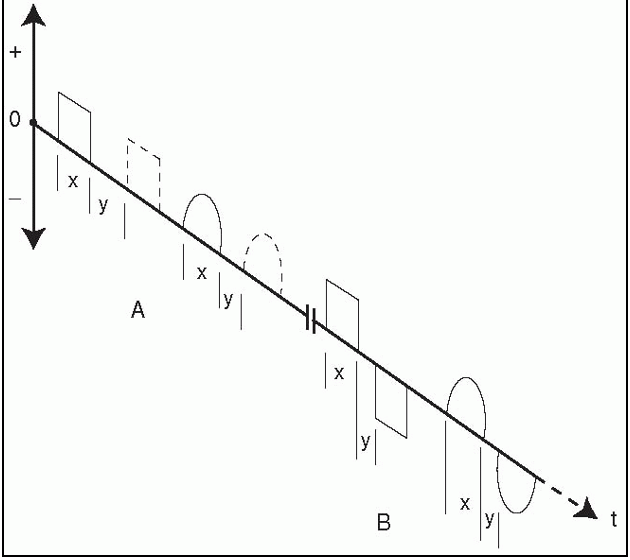
What is X? What is Y?
X = pulse duration
Y = interphasic duration
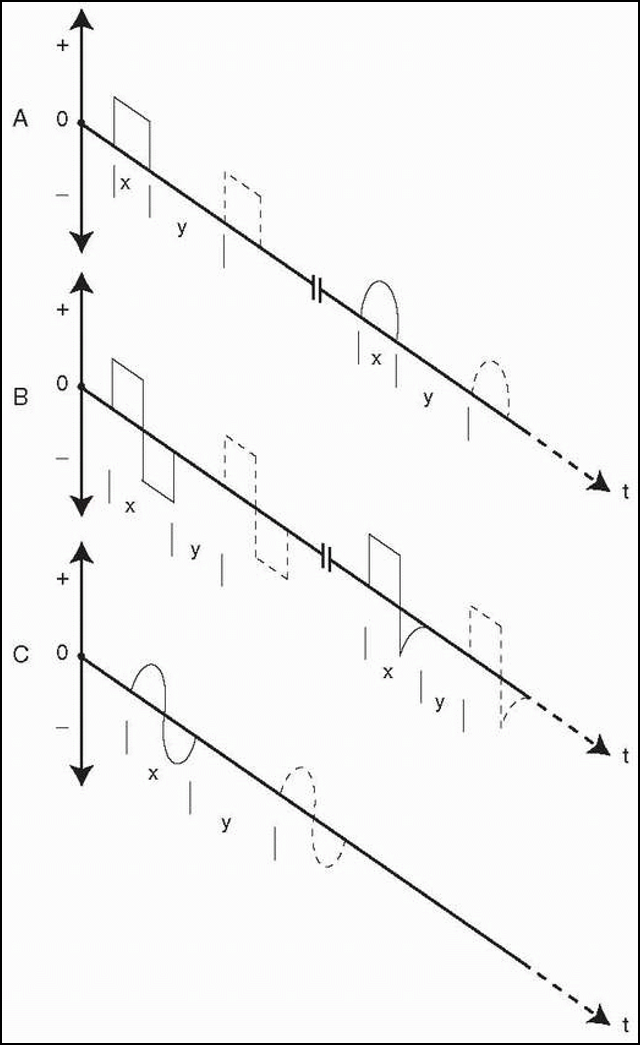
What is X? What is Y?
X - pulse duration
Y - interpulse duration
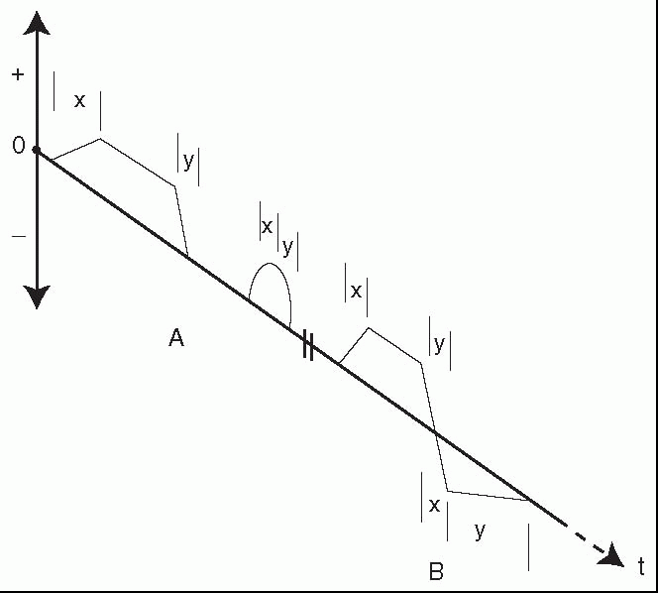
What is X? What is Y?
X = phase rise time
Y = phase decay time
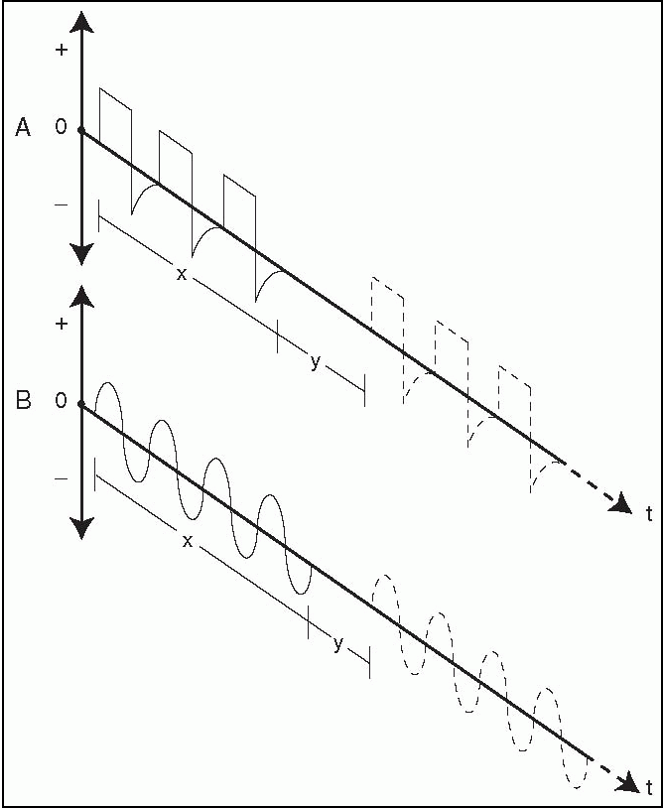
What is X? What is Y?
X = burst duration
Y = interburst duration
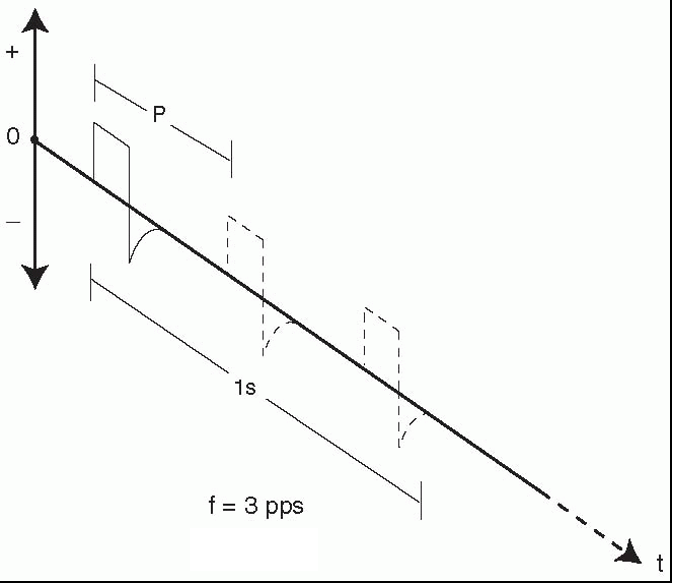
What is the frequency
three
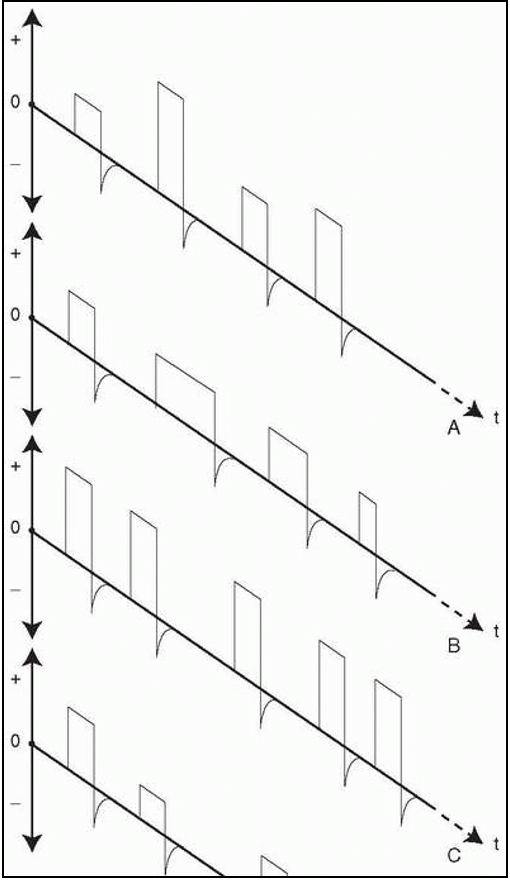
What type of modulation is A? What about C?
A = amplitude modulation
C = pulse frequency
What would be appropriate during the inflammatory/acute phase
PRICE (first 24-48hrs)
Stress/tension is important to incorporate in what phase
remodeling/maturation phase
When should you incorporate movement after injury
inflammatory/acute phase
If two patient's have low back injuries, who is most likely to heal faster
16 yo high-school student
The minimum amplitude needed to depolarize a nerve fiber when phase duration is infinite
rheobase
Monophasic current is the same as
direct current
Temporal summation of an alpha motor neuron is when the
stimulation is so rapid that the muscle goes into tetany
Temporal summation of an alpha motor neuron happens with stimulation of
35-50Hz
Wedenski’s inhibition happens with stimulation of
>1000Hz
Which electrode configuration uses 2 unequal sized electrodes
monopolar (only one electrode is the treatment)
Which will allow for deeper penetration of electrical current
place electrodes further apart
What sensation will patients report if you stimulate an A-beta fiber
tingling
An electrical therapy uses a carrier frequency of 4000Hz, it is a
medium frequency current (all therapies we use are medium)
Which electrode arrangement is for true interferential current
quadripolar
What is the beat frequency range for treating acute pain
80-150Hz
T/F: interferential current uses medium frequency currents in the range of 100,000Hz
False
What is the current terminology for Russian stimulation
NMES
What is true for physiologic muscle contraction
slow twitch muscle fibers are recruited first
(“slow” refers to when they stop contracting)
What is true for electrically stimulated muscle contraction
fast twitch muscle fibers are recruited first
What are the indications for Russian current
muscle strengthening, re-education, muscle spasms
What Russian stimulation protocol is used for strengthening both the wrist flexors and extensors in a patient who was recently in a cast
reciprocal (2 channels)
What electrode placement protocol is used for hivolt current to reduce edema
monopolar
The frequency range for treatment of acute pain with hivolt current is
60-120Hz
T/F: For iontophoresis, the phase duration must be short (~100 microseconds)
false
What polarity electrode is needed for iontophoresis using negatively charged chlorine ions
negative
What polarity electrode is needed to attract fibroblasts
negative
What could be used to aid the healing of skin ulceration
microcurrent and hivolt
What sensation will a patient experience during treatment with microcurrent
nothing
5 different types of electrical stimulation
NMES, TENS, Interferential, ESTHR, Iontophoresis
Three types of NMES
russian, biphasic pulsed, interferential
TENS uses what type of electrical current
biphasic pulsed
Two types of ESTHR electrical stimulation
highvolt pulsed current
microcurrent
Iontophoresis uses what type of electrical stimulation
low voltage direct current
Chief complaint - Muscle weakness
NMES - Russian or Biphasic 10:50
Chief complaint - Muscle spasm
NMES - Russian or Biphasic 10:10
Chief complaint - acute pain
Interferential 80-150 or Sensory TENS
Chief complaint - Chronic pain
Interferential 0-15 or Motor TENS
Chief complaint - Slow healing wound
ESTHR - hivolt pulsed current or microcurrent
Chief complaint - various musculoskeletal complaints
Iontophoresis - ions
Iontophoresis + ions