Exam 3 - Human Anatomy
 Call Kai
 Learn
Learn Practice Test
 Spaced Repetition
 Match
Match Flashcards
 Knowt Play
1/52

There's no tags or description
Looks like no tags are added yet.
Name | Mastery | Learn | Test | Matching | Spaced | Call with Kai |
|---|
No analytics yet
Send a link to your students to track their progress
53 Terms
What are the main functions of the kidneys?
Regulation of BP via BV
Regulation of osmolarity (water/salt balance)
Regulation of pH
Hormone production (EPO)
Filter Blood
Where are the kidneys located?
Behind the peritoneum (the sack around all the organs) located between T12-L2 lumbar vertebrae.
Urine is formed by what structure in the kidney?
Nephrons
What are the three processes involved in the formation of urine? What happens in each process (in general)? In which part(s) of the nephron do they occur?
Filtration: process of filtering the blood → only the blood in the glomerular capillaries is filtered
Reabsorption: “reclaiming” things that were filtered, but we actually want to keep → moves substances from the filtrate, back into the blood.
Secretion: Moves substance from blood into filtrate that we don’t want, it is selective (secretion uses specific transporters to move the substance).
Draw and label the parts of a nephron. Describe the important roles each part of the nephron plays in the formation of urine.
Role of the PTC:
Role of the Loop of Henle:
Role of the DCT/CF
Role of the PTC: reabsorption and uses ATP
Role of the Loop of Henle: creates osmotic gradient
Role of the DCT/CF: controlled by: ADH and aldosterone
What things get filtered out of blood, and what does not?
Filtered: Water, Glucose, Ions, and Urea
Not Filtered: Proteins and Blood Cells (if shown in urine → pathology/infection)
What drives/causes filtration to occur? (Hint: think about the structure of glomerular capillaries and blood flow).
BLOOD PRESSURE!!! → more specifically ⬆ pressure in glomerulus due to afferent arteriole wider than the efferent arterioles.
What is GFR?
(Glomerular Filtration Rate) filtered blood per minute
What is the value for normal GFR?
125mL/min
Why does the body try to maintain a relatively constant GFR?
To ⬆ loss of nutrients and to ⬇ waste build ups.
(A). Without any compensation, GFR would _____ (increase/decrease) if MAP goes up, and urinary output would _____ (increase/decrease). (B). Without any compensation, GFR would _______ (increase/decrease) if MAP goes down, and urinary output would ______ (increase/decrease).
A) increase, increase; B) decrease, decrease.
What happens in response to try to get back to a normal GFR in each case above?
If ⬆ BP → Afferent arteriole constricts → ⬇ GFR
If ⬇ BP → Afferent arterioles dilates → ⬆ GFR
Keeps filtration stable
The parts of the Loop of Henle work together to generate a hypertonic ISF around the nephron
What role does the descending limb of the Loop of Henle play in this process?
What role does the ascending limb of the Loop of Henle play in this process?
Water leaves → Concentrates filtrate
Pumps NaCl → builds medullary gradient
Understand how the countercurrent multiplier keeps the ISF hypertonic.
Flow and opposite functions of limbs: descending (H20 out), ascending (salt out), builds gradient (300 → 1200 mOsm)
Why (explain) is the NaCl that is transported out of the ascending limb into the ISF important to the reabsorption of water out of the CD (when ADH is present)?
It creates a hypertonic environment in the interstitial fluid, which facilitates the osmotic movement of water from the collecting duct back into the bloodstream when ADH is present, enhancing water reabsorption.
Understand the role of the kidneys during times of overhydration and dehydration.
During overhydration, the kidneys excrete excess water, leading to dilute urine; during dehydration, they conserve water, producing concentrated urine.
What is the role of ADH? How and where does it work? What happens when ADH isn’t released? Also, understand the differences in urine concentration and urinary output in each of these situations.
Trigger: Dehydration and High Osmolarity
Mechanism: Inserts Aquaporins in Collecting Ducts
Result: Water reabsorbed → ⬇ Urine Volume
No ADH: Water Stays in Tubule → Dilute Urine
What is secretion? Where does it occur, and what types of things are secreted?
Secretion is important for pH control and drug elimination. It mainly occurs in the DCT and the collecting duct.
Although during both filtration and secretion substances move from the blood to the filtrate, how are these processes different?
Filtration is passive, non-selective, and is in the glomerulus. Secretion is active, selective, and in the tubules.
What is the micturition reflex? Describe the events of that reflex
The micturition reflex is an automatic spinal reflex that triggers urination when the bladder fills, characterized by detrusor muscle contraction and urethral sphincter relaxation.
Your bladder fills→ stretches the wall and activates the sensory neurons to your spinal cord→ releases parasympathetic nerves to your bladder wall to the internal urethral sphincter→ bladder contracts and sphincter opens.
What sphincter do we “learn” to control once potty training occurs?
External Ureteral Sphincter
Know the “urine terms” mentioned on the last slide. (ex: polyuria).
Common terms include:
Polyuria - excessive urination. 2 L/day
Oliguria - reduced urine output. 500 mL/day
Anuria - absence of urine. 0/100 mL/day
Matching: Use the list of terms on the right to fill in the correct blood vessel:
Return blood to the heart ____________
Site where exchange occurs between blood and tissues (O2/CO2, nutrients, wastes)_________________
Control blood flow to organs; regulate BP_______________________
Control blood flow to tissues; feed into capillaries_________________
Near the heart; expand to accommodate blood pumped at high pressure________________
Drain blood from capillaries.___________________
Veins
Capillaries
Muscular Arteries
Arterioles
Elastic arteries
Venules
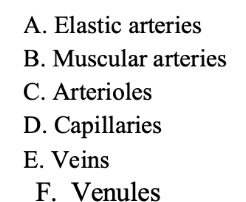
Arrange the blood vessels listed above in order of how they are arranged from the heart to the body and back to the heart. (Write the name of the vessels, not the letter).
Elastic Arteries → Muscular Arteries → Arterioles → Capillaries → Venules → Veins
Why is it important that the large arteries near the heart have elastic tissue in the wall? What do the muscular arteries do? What happens in capillaries?
Large arteries near the heart having elastic tissue in the wall aids in managing high pressure in the ventricles. Muscular arteries control blood flow to organs and regulate blood pressure. Capillaries are where O2 and CO2+ and nutrients are exchanged between blood and tissues.
Are all capillaries open at all times? Why or why not?
No, capillaries are not open at all times! Sphincters help them shut down at any given time, it is estimated that ¾ of our capillaries are shut down.
Which layer of blood vessel wall is in contact with the blood (it lines the blood vessel)?
The tunica intima
Which layer of the blood vessel wall contains smooth muscle?
The tunica media
Which layer of the wall is capable of contracting and relaxing, and therefore causing vasoconstriction and vasodilation?
The tunica media
What purposes do vasoconstriction and vasodilation serve? (Think about two different roles in the body)
Two roles: Control BP & Direct blood flow to tissues
Constrict: raises BP
Dilate: lowers BP
List the characteristics of arteries versus veins. Which has valves? What is the purpose of valves?
Arteries: High pressure, Thick Walls, Small Lumen, No Valves
Veins: Low pressure, Thin Walls, Large Lumen, Valves
Valves prevent backflow. If valves stop working, it can cause varicose veins.
Which part (which blood vessels) of the circulatory system contains the greatest volume of blood?
Systemic Veins and Venules contain 60% BV → Capillaries 5% → Heart 8% → Pulmonary Blood Vessels 12% → and Systemic Arteries and Arterioles at 5%.
Therefore Systemic Vein and Venules contain the greatest volume of blood!
What 3 things help return blood back to the heart? (Help with VR)
Pressure Gradient
Muscular Pump
Valves
What is Blood Pressure?
Pressure of the blood against the walls of the arteries.
What is Systolic BP?
Pressure in the arteries during systole.
What is Diastolic BP?
Pressure in the arteries during diastole
What is the MAP equation?
MAP (MEAN ARTERIAL PRESSURE) = estimate of the avg. BP during 1 cardiac cycle!!!
MAP = systolic pressure + 2 (diastolic pressure)
—-----------------------------------——————
3
>96 mmHg = high risk for deadly CV event, stroke
<65 mmHg = risk for hypoperfusion
90 mmHg = normotensive
According to the AHA guidelines, what are the values for normal BP and hypertension? What values define hypotension?
Normal = <120/80
Hypertension = ≥130/80
Hypotension = <90/60
Write the formula that describes the factors in the body that are responsible for your BP.
Length of blood vessels (never change)
Viscosity (⬆ viscosity → ⬆ SVR) (⬇viscosity → ⬇ SVR)
Diameter of blood vessels (Vasodilation→⬇ SVR) (Vasoconstriction→⬆)
⬆
BP = CO X SVR
⬇
(HR X SV)
SNS (⬆HR) → BV → VR → EDN → Preload
PSNS (⬇HR) → Contractility
Overall Effects!
⬆ HR → ⬆ BP
⬇ HR → ⬇ BP
⬆ SV → ⬆ BP
⬇ SV → ⬇ BP
⬆ CO → ⬆ BP
⬆ SVR → ⬆ BP
⬇ SVR → ⬇ BP
Define systemic vascular resistance (SVR). How does an increase or a decrease in SVR affect BP?
SVR (Systemic Vascular Resistance) = how much resistance blood experiences as it flows. An increase in SVR raises blood pressure, while a decrease in SVR lowers blood pressure.
What factors affect SVR? Explain how each of them changes SVR.
Length of blood vessels (never change)
Viscosity (⬆ viscosity → ⬆ SVR) (⬇ viscosity → ⬇ SVR)
Diameter of blood vessels (Vasodilation→⬇ SVR) (Vasoconstriction→ ⬆)
Which is monitored by baroreceptors? What is the purpose of the baroreceptor reflex?
CO and SVR are monitored by baroreceptors. The baroreceptor reflex detects sudden changes in BP ( ⬆ or ⬇) and “kicks in” to correct it.
Summary of the response in each case of the baroreceptor reflex (short-term BP regulation):
⬆BP → ⬇HR, ⬇contractility → (⬇CO); vasodilation (⬇SVR)
⬇BP → ⬆HR, ⬆contractility → (⬆CO); vasoconstriction (⬆SVR)
Renin/ ANG I/ ANG II pathway: To study this, practice drawing the diagram. What triggers the pathway? What is the overall effect (in a healthy person, not suffering from hypertension) of this pathway?
The Renin/ANG I/ANG II pathway is triggered by low blood pressure or low sodium levels. Its overall effect is to increase blood pressure and blood volume, promoting vasoconstriction and fluid retention, thus aiding in maintaining adequate blood flow and pressure.
Aldosterone – Does it increase or decrease BP? How?
Aldosterone increases blood pressure by promoting sodium and water reabsorption in the kidneys, leading to increased blood volume.
ADH – DOes it increase or decrease BP? How?
ADH (Antidiuretic Hormone) increases blood pressure by promoting water reabsorption in the kidneys, which increases blood volume. It also causes vasoconstriction, further elevating blood pressure.
ANP – Does it increase or decrease BP? How?
Atrial Natriuretic Peptide (ANP) decreases blood pressure by promoting sodium excretion in the kidneys, which leads to increased urine output and reduced blood volume.
What do B-Blockers do?
It is a drug that lowers CO
Blocks SNS Effects!
Effects: ⬇HR & ⬇ CTX
What do Diuretics do?
It is a drug that lowers CO
⬆ U.O → ⬇ BV → ⬇ VR→ ⬇ EDV → ⬇ SV → ⬇ CO
What do “ACE” inhibitors do?
It is a drug that lowers SVR
Blocks “ACE” → Not ANG II formed
Effects:
vasodilation (remove ANG II - induced vasoconstriction) →⬇SVR
Inhibits aldosterone release → No Na+/H2O →⬆Na+/H20.
⬇BV→⬇CO→⬇BP
What are ARB’s?
It is a drug that lowers SVR
Angiotensin receptor blockers
Effects:
ACE inhibitors
What are vasodilators?
It is a drug that lowers SVR
by relaxing blood vessels, reducing resistance to blood flow and lowering blood pressure.

