Unit C: EMR
 Call Kai
 Learn
Learn Practice Test
 Spaced Repetition
 Match
Match Flashcards
 Knowt Play
1/168

There's no tags or description
Looks like no tags are added yet.
Name | Mastery | Learn | Test | Matching | Spaced | Call with Kai |
|---|
No analytics yet
Send a link to your students to track their progress
169 Terms
what is frequency?
The number of cycles per unit of time.
What is wavelength?
The distance between adjacent points that vibrate in phase with one another in a wave.
What is electromagnetic radiation?
Radiant energy in the form of a wave produced by the acceleration of electrons or other charged particles.
What does EMR not require?
Does not require a material medium can travel through a vacuum.
What speed do all EMR waves travel at?
3.8 ×10^8
What is the EMR spectrum from left to right?
Radio waves, microwaves, infrared, visible light, ultraviolet, x-rays, gamma rays
What are examples of radio waves?
Radio
phone
wifi
bluetooth
What do the circles on microwaves do?
Circles on door make it so the waves cannot escape
What is harmful end of the spectrum?
From UV, X-ray, to gamma
What is ionizing radiation?
high-energy radiation capable of removing electrons from atoms (ionization) in matter, including living tissue, potentially causing DNA damage.
How do you measure wavelength?
You can go crest to crest.
What is the difference between an electric field component and magnetic field component?
An electric field pushes or pulls electric charges, while a magnetic field only affects moving charges by bending their motion.
What is the two models of electromagnetic radiation?
the light particle model
the light wave model
Who proposed the light is a particle model?
Newton
Who proposed the light is a wave model?
Young and Maxwell.
What is the particle model?
describes EMR as a stream often particles radiating out from a source
How does the historical particle model describe EMR?
Describes it as a stream of tiny particles radiating outward from a source.
What is a particle?
Is a discrete unit of matter having mass, momentum (and thus kinetic energy), and the ability to carry an electric charge.
How does the EMR propagate?
In straight lines, it can be reflected, and can be absorbed.
What is the wave model?
Describes EMR as a stream of transverse waves radiating out from a source
What does the wave model describe EMR as?
A stream of transverse waves radiating outward from a source.
What is a wave?
A transfer of energy in the form of a disturbance.
Where does the energy transfer occur?
A material like water
How does a water wave travel?
In a straight line, it reflects from surfaces, and can be absorbed.
Does EMR require the presence of a medium?
It does not
What is a transverse wave vs. longitudinal?
A transverse wave oscillates perpendicular to the direction it travels, while a longitudinal wave oscillates parallel to the direction it travels.
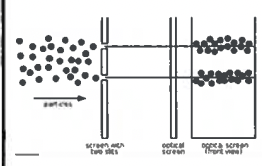
What is Young’s double slit experiment?
Young developed an experiment where he shined light onto
What would we expect to see in the light particle model?
What would we expect to see the wave model?
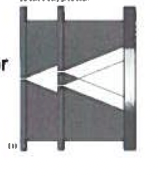
What is proof of the wave model show?
There clearly was portions of constructive interference (the bright areas) and portions of destructive interference (the dark areas).
What did Faradays believe?
Faradays believed that light, electricity, and magnetism were related, but he was a mathematical idiot and could not prove it.
What did James Clerk Maxwell do to develop Faradays theory?
Maxwell produces the maxwell equations that define light, electricity, and magnetism.
What were Maxwells four main ideas in his theory?
The distribution of an electric charge, in space is related to the field it produces
Magnetic field lines are continous, and do not have a beginning or an end, whereas electric field lines begin and end on electric charges
An electric current can produce a magnetic field; also a changing electric field can produce a magnetic field
A changing magnetic field can produce an electric field, and hence an electromagnetic wave does not require a conducting material to exist.
What is Maxwells prediction about electromagnetic waves?
Electromagnetic waves are produced whenever an electric charge is accelerating. Therefore, as an electric charge oscillates, electrical energy will be lost and an equivalent amoint of energy will be radiated outward in the form of oscillating electric and magnetic fields.
What happens when the electric charge is accelerated?
When the electric charge is accelerated in periodic motion, the frequency of oscillation of the charge will correspond exactly to the frequency of the electromagnetic wave that is produced.
How much do all electromagnetic waves travel at?
3.00 x 10^8
What will happen in regards to oscillating electric and magnetic fields?
Will always be perpendicular to each other and perpendicular to the direction of propagation of the wave.
electromagnetic waves should show all the phenomena..
associated with transverse waves, interference, diffraction, refraction, and polarization.
What did Heinrich Rudolf Hertz do?
Proved that electricity can be transmitted in the electromagnetic waves which led to the development of wireless telegraph and the radio.
What did Hertz’s experiment show?
That the nature of reflection and refraction was the same those of light, confirming that light waves are electromagnetic radiation obeying the Maxwell equations
When are electromagnetic waves produced?
Whenever electric charges are accelerated (change direction or velocity). The accelerated charge loses energy that is carried away as an electromagnetic wave.
What happens if the electric charge is accelerated in periodic motion?
emits electromagnetic radiation at the same frequency as its motion, radiating energy outward and losing energy in the process.
What do electromagnetic waves consist of?
Oscillating electric and magnetic fields in constant phase relation, perpendicular to each other, and both 90 degrees to the direction of propagation of the wave.
What properties do electromagnetic waves exhibit?
Properties of interference, diffraction, polarization, and refraction, and can carry linear and angular momentum. their intensity is proportional to the square of the magnitude of to the electric (or magnetic) field amplitude and the square of the frequency.
What was Hertz able to show about speed?
Speed of light is 3.0×10^8
What is Michelsons experiment? List goal, method, result.
Goal: Measure the speed of Earth relative to the "ether wind".
Method: An interferometer split light beams into perpendicular paths, aiming to detect interference patterns caused by differences in speed.
Result: A "null result" — no shift was found, meaning the speed of light is constant regardless of direction or Earth's motion.
How did Young prove that light is a wave?
Able to produce interference pattern with light, showing how it oscillates.
What is Huygens principle?
Model of wave theory that predicts motion of a wave front as being many small point sources propagating outward in a circle at the same speed as the wave as well.
Each location acts as a _____ source and each ____ source is capable of making a new _____ wave front.
point; point; circular
What is constructive interference?
occurs when two or more waves (light, sound, or water) with the same frequency and phase overlap, combining their crests and troughs to create a single wave with a larger amplitude.
What is destructive interference?
phenomenon where two or more waves overlap while "out of phase"—specifically, when the crest of one wave aligns with the trough of another.
What is polarization?
a property of transverse waves which specifies the geometrical orientation of the oscillations
What can we do with a polarizing lens?
Filter out certain polarizations of light.
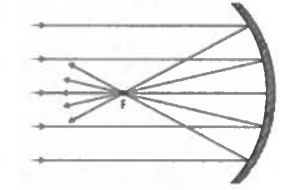
What is a concave mirror?
Converging
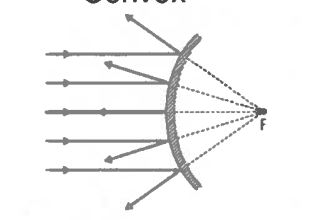
What is a convex mirror?
diverging
What is rectilinear propagation?
Movement of light in straight lines through a uniform medium
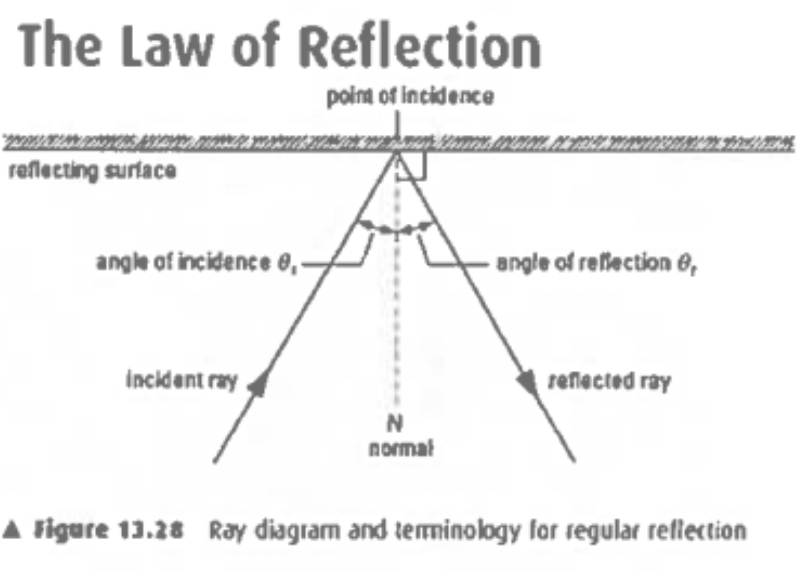
What is the law of reflection?
Angle of reflection is equal to the angle of incidence and is in the same plane
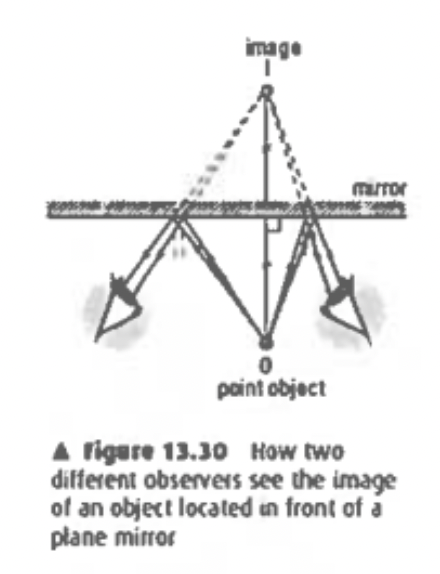
What do dashed lines represent?
extension of reflected rays
What are the four image characteristics?
magnification
attitude
position
type
What are the characteristics of magnification?
same size, enlarged, diminished
What are the characteristics of attitude?
erect of inverted
What are the characteristics of position?
displacement from mirror surface
What are the types?
real or virtual
What are the steps to drawing ray diagrams?
draw a line parallel to principal axis then reflect it through focal point
travels from object through a focal point to mirror then reflects parallel to principal axis
travels from object through centre point (does not meet anything)
What do you do after you have drawn ray diagrams?
Check to see the characeristics of the image.
What is the image characteristics if the objects is distant?
real, inverted, diminished, close to F
What is the image characteristics if the object is outside of centre of curvature?
real, inverted, and diminished, and between F and C
What is the image characteristics if the object is at the centre of curvature?
real, inverted, and same size, at C
What is the image characteristics if object is between focal point and centre of curvature?
real, inverted, enlarged, beyond C
What is the image characteristics if the object is at the focal point?
undefined, no image forms, infinite
What is the image characteristics if the object is between focal point and vertex?
virtual, erect, enlarged, and behind mirror
Refraction
A change in the direction of a light wave due to a change in its speed as it passes from one medium to another.
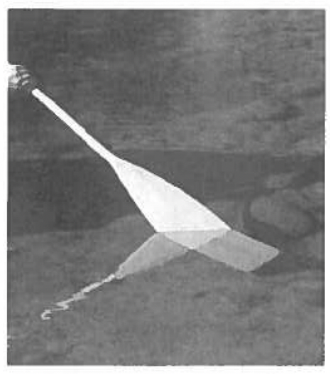
Medium
The “thing” that light travels through
Why does light change speed?
Because there can be a directional change
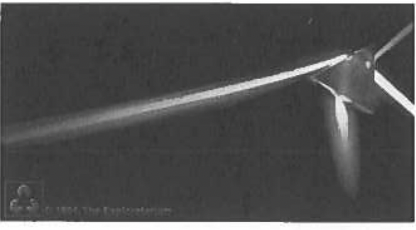
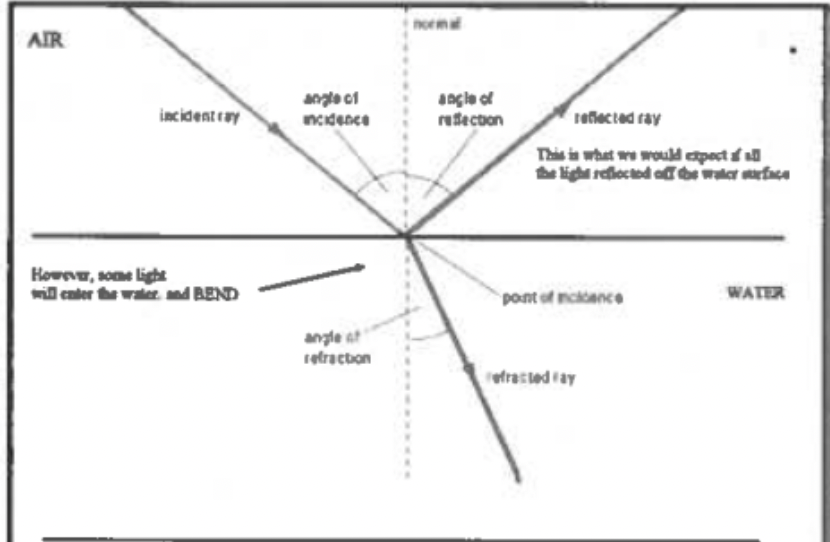
In this diagram, why do the angles change as the light goes through the different mediums?
Higher density = smaller angle
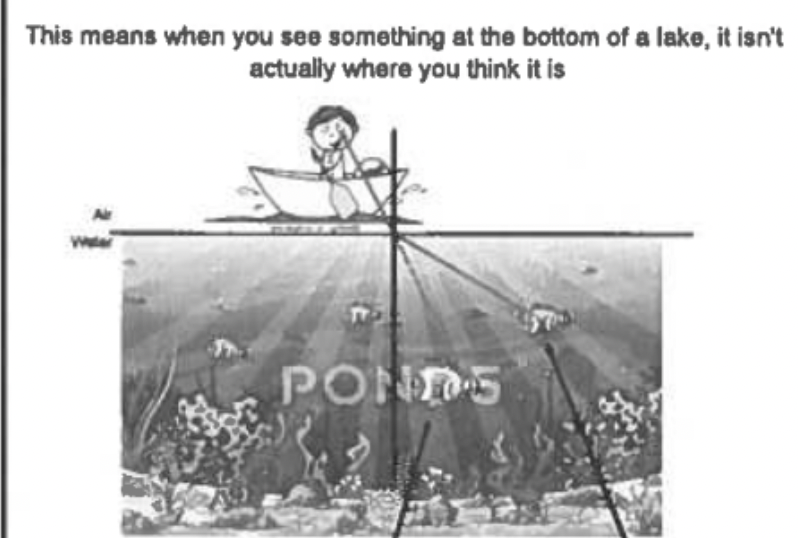
If you appear to see the largest fish in the pond, which one are you actually looking at due to refraction?
This fish :)
How does refraction affect our view of the Sun?
You see the sun rise before it actually rises, and you see the sun set after its set.
Refractive index
A ratio comparing the speed of light in a vacuum to the measured speed of light in a given material.
What is the index for refraction of a vacuum?
1.0000
What is the refractive index kind of like?
The friction value of the substance the light is travelling in. The bigger the refractive index the slower light will go.
What happens when light passes from a medium with a high refractive index to one with a low refractive index?
It is refracted away from the normal line.
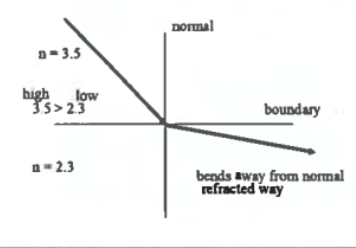
What happens when light passes from a medium with a low refractive index to one with a high refractive index?
It is refracted toward the normal line.
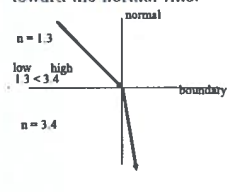
What is the general correlation between a refractive index and an angle measure?
The angle is larger in the smaller index of refraction and vice versa.
All indexes of refraction are produced?
Expiramentally
What are all the things that Snell noticed changed during the refraction of light?
Wavelength and speed changed as mediums changed/
Snell’s formula
Sin θ1 / Sin θ2 = v1 / v2 = 𝛌1 / 𝛌2 = n2 / n1
In Sin θ1 / Sin θ2 = v1 / v2 = 𝛌1 / 𝛌2 = n2 / n1 , what does the first and second quantities represent?
Quantity 1 is whatever medium you’re exiting, and quantity 2 is whatever medium you’re entering
The index of refraction is just what ratio?
n = c / v
θ1 and θ2: Which is incidence which is refraction?
1 = incidence
2 = refraction
Light will change direction when it enters a new medium (because the angle will change) but it will also change its?
Velocity and wavelength
Total internal refraction
There reaches an angle of incidence where the angle of refraction becomes 90 degrees and the light is reflected back into its medium.
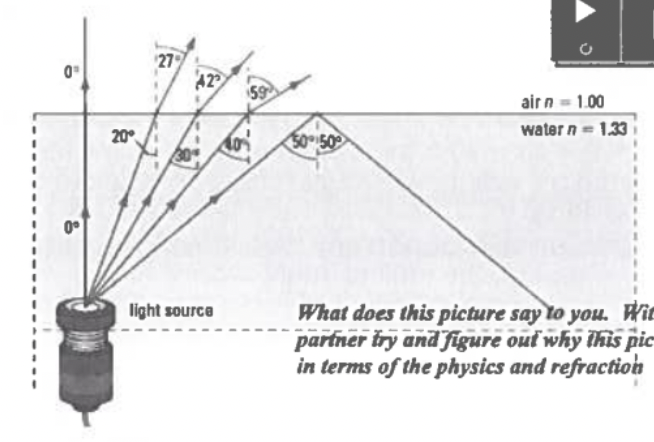
Total internal refraction only works when?
n1 > n2
OR
*diagram*

Increaing the angle for light leaving a water-air interface leads to?
Total internal refraction
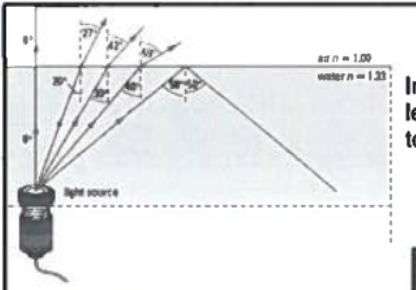
What real life exaple utilizes TIR?
In theory, this is exactly what happens in the optical fibres that faciliate the data and telephone connection of computer networks. In this case, information is coded into the light and can travel very fast
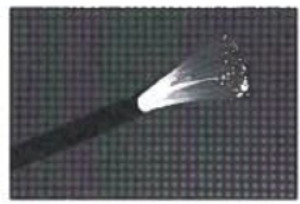
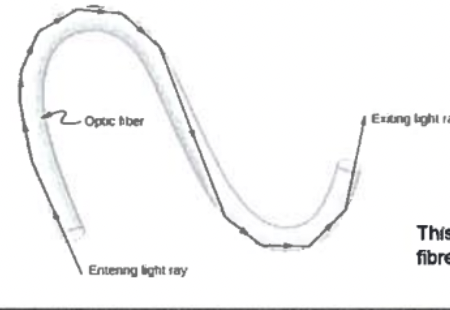
What does this show?
TiR works even when the glass fibre is curved.
Are TIR angles the same for all materials?
Different materials have different angles at which TIR occurs.
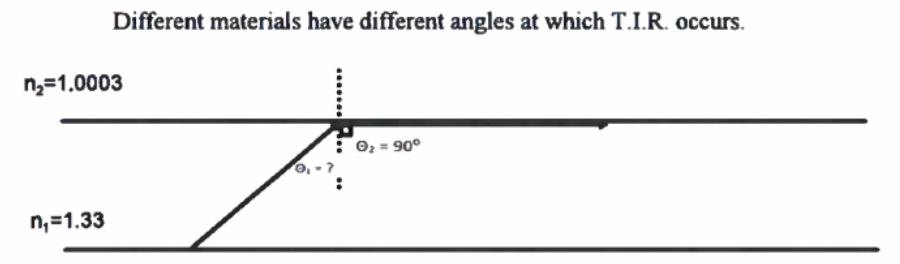
The MINIMUM angle of incidence that causes TIR is called?
Critical angle
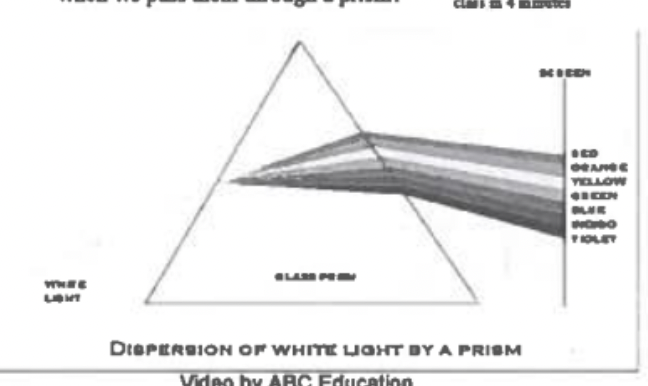
Why does this occur?
In terms of Snell’s Law, light of different wavelengths will refract at different angles

Thin lenses
Curved pieces of glass, called lenses, can also bend light
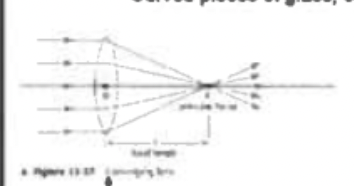
Type of lens and function
Convex lens or converging lens because it causes light to converge and focus onto one point

