evolution unit review
 Studied by 1 person
 Call with Kai
 Learn
Learn Practice Test
 Spaced Repetition
 Match
Match Flashcards
 Knowt Play
1/56

There's no tags or description
Looks like no tags are added yet.
Name | Mastery | Learn | Test | Matching | Spaced | Call with Kai |
|---|
No analytics yet
Send a link to your students to track their progress
57 Terms
Microevolution
is change in the frequency of a gene pool on a small scale
Happens from one generation to the next
Gene Flow (migration)
Description: Gene flow is the movement of alleles between two interbreeding populations with different allele frequencies.
Effect: It changes allele frequencies in one or both populations as genes move between them.
Example: Prairie dog colonies are normally closed, but in summer mature males can enter new colonies, introducing new genes and altering the gene pool.
Non-random Mating
Description: During non-random mating, individuals in a population select mates, often on the basis of their phenotypes.
Effect: Non-random mating increases the proportion of homozygous individuals in a population.
GENETIC DRIFT
Description: random change in genetic variation from generation to generation due to chance.
Effect: Genetic drift changes allele frequencies
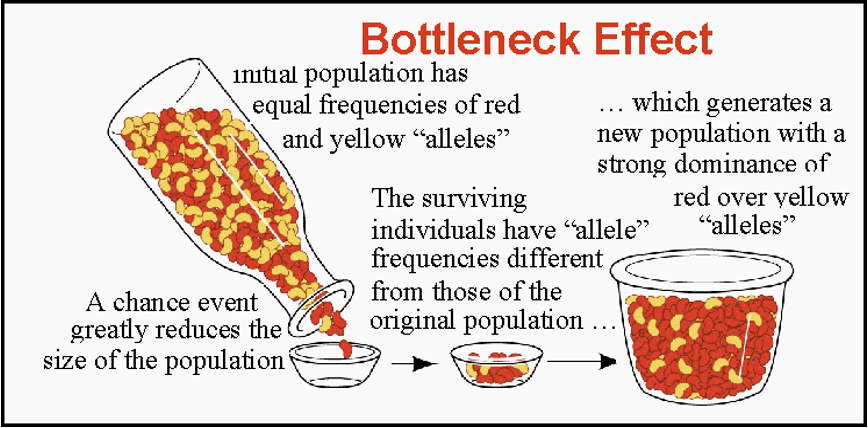
GENETIC DRIFT: THE BOTTLENECK EFFECT
When a severe event results in a drastic reduction in numbers, a population may experience a bottleneck effect.
A very small sample of alleles survives to establish a new population.
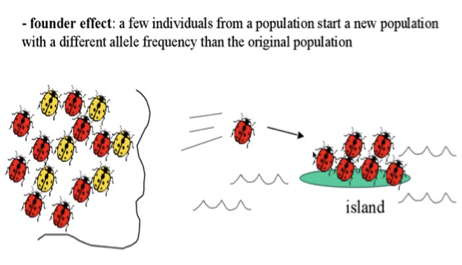
GENETIC DRIFT: THE FOUNDER EFFECT
When a few individuals from a large population leave to establish a new population
1. SEXUAL SELECTION
Favours the selection of any trait that influences the mating success of the individual.
Process by which individuals compete for the chance for a mate.
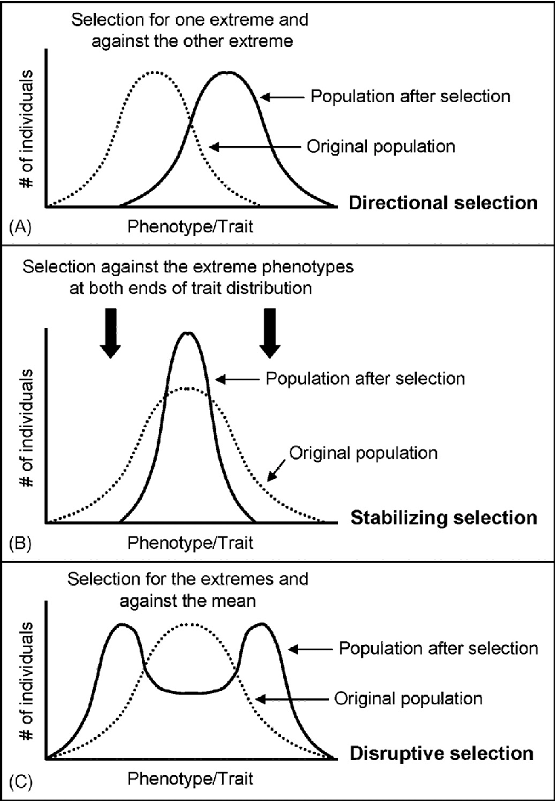
2. Stabilizing selection
It favors the intermediate variants.
Stabilizing selection tends to remove the more severe phenotypes, resulting in the reproductive success of the norm or average phenotypes.
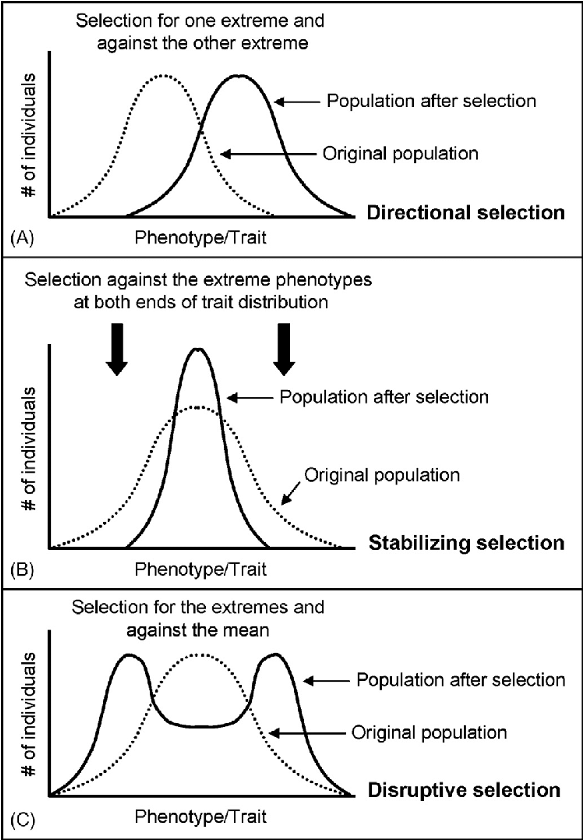
3. Directional selection
is a mode of negative natural selection in which an extreme phenotype is favored over other phenotypes.
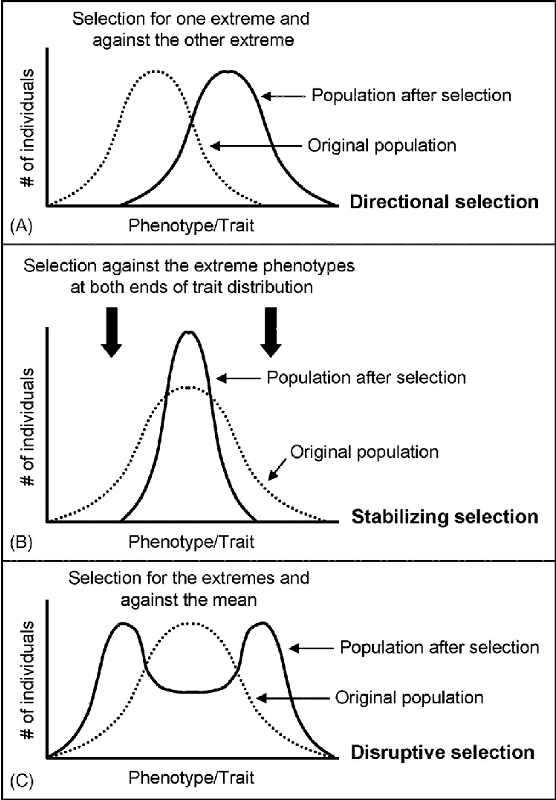
4. Disruptive selection
Describes changes in population genetics in which extreme values for a trait are favored over intermediate values. In this case, the variance of the trait increases, and the population is divided into two distinct groups.
Macroevolution
is evolution over geologic time of groups larger than just an individual.
The process by which a new species evolves is called speciation.
Biological Species Concept
A biological species is a group of organisms that can reproduce with one another in nature and produce fertile offspring.
**Breeding behavior in nature can be different than in captivity (artifical enviornemtn)
How do new species arise?
some members of a species must become reproductively isolated from the rest of the species.
- Evolution within a species means a change in that population’s allele frequency.
When two populations are separated, their allele frequency changes separately from one another.
Since they no longer have migration between the populations, two separate species may develop.
**There are many ways to separate two populations.
Allopatric Speciation
Happens when a geographical barrier (mountains, rivers, oceans, distance) splits a population into two groups.
After being separated, each group develops differences that eventually prevent them from interbreeding.
“Allo” means other/different and “patric” means from → “from different places.”
Geographical isolation is the main cause that starts this type of speciation.
Over time, physical, behavioural, or genetic changes build up and keep the two groups reproductively isolated (unable to mate).
Example
A river forms and splits a population of squirrels.
Each group adapts to its side of the river.
Over many generations, their behaviours and traits change so much that even if they meet again, they no longer mate → they have become two different species.
Reproductive Isolation (formed by geographic isolation)
Any factor in nature that prevents interbreeding (breeding within a closed population) between individuals of the same or closely related species.
Extrinsic isolating mechanism – outside of the organisms in question
Geographic isolation is extrinsic
Geographic isolation: mountains, rivers, oceans, or distance physically separate populations.
Habitat isolation: one group lives in trees, another on the ground.
Temporal isolation (if caused by climate/seasonal differences): they breed at different times because environments differ.
Intrinsic isolating mechanism – internal characteristics that prevent interbreeding
Differences in anatomy, physiology and behavior
Types of Intrinsic Reproductive Isolating Mechanisms
Ecological
Temporal
Behavioral
Mechanical
Gametic
Hybrid inviability
1. Ecological Isolation
A premating (prezygotic) isolating mechanism in which members of different species seldom, if ever, meet because each species prefers to live (is adapted to) different habitats.
(Two species don’t mate because they live in different places, so they never meet.)
When two species have different habitats, they will rarely have contact.
Lions prefer open grassland, tigers prefer forest
2. Temporal Isolation (time-based isolation)
Two or more species that share the same habitat but do not mate within the same time frame.
Two populations of the same species of plant release their pollen at different times of the year. If their reproductive periods did not overlap, they would have reduced gene flow.
Their reproductive periods don't overlap → they barely exchange genes → reduced gene flow.
3. Behavioral Isolation
Even if populations are in contact and breeding can occur, they must choose to mate.
Such a choice is based on specific courtship and mating displays.
4. Mechanical Isolation
Type of prezygotic isolation where reproductive organs differ in size or shape or another feature.
Different species of Alpine Butterfly look similar but have different reproductive organs.
5. Gametic Isolation
Even if mating occurs, offspring may not result if there are incompatibilities between sperm and egg, or between sperm and the female reproductive tract.
6. Hybrid Inviability or Infertility
Hybrids between closely related species are often inviable or, if they live, they are sterile.
This hybrid inviability and sterility, (hybrid incompatibility), can reduce the exchange of genetic variants between species.
Even if offspring develop, they are most often malformed or sterile
Sympatric Speciation
Sympatric speciation occurs when there are no physical barriers preventing any members of a species from mating with another, and all members are in close proximity to one another.
Even though they’re in the same place, a new species can still form if some individuals start using a different resource (like a new food) or develop a new trait that separates them reproductively.
In plants, this often happens through polyploidy, which is when the number of chromosome sets doubles or changes. Polyploid individuals can’t successfully mate with the original population, so they form a new species.s
Polyploidy
100,000 species of plants exist today because of polyploidy
A multiplication of the normal number of chromosomes in an organism.
Most often happens in plants that self pollinate
When does speciation occur?
Consider the horseshoe crab which has not changed much in 300 million years.
Consider Darwin’s finches, they developed into 13 separate species in 100,000 years.
Horseshoe crabs didn’t face strong pressures, so speciation was minimal.
Darwin’s finches faced different pressures on different islands, so speciation was fast.
Generalists' vs Specialists
The horseshoe crabs are generalists – their diet is diverse
The finches are specialists – their diet is very specific, especially when food is scarce.
When the food source changes, the finches must adapt, or they will not survive. The horseshoe crab just moves on and eats something else.
Adaptive Radiation
Rapid emergence of species from a single species that has been introduced into a new environment.
ex. When the finches arrived on the Galapagos there were no other birds of their kind living in the islands.
It was easy for them to specialize and fill the available niches. This is especially true on the Galapagos because there are 25 separate islands.
Water between the islands is a barrier = allopatric speciation
Two conditions that contribute to speciation
Specialization of food source and environment
Ability to migrate to a new environment, especially if there is no competition.
Convergent vs Divergent Evolution
Convergent evolution occurs when species have different ancestral origins but have developed similar features.
Divergent evolution occurs when two separate species evolve differently from a common ancestor
evidence for evolution
Anatomy
Homologous Structures
Same structure + origin
Different function
Show divergent evolution (common ancestor) Divergent evolution happens when one species splits into multiple species because they adapt to different environments.
Analogous Structures
Same function
Different origin/structure
Show convergent evolution (similar environments)
Vestigial Structures
Leftover structures from ancestors
No current function
Evidence of evolutionary change
evidence for evolution
2. Biogeography
Island Populations
Species evolve differently when isolated
Limited gene flow → unique traits
Coastlines of Continents
Continents fit together (e.g., Gondwana)
Similar fossils found on far-apart coasts
3 evidence for evolution
3. Fossils
Chronological Order
Fossils appear in predictable layers (oldest at bottom)
Transitional Fossils
Show intermediate stages between groups
Example: Archaeopteryx (between dinosaurs & birds)
Vestigial Structures in Fossils
Show structure changes over time
Dating Fossils
Carbon-14 dating (recent)
Uranium dating (older)
Other radiometric methods
Examples from Class
Burgess Shale (amazing fossil preservation)
Darwin finding seashells in mountains (land once underwater)
4 evidence for evolution
4. Embryology
Similar embryonic stages across species
Too similar to be by chance → evidence of common ancestry
5 evidence for evolution
5. DNA
Comparing DNA shows how closely related species are
Traits passed through generations
Mutations create variation over time
Class Examples (Fish)
Red Grouper
Iridescent Shark
Escolar
Albacore Tuna
(compare anatomy, DNA, or diets)
6 evidence for evolution
Evolutionary Patterns
Divergent Evolution
Same species → isolated into different environments
Limited gene flow
Different traits selected
Homologous structures
Convergent Evolution
Not closely related
Evolve similar traits due to similar environments
Analogous structures
Parallel Evolution
Two related species
Independently evolve in similar ways
Voyage of Beagle
Dates: February 12th, 1831
Captain: Robert FitzRoy
Ship: H.M.S. Beagle
Destination: Voyage around the world.
Findings: evidence to propose a revolutionary hypothesis about how life changes over time
Fun fact: Charles Darwin was to go into medicine but changed his mind and joined this voyage instead. He did not even get along with the captain and they had many disputes.
Patterns of Diversity
Darwin visited Argentina and Australia which had similar grassland ecosystems.
those grasslands were inhabited by very different animals.
neither Argentina nor Australia was home to the sorts of animals that lived in European grasslands.
Why were there no rabbits in Australia, despite the presence of habitats that seemed perfect for them?
Why were there no kangaroos in England?
Living Organisms and Fossils
Darwin collected the preserved remains of ancient organisms, called fossils.
Some of those fossils resembled organisms that were still alive today.
Others looked completely unlike any creature he had ever seen.
As Darwin studied fossils, new questions arose.
Why had so many of these species disappeared?
How were they related to living species?
The Galapagos Island
The lowest islands, like Hood Island, were hot, dry, and nearly barren with sparse vegetation. (Almost nothing grows there)
Higher islands, like Isabela Island, had more rainfall and rich vegetation.
Darwin was fascinated by the tortoises and marine iguanas.
Giant tortoises varied from island to island, and the shape of their shells showed which island they came from.
Animals found in the Galapagos
Land Tortoises
Darwin Finches
Blue-Footed Booby
Marine Iguanas
The Journey Home
Darwin Observed that characteristics of many plants and animals vary greatly among the islands
Hypothesis: Separate species may have arisen from an original ancestor
Ideas that shaped Darwin’s Thinking
James Hutton:
1795 Theory of Geological change
Forces change earth’s surface shape
Changes are slow
Earth much older than thousands of years
Charles Lyell
Book: Principles of Geography
Geographical features can be built up or torn down
Darwin thought if earth changed over time, what about life?
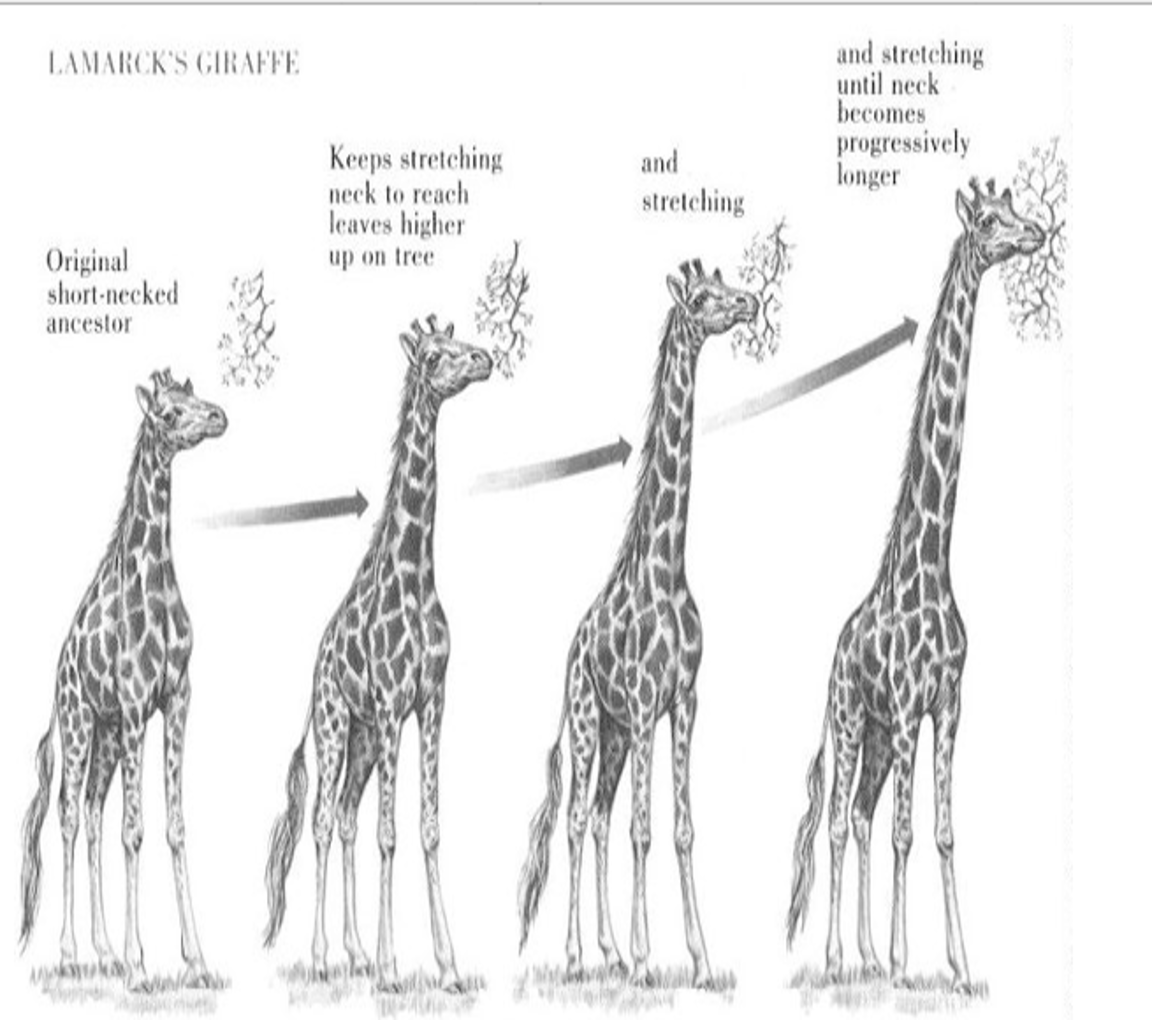
Lamarck
Tendency toward Perfection(Giraffe necks)
Use and Disuse (bird’s using forearms)
Inheritance of Acquired Traits
Thomas Malthus-19th century English economist
If population grew (more Babies born than die)
Insufficient living space
Food runs out
Darwin applied this theory to animals
Publication of Orgin of Species
Russel Wallace wrote an essay summarizing evolutionary change from his field work in Malaysia
Gave Darwin the drive to publish his findings
Darwin`s Birds
Darwin observed many birds and noticed they had some similarities and differences.
Ornithologist John Gould informed Darwin that 25 of his 26 Galapagos birds were different species.
Darwin did not label them by island during his collections but this evidence suggests that there is a single ancestral species transported from a nearby land.
Other Species
Darwin notes the islands were inhabited by many bird species and species that were able to swim and sustain long periods of time at sea such as land lizards and turtles.
Mammals that were unable to survive such travel were not present on the islands. (except rats and domestic animals from ships)
Species had traveled to these islands and evolved and adapted to suit the conditions.
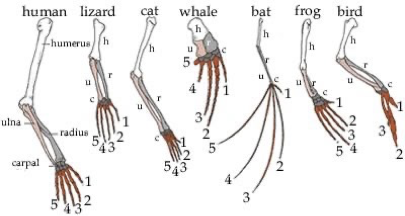
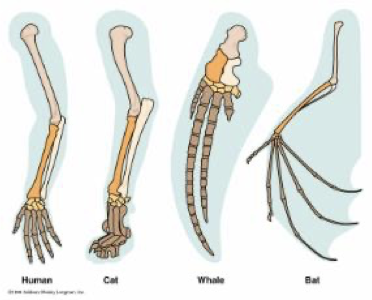
Homologous Features
Homologous – structures that share a common origin but may serve different functions in modern species.
Example – dolphin flippers and human hands
Analogous Features
Features that are shared by many organisms and serving a common function
Ex. Wings of birds, butterflies
Darwin came to the conclusion that organisms with homologous features likely shared a more recent common ancestor, while those with analogous features did not.
Vestigial Features
Structures that serve no purpose in living organisms. Example digits in dogs, pigs and whales
Artificial Selection
Artificial selection is intentional breeding for certain traits, where human influence shapes a species’ evolution.
Darwin saw that species have inherited variations that can be selected for desirable changes.
Artificial selection helped him understand how evolution could work in nature.
Favourable traits are preserved; unfavourable ones are eliminated.
Seven years after his voyage, Darwin concluded that species evolve through natural selection—traits become more or less common depending on survival and reproduction.
Wallace proposed the same idea, prompting Darwin to publish his findings first.
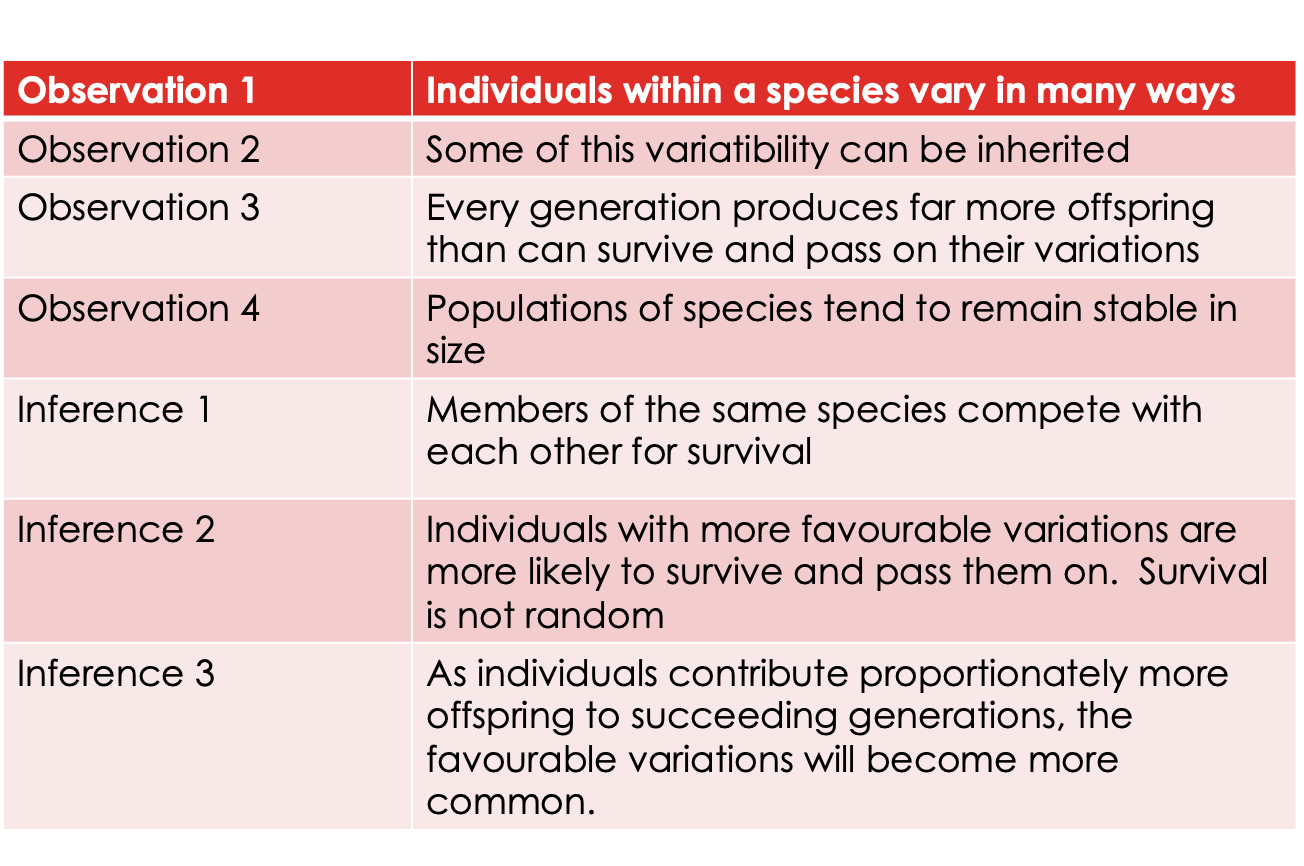
Natural Selection (VISTA)
A simple mechanism explains how populations change over time.
Variation:
Individuals of a species differ due to random mutations.
Inheritance:
Organisms pass on their DNA — including new mutations — to their offspring.
Selection:
Because resources are limited, not all individuals survive; those better at finding food, avoiding predators, or mating are more likely to thrive.
Time:
Across generations, advantageous traits get passed on to more offspring.
Adaptation:
Over many generations, these traits become common, producing a population better suited to its environment.
Problems with Darwin’s work
Some criticized Darwin because he could offer no explanation for the source of new variations.
6 years later Gregor Mendel proposed his theories for genetic variations.
1. How is genetic variation acquired?
Genetic variation is acquired through:
Mutations — random changes in DNA.
Meiosis (sexual reproduction) — mixing of genes through crossing over and independent assortment.
Fertilization — combining DNA from two parents to create unique offspring.
Gene flow — new genes entering a population when individuals migrate.
Mimicry
The ability to mimic something that they are not
Ex. Many harmless species resemble a harmful species in colouration or structure. Predators that avoid that species will also avoid the mimic.
Development of Adaptations
Adaptations come from gradual, helpful changes caused by random DNA mutations over many generations.
Variations are structural, functional, or physiological differences within a species.
Not all variations become adaptations — it depends on the environment.
Helpful variations boost survival and reproduction, so they get passed on and become more common.
Over time, these beneficial traits become adaptations.
Some traits aren’t useful at first but can become helpful if the environment changes.
Example: Peppered moth — the dark form became favoured during industrial pollution.
What Leads to Genetic Variation?
MUTATIONS – are changes in the genetic material
Can occur spontaneously altering the alleles in an individual
May cause a new characteristic that can be beneficial to a species
Selective Advantage
Mutations that were neutral or harmful can become helpful if the environment changes.
Helpful mutations give organisms a selective advantage — they survive and reproduce better.
Examples:
Daphnia with mutations that let them survive wider temperature ranges
Bacteria where a single mutation can spread quickly and cause antibiotic resistance
Homologous Structures → Divergent Evolution
2. Analogous Structures → Convergent Evolution
1. Homologous Structures → Divergent Evolution
Homologous = same origin, different function.
Examples: human arm, cat leg, whale flipper, bat wing.
Why this means divergent evolution:
All these structures come from a common ancestor.
Over time, that ancestor’s descendants moved into different environments.
Because the environments and uses were different, the structure diverged (changed in different directions).
Same starting blueprint → modified for different purposes.
Visual logic:
Common ancestor → branches out → different forms
This is divergence.
Key idea:
Homologous structures show shared ancestry, so they prove divergent evolution.
2. Analogous Structures → Convergent Evolution
Analogous = different origin, same function.
Examples: butterfly wing vs bird wing, shark fin vs dolphin flipper.
Why this means convergent evolution:
These organisms do not share a recent common ancestor with that structure.
They live in similar environments or face similar selective pressures.
Because of this, they independently develop similar solutions to the same problem.
Different starting blueprints → evolve to look/function similarly.
Different ancestors → converge → similar function
This is convergence.
Key idea:
Analogous structures show similar adaptations without shared ancestry, so they prove convergent evolution.
 Note
Note  Flashcards (24)