W11 and W12 exam style questions
 Studied by 0 people
 Call Kai
 Learn
Learn Practice Test
 Spaced Repetition
 Match
Match Flashcards
 Knowt Play
1/9

There's no tags or description
Looks like no tags are added yet.
Name | Mastery | Learn | Test | Matching | Spaced | Call with Kai |
|---|
No analytics yet
Send a link to your students to track their progress
10 Terms
1) Do you think that community members are becoming overly dependent on this social service provided by entrepreneurs? Talk about it using examples
Yes, sometimes communities can become too dependent on social services if the support does not build long-term skills. When people rely only on donations or free services, they may stop developing their own abilities or income sources.
Example (Real business: TOMS Shoes)
TOMS gave free shoes to many developing countries.
Some critics said communities became dependent because local shoe businesses could not compete with free shoes.
This shows that good intentions can unintentionally create dependency if not combined with community empowerment.
Create a social venture plan that promises long-term community empowerment, including a mission, vision, goals, objective, short-term milestone, and work plan.
Mission:
To empower rural youth in Cambodia by providing digital skills training for better job opportunities.
Vision:
A future where all Cambodian youth can access quality digital education and stable employment.
Goals:
Improve digital skills in rural communities.
Increase employment opportunities.
Reduce poverty long-term.
Objectives:
Train 500 youth in basic digital skills within 2 years.
Partner with 10 tech companies for internships.
Short-Term Milestone:
Complete the first 100 trainees in 6 months.
Work Plan:
Conduct community outreach.
Set up training centers with computers.
Provide courses in typing, coding, digital marketing.
Monitor job placements.
Real Business Inspiration:
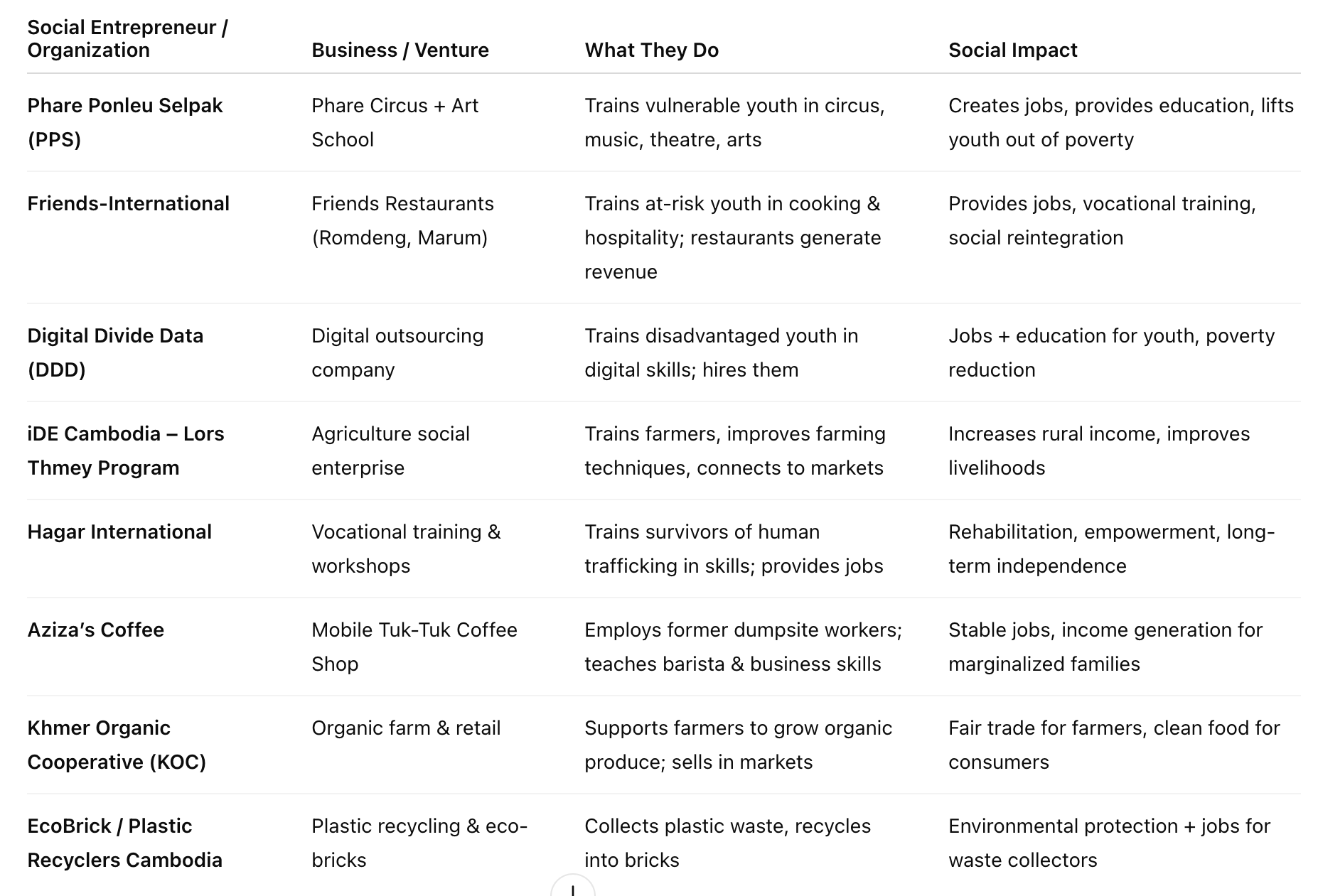
Digital Divide Data (DDD) – a global company founded in Cambodia that trains disadvantaged youth in digital skills and hires them. It proves long-term empowerment is possible.
What qualities are necessary for someone to become a social entrepreneur? Do you believe that social entrepreneurship will emerge in the future as more businessmen succeed on the commercial front? Look for a true case from Cambodia and talk about it.
A social entrepreneur needs:
Empathy (understanding community needs)
Creativity (finding new solutions)
Risk-taking (trying new ideas)
Leadership (motivating others)
Persistence (not giving up)
Yes, social entrepreneurship will grow because more businesspeople want to create both profit and social impact.
Real Cambodian Example:
Hagar International – founded to help women and children who survived trafficking and abuse.
Their work shows strong leadership, empathy, and innovation (providing shelter, training, and jobs).
What might lead to the failure of social entrepreneurship? What are the commercial venture's similarities and differences?
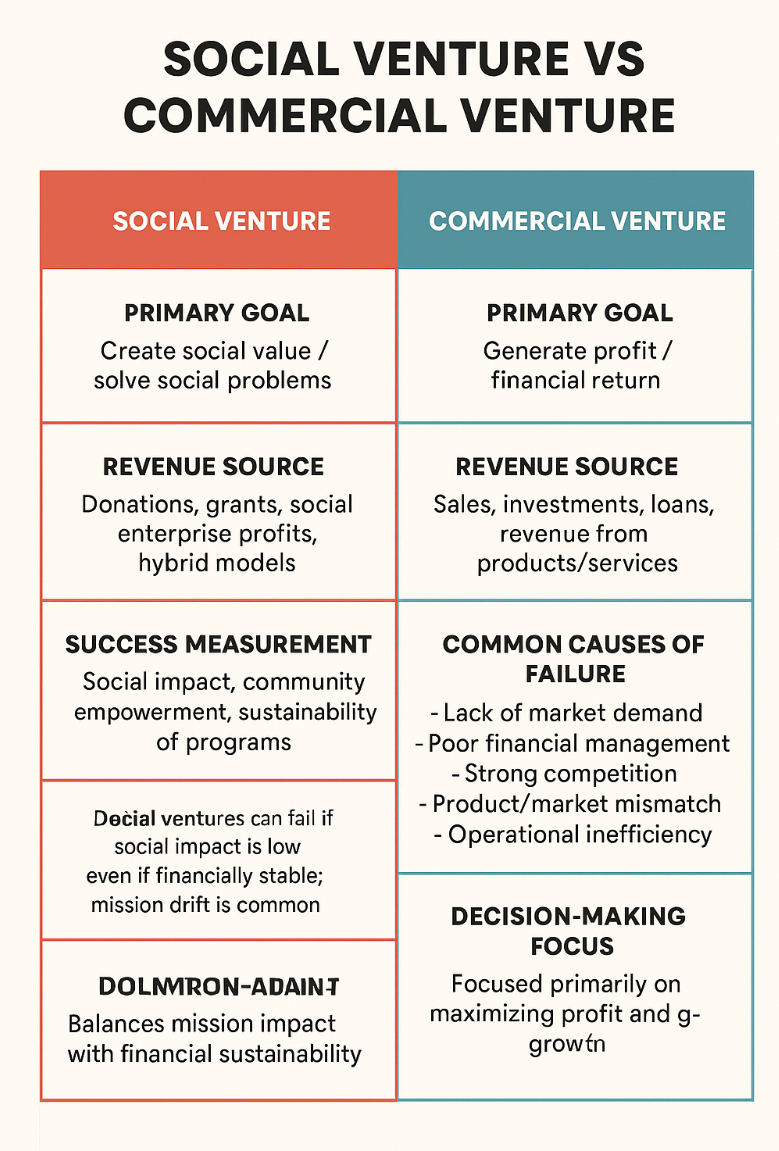
Reasons for failure:
Lack of funding
Poor management
No clear business model
Depending too much on donations
Not understanding community needs
Similarities with commercial ventures:
Both need good planning
Both face risks
Both must satisfy customers or beneficiaries
Differences:
Social ventures focus on impact, not profit
Commercial ventures focus on profit, not social change
Social ventures measure success by social outcomes
Real Example:
Many small NGOs in Cambodia fail because they rely on unstable donor funding and do not build sustainable income.
How may digitalization be used to improve social venture impact? Examine a few actual situations.
Digital tools can help social ventures reach more people at lower cost. They can improve transparency, communication, and training through online platforms.
Real Examples:
Teach for Cambodia uses digital tools to track student progress and train teachers online.
M-Lab Cambodia teaches coding to youth through online platforms.
Charity:Water uses digital maps and GPS to show donors exactly where wells are built, increasing trust.
Digitalization makes social impact faster, cheaper, and more scalable.
How should entrepreneurs balance effectuation ("making do with what you have") with causation ("planning to achieve a specific goal")?
Entrepreneurs should start with effectuation, using what they already have to test ideas and reduce risks.
Once they understand the market, they should switch to causation, making clear plans and setting goals.
Short Answer:
Start flexible, then plan clearly once you know what works.
Real Example:
Airbnb began with effectuation (using their own apartment and small resources).
After proving demand, they shifted to causation with a global scaling strategy.
As an early entrepreneur which quadrant you will choose in negotiation stage? Explain with logic.
Exam Answer (Simple):
Choose the Collaborating quadrant because it creates win-win solutions, builds trust, and helps new entrepreneurs who have limited power.
Logic:
Collaboration builds long-term partnerships.
It helps both sides share resources and reduce risks.
Real Example:
Grameen Bank (Bangladesh) collaborates with borrowers, building trust and long-term relationships—it is key to their success in microfinance.
Investigate some business examples where this effectuation practice will not work? Give detailed explanation.
Exam Answer (Simple):
Effectuation does not work in industries that need huge investment and strict planning.
Examples (Real Businesses): A) Pfizer (Pharmaceuticals)
Drug development needs strict testing and regulation.
You cannot “experiment cheaply.”
B) Boeing (Airplane manufacturing)
Requires billions of dollars and precise engineering.
Safety regulations prevent trial-and-error.
C) Nuclear Energy Companies
Needs exact planning and zero mistakes.
Effectuation is too risky.
Short Summary:
Effectuation fails in industries with high cost, high safety standards, and long timelines.
examples of khmer businesses
Difference Social venture and Commercial venture
 Note
Note  Flashcards (77)