Economics of organisations - theory
 Call Kai
 Learn
Learn Practice Test
 Spaced Repetition
 Match
Match Flashcards
 Knowt Play
1/432

There's no tags or description
Looks like no tags are added yet.
Name | Mastery | Learn | Test | Matching | Spaced | Call with Kai |
|---|
No analytics yet
Send a link to your students to track their progress
433 Terms
what are the 5 theories of why firms exist?
transaction costs
property rights theory
incentives
adaption
teams
why do we bundle steps of production inside a firm instead of having separate suppliers for each step?
because price/contracts are costly
there are transaction costs
firms centralise the tasks and directs production, eliminating the transaction costs
ie employees don’t make contracts with one another, the manager will decide on any dispute between employees
examples of transaction costs found in markets
search and price discovery
set contracts between individuals
enforcing contracts
renegotiate/resolving disputes
why do contracts break down?
according to Williamson (1975):
bounded rationality and uncertainty
can’t foresee all contingencies or specify all actions ex-ante
ie we can’t predict every single action that could happen and write it into the contract
contracts are there incomplete
opportunism
parties exploit contract gaps: shading, renegotiation threats, misrepresentation
asset specificity creates hold-up problems
overall, costly ex-post bargaining and safeguards are unavoidable
what does hierarchy (present in firms) do well compared to the market?
adaption to shocks (no full renegotiation)
authority for dispute resolution
coordination across interdependent tasks
what does hierarchy (present in firms) not do well compared to the market?
weaker incentives (‘low-powered’)
firms don’t replicate the same changes as in the market
ie if the price of a good goes down, the firm will decrease profits but won’t decrease the wage to the workers
this shows that rich information is not so easily absorbed compared to the market
monitoring/communication limits due to bureaucracy present
loss of market discipline/competitiveness
workers on the same task won’t act competitively in the same firm as they would in the market setting
example of appropriable quasi-rent
a bicycle company was developing a new model which required special wheels,
the wheels cannot be produced by wheel producers who don’t have a special machine that is specific to the wheel design
the wheels cannot be sold to any other producer
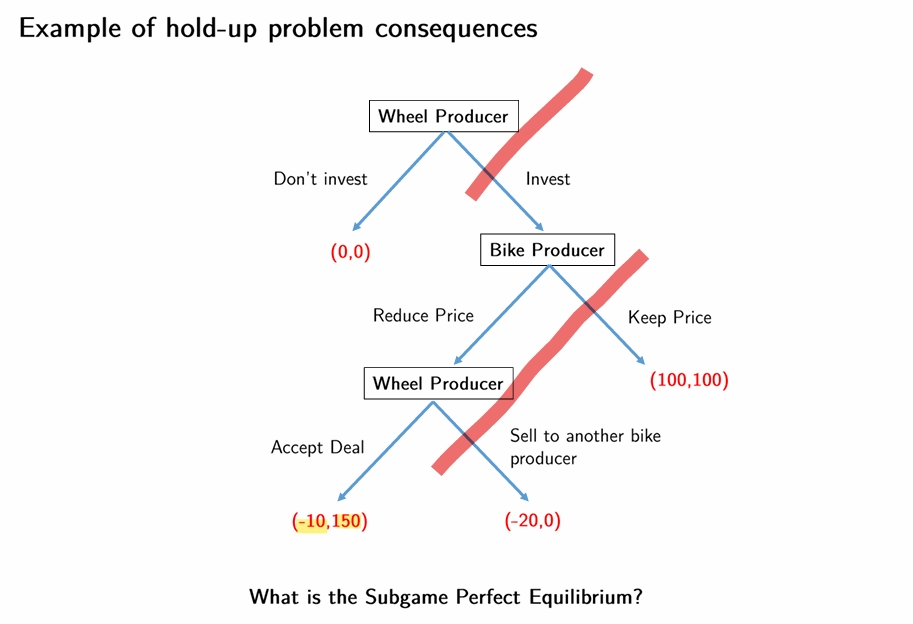
what is the subgame perfect equilibrium?
using backward induction, the wheel producer prefers to accept the deal (-20) to selling to another bike producer (-20)
the bike producer prefers to reduce the price (150) to keeping the price (100)
the wheel producer prefers to not invest (0) to accepting the deal (-10)
therefore, the subgame perfect equilibrium is not invest
therefore, the hold-up problem results in the most efficient outcomes (100,100) not being achieved due to pareto efficiency
are there solutions to solve the ‘hold-up’ problem?
could write a contract to avoid not achieving the most efficient outcome
there’s always ways-out/loopholes
ie claim quality was not good
ways out may be desirable, especially if the asset doesn’t sell
producer could claim ‘unexpected’ costs and raise the price
integrating the transactions into a single firm would reduce the rent-seeking opportunistic behaviour
key idea of transaction cost theory
make or buy
integrate when transaction hazards dominate, ie high appropriable quasi rents, uncertainty, etc
outsource to market when bureaucratic/monitoring costs dominate
all issues are ‘ex-post’ transaction
problems due to rent-seeking arise after transaction
property rights theory
developed by Grossman, Hart, and Moore
parties combine assets to create value
as ownership gives right to exclude/redeploy the assets, cooperation requires compensating owners enough to participate
ownership determines how the transaction’s value is allocated and confers rights of use
problems arise from ex-ante decisions
payoffs not affected by ex-post issues, only by ownership (ie ex-ante non-contractible investments)
this is because investment is needed before a transaction can take place such as training which is not contractable
ex-ante investments can increase value of transaction but investments are not guaranteed due to incomplete contracts
some investments may not take place unless there is integration into a firm
ie some efficient investments may not occur without integration
example of property rights theory
input producer owns asset 1 and final producer owns asset 2
asset produces V1 and V2 separately but V >/= V1 + V2 when combined
party i can invest Ii (eg training) that increases the payoff but not the asset price
ie payoff is higher if ownership is higher (similar to stocks)
they can’t write a contract setting the level of investment
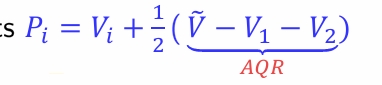
each party i gets what is in the picture
the share of AQR is fixed ex-ante (ie there are no opportunistic issues)
AQR here represents the surplus of the transaction generated
why does the free rider problem occur within the property rights theory?
efficient bargaining results in parties sharing the surplus from their specific investments
party i bears the full cost of investment but receives only a share of the surplus
this results in suboptimal investment due to free riding
however, if party i has a higher level of ownership (eg higher Vi), this increases the party’s incentives to invest
key takeaways from the property rights theory
if V = V1 + V2, there are no incentives to integrate
if I has a large impact on V, then i should own more assets
if V1 + V2 = 0 but V > 0, the assets should have a single owner
incentives theory of firms
firms exist to solve incentive issues (eg moral hazard)
some tasks/transactions may be too costly to integrate
firms implement pay systems, task allocation, technology, etc to mitigate these issues
availability of these tools determine firm boundaries
integration is only optimal if there is good technology to monitor effort
two ways to structure the problem:
if the agent owns the asset, they receive a payment based on measured performance and the asset’s value after production occurs (two incentives)
if the agent does not own the asset, the incentives come from being paid on performance
adaptation theory of firms
collective decisions are costly and slow
delegate authority into a ‘boss’ who can make fast decision
potential problem: bosses may have different objectives to the firm
team theory of firms
teamwork requires supervisors that prevent free riding
who control the supervisors?
need a whole hierarchy just to solve the free riding problem
ownership trade-off in trucking industry (Baker and Hubbard, 2004)
driver
good: incentives to drive carefully which preserve truck’s value
bad: discretion to take external jobs or reject trips
carrier has less incentives to find good ‘backhauls’
carrier company
good: incentives to find backhauls
force drivers to not accept external trips and to accept profitable trips
bad: drivers may not drive carefully, drive fast to have more breaks, blame traffic for delays, etc
how is the trade-off in ownership related to theory? (Baker and Hubbard, 2004)
asset ownership gives different incentives to invest
eg preserving the truck vs coordination efforts, haggling, etc
driver’s actions are hard to monitor
carriers can’t enforce contracts with careful driving, how to drive, etc
carriers can’t specify what to do in every single scenario
how does the trade-off in asset ownership depend on trip/cargo? (Baker and Hubbard, 2004)
long hauls: more likely to drive fast, make up time, etc
more valuable to have a backhaul or else it is very costly
specialized trailers: backhaul is unusual
lowers potential for haggling or bargaining on trips
eg would not expect chilled goods and fuel to have backhaul
what do Baker and Hubbard (2004) study?
the study the trade-offs between asset ownership in the trucking industry
carriers work with a mix of drivers; some own their trucks and others drive company’s owned trucks
study driver vs carrier ownership in two ways:
how it differs for different trips/cargos
what happened after the introduction of a technology (on board computers) that allowed measuring driver’s behaviour accurately
data is not a panel of trucks but instead a repeated cross-section
define: cohort = state*product*trailer*distance
eg long-distance hauls of food in refrigerated vans based in California
each cohort observed before (1987) and after (1992) OBC introduction
minimises within-segment hetereogeneity in haul characteristic that would otherwise tend to bias estimates
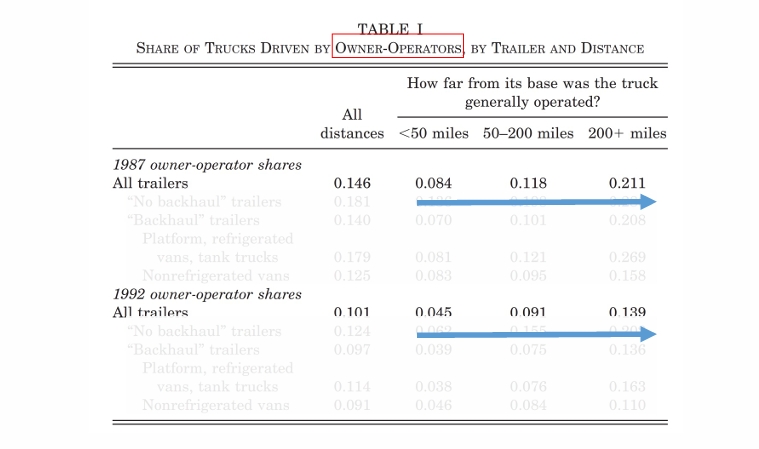
what does this table of results show us? (Baker and Hubbard, 2004)
the share of trucks owned by employees increase as distance increases
consistent with the hypothesis that carrier-owned drivers have less of an incentive to drive carefully
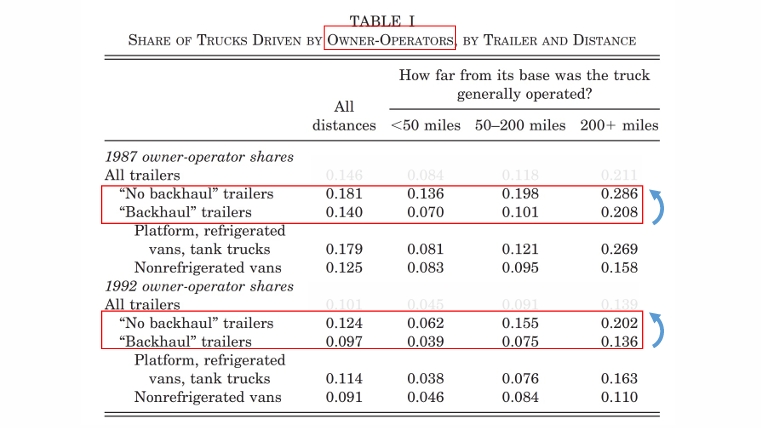
what does this table of results show us? (Baker and Hubbard, 2004)
the share of owner-owned trucks is lower for backhaul trailers
consistent with owner-drivers’ rent seeking behaviour (eg reject trip, bargain commissions)
this means carriers have low incentives to secure backhauls for owner-drivers
predictions about on board computers (Baker and Hubbard, 2004)
more adoption for long hauls and backhauls trailers
most commonly carried out by carrier-owned drivers who are more likely to speed, not drive carefully etc
on board computers makes it easier to monitor drivers and enforce careful driving with contractual clauses
adoption of on board computer should increase carrier-ownership
this is because there is a higher benefit to the carrier company in having the on board computers compared to employees who own their trucks
carrier-drivers should change their driving behaviour more than owner-drivers
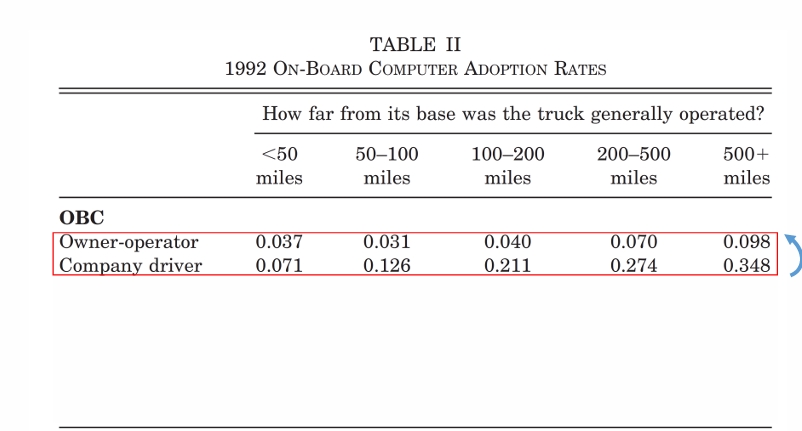
what do these results show us? (Baker and Hubbard, 2004)
company-owned trucks adopted more on board computers
this is because the on board computers has a higher benefit for the carrier company
adoption is higher for longer distances
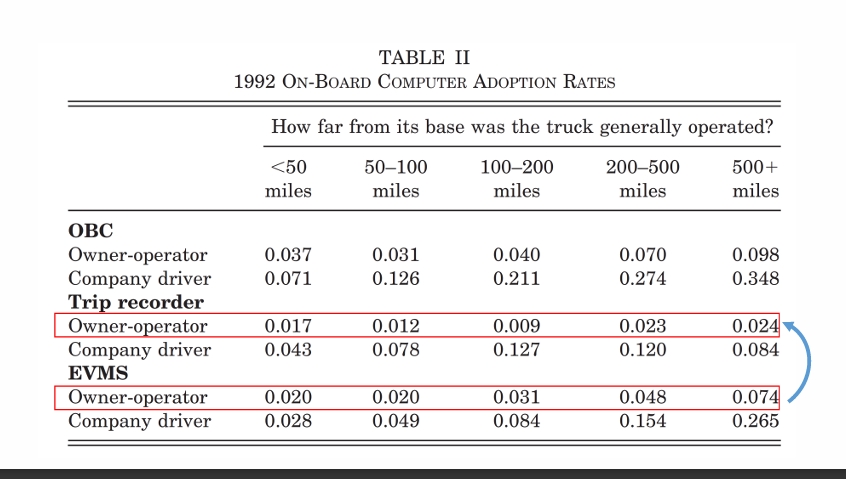
what do these results show us? (Baker and Hubbard, 2004)
owner drivers are more likely to adopt the on board computers with messaging capability (eg EVMS) as they benefit from receiving traffic updates
benefit from on board computers for coordination rather than for solving ‘careless driving’ issues
still lower adoption rates compared to company owned trucks

what does this equation show us? (Baker and Hubbard, 2004)
Sr = ratio of carrier vs driver owned trucks in cohort r (triangle = change)
the higher the ratio, the more carrier-owned trucks in that cohort compared to driver-owned trucks
OBCr = share of cohort r that adopted OBC (between 1987 and 1992)
Xr = some characteristics of the cohort
this equation helps us to answer whether the adoption of the computer machines changes the structure of ownership
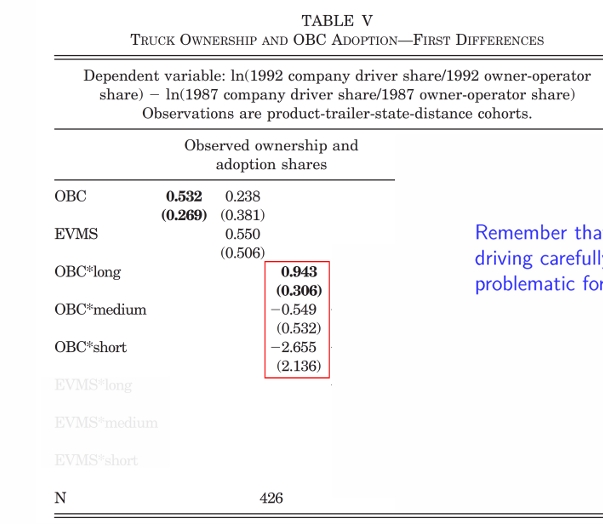
what do these results show us? (Baker and Hubbard, 2004)
on board computers adoption increases carrier ownership
it solves the issue of carriers previously not being able to monitor drivers
solves the main incentive issue
however, this effect is only significant for long trips
this is because the incentives for driving carefully are more problematic for long hauls
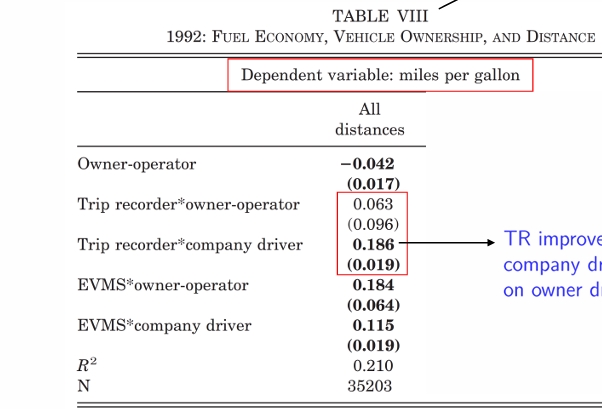
what do these results show? (Baker and Hubbard, 2004)
trip recorders encouraged carrier-drivers to drive more efficiently
ie to consume less fuel
fuel consumption is used as a proxy for careful driving as if the driver speeds and breaks harshly, they will use up a lot of fuel
no effect on owner drivers as they already have the incentive to drive carefully
EVMS (on board messaging computer) improved fuel consumption for both employee-owned and carrier-owned drivers
better ‘coordination’ can help with fuel consumption (eg carrier can tell you to avoid a busy route)
key messages from Baker and Hubbard (2004)
ownership of assets affects incentives of parties
depends on the ability to measure and monitor the actions of parties
can be different for different tasks (eg long vs short trips)
new technologies can affect this trade-off and induce changes in ownership and firm’s structure
background into Hansman et al (2020)
setting: Peruvian fishmeal industry
many independent fishing boats supplying processing plants
key friction: the quality of fishmeal (ie the protein content) is hard to contract on
protein content depends on how long fish has been out of water
a matter of hours can make huge differences
only observed ex post, making it difficult to trace quality back to individual boats
questions:
does quality premium increase integration?
integration = boats are owned by processing firm
quality premium = huge price differentials between high and low protein content fish
do integrated suppliers prioritize quality?
data: observe prices and production of each processing plant and over time
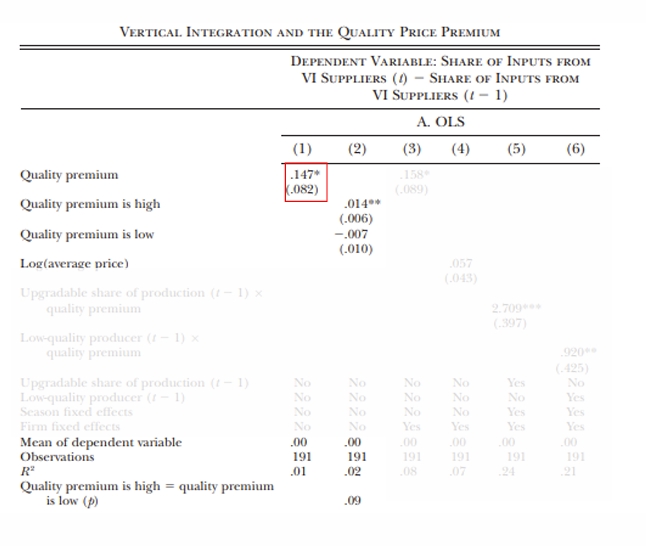
what do these results show us? (Hansman et al, 2020)
we are regressing integration (share of fish bought from owned suppliers) on quality premium
comparing the same plant when the quality premium is low and high
export markets pay large premia for high quality
when quality becomes more valuable, firms are more likely to vertically integrate fishing boats
market contracts fail to induce quality
integration allow direct control of boat behaviour
have GPS to track boats to tell them to return immediately once caught fish
link to theory: firm boundaries shift when markets cannot provide the right incentives
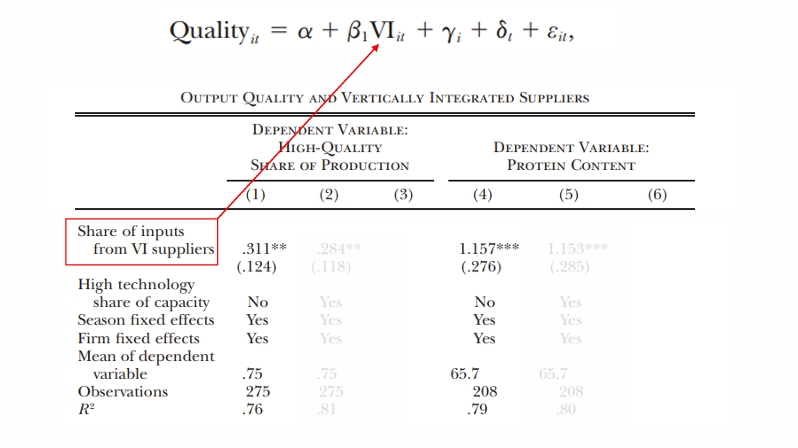
what do these results show us? (Hansman et al, 2020)
we are comparing the same boats before and after integration
including plant and year fixed effects
the higher the share of inputs, the higher the quality of fish
after integration, the same boat will deliver less fish but higher quality fish
under market contracts, suppliers will focus on quantity as quality cannot be observed so cannot have contracts on quality
quality therefore can only be achieved through integration
when does integration become more important?
when contract imperfections are high
what happens when appropriable quasi rents are large?
it makes integration more likely
AQRs makes haggling more likely/costly as it provides a source of private monetary gain
assumptions of rent-seeking/transaction costs theory of firms that are not clear
assumes that integration can stop the haggling induced by the AQRs but it requires an implicit focus on certain types of haggling
eg if haggling was completed through the manipulation of alienable capital, then integration could remove the control rights form the haggler
if haggling was completed by manipulation of inalienable capital, then integration could not stop rent-seeking
suggests that ownership could stop haggling that is undertaken via alienable assets
reasons why hold-ups between firms may not result in integration (according to rent-seeking/transaction costs theory)
the hold-ups use inalienable instruments (eg human capital) so the observed hold-ups are unavoidable
integration would do nothing to solve it
the observed hold-ups are actually better than what integration would have provided
comparison of property rights theory and rent seeking/transaction costs theory
rent-seeking theory predicts socially destructive haggling
property rights theory assumes efficient bargaining
rent seeking is consistent with contractible specific investments ex ante
property rights requires non-contractible specific investments
in rent seeking theory, the integration decision determines ex post haggling and hence total surplus
in the property rights theory, the integration decision determines ex ante investment and hence total surplus
rent seeking theory does not say anything about internal organisation
property rights theory defines and evaluates life under integration and non-integration to give benefits and costs of integration
why does owning more assets result in stronger investment incentives, according to the property rights thoeyr?
efficient bargaining results in parties sharing the surplus from their specific investments
surplus share is determined by each party’s investment incentive
each party’s asset ownership determines the party’s surplus share
therefore, owning more assets guarantees a bigger surplus share and creates a stronger investment incentive
if it is more important to maximise one party’s investment, then that party should own all of the asset
if all the parties’ incentives are important, then dividing the asset between parties is efficient
downside of integration
after integration, if the producer can now hold up the supplier, this may reduce the supplier’s incentive to invest
reduced initiative for the acquired firm
how does the incentive theory differ from the property rights and transaction costs theories?
incentive theory: focuses on an incentive problem between a principal and agent
transaction cost/property rights theory: focuses on make-or-buy problem
what is the optimal incentive contract?
depends on ownership structure
if the agent owns the asset, they have the incentive to increase the asset’s value
the optimal contract for an agent who does not own the asset (employee) provides weaker incentives than does the optimal contract for an agent who does own the asset (contractor)
why should we care about vertical integration?
frictions: transaction costs, information asymmetries
overcomes the problem of imperfect contracts
easier for firms to acquire the inputs themselves rather than going to the market to avoid the market frictions present
firms vertically integrate to ensure the quality of their inputs
3 main hypotheses of Hansman et al (2020)
should see a correlation between the proportion of inputs coming from a vertically integrated supplier and the quality of output
when the incentives of the market are larger (ie when the quality premium is larger), firms should source more of their fish from vertically integrated suppliers
ie they should be reacting to prices
vertical integration increases when quality becomes more important
vertically integrated suppliers take more actions to ensure high quality inputs
when firms source more from a vertically-integrated supplier, this has a causal effect on quality of output
how does diseconomies of scale arise?
arises not from variations in scale but from the inability to vary all factors
eg management
it is fixed and cnanot be replicated
advantages of spot markets
efficient adaptation to changes in demand and cost
equilibrium prices and quantities adjust to reflect changes in demand and cost and realize maximum total surplus
cost minimization
a firm will invest in cost reduction until the marginal benefits of cost reduction equals the marginal cost
realisation of economies of scale
these advantages arise as there is not a relationship between a firm and its suppliers, meaning firms can substitute away to a cheaper supplier
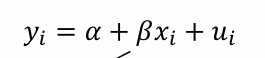
what do the terms in the regression represent?
beta = the effect that X has on Y
causal effect
u = error term
captures everything that is not included in x
what does the hat above parameters mean?
means they are ‘estimated’ from the data
what does the bar above parameters mean?
average
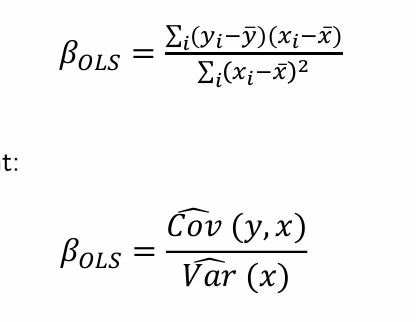
OLS formula (with one regressor)
if we divide the numerator in the first equation by N, it becomes the covariance
if we divide the denominator in the first equation by N, it becomes the variance of x
therefore, beta measures the correlation between y and x
this does NOT imply causality though
do we really need the ‘true’ model to be linear?
no
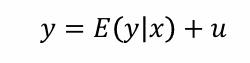
for any two variables (y and x), we can write what is in the picture
u = a residual uncorrelated with x
E(y I x) = conditional expectation function which captures the ‘average’ relation between y and x
tells us how x affects y on average
can take any form, including non-linear
looking at what the average of y is when x is held constant and we do this for several values of x to create a best fitted line
even if the true relation is not linear, can we use OLS?
yes
this is because we can show that the best linear approximation to the conditional expectation function is a line with slope cov (y, x) / var(x)
this is just OLS !!
reasons why beta will not measure the ‘true’ causal beta
omitted variable bias / selection
measurement error
reverse causation
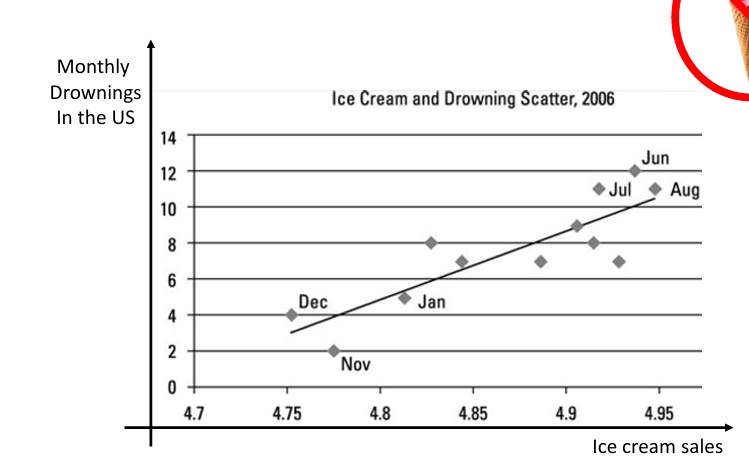
what is the omitted variable in this?
temperature/ weather
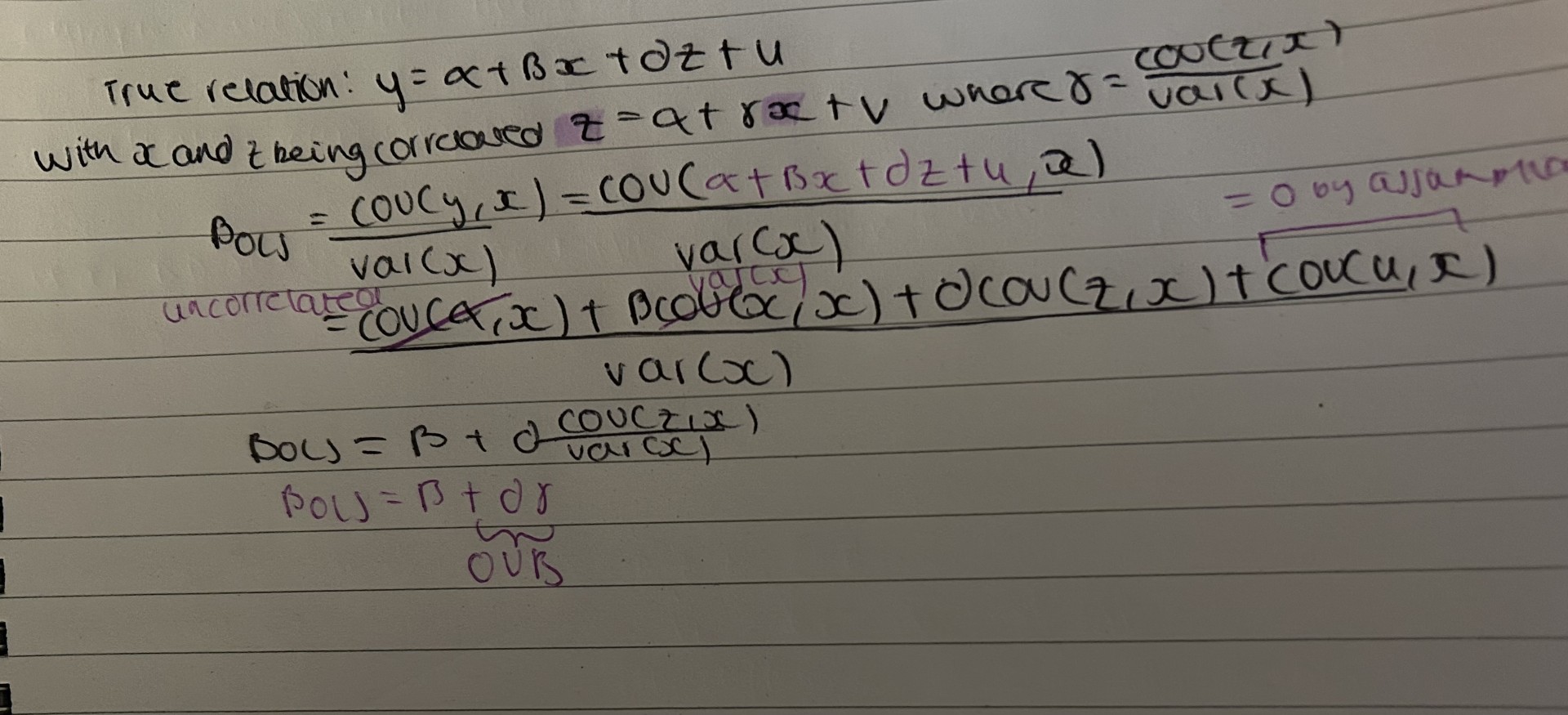
OVB formula
the problem is the beta picks part of the effect of z on y
there is no OVB if gamma = 0 (ie x and z are uncorrelated)
what could be the omitted variable in this?
the type of organisation
ie more horizontal firms may be able to implement working from home but there may be less promotional opportunities
what is the omitted variable when we we regress profits on CEO pay?
CEO experience
we would expect high experienced CEOs are paid more
we would also expect experienced CEOs increase profits
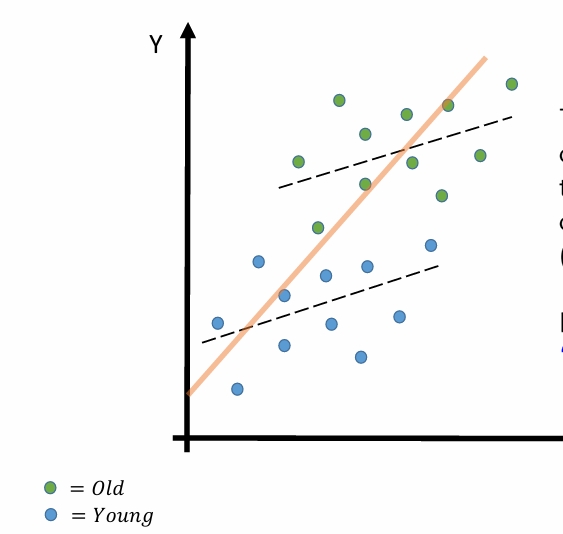
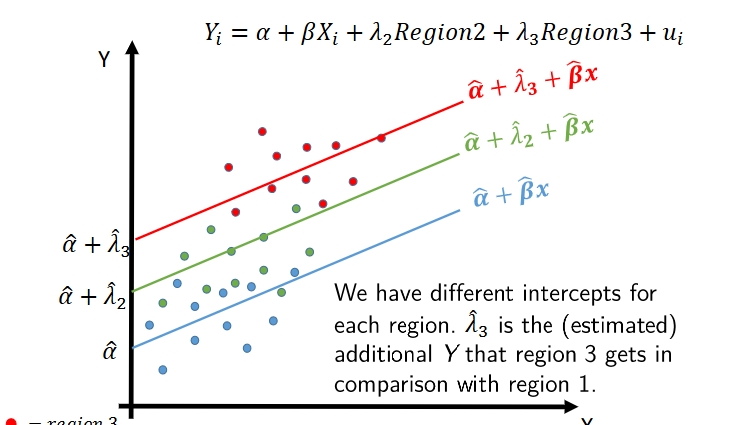
how would we solve this problem where there are two identifiable groups with different outcome values?
solve this by controlling for the omitted variable
ie have a dummy variable to differentiate the two groups
if we don’t do this, we would conclude that the effect of X on Y is much higher than the true one
results in an extra constant
results in two different intercepts
notes about OVB
in a multiple regression, beta is interpreted as the effect of X on Y conditional on other controls
can be interpreted as the effect of X on Y after netting out the effect of other controls
need to control for a variable if it affects Y and is correlated with the variable of interest (ie X)
can’t interpret the correlation as causal if there is OVB
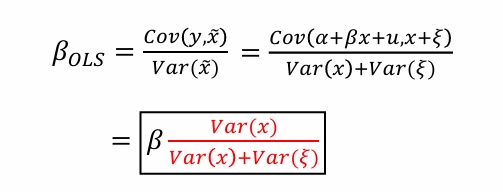
beta formula with measurement error
don’t observe x but observe a noisy version of it
noise is uncorrelated with any variable
the higher the noise (ie the higher variance of the noise), beta is biased towards to zero
ie it observes attenuation bias
can’t fix it but if it is very small, we can ‘ignore’ it
if the attenuation bias is high, then the regression line is flatter
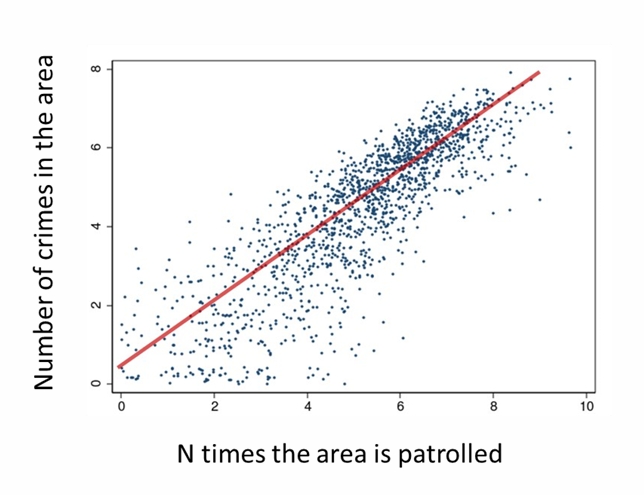
what is the problem with this graph?
looks like when there are more police, crime is higher so the police are not good at their job
they are actually capturing when crime is higher, more police will patrol that area
OLS cannot distinguish in which direction the relation goes
there could be a causal effect but OLS will pick the total effect so we may overestimate the effect we are wanting to study
this happens when the reverse relationship is very large

Which theory of the firm is consistent with this setting?
the property rights theory
claims that the issues determining the boundaries of the firm (which transaction should be internalized) are due to ex-ante investments that parties can make to increase the value of the transaction
due to contracting problems (and the fact that asset ownership confers the right to decide on the asset’s use), the parties can’t commit to make these investments
in this context, integrating transactions (eg a common owner of assets) can be efficient

What is the optimal level of investment if producers could commit to it with a contract?

Discuss why the owner will not hire the chef if they have to pay a fixed wage
as effort is not observable (thus no penalties can be imposed on it), the chef has no incentives to put any effort
on average, R = 1, while the paid wage has to be at least equal to 1.5 (so the chef would accept it as this is equal to the outside option)
Based on the example of the semi-skimmed milk vs yoghurt production, explain why incomplete contracts are problematic (Hansman et al, 2020)
when producing something very standard as semi-skimmed milk, different parts of the production process can be done by separate firms
eg the farmers and the milk processing
it is easy to specify in a contract what are the requirements of the transacted products and related terms
when you need to produce something much more specific such as a certain type of yoghurt, it is more difficult to establish the requirements of the products into a contract
particularly, things related to quality that is difficult to observe and measure (in a short period) become difficult to contract
we expect more integration when unobserved quality of the inputs are important for the final value of the product
what we see in Hansman et al (2020)
OVERALL: quality is hard to specify in a contract
why is it difficult to monitor the behaviour of the boats in order to specify in a contract the way in which they should manage catchment? (Hansman et al, 2020)
although boats have GPS, this is not observed by the firms
observed only by regulators
also it is not obvious there is a unique strategy for fishing efficiently
eg it may be better sometimes not to do short trips but to stay in a sea area where you would find a lot of fish
ie a contract would have to be contingent on many different things that are hard to specify in a contract
thus, a contract about how the boat should behave would have to be contingent on a large number of sea/weather/etc conditions
how does the fact that quality is unobserved affect the decision to integrate? (Hansman et al, 2020)
by integrating vertically (the input and final good producer), they can avoid many transaction costs related to problems with quality checking
as the firm producing the input (responsible for making effort to keep quality standards) and the output producers are both affected by the quality of the inputs, there is no need to rely on complicated contracts to set quality standards
with integration, the producer can control boat’s behaviour in real time
ie have a supervisor on the boat to tell them when to go back
why is it possible (particularly in the context where the study takes place) that problems preventing quality upgrading with market transactions are not solved even if parties can write a very detailed market with all the necessary specifications? (Hansman et al, 2020)
even if quality is easily observable and can be specify into contracts, these problems may not be solved
main reasons:
the poor institutional quality (eg non-efficient judicial system)
high cost of enforcing the contact (eg if your input provider breaks the contract, you need to hire lawyers, go to a court, wait years before court decision, etc)
verifying breaches is costly

(Hansman et al, 2020)
if we switch VI from 0 to 1, the share of high-quality production will increase by 0.311 ie by 31.1 percentage points
can scale the effect to say that a 10-percentage-point increase in vertical integration raises the share of high-quality output by about 3.1 p.p

(Hansman et al, 2020)
VI = dummy (important to note for log-level regressions)
ignoring the approximation error, this implies that increasing vertical integration from 0 to 1 (ie the boat becomes fully integrated) raises the number of trips by 19%
if we account for the approximation error, this corresponds to an increase of exp(0.19) - 1 = 0.21 ie a 21% increase in the number of trips made by the boat

This regression includes boat (ie supplier) fixed effects. Explain intuitively what the estimated coefficient (beta) captures. What comparison does the regression implicitly make? (Hansman et al, 2020)
boat fixed effects imply that we are comparing changes within boats
ie we are looking at the number of trips of the same boat, before vs after integration (and then, we get an average of the effect across all boats)
if a boat is always integrated or always not integrated, it does not contribute to the estimation of beta
Consider the baseline regression used by Baker and Hubbard (2004) in the paper about the trucking industry (specifically the effect of OBC adoption on ownership). Discuss what are the main threats to interpreting the estimation as causal?
omitted variables, eg the demand for a particular type of produce at some locations may have increased
carrier companies may have the incentive to buy more trucks to exploit these potential profits
at the same time, they may use these higher profits to invest in new technology which includes OBC
the effect on ownership is not driven by the OBC but the higher profits potential affected both ownership and OBC adoption simultaneously
reverse causality, ie the fact that carrier-ownership expansion may affect the OBC adoption
OBC producers may track, advertise and send their sale agents to talk to carrier companies that have just expanded
measurement error
could happen when an individual lies in a survey or variables are not measured correctly
results in attenuation bias (results are biased towards zero)
Why is Baker and Hubbard (2004)’s specification better than a single cross-section using a single survey year?
their specification is first differences (similar to fixed effects)
first differences means it is controlling for any unobservable time-invariant differences between the different cohorts
eg the price of OBC may differ across states and in states where OBC are cheaper or where carrier companies are bigger so they can buy more of them
any time-invariant characteristic that makes ownership different across states, trailer type, or distances that is also correlated with OBC adoption will show up as OVB in a cross-section regression
Explain the IV strategy Baker and Hubbard (2004) use and discuss the conditions to solve the causality problem
instead of using a single IV, they use 19 dummies indicating the transported product as instruments
intuition behind instruments: they only use the variation in the OBC adoption coming from the fact that OBC is more valuable for some products (independently of the ownership)
ie we would expect OBC to be adopted more for truck hauls with dangerous cargo such as petrol or chemicals
relevance: the dummies are not jointly insignificant
exogeneity: products shouldn’t influence the shift from using an owner-operator to a company driver
however, different products could also be associated to changes in incentives to adopt one type of ownership, ie drivers may be less willing to use their truck for dangerous cargo

Discuss the advantages and disadvantages of having the sales agent vs the insurance company owning the client network
advantage of sales agent:
has the incentive to work in order to get commission
advantage of internal agent:
easier to monitor as they can bypass contracting issues such as the hold-up problem
disadvantage of sales agent:
she may sell products from other company, suggesting to invest in packages that are not best for the company
hard to contract them to do exactly what the company wants them to do
disadvantage of internal agent:
wage is fixed so they don’t have the incentives to make much effort in keeping clients happy

Suppose that a new AI technology allows analysing email exchanges and measuring whether a worker is making enough effort to understand the needs of the client or to sell the correct products. How would this affect the decision of the firm to have more/less internal sale agents?
we expect that the share of internal agents increase in the insurance industry

You randomize the access to two different monitoring technologies across all the insurance firms in the industry. One technology (T1) analyses emails and the second one (T2) analyses emails but also the meetings and agenda information. You estimate the equation 𝑌𝑖 = 𝛼 + 𝛽𝑇1𝑖 + 𝛾𝑇2𝑖 + 𝜀𝑖 where 𝑌𝑖 is
the ratio of internal vs. external sales agents in firm 𝑖 and T1, T2 are the observed adoption of each technology in the firm. Interpret 𝛽 and 𝛾
if we ignore causality issues, 𝛽 aims to measure the effect of using T1
y will aim to measure the effect of using T2
OLS estimation will not capture this unless we make additional assumptions

You randomize the access to two different monitoring technologies across all the insurance firms in the industry. One technology (T1) analyses emails and the second one (T2) analyses emails but also the meetings and agenda information. You estimate the equation 𝑌𝑖 = 𝛼 + 𝛽𝑇1𝑖 + 𝛾𝑇2𝑖 + 𝜀𝑖 where 𝑌𝑖 is
the ratio of internal vs. external sales agents in firm 𝑖 and T1, T2 are the observed adoption of each technology in the firm. Why do the estimated 𝛽 and 𝛾 may not measure the causal effect of “using” T1 and T2? (hint:
compare underlined words)
access to T1 or T2 is random but actually using it may not be random and correlated with omitted variables
for instance, maybe only the big firms adopt T1 and big firms have more external sale agents

You randomize the access to two different monitoring technologies across all the insurance firms in the industry. One technology (T1) analyses emails and the second one (T2) analyses emails but also the meetings and agenda information. You estimate the equation 𝑌𝑖 = 𝛼 + 𝛽𝑇1𝑖 + 𝛾𝑇2𝑖 + 𝜀𝑖 where 𝑌𝑖 is
the ratio of internal vs. external sales agents in firm 𝑖 and T1, T2 are the observed adoption of each technology in the firm. Assume that every firm with access to T1 or T2 adopted its use. How would you measure the effect of AI monitoring meetings and agenda separately from the effect of AI monitoring emails?
T1 only contains the effect of emails AI analysis while T2 contains both the effects of email and agend/meetings AI analysis
the separate effect of monitoring meetings/agenda is 𝛾 − 𝛽
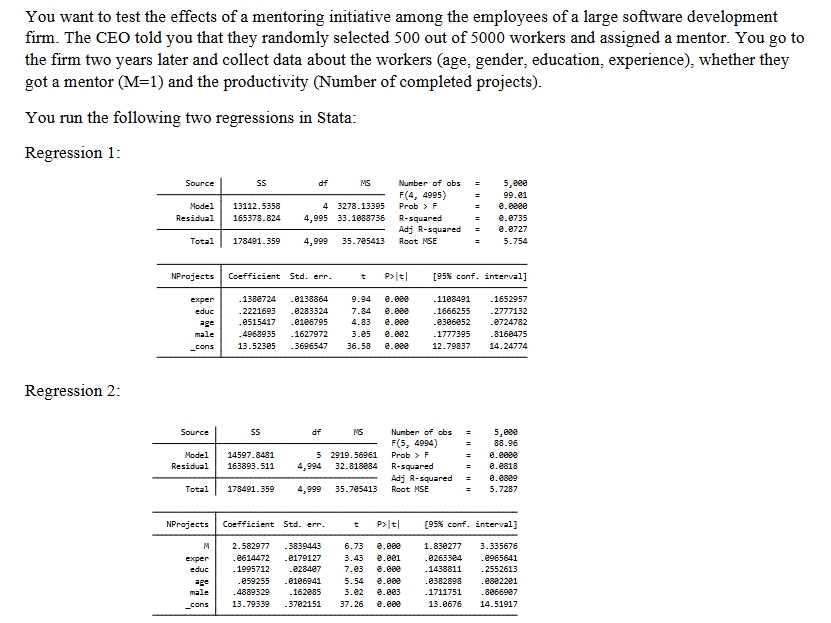
Why can you conclude that the mentoring program was not really randomized? (hint: compare the coefficients of experience and education and think about OVB)
the coefficient of experience and education change significantly between regressions so we can conclude that experience is correlated with M
in a true randomization, excluding M should not change (significantly) the coefficient of another variable because it would be uncorrelated with the excluded M
as the coefficient of experience and education drops significantly when excluding M, this means they are more likely positively correlated with M
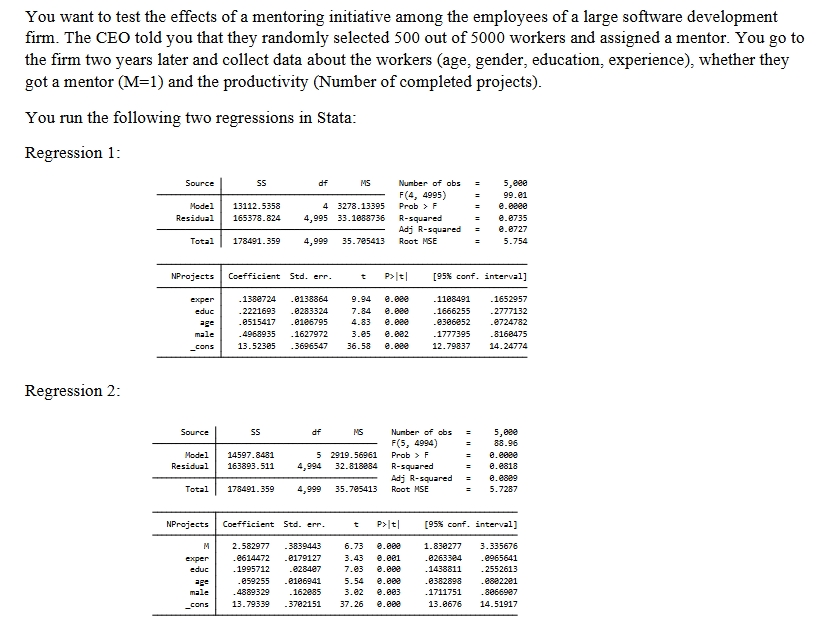
Discuss the following statement: “Since we are already controlling for other determinants of productivity, it does not matter that the program was not randomized. We can still interpret the regression coefficient of M as a causal effect”
it may reduce the chances that this happen
however, the fact that M correlates with things like experience and education, we would suspect that other variables such as how smart the worker is and how efficient the worker is, may also be correlated with M
as we cannot control for all these determinants, we should not think it is a causal interpretation
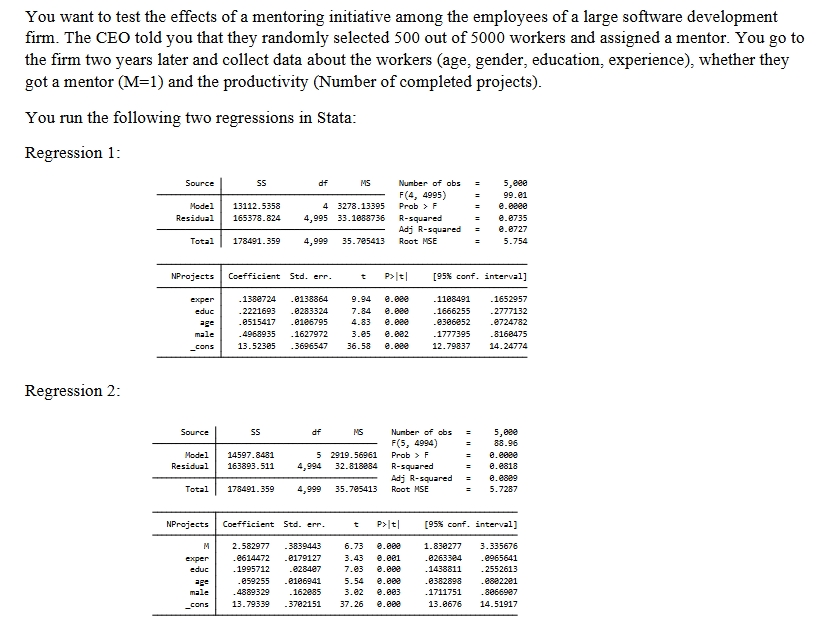
In which direction do you suspect that the coefficient of M is biased in regression 2? (hint: think about other omitted variables in regression 2)
according to the OVB, we expect that M is correlated with omitted variables that are associated with goods workers (such as IQ, effort)
this is because by omitting M in regression 1, this increases the coefficients of education and experience
if we expect that M has non-negative effect on Y, these characteristics should be positively correlated with M
additionally, experience and education are associated with more productive workers
we expect that the second regression overestimates the effect of M
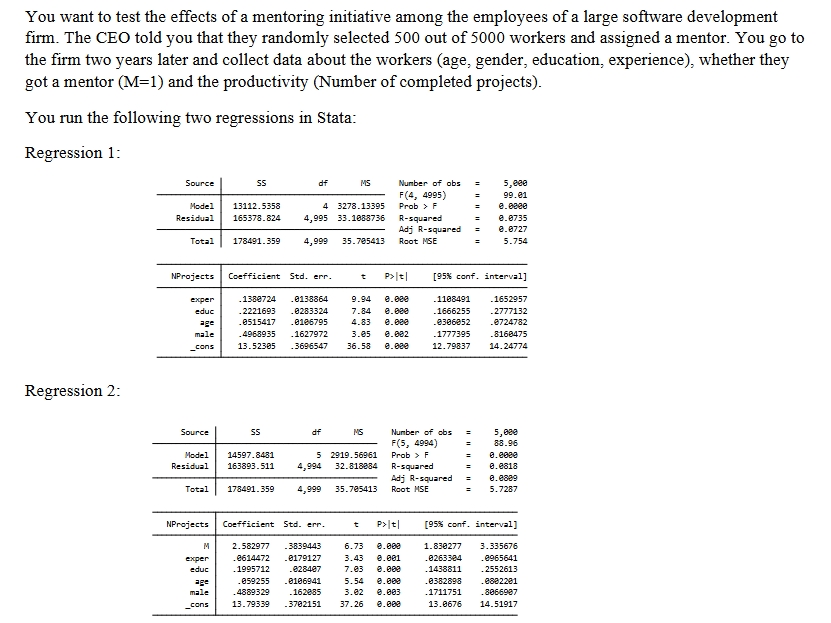
Propose a direct way of testing whether the program was randomized or not
can run a regression of M on all the worker characteristics that we observe (such as experience, education, age, male, etc) and test if they are jointly significant
can run multiple regressions of those variables on M and we should expect that in most of these regressions, M has a non-significant coefficient (eg balance test)
what are balance tests used for?
to test how well the randomization was done
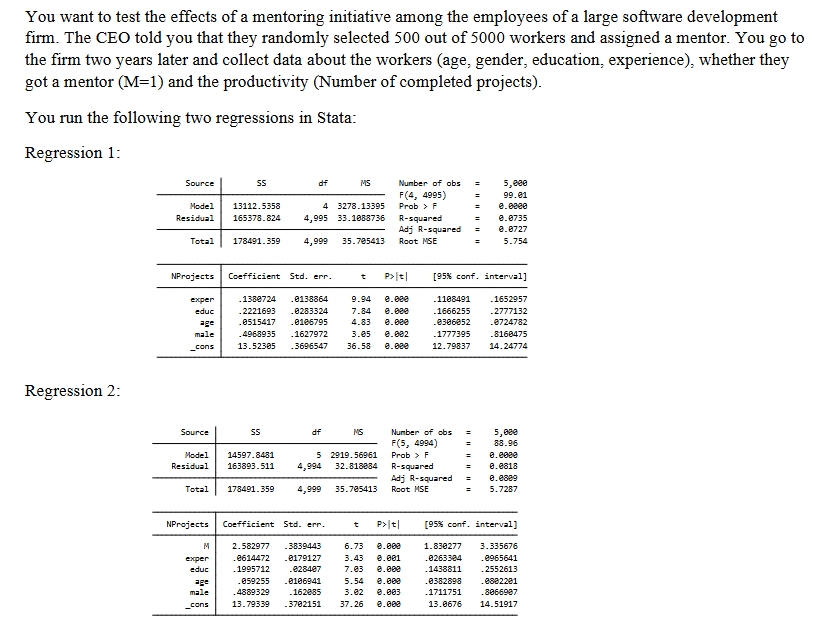
A manager in the firm mentions that the probability of getting a mentor actually depended on the internal evaluation score of each worker, which is likely correlated with productivity. You ask data about the evaluation score of workers, as you would like to control for that (why?), but these are
confidential. However, they offer you the following alternative: They will regress M on the evaluation score, calculate the residuals of that regression and they can share you that variable. Would that help you in estimating the causal effect of the program? (hint: think about FWL theorem)
the omitted variable affects the allocation of M so controlling for this variable in this main regression will solve the endogeneity problem
problem arises because the internal evaluations (measures how good is a worker) also affects the number of projects completed by the worker
can’t include the internal evaluation score in our regressions but we can carry out the application of the Frisch-Waugh-Lowell (FWL) theorem
the resulting coefficient of the ‘residualized’ variable will not have the problem of OVB

What is the optimal level of investment if producers could commit to it with a contract?
we can find the optimal I1 and I2 that maximises the total value minus the total cost of the investments (as if a central planner can decide both investments)
I1 and I2 equal each other


Show that the producers’ actual level of investment is lower than the optimal. What is the intuition behind this result? How does it relate to the property rights theory?
the intuition behind this is that investment costs are fully burdened by each party (not shared) while the benefits are shared
this creates a problem that resembles free riding


Assume that v1 = v2 = 2 and the cost of investment now is I2/2 + a with a>1 (for both I1 and I2) . Show that there are values of a for which joint production is efficient but it would not happen due to the absence of contracts
as the cost of investment is only affected by a fixed term, the optimal investment and actual investment remain the same (need to calculate this beforehand)
replacing v1 + v2 = 4, we get I*i = 22/3 (first-best) and Ii = 1 (actual)
we need to compare the level of benefits with optimal vs actual investment
under efficient investment, the joint production should take place whenever the net benefit exceeds the value outside the transaction (v1 + v2 = 4) (when a <3.77)
in the case of the actual investment, parties will agree as long as each party gets more than the value of their stock outside the transaction (2) (when a < 3.5)
this means that for values of a between 3.5 and 3.7, transactions that would be efficient will not happen due to the lack of contractual commitment on investment


Find the level of investment of each producer (if they can’t enforce I1 and I2 with contracts)
this


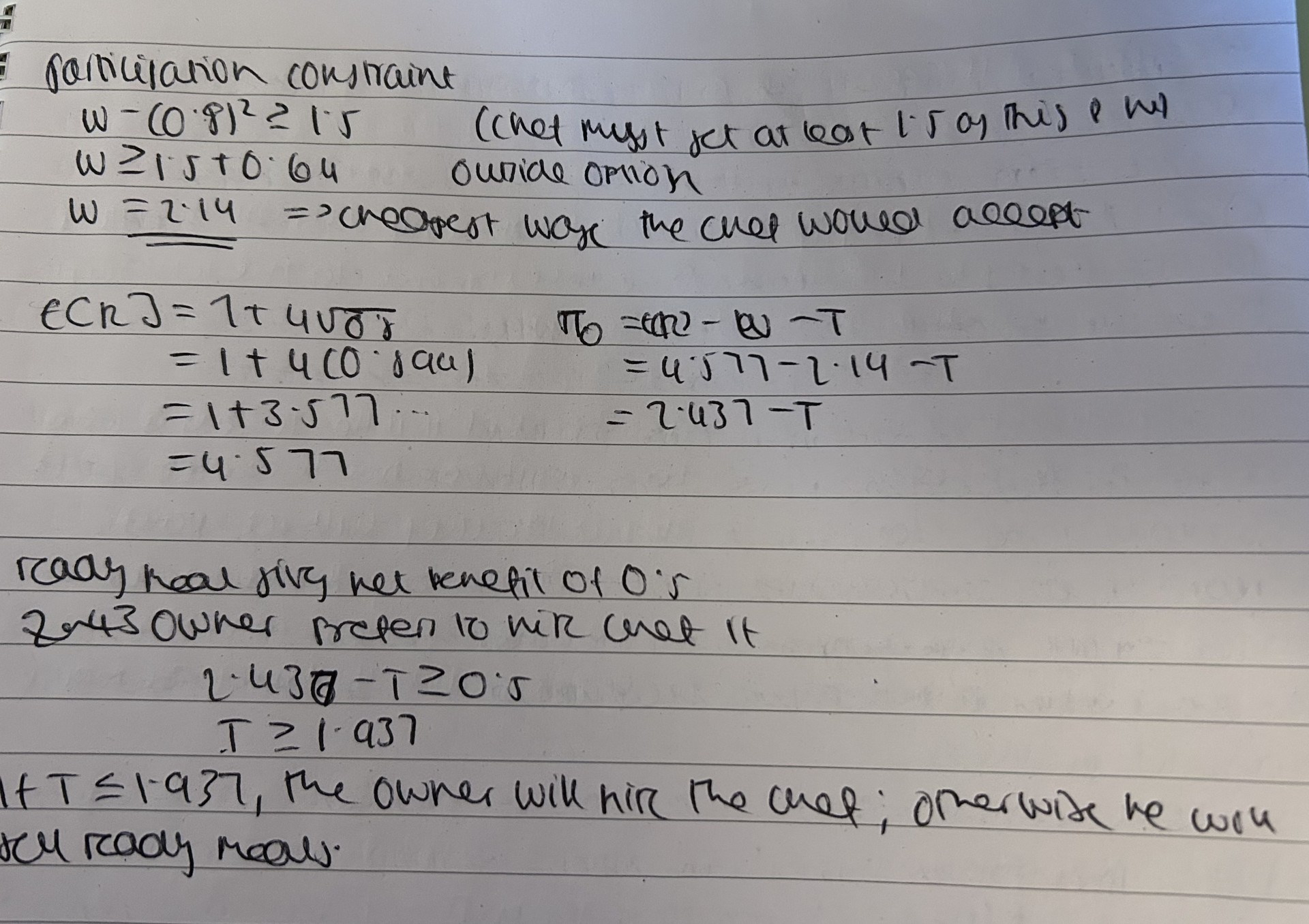
Find out the level of investment of each producer (if they can’t enforce I1 and I2 with contracts) and use this to find the optimal ownership allocation a1 and a2 that would maximise net value (V - costs). How does the answer change if no party can own less than 10% of the asset? How is this consistent with the predictions of the property rights theory?
we choose a1 and a2 to maximise V - costs
Replace the investment levels into the equation
substitute in a2 = 1 - a1
use this to plot the graph
the optimal ownership (the one that maximises the new value) is to assign the whole property of the asset to producer 1 (a1 = 1)
if not party can have less than 10%, then a1 = 0.09 is optimal
consistent with the prediction that when the investment of a party has a stronger effect on the value of the transaction, that party should get a higher proportion of the assets
if we look at the effect of I1 and I2 on C, it is clear (and given that costs are symmetric) that I1 has a larger influence on V
the effect is so much larger than producer 1 should own as much as possible of the asset
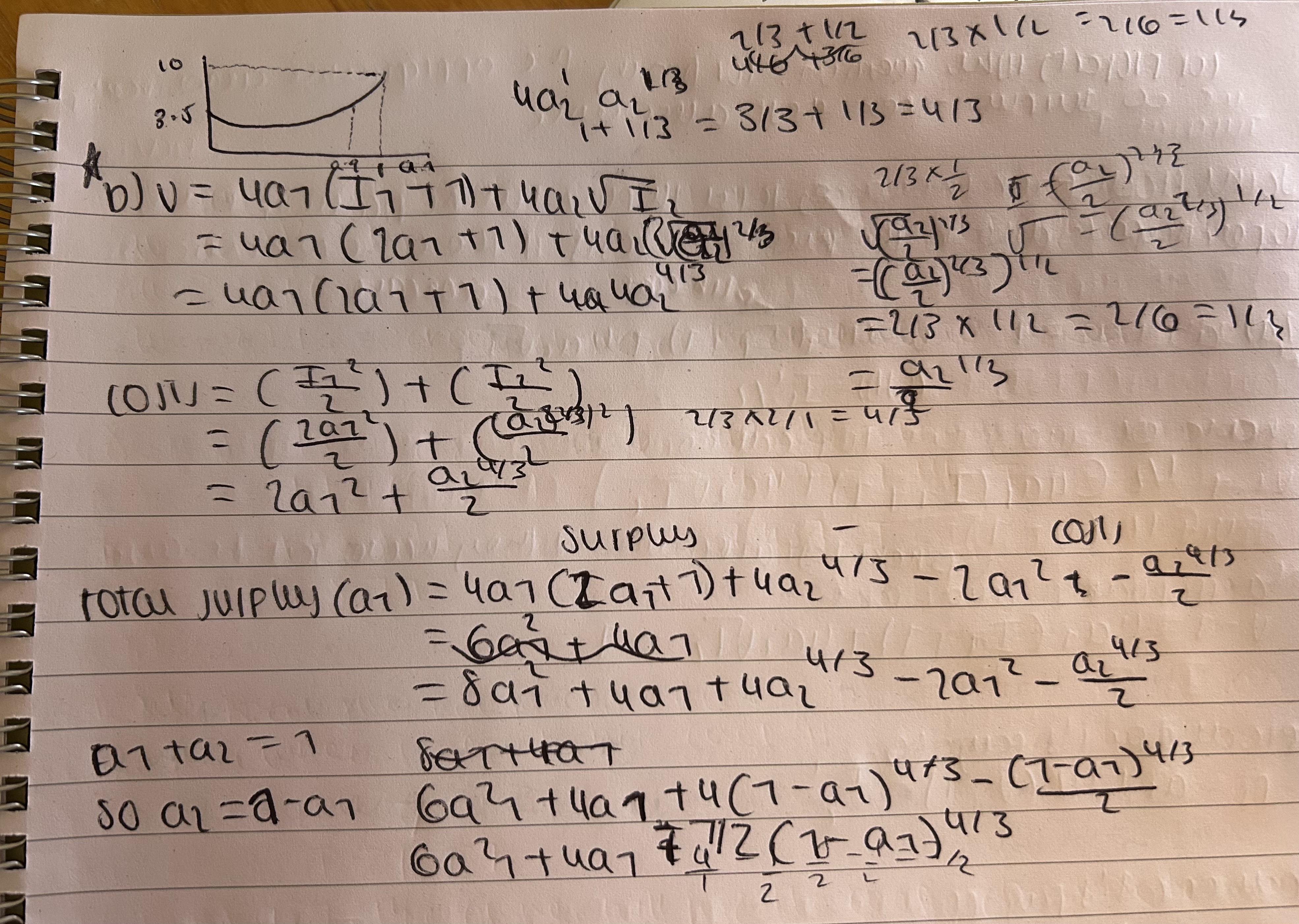

Find the effort that the chef would make if he owns the restaurant. How much would be the chef willing to offer to buy the restaurant?
if the chef owns the restaurant, he would pick effort so to maximise (expected) revenue minus the cost of effort
ignoring the error term (which has zero mean), effort will be 1
the chef would offer a maximum of 2.5 to the owner
in this case, he would be indifferent between buying the restaurant and working in another job as in both cases, he would have a net benefit of 1.5
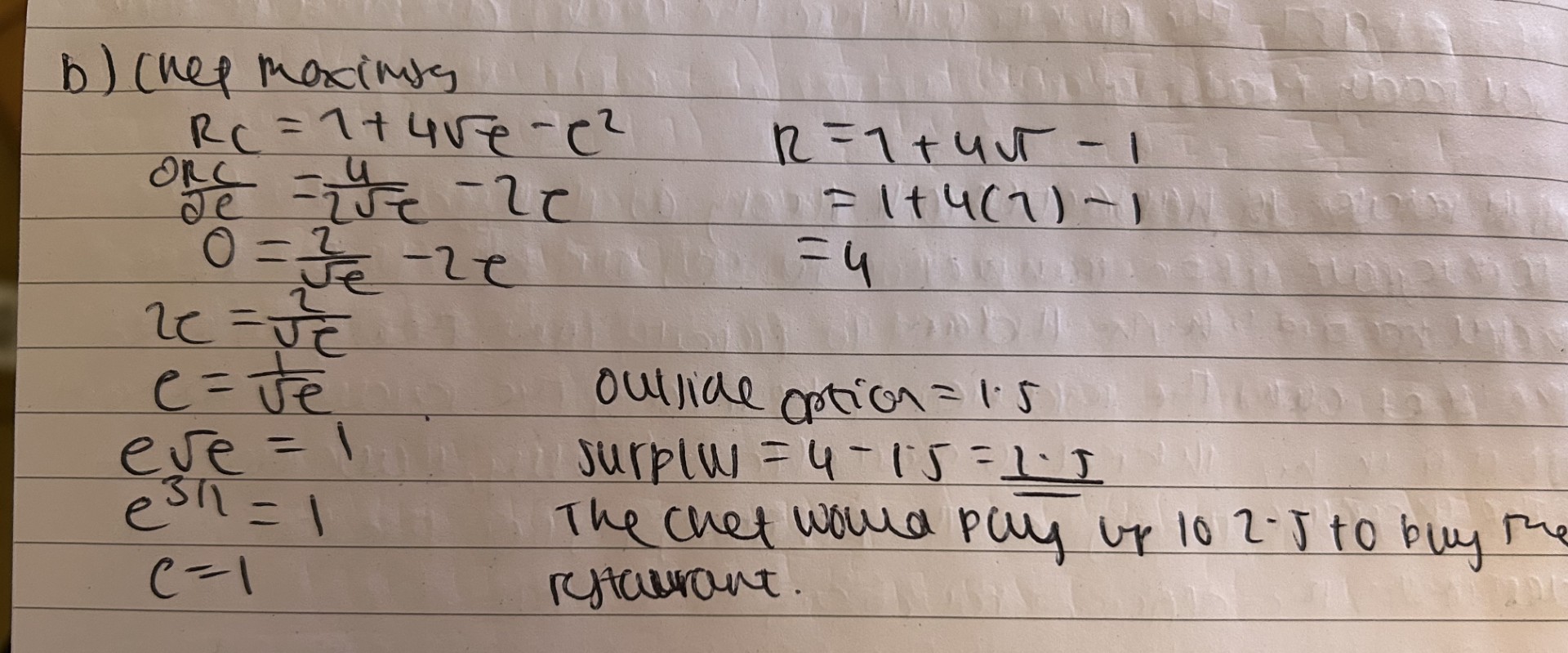

Suppose that there is a monitoring technology that costs 𝜏, which tells the owner whether the chef’s effort is above or below 0.8 (but not the exact level). The owner pays a fixed wage, but he can terminate the contract (and pay zero to the chef) if effort is below 0.8. Alternatively, the owner can buy and resale ready meals from a provider for a net benefit of 0.5. Show that if this technology is cheap enough, the owner will hire the chef but otherwise, he will buy ready meals
the chef will make an effort of 0.8 but not above it
the fixed wage that the owner pays has to cover the cost of effort and the alternative option of the chef
the total cost for the owner if they adopted the technology would be 2.14 + 𝜏
the net benefits of adopting the technology will be 4.57 - 2.14 - 𝜏 and this has to be larger than the ready meal alternative that gives 0.5
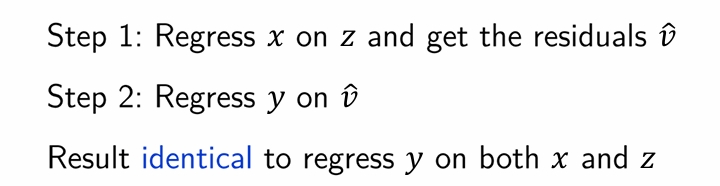
Procedure of the Frisch-Waugh-Lowell (FWL) theorem
we ‘clean’ x from z before running the regression
no OVB for omitting z as the residuals are not correlated with z (consistent with OLS assumption that the covariance between deviations and regressors is zero)
we are using the variation in x that is uncorrelated with z
allows us to interpret beta as the effect of x after netting out z
is controlling for more stuff always better?
no
eg we could have the collider bias where controlling for z will bias the estimation of true beta
or we could have the bad control problem where controlling for z (an outcome/mediator) will remove the causal effect you want to estimate)
ie controlling for an outcome of X is generally wrong
results in beta going towards zero
many gray areas cases, subject to debate:
eg education → IQ → income
schooling improves IQ tests but IQ is also a genetic confounder
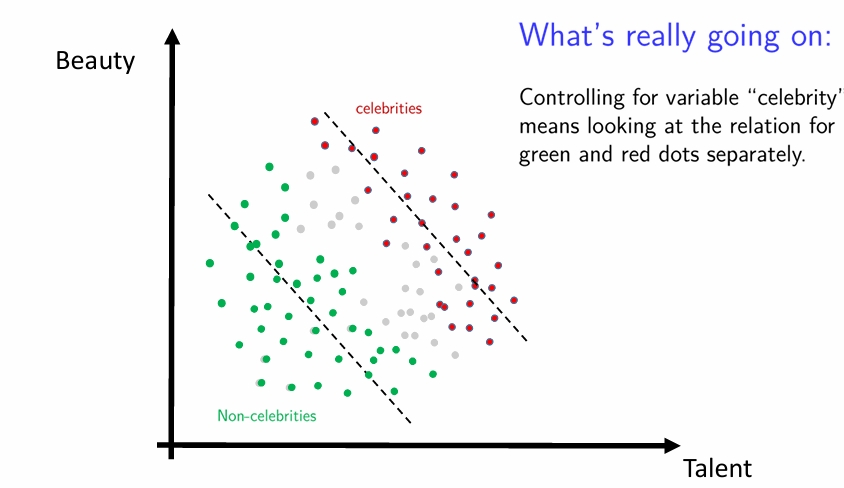
example of the collider bias
beauty and talent both contribute to becoming a celebrity so looking at celebrities biases conclusion
example of bad control problem
suppose you regress ‘alarm on’ on ‘fire’ but also control for ‘smoke’
beta is likely to be zero as we are asking if, for a given level of smoke, fire triggers the alarm
if we regress parental income on future wage but control for education, beta is likely to be zero as education will absorb the majority of the causal effect

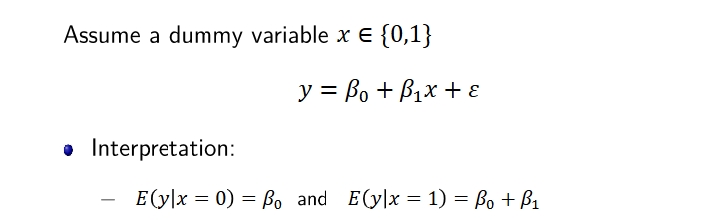
how do you interpret dummy variables?
takes only two values
eg immigrant = 1 or native = 0
B1 = average effect on y of switching x from 0 to 1
captures the average difference in y between the two groups
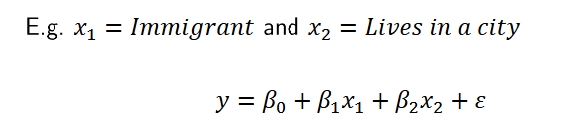
how do you interpret more than one dummy variable?
B0 = average earnings of non-immigrant who lives in countryside
B1 = additional average earnings for being an immigrant
B2 = additional average earnings for living in a city

Can we estimate this?
no due to perfect multicollinearity (violation of OLS assumptions)
the constant of the model can be written as a linear combination of the two dummies
therefore, we need to exclude one of the dummies
how can we solve for mutually exclusive dummies?
beta is the same for all the dummies
we have an additional intercept for other dummies which captures the additional effect of that dummy compared to the baseline dummy