exchange
 Call Kai
 Learn
Learn Practice Test
 Spaced Repetition
 Match
Match Flashcards
 Knowt Play
1/125

There's no tags or description
Looks like no tags are added yet.
Name | Mastery | Learn | Test | Matching | Spaced | Call with Kai |
|---|
No analytics yet
Send a link to your students to track their progress
126 Terms
where do organisms transfer to survive?
between the external and internal environment at exchange surfaces and through cell plasma membranes
what is the environment around the cells of multicellular organisms called?
tissue fluid
what is the case with the majority of cells?
they are too far from exchange surfaces for diffusion alone to supply/ remove their tissue fluid with the various materials they need
what therefore happens once they have absorbed the materials?
the materials are rapidly distributed to the tissue fluid and the waste products are returned to the exchange surface for removal - mass transport system
what does this mass transport system do?
maintains diffusion gradients that bring materials to and from the cell surface membranes
what will affect the amount of each material that is exchanged?
the size and metabolic rate of an organism
example:
organisms with a high metabolic rate exchange more materials and so required a larger surface area to volume ratio. in turn this is reflected in the type of exchange surface and transport medium that evolved to meet the requirements of each organism
examples of things that need to be interchanged between an organism and its environment:
respiratory gases (oxygen and CO2)
nutrients (glucose, fatty acids, amino acids, vitamins, minerals
excretory products (urea and CO2)
heat
except for heat, what are the 2 ways that exchanges can take place?
passively by diffusion and osmosis (no metabolic energy required)
actively (metabolic energy required) by active transport
despite exchange happening at the surface of an organism, what is the case?
the materials absorbed are used by the cells that mostly make up its volume
what therefore must happen for exchange to be effective?
the exchange surfaces of the organism must be large compared with its volume
what happens as organisms become larger?
their volume increases at a faster rate than their surface area
what is the case because of this?
simple diffusion of substances across the outer surface can only meet the needs of relatively inactive organisms, and even if the outer surface could supply enough of a substance, it would still take too long for it to reach the middle of the organism if diffusion alone was the method of transport
what features have organisms therefore evolved to?
a flattened shape so that no cell is ever far from the surface
specialised exchange surfaces with large areas to increase the SA:V ratio
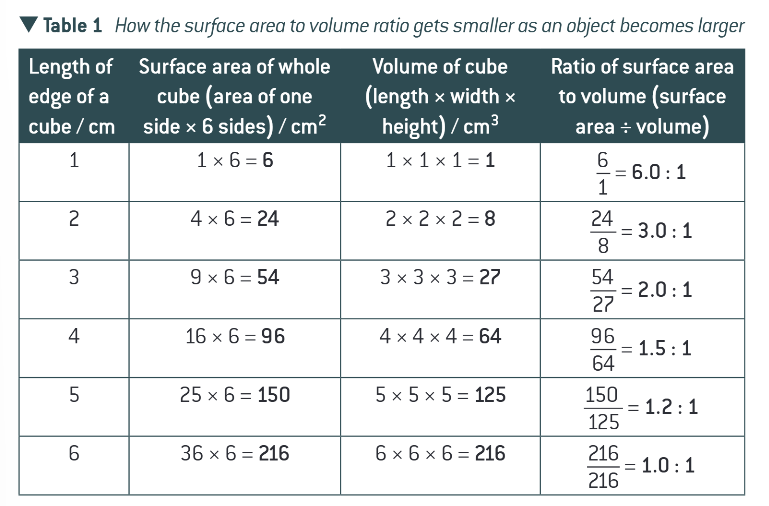
table to show how SA:V ratio gets smaller as an object becomes larger:
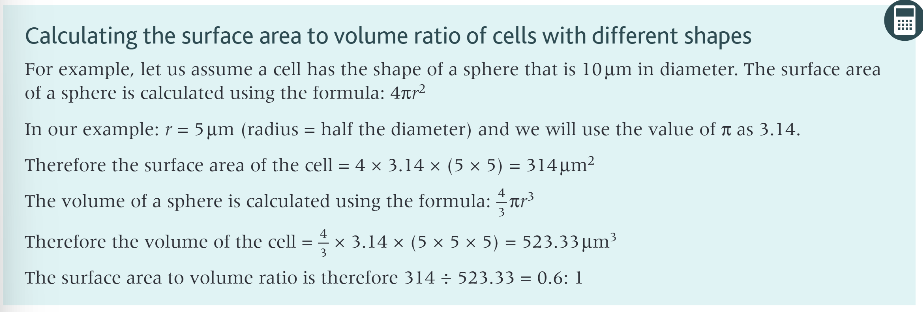
worked example: calculating SA:V ratio of cells with different shapes:
features of specialised exchange surfaces to allow effective transfer of materials:
a large SA:V ratio of the organism which increases the rate of exchange
very thin so that the diffusion distance is short and therefore materials cross the exchange surface rapidly
selectively permeable to allow selected materials to cross
movement of the environmental medium, eg. air to maintain a diffusion gradient
a transport system to ensure the movement of the internal medium, eg. blood, to maintain a diffusion gradient
relationship between diffusion, SA, difference in conc and length of diffusion path:

what is the case when organisms are thin?
specialised exchange surfaces are easily damaged and dehydrated, and so are therefore often located inside an organism
what is the case when an exchange surface is located inside the body?
the organism needs to have a means of moving the external medium over the surface, eg. a means of ventilating the lungs in a mammal
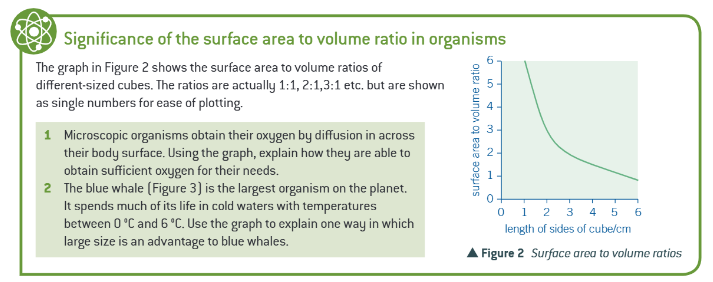
extra info: significance of SA:V ratio in organisms:
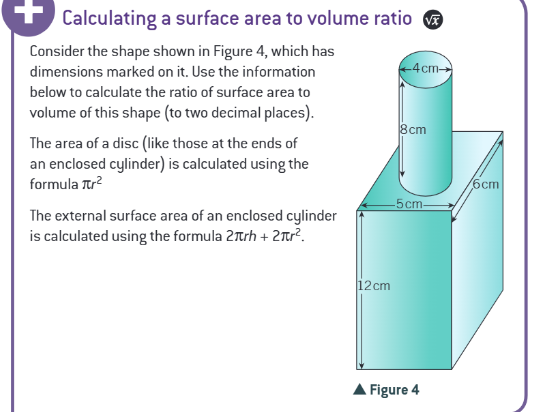
extra info: calculating a SA:V ratio:
what is the case with gas exchange in single cells organisms?
they are small and so have a large SA:V ratio
O2 is absorbed by diffusion across their body surface which is covered only by a cell surface membrane
CO2 from respiration diffuses out across their body surface
where a living cell is surrounded by a cell wall, this is no additional barrier to the diffusion of gases
what have insects evolved to conserve?
water
why have they evolved to do this?
the increase in SA required for gas exchange conflicts with conserving water as water will evapourate from it
insects evolutions for gas exchange:
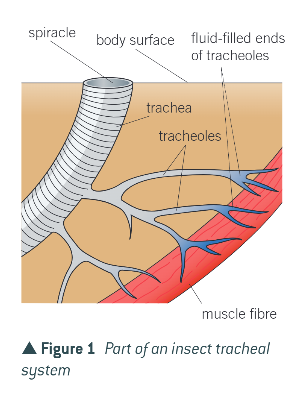
evolved an internal network of tubes called tracheae
tracheae are supported by strengthened rings to prevent them from collapsing
tracheae divide into smaller dead end tubes called tracheoles, which extend throughout the body tissues of the insect
in this way air is brought directly to the respiring tissues as there is a short diffusion pathway from a tracheole to any body cell
3 ways respiratory gases move in and out the tracheal system:
along a diffusion gradient
mass transport
the ends of the tracheoles are filled with water
along a diffusion gradient:
when cells are respiring, O2 is used up and its conc at the ends of the tracheoles fall
creates a conc gradient that causes gaseous O2 to diffuse from environment into tracheoles and tracheae and cells
CO2 is produced by cells in respiration, which creates a diffusion gradient in the opposite direction and makes CO2 diffuse along the tracheoles and tracheae from the cells to the atmosphere
as diffusion in air is much more rapid than in water, respiratory gases are exchanged quickly by this method
mass transport:
the contraction of muscles in insects can squeeze the trachea enabling mass movements of air in and out. this further speeds up the exchange of respiratory gases
the ends of the tracheoles are filled with water:
in major activity, muscle cells around the tracheoles respire through anaerobic respiration producing lactate (soluble and lowers water potential of mucle cells)
water therefore moves into cells from tracheoles by osmosis
water in the ends of the tracheoles decrease in volume and in doing so draws air further into them
this means the final diffusion pathway is in a gas rather than a liquid phase, and therefore diffusion is more rapid
this increases the rate at which air is moved in the tracheoles but leads to greater water evapouration
where does gas enter and leave tracheae?
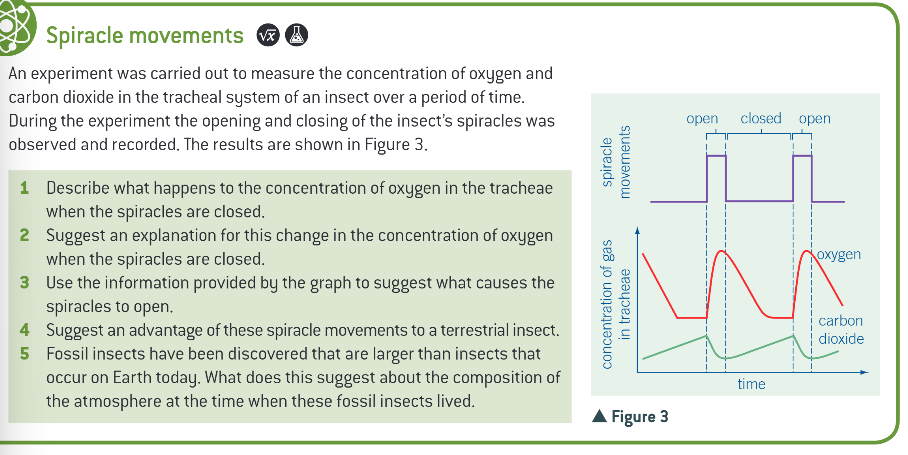
through tiny pores called spiracles on the body surface, which may be opened/ closed by a valve
what is the case when the spiracles are open?
water vapour may evapourate from the insect
why are the spiracles closed most of the time?
to prevent water loss (they only periodically open to allow gas exchange)
limitations of the tracheal system:
relies mostly on diffusion to exchange gases between the environment and the cells
for diffusion to be effective, the diffusion pathway needs to be short which is why insects are of small size. as a result the length of the diffusion pathway limits the size that insects can attain
diagram to show insect tracheal system:
extra info: spiracle movements:
what kind of outer covering to fish have?
waterproof and gas tight covering
what is the case because fish are relatively large?
small SA:V ratio and so body surface isnt adequate to supply and remove respiratory gases - therefore evolved gills
where are gills located?
within the body of the fish, behind the head
what are gills made up of?
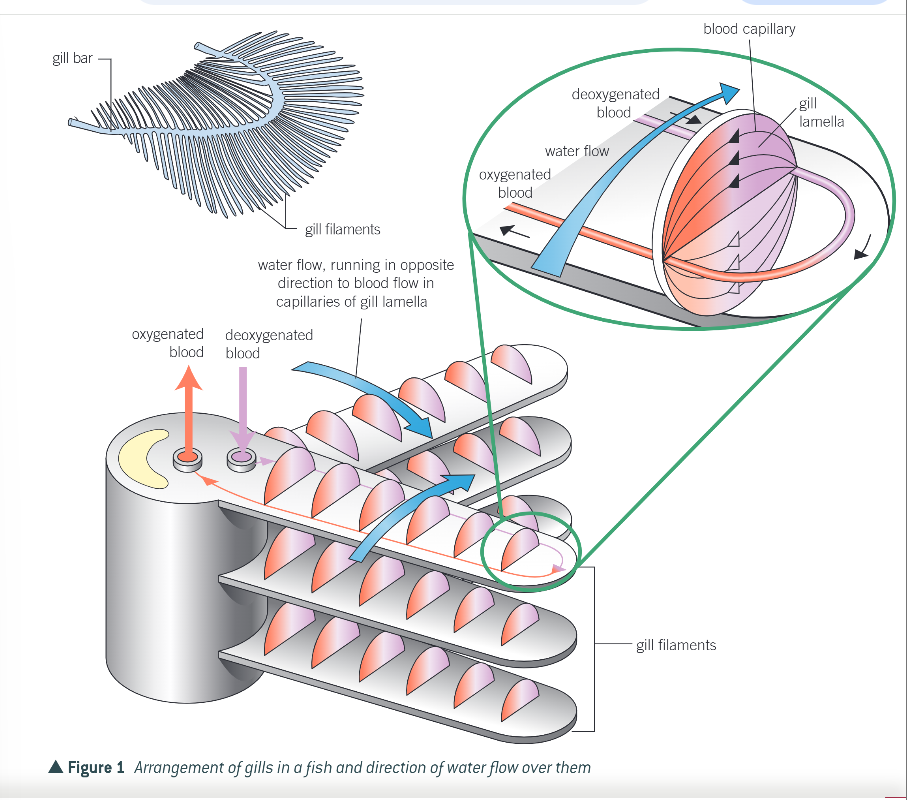
gill filaments which are stacked in a pile
what are at right angles to the filaments?
gill lamellae, which increase the surface area of the gills
where does water move through fish?
taken in through mouth, forced over the gills and out through an opening on each side of the body
how is the flow of water over the gill lamellae and the flow of blood within them?
in opposite directions (countercurrent flow)
diagram to show arrangement of gills in a fish and direction of water flow over them:
what would be the case if water and blood flowed in the same direction?
far less gas exchange would take place
what is the essential feature of the countercurrent exchange system?
that the blood and the water that flow over the gill lamellae do so in opposite directions
what does this arrangement mean?
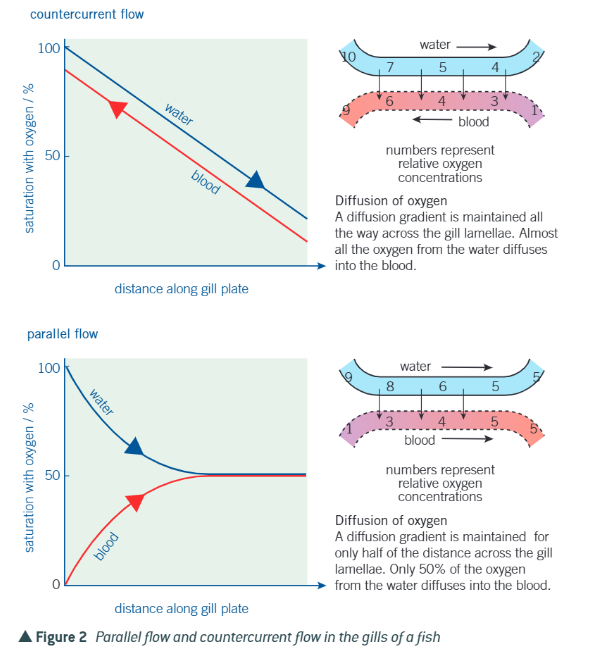
blood that is already well loaded with oxygen meets water, which has its max concentration of oxygen. therefore diffusion of oxygen from the water to the blood takes place
blood with little oxygen in it meets water which has had most, but not all, of its oxygen removed. again, diffusion of oxygen from the water to blood takes place
what happens as a result of this?
a diffusion gradient for oxygen uptake is maintained across the entire width of the gill lamellae. in this way, about 80% of the oxygen available in the water is absorbed into the blood of the fish
what would be the case if the flow of water and blood had been in the same direction (parallel flow)?
the diffusion gradient would only be maintained across part of the length of the gill lamellae and only 50% of the available oxygen would be absorbed by the blood
diagram to show parallel flow and countercurrent flow in the gills of a fish:
what do plant cells do thats different to animal cells?
carry out photosynthesis, where they take in CO2 and produce O2
because of this process, what does it reduce?
gas exchange with the external air, so the volumes and types of gases that are being exchanged by a plant leaf change
what is this balance between the rate of photosynthesis and respiration?
although some CO2 comes from respiration of cells, most of it is obtained from the external air
although some oxygen from photosynthesis is used in respiration, most of it diffuses out the plant
what happens when photosynthesis isnt occuring (eg. in the dark)?
oxygen diffuses into the leaf as it is constantly being used by cells during respiration. in the same way, CO2 produced during respiration diffuses out
gas exchange in plant leaf:
no living cell is far from the external air, and therefore a source of O2 and CO2
diffusion takes place in the gas phase which makes it more rapid than if it were in water
short, fast diffusion pathway
air spaces in leaf have a very large SA:V ratio
gases simply move in and through plant by diffusion
adaptations for gas exchange in the leaves:
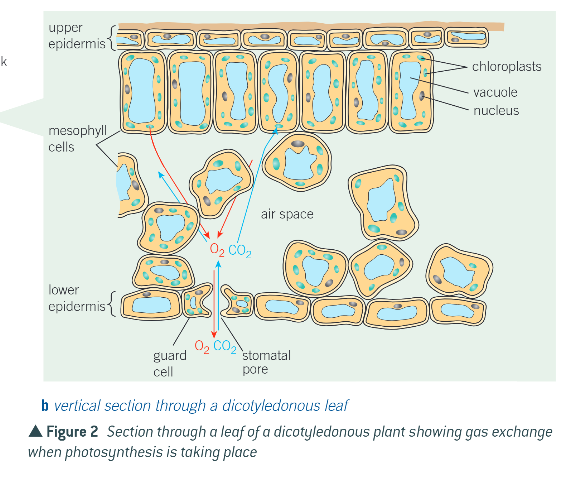
many small pores called stomata, so no cell is far from a stoma and so diffusion pathway is short
numerous interconnecting air spaces that occur throughout the mesophyll so that gases can readily come in contact with mesophyll cells
large SA of mesophyll cells for rapid diffusion
more detailed description of stomata:
tiny pores that occur mainly on the leaves and mainly on the underside of them
each stoma surrounded by a pair of guard cells which can open and close the stomatal pore - can control rate of gas exchange
close stomata in times when water loss would be excessive to balance the needs of gas exchange and control the water loss
diagram to show surface view of stoma closed and open:
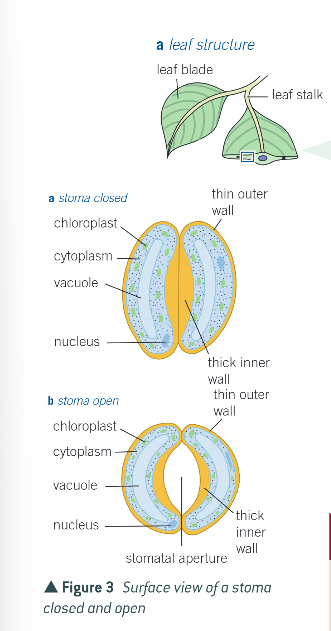
diagram to show section through a leaf showing gas exchange when photosynthesis is taking place:
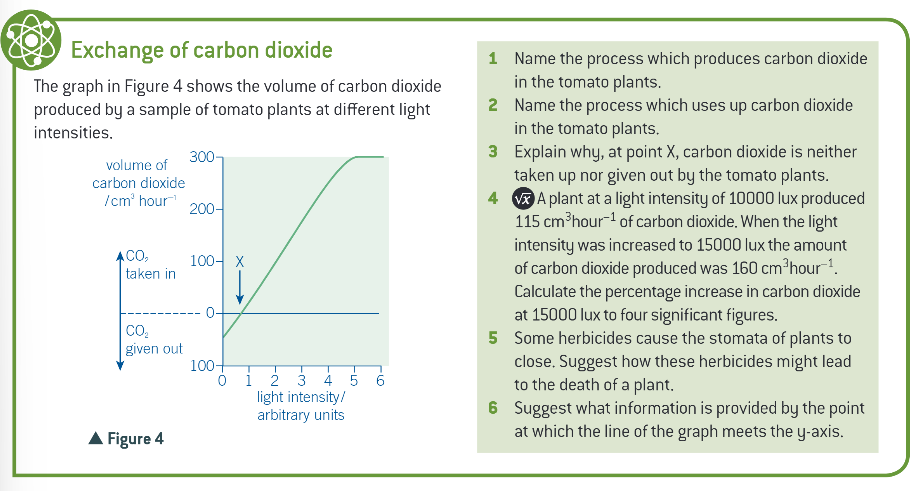
extra info: exchange of CO2:
whats the issue with good gas exchange systems?
these features also increase water loss
what reduces the loss of water by evapouration at exchange surfaces?
exchange surfaces are in the body
air at exchange surfaces are nearly 100% saturated with water vapour
less evapouration of water from the exchange surface
terrestrial:
live on land
whats the problem for terrestrial organisms?
water easily evapourates from surface of bodies and they can become dehydrated
what features conflict with the need to conserve water?
thin, permeable surfaces with large surface areas
adaptations in insects to reduce water loss:
small SA:V ratio: minimises area over which water is lost
waterproof coverings over body surfaces: rigid exoskeleton made of chitin and covered with waterproof cuticle
spiracles: can be closed to reduce water loss (normally when insect at rest)
what do these features mean?
insects cant use their body surface to diffuse respiratory gases in the way a single cells organism does. instead they have an internal network of tubes called tracheae that carry air containing O2 directly to the tissues
why cant plants have a small SA:V ratio?
to photosynthesise they need a large leaf SA to capture light
how do plants reduce water loss?
waterproof covering over certain parts of leaves
can close stomata
xerophytes
what are xerophytes?
plants that are adapted to living in areas where water is in short supply. without these adaptations these plants would become desiccated and die
how do you reduce the rate at which water is lost through evapouration?
modifications in leaves
what are these modifications in leaves?
thick waxy cuticle
rolling up of leaves
hairy leaves
stomata in pits/ grooves
a reduced SA:V ratio of the leaves
thick cuticle:
thicker the cuticle, the less water can escape (despite being waxy, up to 10% of water is still lost through this)
rolling up of leaves:
most leaves have stomata on lower epidermis
rolling the leaves protects the lower epidermis and helps trap a region of still air in rolled leaf
this region becomes saturated with water vapour so has high water potential - then no gradient between inside and outside and so no water loss
hairy leaves:
especially on lower epidermis, traps still, moist air next to leaf surface. the water pot gradient is therefore reduced and so less water is lost by evapouration
stomata in pits/ grooves:
trap still, moist air next to leaf and reduces water pot gradient
reduced SA:V ratio of leaves:
smaller SA:V ratio, slower rate of diffusion. by having leaves that are small and roughly circular in cross section (rather than broad and flat), the rate of water loss can be considerably reduced
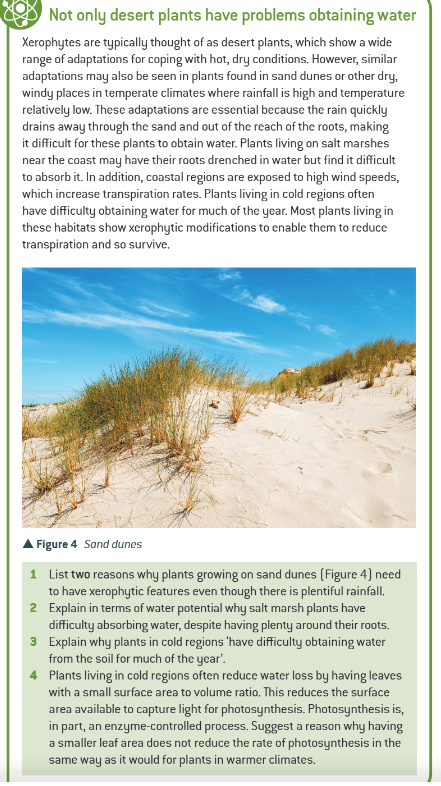
extra info: not only desert plants have problems obtaining water:
why do all aerobic organisms require a constant supply of oxygen?
to release energy in the form of ATP during respiration
why does the CO2 produced from respiration need to be removed?
its build up could be harmful to the body
why does the volume of O2 that has to be absorbed and the volume of CO2 that has to be removed in mammals large?
they are relatively large organisms with a large volume of living cells
they maintain a high body temperature which is related to them having a high metabolic and respiratory rates
what specialised surfaces have mammals evolved as a result?
lungs which ensures efficient gas exchange between air and blood
diagram to show the gross structure of the human gas exchange system:
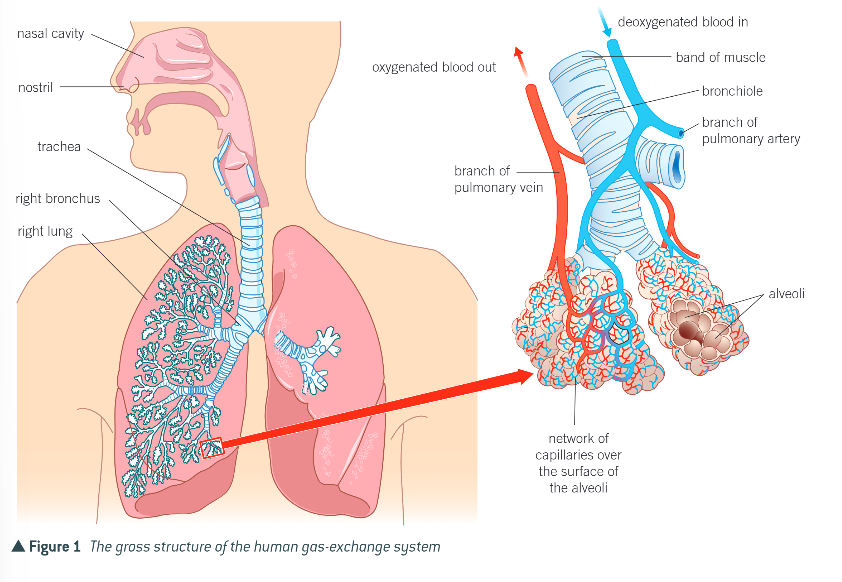
why are the lungs (site of gas exchange in mammals) located inside the body?
air isnt dense enough to support and protect the delicate structures
the body as a whole would otherwise lose a lot of water and dry out
what are the lungs supported and protected by?
the ribcage, with ribs which can be moved by the muscles between them
what are the lungs ventilated by?
constant air to ensure it is constantly replenished
main parts of the human gas exchange system:
lungs
trachea
bronchi
bronchioles
alveoli
lungs:
pair of lobed structures made up of a series of highly branched tubules called bronchioles, which end in tiny air sacs called alveoli
trachea:
flexible airway that is supported by rings of cartilage - this prevents the trachea from collapsing as the air pressure inside falls when breathing in. the tracheal walls are made up of muscle, lined with ciliated epithelium and goblet cells
bronchi:
2 divisions of the trachea, each leading to one lung. similar in structure to trachea, and also produce mucus to trap dirt particles and have cilia to move the mucus to the throat. the larger bronchi are supported by cartilage although this is reduced as the bronchi get smaller
bronchioles:
series of subdivisions of the bronchi. their walls are made of muscle lined with epithelial cells. this muscle allows them to constrict so that they can control the flow of air in and out of the alveoli
alveoli:
tiny air sacs (diameter of 100micrometres) at end of bronchioles. between the alveoli are collagen and elastic fibres. the alveoli are lined with epithelium. the elastic fibres allow the alveoli to stretch as they fill with air when breathing in. they then spring back during breathing out to expel the CO2 rich air. the alveolar membrane is the gas exchange surface
what is ventilation?
air constantly being moved in and out of the lungs
what is inspiration?
when air pressure of the atmosphere is greater than the air pressure inside the lungs, so air is forced into the lungs
what is expiration?
when air pressure in the lungs is greater than that of the atmosphere, so air is forced out of the lungs
how are the pressure changes within the lungs brought about?
by the movement of 3 sets of muscles
what are these 3 sets of muscles?
the diaphragm, which is a sheet of muscle that separates the thorax from the abdomen
the intercostal muscles which lie between the ribs:
internal intercostal muscles whose contraction leads to expiration
external intercostal muscles whose contraction leads to inspiration
the arrangement of the diaphragm and intercostal muscles:
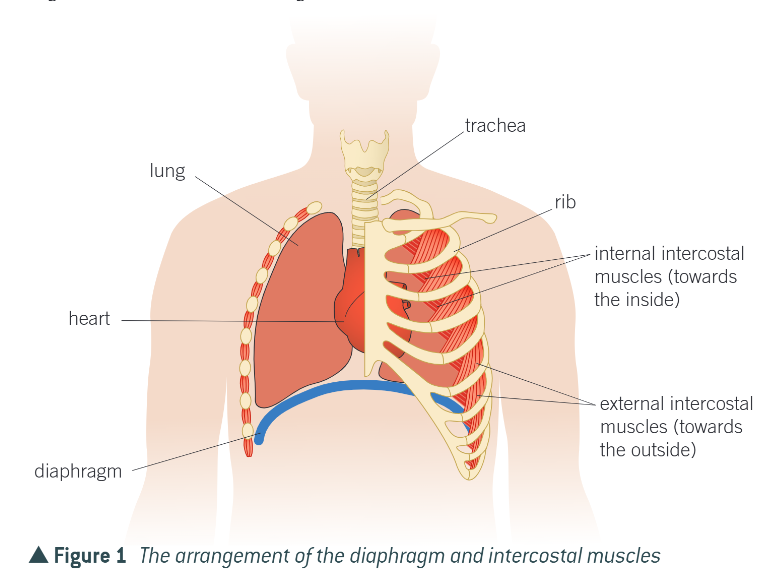
breathing in (inspiration) process:
the external intercostal muscles contract, while the internal intercostal muscles relax
the ribs are pulled upwards and outwards, increasing the volume of the thorax
the diaphragm muscles contract, causing it to flatten, which also increases the volume of the thorax
the increased volume of the thorax results in reduction of pressure in the lungs
atmospheric pressure is now greater than pulmonary pressure, and so air is forced into the lungs
breathing out (expiration) process:
internal intercostal muscles contract, while the external intercostal muscles relax
the ribs move downwards and inwards, decreasing the volume of the thorax
the diaphragm muscles relax and so it is pushed up again by the contents of the abdomen that were compressed during inspiration. the volume of the thorax is therefore further decreased
the decreased volume of the thorax increases the pressure in the lungs
the pulmonary pressure is now greater than that of the atmosphere, and so air is forced out of the lungs

