Political Science: Chapter 1
 Studied by 1 person
 Call Kai
 Learn
Learn Practice Test
 Spaced Repetition
 Match
Match Flashcards
 Knowt Play
1/35

There's no tags or description
Looks like no tags are added yet.
Name | Mastery | Learn | Test | Matching | Spaced | Call with Kai |
|---|
No analytics yet
Send a link to your students to track their progress
36 Terms
Political Science
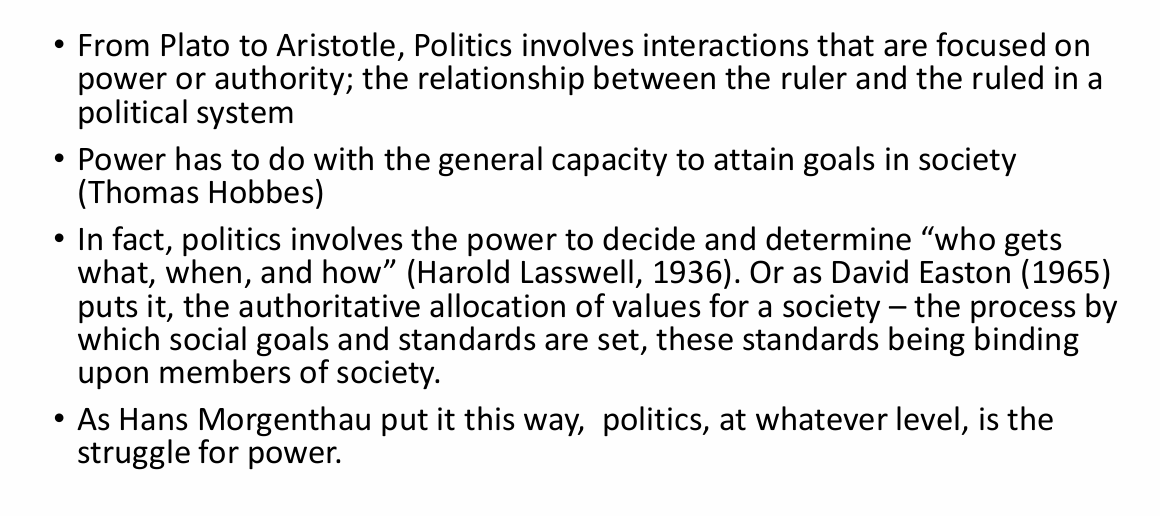
the study of the theory and practice of government and politics at the local, state, national, and international levels. focuses on POWER. the study of politics, government, and public policy.
power
the ability of one political actor to get another actor to do what it wants—at the international, national, and local.
the ability to do something; it could involve the ability to control. the ability to determine outcomes, influence and effect the decision of those who could determine outcome
Political Scientists
Interpretivists: dealing with historical and philosophical aspects of politics
Behavioralists: looking for broad patterns across case using statistical analysis of numerical information)
politics involves the making of common decisions using…
power:
the search for a common choice, the use of power to achieve the end
Power and politics
Relational Power
allies, relationship leverage; ability to influence others through interpersonal relationships and social connections
Covert: secret
Overt: not secret
Structural Power
power embedded within systems, institutions, and social norms that shape our lives
control of economy, patent owners, universities, etc.
Soft Power
intangibles, what other people want to imitate
EX: education and political systems
Sharp Power
destructive methods used to influence thinking, destroy, scatter
What do we study in politics
• Decision making • Legislatures • Executive • Judicial • Voting system • Political parties • Interest groups • The role of the minority groups • Power • Public policy • Constitutions
Who exercises power in a political system
• The Government (which can be elected officials, appointed or unelected who use the means force); the State has the legitimate authority to use force.
• Non-state actors including interest groups, companies etc., can also exercise power
Public choice
cooperative aspect of decision making. It involves the use of power of persuasion
Dominant choice
choice made by the dominant group through the use of power of coercion, or election
__ is needed to exercise power. Power is concentrated on the _
authority; leaders
authority is given to a person or a group by
agreement among those involved that the person or the group has the right to control certain decisions and that their decisions in those areas should be complied with
Legitimacy
the right and acceptance of an authority, usually a governing law or a regime. It denotes “sphere of influence”.
Legitimacy like authority, exist to a degree. Not everyone or every group would necessarily agree that its government is legitimate or has the government the legitimacy to act on their behalf
EX: some believe that Biden wasn’t legitimate
Sources of legitimacy
• by results, that is, providing the things that the population want, such as security (physical security, economic security, territorial security).
• by habits, that is, when people become accustomed to obeying laws regardless of the government in power.
• by historical, religious or ethnic identity, that is, by ties that exist between themselves and the people because of the government leaders’ past accomplishments
• by procedures, that is government following certain procedures in which the people have developed some degree of confidence
State means
“country;” a nation or territory considered as an organized political community under one government. The State determines more of what goes on in the lives of its population.
Responsibilities of the State
the focus on peace and war; maintenance of peace within its borders and waging war with other States; organizer of commerce and industry within its borders; regulating prices and the quality of products; constructing road, bridges, canals; maintain stability in the economy etc
Big 3: peace, infrastructure, economy
government
the organization, machinery, or agency through which a political unit exercises authority and performs functions and which is usually classified according to the distribution of power within it
Theory
a statement linking specific instances to broader principles. it is an idea or belief about something arrived at through assumptions or a set of facts, propositions, or principles.
Empirical Theory
describe how things work in the world we observe. it is explanatory i.e. why things happen as they do. It consists of causal statement of form
things you study/ observe; facts
Normative Theory
involves making a judgement about the world, but not describe how it works. It is concerned with addressing the question of, what should X be or do? What should the health care system be?
“governments should intervene as little as possible in people’s lives” or “socieites are good to the extent that everyone has equal chances in life”
Branches of Political Science
• Political philosophy • Comparative politics • International Relations • Public Administration • Public Law • International Law • Administrative law • Constitutional law (8)
political system
the set of formal legal institution that constitute a government or a state, such as democracies, monarchies, oligarchies, and authoritarian and totalitarian regimes.
democracy
A political system featuring selection to public offices through free and fair elections; the right of all adults to vote; political parties that are free to compete in elections; government that operates by fair and relatively open procedures; political rights and civil liberties; an independent judiciary; and civilian control of the military.
consolidated democracy
democratic political systems that have been solidly and stably established for an ample period and in which there is relatively consistent adherence to the core democratic principles.
been around a long time
mixed system
countries whose political systems exhibit some democratic and some authoritarian elements
Authoritarian regimes
A system in which power depends not on popular legitimacy but on the coercive force of the political authorities.
political culture
consist of the attitudes, beliefs, emotions and values of society that relate to the political system and to political issues. For example, American political culture is defined as freedom, equality, and justice
distributional politics
the use of power, particularly by the State, to allocate some kind of valued resources among competing groups
political economy
the study of the interaction between the state and the economy, that is, how the state and political processes affect the economy and how the organization of the economy affects political process
critical juncture
an important historical moment when political actors make critical choices, which shape institutions and future outcomes
EX: 1989 the end of Cold war; September 11, 2001, shift from the development gap to terrorism, security, and the use of force; 2008 the financial and economic crisis around the world; 2014 the annexation of Crimea by Russia in violation of the sovereignty of Ukraine etc.
level of analysis
an organizational scheme for thinking about comparative politics; induviduals, institutions, entities, regions, country to global.
nationalization
process of transforming privately owned assets into public assets by bringing them under the public ownership of a national government or state
eminent domain
the right of a government or its agent to expropriate private property for public use, with payment of compensation
 Note
Note  Flashcards (31)