BOC Laboratory Operations
 Studied by 0 people
 Call Kai
 Learn
Learn Practice Test
 Spaced Repetition
 Match
Match Flashcards
 Knowt Play
1/259

There's no tags or description
Looks like no tags are added yet.
Name | Mastery | Learn | Test | Matching | Spaced |
|---|
No study sessions yet.
260 Terms
The laboratory manager receives a complaint from the ICU about turnaround times for coagulation tests. The first step in problem solving should be:
a gather data on current times by shift
b talk to staff about various solutions
c perform root cause analysis
d draw a process map to send to the ICU explaining why it takes so long
a gather data on current times by shift
Which action by the phlebotomist will comply with the College of American Pathologists (CAP) Patient Safety Goal "to improve patient and sample identification at the time of specimen collection" and The Joint Commission Patient Safety Goal to "improve the accuracy of patient identification ?
a match the name and room number on the patient s ID bracelet to the name and room number on the preprinted collection label
b match the name and medical record number on the patient's ID bracelet to the name and medical record number on the preprinted collection label
c verify patient information by stating the patient's name when approaching the patient
d label the collection tubes prior to the blood draw at the patient's bedside
b match the name and medical record number on the patient's ID bracelet to the name and medical record number on the preprinted collection label
A swab and requisition are received in the microbiology laboratory with the following information:
Label on specimen:
Patient name: Mary Jane Smith
MR#: 400567
Location: emergency department
Doctor: Henry Jones
Specimen type: lesion on left ankle
Collection: @ 2 pm by nurse MB
Requisition:
Patient name: Nancy Ann Smith
MR#: 400443
Location: emergency department
Doctor: Henry Jones
Specimen type: lesion on left ankle
Collection: @ 2 pm by nurse MB
The laboratory receiving clerk notes a discrepancy between the patient identifiers on the requisition and the specimen label, and questions the emergency department nurse MB. This is the fourth specimen this week that has had a specimen discrepancy. What action is the most appropriate to prevent this type of error in the future?
a correct the error in the laboratory when the nurse communicates the appropriate patient name
b ask nurse MB to correct discrepancy and read the procedure for specimen labeling
c document error and communicate to laboratory supervisor so that the risk manager conducts a root cause analysis
d discard the specimen and call the emergency department for a recollect
c document error and communicate to laboratory supervisor so that the risk manager conducts a root cause analysis
Preanalytical variables in laboratory testing include:
a result accuracy
b report delivery to the ordering physician
c test turnaround time
d specimen acceptability
d specimen acceptability
3 The first procedure to be followed if the blood gas instrument is out-of-control for all parameters is:
a recalibrate, then repeat control
b repeat control on the next shift
c replace electrodes, then repeat control
d report patient results after duplicate testing
a recalibrate, then repeat control
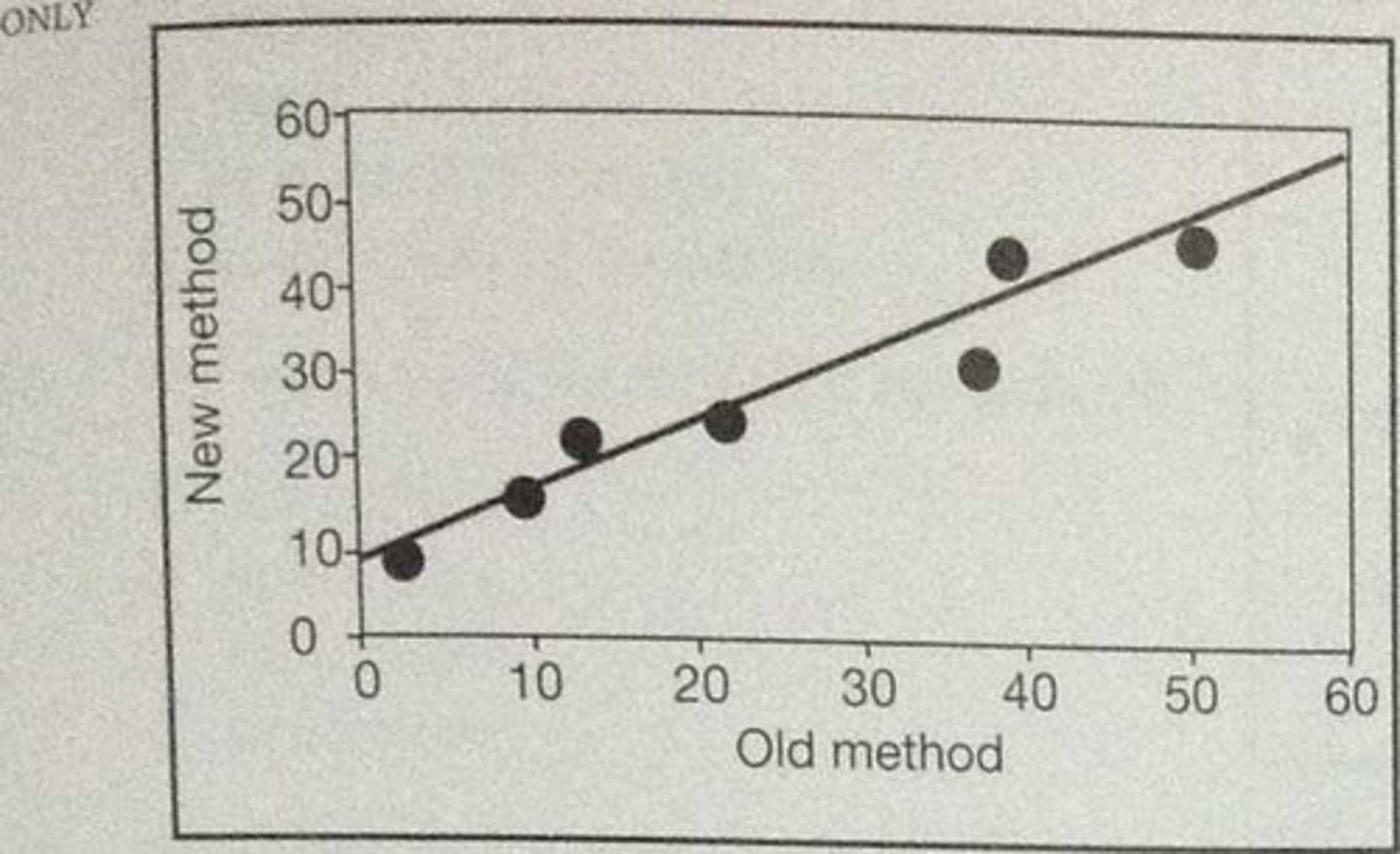
Refer to the following graph:
A new methodology for amylase has been developed and compared with the existing method as illustrated in the graph shown above. The new method can be described as:
a poor correlation with constant bias
b good correlation with constant bias
c poor correlation with no bias
d good correlation with no bias
b good correlation with constant bias
Refer to the following diagram:
The line that demonstrates a proportional error relationship is:
a line A
b line B
c line C
d line D
d line D

Refer to the following illustration:
Shown above is a Levy-Jennings quality control chart, which represents control values for 13 consecutive analyses for a particular serum constituent. If the 14th value is below the -2 SD limit, which of the following should be done?
a control should be repeated to see if it will fall within the established interval
b analysis system should be checked for a deteriorating component
c analysis system should be checked for a change in reagent lot number
d no action is needed
b analysis system should be checked for a deteriorating component

The precision of an instrument is validated by:
a running the same sample multiple times
b performing serial dilutions
c processing unknown specimens
d monitoring normal and abnormal controls
a running the same sample multiple times
The mean value of a series of hemoglobin controls was found to be 15.2 g/dL, and the standard deviation was calculated at 0.20. Acceptable control range for the laboratory is ±2 standard deviations. Which of the following represents the allowable limits for the control?
a 14.5-15.5 g/dL
b 15.0-15.4 g/dL
c 15.2-15.6 g/dL
d 14.8-15.6 g/dL
d 14.8-15.6 g/dL
In quality control, ±2 standard deviations from the mean includes what percent of the sample population?
a 50
b 75
c 95
d 98
c 95
Upon completion of a run of cholesterol tests, the technician recognizes that the controls are not within the 2 standard deviations confidence range. What is the appropriate course of action?
a report the results without any other action
b run a new set of controls
c run a new set of controls and repeat specimens
d recalibrate instrument and run controls
c run a new set of controls and repeat specimens
The following data were calculated on a series of 30 determinations of serum uric acid control: mean = 5.8 mg/dL, 1 standard deviation — 0.15 mg/dL. If confidence limits are set at ±2 standard deviations, which of the following represents the allowable limits for the control?
a 5.65-5.95 mg/dL
b 5.35-6.25 mg/dL
c 5.50-6.10 mg/dL
d 5.70-5.90 mg/dL
c 5.50-6.10 mg/dL
An index of of precision is statistically known as the:
a median
b mean
c standard deviation
d coefficient of variation
d coefficient of variation
The term used to describe reproducibility is:
a sensitivity
b specificity
c accuracy
d precision
d precision
The hability of a procedure to measure only the components it claims to measure is called:
a specificity
b sensitivity
c precision
d reproducibility
a specificity
The extent to which measurements agree with the true value of the quantity being measured is known as:
a reliability
b accuracy
c reproducibility
d precision
b accuracy
Diagnostic specificity is defined as the percentage of individuals:
a with a given disease who have a positive result by a given test
b without a given disease who have a negative result by a given test
c with a given disease who have a negative result by a given test
d without a given disease who have a positive result by a given test
b without a given disease who have a negative result by a given test
If the correlation coefficient (r) of 2 variables is 0:
a there is complete correlation between the variables
b there is an absence of correlation
c as one variable increases, the other increases
d as one variable decreases, the other increases
b there is an absence of correlation
Employees are guaranteed the right to engage in self-organization and collective bargaining through representatives of their choice, or to refrain from these by which of the following?
a Civil Rights Act
b Freedom of Information Act
c Clinical Laboratory Improvements Act (CLIA)
d National Labor Relations Act
d National Labor Relations Act
Which of the following organizations was formed to encourage the voluntary attainmen of uniformly high standards in institutional medical care
a Centers for Disease Control (CDC)
b Health Care Finance Administration (HCFA)
c The Joint Commission (JCAHO)
d Federal Drug Administration (FDA)
c The Joint Commission (JCAHO)
The process by which an agency or organization uses predetermined standards to evaluate and recognize a program of study in an institution is called:
a regulation
b licensure
c accreditation
d credentialing
c accreditation
CLIA was established to provide oversight to:
a research labs
b point-of-care testing by non laboratory personnel
c CAP-accredited labs
d any lab performing patient testing
d any lab performing patient testing
Which statement about Proficiency Testing (PT) is true?
a results can be compared to another hospital prior to submission if that hospital is in your system
b results between 2 technologists can be averaged
c CAP requires duplicate testing to ensure good instrument performance
d it is necessary to assess results even if a PT challenge is ungraded
d it is necessary to assess results even if a PT challenge is ungraded
Which of the following is part of The Joint Commission's National Patient Safety Goals?
a communication of critical results
b documentation of lab QC
c trending of instrument problems
d reconciliation of lab orders and results in the medical record
a communication of critical results
If your lab performs a test for which there is no commercially available control of Proficiency Test QNLY material, which of the following is acceptable for documentation of test accuracy?
a perform the test in duplicate
b you do not have to do anything if there is nothing available
c make an internal lab control from a previous negative and positive
d have 2 technologists perform the test independently
d have 2 technologists perform the test independently
CAP requires refrigerator temperatures to be recorded:
a daily
b weekly
c monthly
d periodically
a daily
A paper or electronic report of lab results must include:
a the name of the person who collected the specimen
b the test price
c a pathologist's signature
d the name and address of the testing laboratory
d the name and address of the testing laboratory
CAP requires that glassware cleaning practices include periodic testing for:
a chemical residues
b silicates
c detergents
d heavy metals
c detergents
Prior to implementing a new lab test, the analytical measurement range (AMR) must be verified. This is to verify a value that can be:
a directly measured on a specimen without any dilution or concentration
b reported after specimen pretreatment
c reported up to a 1:100 dilution
d sent out to a reference lab for verification
a directly measured on a specimen without any dilution or concentration
HIPAA is a federal law that requires:
a confidentiality of patients' health care information between 2 organizations
b reporting of errors in laboratory results
c access to patient records when there is a lawsuit
d unannounced inspections by accreditation agencies
a confidentiality of patients' health care information between 2 organizations
Your friend calls and asks you to access his test results. Which of the following doe this violate:
a CAP
b The Joint Commission
c HIPAA
d CLIA
c HIPAA
An ICD-9 code is related to:
a patient charges
b diagnosis
c lab accreditation
d test methodology
d test methodology
A technician is asked to clean out the chemical reagent storeroom and discard any reagents not used in the past 5 years. How should the technician proceed?
a discard chemicals into biohazard containers where they will later be autoclaved
b pour reagents down the drain, followed by flushing of water
c consult MSDS sheets for proper disposal
d pack all chemicals for incineration
c consult MSDS sheets for proper disposal
Using a common labeling system for hazardous material identification such as HMIS or NFPA 704, the top red quadrant represents which hazard?
a reactivity
b special reactivity
c health
d flammability
d flammability
If the HMIS® or NFPA 704 hazardous material identification system has a number 4 in t he left blue quadrant, it represents a:
a high health hazard
b low health hazard
c high reactivity hazard
d low reactivity hazard
a high health hazard
Which chemical is a potential carcinogen?
a potassium chloride
b formaldehyde
c mercury
d picric acid
b formaldehyde
Compressed gas cylinders should:
a be stored with flammable materials
b be transported by rolling or dragging
c have safety covers removed when pressure regulators are unattached
d be secured upright to the wall or other stable source
d be secured upright to the wall or other stable source
A chemical that is extremely volatile, flammable, and capable of forming explosive peroxides upon long-term contact with atmospheric oxygen, is:
a ethyl alcohol
b ethyl acetate
c diethyl ether
d xylene
c diethyl ether
The HMIS® or NFPA 704 hazardous material identification system rating for a slightly toxic chemical would be:
a 1 in the yellow quadrant
b 4 in the blue quadrant
c 1 in the blue quadrant
d 4 in the yellow quadrant
c 1 in the blue quadrant
A chemical that causes immediate visible destruction or irreversible alterations of human tissue at the contact site is best classified as a(n):
a carcinogenic
b toxic
c ignitable
d corrosive
d corrosive
Labels on shipped chemicals from manufacturers, importers or distributors are required to include information on:
a physical properties of the chemical
b accident instructions
c appropriate hazard warnings
d exposure limits
c appropriate hazard warnings
When hazardous chemicals are transferred from the original appropriately labeled container(s) to a secondary container for immediate use by the person performing the transfer, it:
a must be labeled with an emergency response phone number(s)
b must be labeled with the identity or contents of the hazardous chemical(s)
c must be labeled with hazard warnings related to the effect on involved target organs
d does not require labeling
d does not require labeling
Which hazardous chemical combinations are incompatible and should not be stored together?
a acetone and xylene
b chlorine and ammonia
c ethanol and acetone
d sodium and potassium
b chlorine and ammonia
A technologist spilled 10 gallons of formaldehyde on the floor. After determining the chemical poses a significant health hazard, the first action step would be to:
a notify emergency assistance
b control the spill with appropriate absorbent material
c evacuate the area
d don appropriate personal protective equipment
c evacuate the area
A gallon of xylene waste should be:
a flushed down the sink
b allowed to evaporate in an open room
c disposed of with nonincinerated regulated medical waste
d disposed of as an EPA hazardous waste through a licensed waste hauler
d disposed of as an EPA hazardous waste through a licensed waste hauler
A technologist, who has been routinely working with hazardous chemicals, begins to notice only symptoms of persistent headaches after exposure to these chemicals. What is the first action the technologist should take?
a seek independent medical consultation and evaluation
b continue to perform work assignment to see if symptoms persist
c acquire involved MSDS to investigate signs and symptoms
d report situation to supervisor
d report situation to supervisor
When an employee reports signs and symptoms of a chemical exposure, the employer should suggest a medical consultation and evaluation, which is paid by the:
a employee using the employee's personal benefit time
b employer using the employee's personal benefit time
c employer on work time without loss of pay
d employee on work time without loss of pay
c employer on work time without loss of pay
When initial or baseline chemical exposure monitoring required by OSHA for substances like formaldehyde or xylene is performed and the results are within permissible exposure limits,
repeat monitoring should be performed:
a when procedures or equipment surrounding use of the specific chemical change
b annually
c twice a year
d every 2 years
a when procedures or equipment surrounding use of the specific chemical change
An example of personal protective equipment (PPE) for handling hazardous chemicals is:
a eyewash or safety shower
b fume hood
c latex or vinyl gloves
d neoprene or nitrile gloves
d neoprene or nitrile gloves
One of the elements of a written laboratory chemical hygiene plan is to:
a require employees who handle chemicals to have annual medical evaluations
b prohibit use of carcinogens
c designate a laboratory chemical hygiene officer
d perform chemical monitoring every 6 months for OSHA regulated substances
c designate a laboratory chemical hygiene officer
The purpose of OSHA Hazard Communication, General Industry Standard, 29 CFR, Subpart Z, 1910.1200, is to require employers to establish a program ensuring personnel are provided with information regarding the workplace dangers of:
a bloodborne pathogens
b environmental hazards
c general safety hazards
d hazardous chemicals
c general safety hazards
This symbol indicates which of the following hazards?
a flammable
b electrical
c radiation
d biohazard
a flammable

When working with sharp equipment and objects, use a:
a double-glove technique with specimen handling gloves
b mechanical device
c paper towel or gauze as a barrier
d two-handed technique
b mechanical device
For safe operation of a centrifuge:
a clean with soap/detergent when maintenance is performed or spills occur
b open the centrifuge cover when it is in the process of slowing down
c leave liquid specimen tubes uncovered during centrifugation
d ensure proper balance is maintained
d ensure proper balance is maintained
For safe use and handling of liquid nitrogen:
a use chemically resistant gloves
b shield all skin and use a face shield
c store cylinders away from ventilation
d store cylinders in a horizontal position in a cool dry place
b shield all skin and use a face shield
Incident reports for occupational injury or illness should:
a include information on the employees past medical history
b be filed only for incidents involving serious injury or illness
c be filed for all incidents including near miss incidents
d not be retained after review by a safety committee or officer
c be filed for all incidents including near miss incidents
According to OSHA, what type of warning sign should be posted in an area where an immediate hazard exists and where special precautions are necessary?
a red, black and white "Danger" sign
b yellow and black "Caution" sign
c green and white "Safety Instruction sign
d orange and black "Biohazard" sign
a red, black and white "Danger" sign
All laboratory instruments should:
a have repairs conducted while connected to facility wiling
b be grounded or double insulated
c have safety checks performed initially and then every 6 months
d be connected to multiple outlet adapters
b be grounded or double insulated
If areas of the laboratory are designated as "clean" or "contaminated", it is appropriate for a technologist to:
a clean technical area bench tops after spills on a weekly basis
b wear a lab coat in the break or lunch room
d touch a "contaminated" area phone with ungloved hands if hands are washed afterward
d touch a "contaminated" area phone with ungloved hands if hands are washed afterward
for fire safety and prevention:
a fire drills should be announced and practiced in advance
b hallways and corridors should be clear and free of obstruction at all times
c only one exit is necessary in laboratories that contain an explosion hazard
d hazard evaluations only need ot be done prior to initiation or clinical operations
b hallways and corridors should be clear and free of obstruction at all times
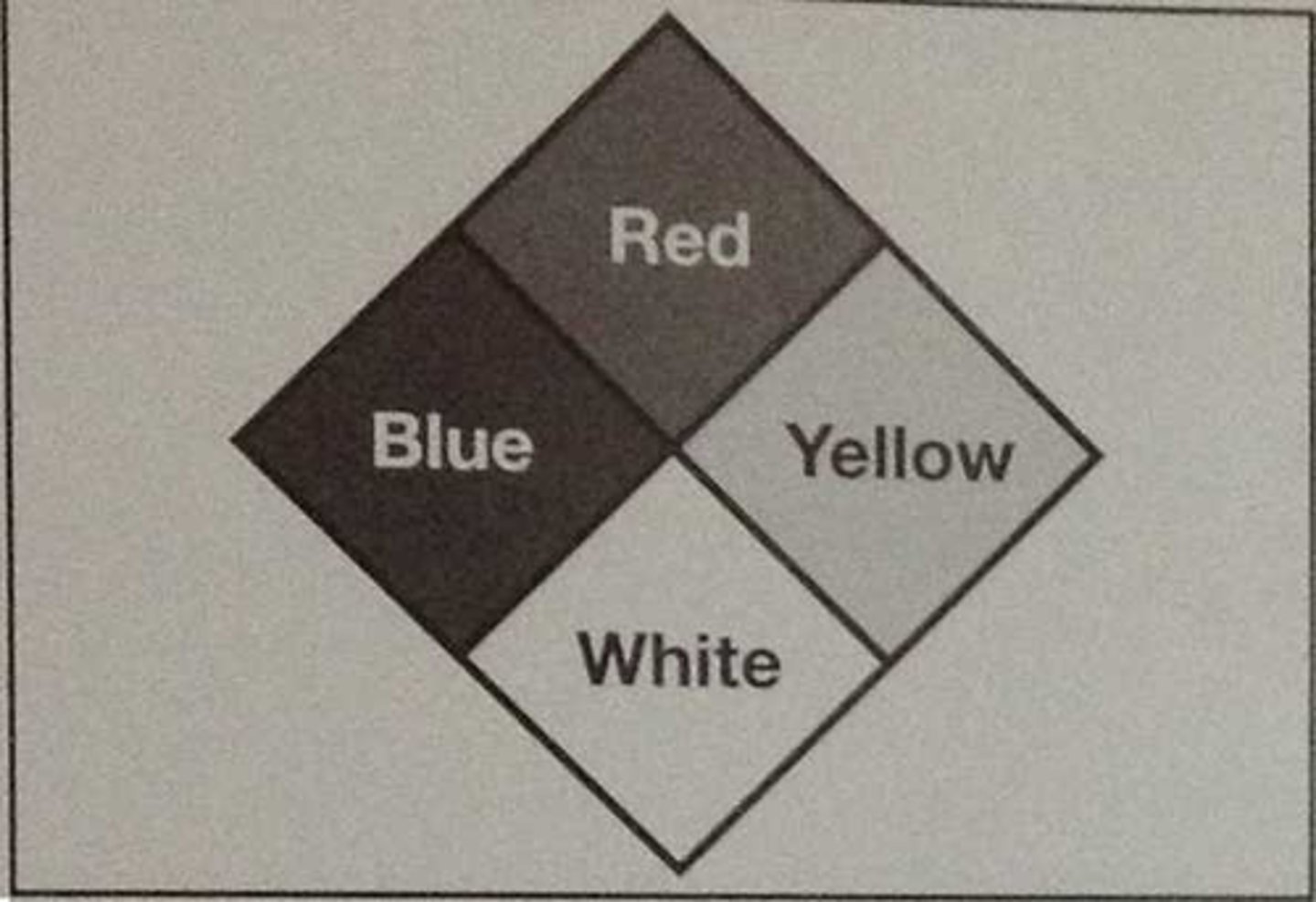
What type of identification system does this symbol represent?
a transmission-based precautions
b physical environmental hazards
c chemical hazardous materials
d radiation hazards
c chemical hazardous materials
Flammable and combustible liquids in containers >5 gallons should be stored in a:
a flammable safety cabinet vented to room air
b nonexplosion proof refrigerator
c fume hood
d approved safety can
d approved safety can
After receiving appropriate training, the first step in using a fire extinguisher is to:
a sweep the flow of the hose from side to side
b pull the pin
c squeeze the top handle or lever
d aim the hose at the base of the fire
b pull the pin
To help prevent electrical fires in healthcare facilities:
a use multiple outlet or gang plug adapters
b change circuit breakers annually
c tape over worn wiring with certified electrical tape
d use only UL or other safety-agency-rated electrical equipment
d use only UL or other safety-agency-rated electrical equipment
In addition to keeping the load close to your body and tightening your abdominal muscles when lifting heavy boxes of supplies, it is important to bend at the:
a waist; lift with legs and buttocks
b knees and hips; lift with legs and buttocks
c knees and hips; lift with arms and back
d waist; twist your body when lifting
b knees and hips; lift with legs and
The best way to prevent or relieve symptoms of carpal tunnel syndrome is to:
a raise arms and bend wrists downward b redesign facilities
c bend back and neck slightly forward
d maintain wrists in a neutral position
d maintain wrists in a neutral position
A fire occurs in the laboratory. The first course of action is to:
a evacuate the entire area
b pull the fire alarm box
c remove persons from immediate danger
d contain the fire by closing doors
c remove persons from immediate danger
An electrical equipment fire breaks out in the laboratory. Personnel have been removed from immediate danger, the alarm has been activated. What is the next action to be taken?
a evacuate the facility
b contain the fire by closing doors
c extinguish fire with type A extinguisher d lock all windows and doors in the immediate area
b contain the fire by closing doors
Class C fires involve:
a grease and oil
b xylene and alcohol
c paper, wood and plastics
d electrical equipment
d electrical equipment
A laboratory employee identifies arm and neck pain after performing repetitive movements during his/her work assignment. What is the best first action to be taken?
a report to and discuss issue with supervisor
b continue to perform work assignment and see if it improves
c make an appointment with his/her personal physician
d change or adjust his/her workstation
a report to and discuss issue with supervisor
A technologist splashed a corrosive chemical in his/her eyes. To prevent permanent injury, the first action should be to:
a bandage the eyes and seek immediate emergency medical assistance
b flush eyes with a chemical of opposite pH to neutralize the injury
c use the eyewash station to flush eyes with water for 15 minutes
d seek immediate emergency medical assistance
c use the eyewash station to flush eyes with water for 15 minutes
A technologist spilled concentrated hydrochloi ic acid on his/hei clothing and skin, affecting a large portion of the body. After removing involved clothing, the next first aid treatment step would be to:
a seek immediate emergency medical assistance
b use emergency safety shower and flush body with water
c apply burn ointment to affected skin
d pour baking soda on the skin and bandage
b use emergency safety shower and flush body with water
An example of personal protective equipment (PPE) is a(n):
a biological safety cabinet
b emergency safety shower
c eyewash station
d lab coat
d lab coat
Gloves worn in the laboratory for specimen processing must be removed and hands washed when:
a answering the telephone in the technical work area
b carrying a specimen outside the technical work area trough "clean areas"
c answering the telephone in a designated "clean area"
d after handling specimens from know isolation precaution patients
c answering the telephone in a designated "clean area"
Safety glasses, face shield or other eye and face protectors must be worn when:
a working with caustic or toxic materials
b present m technical work area
c viewing microbiology culture plates d processing specimens using a splash barrier
a working with caustic or toxic materials
To prevent injury, a safe lab work practice is to:
a secure long hair and jewelry
b store well-wrapped food in the supply refrigerator
c wear contact lenses for eye protection
d wear comfortable, rubber-bottomed, open-weaved shoes
a secure long hair and jewelry
Safe handling and disposal of laboratory generated infectious waste require:
a disinfection of all waste
b thorough mixing of infectious and noninfectious waste
c separation of infectious and noninfectious waste
d incineration of all waste
c separation of infectious and noninfectious waste
Which of the following is the best choice for decontaminating bench tops contaminated by the AIDS virus?
a sodium hypochlorite bleach
b formalin
c a quaternary ammonium compound
d 100% alcohol
a sodium hypochlorite bleach
The safest method of disposing of hypodermic needles is:
a recap the needle with its protective sheath prior to discarding
b cut the needle with a special device before disposal
c discard the needle in an impermeable container without other handling immediately after use
d drop the needle in the waste basket immediately after use
c discard the needle in an impermeable container without other handling immediately after use
Precautions for health care workers dealing with patients or patient specimens include: a mouth pipetting when specimens lack
a Precaution label
b reinserting needles into their original sheaths after drawing blood from a patient
c wearing a mask and disposable gown to draw blood
d prompt cleaning of blood spills with a disinfectant solution such as sodium hypochlorite
d prompt cleaning of blood spills with a disinfectant solution such as sodium hypochlorite
Infection rate is highest for laboratory professionals exposed to blood and body fluids containing:
a hepatitis A
b hepatitis B
c CMV
d HIV
b hepatitis B
79 Which of the following forms of Which of the following forms of exposure, places a technologist at the highest risk for infection with human immunodeficiency virus:
a aerosol inhalation (eg, AIDS patient's sneeze)
b ingestion (eg, mouth pipetting of positive serum)
c needlestick (eg, from AIDS contaminated needle)
d splash (eg, infected serum spill onto intact skin)
c needlestick (eg, from AIDS contaminated needle)
Which disinfectant inactivates HIV and HBV?
a alcohol
b iodine
c phenol
d sodium hypochlorite
d sodium hypochlorite
Filters generally used in biological safety cabinets to protect the laboratory
particulates and aerosols generated by microbiology manipulations are.
a fiberglass
b HEPA
c APTA
d charcoal
b HEPA
What is the single most effective method to prevent nosocomial spread of infection?
a wear mask, gown and gloves
b require infectious patients to mask
c wear an N95 respirator mask
d perform frequent and appropriate hand hygiene
d perform frequent and appropriate hand hygiene
Contaminated needles and syringes Contaminated needles and siringes without safety self-sheathing devices should be:
a sheared by a needle cutter or bent
b re-capped using a two-handed technique
c discarded directly into an appropriate sharps container
d removed from the syringe/needle holder
c discarded directly into an appropriate sharps container
Use of "standard" (universal) precautions minimizes exposure to:
a bloodborne pathogens
b chemical hazards
c radiation hazards
d environmental hazards
a bloodborne pathogens
After an accidental needle stick with a After an accidental needle stick with a contaminated needle, the first action should be to:
a apply antiseptic ointment to the wound
b seek immediate medical assistance
c bandage the wound
d thoroughly wash the wound with soap and water
d thoroughly wash the wound with soap and water
What is the most likely mode of transmission for bloodborne pathogens in laboratory-acquired infections?
a parenteral inoculation of blood
b contact with intact skin
c airborne transmission
d fecal-oral transmission
a parenteral inoculation of blood
Which infectious disease is considered to be the primary occupational health hazard regarding transmission of blood borne pathogens?
a human immunodeficiency virus
b hepatitis B
c tuberculosis
d methicillin-resistant Staphylococcus aureus
b hepatitis B
When processing specimens for mycobacterial testing, which specific engineering control must be used?
a horizontal laminar flow hood
b barrier protection only
c biological safety cabinet
d fume hood
c biological safety cabinet
Hepatitis B vaccine is:
a administered as a single 1-time injection
b required foi all healthcare employees
c must be provided by the employer free of charge
d recommended only when an exposure incident occurs
c must be provided by the employer free of charge
When cleaning up a small (5 mL) blood spill on the counter-top, the first step after donning appropriate personal protective equipment is to:
a flood the area with an appropriate intermediate to high-level disinfectant
b absorb the spill with disposable absorbent material
c evacuate the area for 30 minutes
d clean the area with an aqueous detergent solution
b absorb the spill with disposable absorbent material
The most effective disinfectant recommended for bloodborne pathogens is:
a sodium hypochlorite
b isopropyl alcohol
c chlorhexidine gluconate
d povidone-iodine
a sodium hypochlorite
93 Which of the following microbial agents do not respond to the general rules regarding microbial inactivation and decontamination?
a Mycobacterium tuberculosis
b transmissible spongiform encephalopathy agents (prions)
c agents of bioterrorism (smallpox, Bacillus anthracis)
d Coccidioides immitis
b transmissible spongiform encephalopathy agents (prions)
When processing patient blood specimens and handling other potentially infectious material, the best choice of gloves is:
a reusable utility gloves
b latex gloves only
c single use and disposable gloves
d cut-resistant gloves
c single use and disposable gloves
While processing patient specimens, a technologist splashes a few small drops of a bronchial wash specimen on his/her gloves. The first action should be to:
a Wash the gloves with antiseptic/soap and water
b continue to wear the gloves until grossly contaminated or leaving the area
c wash the gloves with an appropriate disinfectant
d change gloves and wash hands with antiseptic soap and water
d change gloves and wash hands with antiseptic soap and water
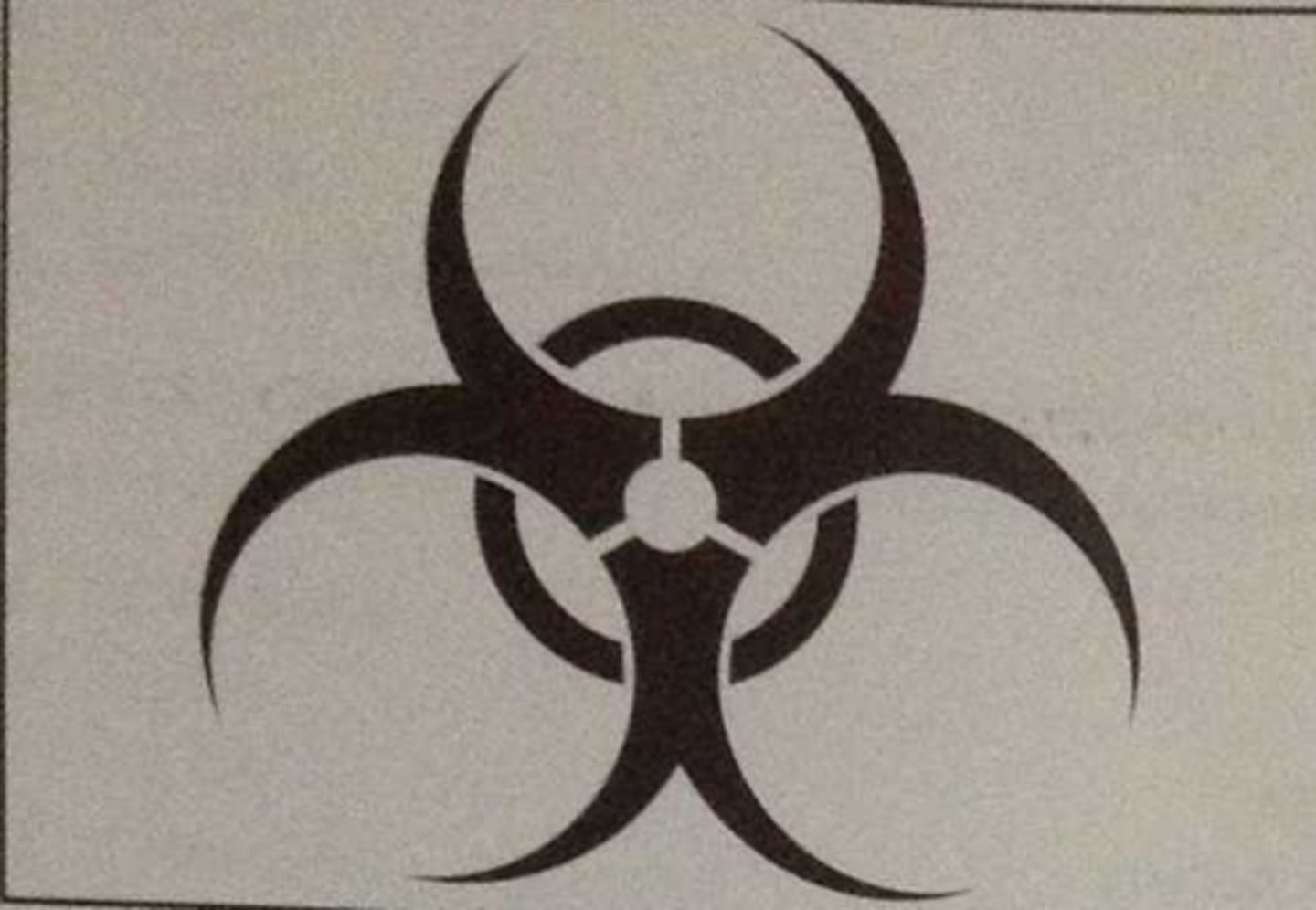
This simbol represents a:
a biohazard
b radiation hazard
c chemical hazard
d environmental hazard
a biohazard
Regulated medical waste refers to:
a chemical waste
b infectious waste
c radioactive waste
d all waste from healthcare facilities
b infectious waste
 Note
Note  Flashcards (55)