Scand 342 Final Exam Content
 Call Kai
 Learn
Learn Practice Test
 Spaced Repetition
 Match
Match Flashcards
 Knowt Play
1/49

Earn XP
Description and Tags
Chapters 12 -
Name | Mastery | Learn | Test | Matching | Spaced | Call with Kai |
|---|
No analytics yet
Send a link to your students to track their progress
50 Terms
When did the conversion to christianity occur (in Scandinavia?)
Spanned virtually the entire Viking age. Began with St. Anskar and other missionaries in the 800s, continued on and was mostly (officially) Christian by the 1100s (what people did in private was another matter though). Began with the conversion of Kings/leaders, who then influenced the places that they ruled to also convert (often through violence)
St. Anskar (Apostle of the North - d. 865)
First archbishop of Hamberg-Bremen (857), undertook missionary trips to Scandinavia (Denmark and Sweden specifically). Desirable goal to travel to Heathen lands and prove your devotion to God by being able to convert these people to Christianity. Tales of his efforts written in Life of Anskar by Rimbert (special type of work called hagiography, meant to show all his miracles and how awesome he was to convince the church to make him a saint).
Life of Anskar Reading
Harold Clark of Jutland is driven out of Denmark and converts to Christianity under Louis the Pious. He travels back to Denmark with Anskar on a missionary effort. Along the way Anskar frees people from slavery, builds churches etc. They target political leaders for conversion firts, encouraging cooperation between Sweden and Denmark leaders, with the knowledge that Christianity had the power to unite whole kingdoms, as the Church was so centralized (contrasted by the vikings, where worship was more private, in one’s own home).
Conversion Timeline
Denmark: First, with the baptizing of King Harald Bluetooth (much to the dismay of his father Gorm) in 958 by Poppo (priest who convinced Harald to get baptized by holding a red hot stone in his palm without getting burned).
Iceland: Peaceful conversion at the Althing in 1000 by Norwegian King Olaf Tryggvasson. Greenland: Also converts in 1000, under Tryggvasson.
Norway: Hakon the Good (ruled until 960), was Christian but unsuccessful in converting all of Norway. Next came Olaf Tryggvasson (995-1001) who used violence (Christinization by the sword) to attempt to convert Norway to Christianity. Finally, Olaf Haraldsson (1015-1030), succeeded in converting Norway to Christianity in 1024, set up the Bishopreich (Trondheim)
Sweden: Christian King Olof Skottonung (994-1022), did not successfully fully convert, despite evidence on rune stones and engravings. Full conversion occured in the early 1100s
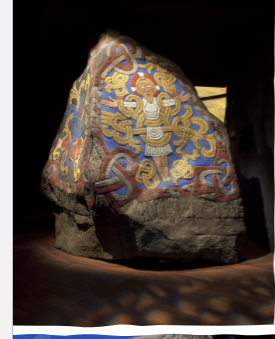
Jelling Stones (965)
The birth certificate of Denmark, erected by King Haraldr (Harald Bluetooth); also describes that Denmark was Christian at this point in time. “King Haraldr ordered this monument made in memory of Gormr, his father, and in memory of Þyra, his mother; that Haraldr who won for himself all of Denmark and Norway and made the Danes Christian”.
Olaf Tryggvasson
King of Norwary from 995-1000, vowed to bring about the Christinization of Norway or die trying. Mainly for political reasons (wanted to unite all of Norway, and surrounding terretories, under one “law”, making them easier to rule). Resorted to threats and violence in his attempts; was merciless. Marries his sister Astrid off to a promising Norwegian to gain more political power; is said to have encountered Odin (one-eyed old man who knew a bit of everything and talked with Olaf extensively throughout the evening).
Halfred the troublesome poet
Writes a poem about the difficulties he is facing when attempting to convert from paganism to Christianity, under Olaf Tryggvasson (court poet for him). Very committed to Odin due to his family being given the gift of peotry from him.
Saint Olaf Haraldsson (alive 990-1030)
Great-grandson of King Harald Fairhair. Engaged in viking activity, raided in England. Had the goal of converting all of Norway to Christianity (very difficult due to the isolating landscap; many different fjords, towns, mountains etc = reason for the many different dialects of Norwegian). King of Norway from 1015-1030; made Christianity official in 1024. Ousted from his throne in 1028 in a rebellion, due to his forcefullness. Punished all those who did not convert to Christianity (hanged, executed, mutilated, blinded etc). Attempted to take back his throne in the battle of Stiklestad (1030), north of Trondheim where he died.
Hlaut ritual (Olivar)
Pagan ritual where in which altars are covered in blood and the people all drink toasts. This was practiced by isolated communities, even under King Olaf Haraldsson’s rule. When this was discovered by King Olaf, the people were all punished severely (in most cases executed). Olaf especailly pissed, becaus the ringleader of these events had already previously lied and denied to the King that any pagan activities were continuing, blaming it on individuals drunkeness.
Gudbrand and paganism
Is convinced that the pagan way is still better than Christianity. King Olaf Haraldsson is able to convince him otherwise through a miracle, in which upon God making the sun appear on a cloudy day, the statue/idol of the pagan God is destroyed and lizards, snakes and mice emerge from it, terrifying the pagans and causing them all to convert.
Icelandic conversion
Headed by Olaf Tryggvasson. First sent a missionary who was overzealous in his attempts and began destroying heathen temples, who was then exiled. Next he sent Thangbrand, a priest who managed to baptise a few chieftans, but was then exiled due to him killing a few people who opposed him. This angered Olaf, and he threatened to kill every heathen Icelander. Gizur and Hjalti (2 icelanders), negotiated with him and promised that Iceland would be Christianized in the near future. Instead of killing people, Olaf took hostages. At the Icelandic Althing (1000), the issue was presented to all the people and opinions were very divided; it looked like things could get hostile. Thorgeir was chosen by the chieftans as a representitive/moderate of the Heathen group, and make a decision. He meditates for a while, comes to the realization that no good/no peace comes if they are divided religiously. So everyone should be baptized in Christianity.
Icelandic first stage of Christianity
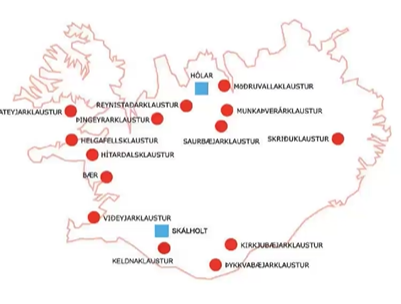
Chieftans built churches but there were very few priests available (had to be brought over from England and Germany, and then trained in Iceland). Church was very weak until 1056, with the establishment of the Skaholt bishopric in the south, and then the Holar in the north (1106).
Greenland Conversion
Headed by Lief Erikson, under orders from King Olaf Tryggvasson. Lief’s mother (Thjodhild) converted quickly, building a church, but Eirik the Red did not want to. Thjodhild would not sleep with Eirik under these circumstances. Occured at the same time as Iceland (1000).
Literary sources description of Christianity
Most from outsiders (as Scandinavia did not have writing yet) or if they were native to Scandinavia, they were written after Christianity has already been established (300 years after), containing their own biases. Also don’t provide a complete picture of all the viking establishments, just the main ones (Iceland, Sweden, Norway; missing places like Shetland and Orkney, among other colonies in England and Ireland).
Pilgrimage to the Holy Land (Palestine)
Done via the Crusades (for Scandinavian men) or just a journey without violence (for Scandinavian women). King Sigurd was one of these people, who led crusades across the lands. Abbot Nikolas Bergsson was another, who went on a journey and detailed all the places and routes one could take to get to these places, starting in Iceland and ending in Palestine (over 200 place names) - very valuable resource, used by others as a travel guide.
Gudrid Thorbjarnardottir
Christian Norse women who travelled from Iceland to Greenland and then all the way to North America, and then all the way to the Holy Land on a pilgrimage. Mother to the first Norse child (snorri) that is born in North America. Becomes a nun late in life, goes off in solitude until the end of her life.
King Harald Finehair (Fairhair)
Took over at age 10 from his father, along with his Uncle Guthorm; defended his new kingdom from 4 other King’s that tried to take it over (King Gandalf, Hogni Karuson, Haki Gandalfsson, and Hogni/Frodi = brothers). Wants to marry Gyda, but she responds that she will agree only if he takes over all of Norway (swears he won’t cut his hair until this is done). After defeating many kings, he won a final battle in Hafrsfjord, after which he faced no more opposition, and became sole king of Norway (cutting his hair and marrying Gyda). However, after his death, the kingdom fractured once again, and split apart, until the Olaf’s began trying to unify it once again.
Why were states created?
Security and protection - could be against raids, for instance (centralized leaders emerged to organize militaries and defence)
Managing problems which small communities could not on their own (such as economic regulations and resource management as trade and economies grew)
Establishment of central rules/laws (through governments and administration) to create order within society (attempting to reduce internal violence/disputes)
Shared identities/cultures and external pressures/forces (colonialism or war)
Agricultural revolution, writing and administration, and technological advancements
Ideological and revolutionary movements (wanting to move away from many different Kings to a state system)
Harald Bluetooth
Carved in the jelling stones that he had won all of Denmark for himself (unified Denmark and Norway) and made the Dane’s Christian (directly links christianization to kingship in the new era of the vikings). Constructed ring fortresses and the Ravning Bridge. Faced revolutions from his son Sven Forkbeard.
King Cnut (Cnut the Great)
Bluetooth’s grandson. Viking who united England, Denmark and Norway into the North Sea Empire. Attacked King Aethelred and gained control from 1016 - 1035. Used military prowess but also respected local systems (and churches), integrating rather than steamrolling them under his control. Collected taxes effeciently and married Queen Emma of Normandy to legitimize himself among the English. Strongly pushed forward Christinization in his state building, travelling to Rome in order to prove himself as a true Christian King. After he died in 1035, his empire fragmented, as it was unstable without his leadership.
King Aethelred the Unready
King of England for 38 years. Fought battles against Olaf Tryggvasson (eventually signing a peace treaty with him) and against Cnut the Great. Forced out of England in 1013 by King Svein. In 1014, works with St. Olaf to reclaim his kingdom after the death of King Svein. Married to Queen Emma (who Cnut would go on to marry after she became widowed). Dies in 1016, when Cnut gains control over Engalnd.
Earl Thorfinn (Thorfinn Sigurdarson)
Led the Earldom of Orkney, which controlled many key islands and territories, despite being on the fringes of larger kingdoms. He combined military strength with christinization and governance, securing states. Established the first Bishopric in Orkney, after pilgramage to Rome. After returning from Rome, he focused more on laws and state building, giving up raiding. Orkney and Shetland ruled by Norwegian earls until 1468
Godrid
Led the Kingdom of Man and the Isles of Man, in the late 11th century. Used strategic suprise attacks to establish royal dominance, after which he claimed ownership of all the territory (centralized land ownership = mix of Norse and local traditions), redistributing it fairly, so new rivalries would have less chance of beginning and creating durable governance. Lasted for nearly two centuries, and exerted influence over Scottish maritime activities.
When did Scandinavian countries become official states
Between the 9th and 11th centuries. By the viking’s age end, Denmark, Norway and Sweden were established in European politics.
Denmark: By 800s, Danes had established a region encompassing Denmark and parts of Sweden/Norway. Iron age site = Jutland.
Norway: Iron age site = Vestfold
Sweden: Iron age site = Lake Malaren; two tribes inhabited Sweden for most of viking age (Svear and Gotar) - a single king ruled these tribes by the late 10th century.
3 Reasons for end of viking age
Christian Conversion (since most aspects of Christianity are opposed to viking fundamentals/activites). Denmark the first via Bluetooth.
Political Unification via state development (as a result of christinization). Brought Scandinavian countries in line with mainland Europe.
Military Activity
St. Brice’s Day Massacre 1002
Motion put forth by King Aethelred after danegald does not fend off vikings from attacks on England, stating that all Danes in England should be executed.
The Battle of Stamford Bridge, 1066
After the death of Edward the Confessor (Aethelred’s brother, after Cnut’s 4 sons pass away), there are 3 contenders for King of England: Harold Godwinson (chosen by the English), Harald Hardradi (Norwegian) and William (Duke of Normandy, aka the Conqueror). Harald Hardradi is against this decision, attempts to invade the English but is defeated by Harold Godwinson at Stamford Bridge. This is seen as the last viking expedition that had a chance of success/large influence over England. In the reading, viking values of honor in death (Harald not turning back when the odds are against him, the English still being scared to face him) and luck (Harald falling off his horse, as he is watched by Harold) are present.
William, Duke of Normandy (The conqueror)
Descendant of Danish vikings; defeats Harold Godwinson just 3 weeks after the Stamford Bridge battle at the battle of Hastings. Crowned King of England on Christmas Day 1066.
Battle of Clontarf, 1014
Last major viking battle in Ireland, occuring on Good Friday. Battle between High King Brian Boru vs an alliance of Sigtrygg Silkenbeard, Maelmorda mac Murchada and Sigurd Hlodvinsson. Interestingly, there were Scandinavians on both sides of this battle, being drawn into existing Irish conflicts. In the reader, Valkyries are mentioned again (12 of them who decided who lived/died in the battle) as well as the idea of visions/dreams, as many men and priests encounter weird experiences/visions while the battle happens (blood drops, sea with many creatures in it).
Battle of Largs, 1263
Occured in Scotland, Orkney and Shetland. Vikings were driven from Scotland in 1100, but ruled the Western Isle’s until the 1200’s. King Haakon Haakonsson (the IV) of Norway attempted to take back Norwegian sovereignty over the Western seaboard of Scotland, but was defeated by the Scots.
First revivial of the vikings
Romanticism
Wagner
Viking influence on 20th Century European politics
Odinism
Ásatrú
Heathenry
Viking age readaption, repurpose and reinterpretations
Eirik Bloodaxe
King Hakon IV
1262
Audhumla
Ymir
Unn the Deep Minded
Snorri Sturluson
Saxo Grammaticus
Brattahlid
Richard Wagner
Hans Gunther
Thomas Gray

