important
 Call Kai
 Learn
Learn Practice Test
 Spaced Repetition
 Match
Match Flashcards
 Knowt Play
1/48

There's no tags or description
Looks like no tags are added yet.
Name | Mastery | Learn | Test | Matching | Spaced | Call with Kai |
|---|
No analytics yet
Send a link to your students to track their progress
49 Terms
Name the three parts of the cytoskeleton
microfilaments
intermediate filaments
microtubules
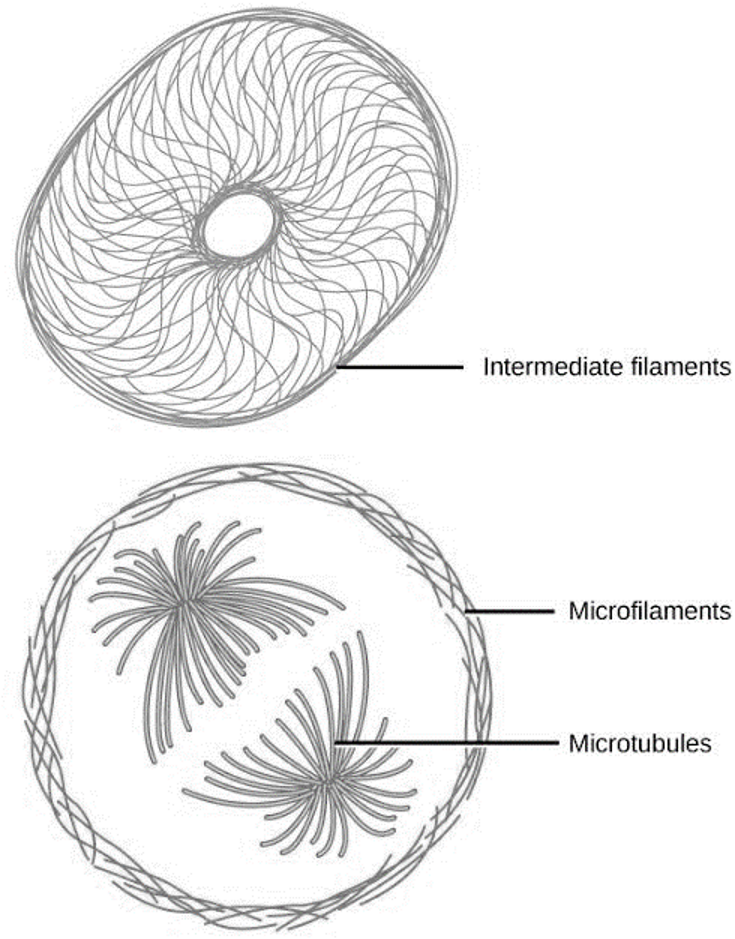
Structure of microfilaments
Not hollow
smallest
actin (polymer of protein)
Function of microfilaments
helps to hold the cell shape
helps cell to move and change shape
structure of intermediate filaments
medium size
polymer of mix of proteins
Function of intermediate filaments
holds nucleus and other organelles in place
Involved in cell communication
Structure of microtubules
hollow
largest
polymer of protein = tubulin
motor proteins use ATP to move cargo on this
Function of microtubule
provides pathways for vesicle transport
moves undulipodia and cilia
forms mitotic/meiotic spindle
Define active transport
The net movement of substances
against their concentration gradient
using ATP
and carrier proteins
Explain how cell surface membranes contribute to process of cell signalling
there is a release of a signal molecule via exocytosis
glycoproteins/glycolipids have receptors for these molecules
the receptors are specific - and so the shape of receptors and molecule are complementary
this attachment causes change on the cell surface membrane
this change now allows the entry of some signal molecules through the membrane
Define cell signalling
communication between cells
Why is it essential for genetic material to replicate before cell division?
cells need to be genetically identical - and you are producing 2 daughter cells
and for both daughter cells to receive full count of chromosomes
function of squamous epithelial tissue
acts as a surface for a short diffusion pathway
Suggest two ways that cell division in plants differ from in animals
nuclear envelope does not reform in most plant cells in telophase 1 in meiosis
cell plate forms
cytokinesis starts from the middle of cell
What is precision and ways to improve it
do not vary from mean
lower precision = higher standard deviation
repeating trials - allows data to cluster around the mean
higher increments in equipment
What is accuracy and ways to improve it
really close to actual answer
identifying anomalies
accuracy improves when your instruments or tools are calibrated properly
Adaptations of xylem and its use
hollow for continuous water transport
walls strengthened with lignin - prevent collapse
narrow vessels - increase capillary action
lignin - allows adhesion of water molecules to walls
has bordered pits
If cell has more chromosomes then necessary after completing the cell cycle, which checkpoint failed and why?
M checkpoint (metaphase)
because chromosomes have not been aligned correctly at the spindle - causing chromatids to be pulled apart incorrectly
Method to successfully extract DNA - and reason for steps
Pestle and mortar/Blend
Breaks down cells walls of onion cells
Add salt to mixture
breaks the H bonds between DNA and water molecules
Add onion pieces with detergent and in hot water bath
Both disrupt the phospholipid bilayer - releasing DNA
Cool mixture in ice bath
prevents DNA itself from breaking down
Filter mixture
Add ice cold ethanol to test tube
Nucleic acids are insoluble in this - DNA forms a white precipitate
How smoking causes smokers cough
forms tar
smoke destroys cilia
smoke stimulates goblet cells to release more mucus
so the mucus builds up and is not removed
causing pathogens to build up
the cough is an attempt to increase the airflow
How smokers cough can lead to further problems in lungs in the future
the frequent coughing can damage airways such as trachea and alveoli
the damage to alveoli causes a reduced SA for gas exchange
the airways walls (smooth muscle) thicken due to increase in inflammation
and so the lumen of airways narrow
causing airflow to restrict
increase in pathogens - likely to catch diseases
How refreshing air in alveoli helps to maintain a steep diffusion gradient
increases the pO2 in alveoli
this means the conc. of O2 in alveoli > in blood
this also decreases the pCO2 in alveoli
means the conc of CO2 in alveol < blood
causing a steep diffusion gradient
Function of golgi
production of vesicles
modification of proteins
Describe how to use a spirometer to measure rate of O2 uptake
Draw line along the peaks in the trace and calculate the gradient of the line
How does the increased permeability of capillary walls effect surrounding tissues?
more tissue fluid is formed as more blood plasma leaves the capillaries
increases pressure in tissue as volume increases
swelling/oedema can occur
What causes fluctuation as the blood flows along the aorta
the systole pressure increases
diastole pressure decreases
Suggest advantages of keeping blood inside vessels
higher blood pressure
increase rate of flow
flow can be diverted
How is a wall of artery adapted to withstand pressure NOT maintain
wall is thick - as it has a thick layer of collagen
which provides strength
Explain why the wall of left ventricle is thick
more muscle for more force
creates a higher pressure to push blood against greater resistance
to pump blood further
How pressure changes in the heart bring about the closure of the AV valve
ventricular systole occurs
the contraction raises ventricular pressure
which is higher than atrial pressure
the pressure pushes valve shut
Adaptations of sieve tubes for mass flow
elongated elements
sieve plates
little cytoplasm
elements are joined end to end to form column
Describe and explain how transpiration contributes to the mechanism of water transport up the stem
In leaf:
water loss is replaced
via apoplast/symplast/vacuolar pathway
down the water potential gradient
lost water is replaced by water from xylem
Stem/xylem
this creates a low hydrostatic pressure at top of leaf
water moves down the pressure gradient - towards the leaf
under tension by mass flow
due to cohesion, a chain of water molecules form = transpiration stream
Describe how the RER and the Golgi apparatus are involved in the production of a secretory vesicle that contains protein
proteins are synthesised at ribosomes in RER
then they are passed into the cisternae of RER
then can be folded to have carbohydrates added
then packaged into transport vesicles
these move to Golgi via microtubules
they fuse with the Golgi - the proteins are then modified in Golgi and packaged into secretory vesicle
How to prepare a microscope slide
(pond water - use a pipette to place a drop onto slide) - prepare sample
place coverslip over sample
ensuring no air bubble
Outline the method that students would use to carry out an investigation into the effect of temperature on the diffusion rate in their model cells?
Add glucose to dialysis tubing
secure dialysis tubing before addition of glucose
place tubing in a water bath and remove sample at set time intervals
add benedicts solution to sample
use calorimeter to obtain absorption values
repeat at different temp
How does the induced fit hypothesis for enzymes work?
substrate binds to active site of enzyme
temporary bonds are formed between the R groups of the substrate and the active site
causes shape of active site to change
this puts strain on the substrate bonds
and so lowers the activation energy
describe the role of mitosis in fragmentation (asexual reproduction)
produces many cells for growth
which are genetically identical to mother
Properties and function of collagen
fibrous protein
structural component in skin, tendons, bones, teeth etc
3 polypeptide chains
wound around each other - rope like structure
provides strength + flexibility
Describe how to use colorimeter
calibrate calorimeter with distilled water
then place samples in a cuvettes
use a range of known concentrations first
then measure these values of absorption
then measure the value of absorption of the sample
Function - How are sieve tube elements used in phloem
translocation
transport of, assimilates/ (organic) solutes/sucrose/amino acids.
tissue made up of sieve tube elements and companion cells.
allows mass flow / transport down a pressure gradient
up and down plant / From source to sink/ bidirectional.
allows movement with less resistance.
(assimilates/AW used in) respiration / synthesis of (named) molecule
Structure - sieve tube elements in phloem
living cells
long / hollow/ continuous, tubes
stacked end to end, to allow mass flow/ for less resistance/ to connect source to sink
no nucleus/little cytoplasm/few organelles
end walls are sieve plates
walls are, thin
(walls are) not lignified
sieve, plates /pores, to allow (named) solutes through/ limit size passing through
sieve pores linking cytoplasm of adjacent cells
sieve, pores/plates to reduce (rate of) flo
Function - How are companion cells used in phloem
‘life (non-structural) support’ to sieve tube elements
gains sucrose from, mesophyll cell/source
(gains sucrose using) protons/ H+ /energy/ active transport/active loading
allow / load, sucrose/ (organic) solutes (into sieve tube element)
Structure - how are companion cells used in phloem
(dense) cytoplasm / (lots of) mitochondria
(large) nucleus.
plasmodesmata, (connecting to sieve tube elements).
What is chi squared test used for
used on data that has been observed
when we know what the expected values are
compares observed with expected
What is degrees of freedom - how to find out
used for chi test
helps decide if data is significant or not
df = (number of rows - 1) x (number of columns -1)
in table
What is spearmans rank correlation coefficient
used to see if 2 different variables are correlated in a linear pattern
using a scatter graph
how to find d (difference in spearmans test)
order the two sets of variables in size order and rank them
then match the rankings together
and find the difference between the rankings
What is unpaired t test used for
comparing the means of two groups of different individuals
independent
two different categorical groups
What is paired t test for
comparing two sets of data that came from the SAME individual
cell cycle

