Decision Making 12.1, 12.2 & 12.3 - Textbook Test
 Call Kai
 Learn
Learn Practice Test
 Spaced Repetition
 Match
Match Flashcards
 Knowt Play
1/28

There's no tags or description
Looks like no tags are added yet.
Name | Mastery | Learn | Test | Matching | Spaced | Call with Kai |
|---|
No analytics yet
Send a link to your students to track their progress
29 Terms
Decision
The choice made from two or more alternatives. Happens at all levels of an organization.
Developing commitment to a course of action (process, commitment and course of action based on a choice among alternatives).
Rational & Perfect Rationality
Rational: Refers to choices that are consistent and value-maximizing within specified constraints.
Perfect Rationality: A decision strategy that is completely informed, logical and oriented towards economic gain. The “perfect thinker.
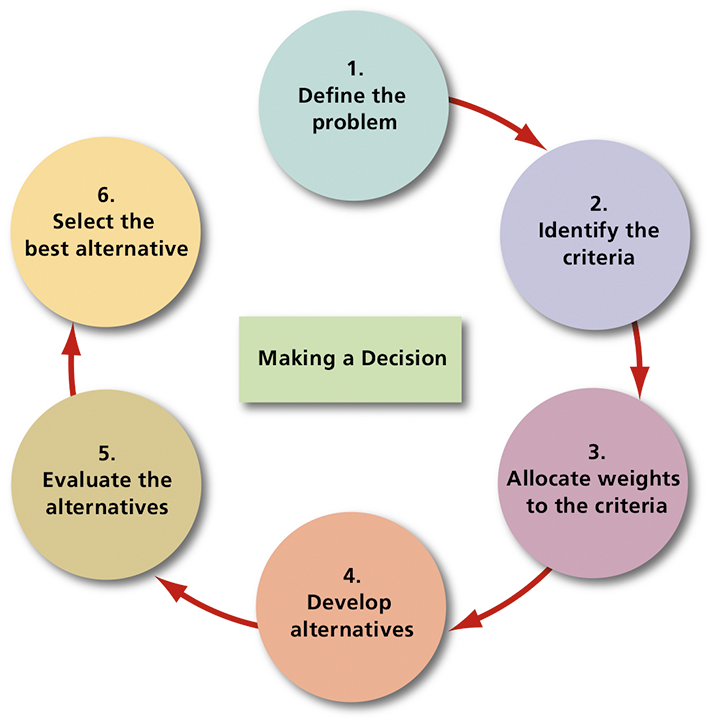
Rational Decision-Making Model
6 Steps
DIADES
Model that describes how individuals should behave to maximize some outcome. Assumes that the decision maker has complete information, can identify all the relevant options in an unbiased manner, and chooses the option with the highest utility. However, most decisions do not follow this rational model. Choice can be limited to the problem’s symptom and the current alternative.
Making a decision model:
Define the problem
Identify the criteria
Allocate weights to the criteria
Develop alternatives
Evaluate the alternatives
Select the best alternative
Bounded Rationality
Limitations on a person’s ability to interpret, process, and act on information. Occurs because the human mind cannot formulate and solve complex problems with full rationality.
We construct simplified models that extract the essential features from problems without capturing all their complexity. We can then behave rationally within the limits of the simple model.
Limitations to time constraints, poltical considerations and self-interest.
Carter Racing example.
Satisficing
Bounded Rationality
To provide a solution that is both satisfactory and sufficient. It is not always bad, a simple process maybe more sensible in some cases.
The end of the bounded rationality search.
The solution represents a satisficing choice, the first acceptable one we encounter rather than an optimal one.
Bounded Rationality Process for the Typical Individual
Search for Criteria: Once we have identified a problem, we begin to search for criteria and alternatives. But the criteria are unlikely to be exhaustive.
Find Alternatives: Find alternatives that are highly visible and that usually represent familiar criteria and tried-and-true solutions.
Review Alternatives: Begin reviewing the alternatives, focusing on choices that differ little from the current state until we identify one that is “good enough” that meets an acceptable level of performance. That ends our search.
Satisficing Choice: The solution represents a satisficing choice, the first acceptable one we encounter rather than an optimal one.
Intuitive Decision Making
An unconscious process created out of a person’s many experiences.
Occurs outside conscious thought (think about “gut feeling”).
Relies on holistic associations or links between disparate pieces of information.
Is fast and is affectively charged, meaning that it engages the emotions.
Overconfidence Bias
Error in judgment that arises from being far too optimistic about one’s own performance.
We tend to be overconfident about our abilities and the abilities of others; also, we are usually not aware of this bias.
When we are given factual questions and asked to judge the probability that our answers are correct, we tend to be overly optimistic.
Anchoring Bias
Individual decision making bias
A tendency to fixate on initial information, from which one then fails to adequately adjust for subsequent information.
Occurs because the mind gives a disproportionate amount of emphasis to the first information it receives.
Widely used by people in professions where persuasion skills are important, such as advertising, management, politics, real estate, and law.
Confirmation Bias
Individual decision making bias.
The tendency to seek out information that reaffirms past choices and to discount information that contradicts past judgments. Gather or remember information selectively. Interpret ambiguous evidence as supporting their existing position.
The rational decision-making process assumes that we objectively gather information. But we don’t. We selectively gather it.
The confirmation bias represents a case of selective perception.
Availability Bias
The tendency for people to base their judgments on information that is readily available to them rather than complete data.
A combination of readily available information and our previous direct experience with similar information has a particularly strong impact on our decision making.
Escalation of Commitment
An increased commitment to a previous decision despite negative information. Refers to staying with a decision even when there is clear evidence that it’s wrong.
For example, a friend has been dating someone for several years. Although she admits that things are not going well, she is determined to marry him anyway. Her justification: “I have a lot invested in the relationship!”
An individual decision making bias.
Includes sunk costs which are permanent loses of resources that happens as a result of a decision.
Randomness Error
The tendency of individuals to believe that they can predict the outcome of random events.
Decision making suffers when we try to create meaning in random events, particularly when we turn imaginary patterns into superstitions.
Risk Aversion
The tendency to prefer a sure gain of a moderate amount over a riskier outcome, even if the riskier outcome might have a higher expected payoff. Has important implications such as:
Offset the risks inherent in a commission-based wage, companies may pay commissioned employees considerably more than they do those on straight salaries.
Employees will stick with the established way of doing their jobs rather than take a chance on innovative methods.
Continuing with a strategy that has worked in the past minimizes risk, but it will lead to stagnation.
Ambitious people with power that can be taken away (most managers) appear to be especially risk averse, perhaps because they don’t want to gamble everything that they have worked so hard to achieve.
Hindsight Bias
The tendency to believe falsely, after an outcome of an event is known, that one could have accurately predicted that outcome.
When we have accurate feedback on the outcome, we seem to be pretty good at concluding that it was obvious.
Strengths of Group Decision Making
More complete information and knowledge: By combining the resources of several individuals, groups bring more input into the decision-making process.
Increased Diversity: They offer increased diversity of views, which opens the opportunity to consider more approaches and alternatives.
Lead to increased acceptance of a solution: Group members who participate in a decision are likely to support it enthusiastically and encourage others to accept it later.
Weaknesses of Group Decision Making
Time-Consuming: Groups typically take more time to reach a solution.
Conformity Pressures: The desire by group members to be accepted and considered an asset to the group can result in squashing any overt disagreement.
Discussion can be dominated by one or a few members: If they are low- and medium-ability members, the group’s overall effectiveness will suffer.
Group decisions suffer from ambiguous responsibility: In an individual decision, it’s clear who is accountable for the final outcome. In a group decision, the responsibility of any single member is watered down.
Groupthink
A phenomenon in which group pressures for conformity prevent the group from critically appraising unusual, minority, or unpopular views. Favor unanmity over quality decisions or conflict.
Have you ever felt like speaking up in a meeting, classroom, or informal group, but decided against it? One reason may have been shyness. On the other hand, you may have been a victim of this.
Relates to norms.
Attacks many groups and can dramatically hinder their performance.
Symptoms of Groupthink (6 Symptoms)
Illusion of invulnerability: Become overconfident among themselves, allowing them to take extraordinary risks.
Assumption of morality: Believe highly in the moral rightness of the group’s objectives and do not feel the need to debate the ethics of their actions.
Rationalized resistance: Rationalize any resistance to the assumptions they have made. No matter how strongly the evidence may contradict their basic assumptions, members behave to reinforce those assumptions continually.
Peer pressure: Apply direct pressure on those who momentarily express doubts about any of the group’s shared views or who question the validity of arguments supporting the alternative favoured by the majority.
Minimized doubts: Group members who have doubts or hold differing points of view seek to avoid deviating from what appears to be group consensus by keeping silent.
Illusion of unanimity: If people do not speak, it’s assumed that they are in full agreement.
Methods to Minimize Groupthink
4 Methods
Monitor Group Size: People grow more intimidated and hesitant as group size increases, and, although there is no magic number that will eliminate groupthink, individuals are likely to feel less personal responsibility when groups get larger than about 10.
Encourage Group Leaders to Play an Impartial Role: Leaders should actively seek input from all members and avoid expressing their own opinions, especially in the early stages of deliberation.
Appoint One Group Member to Play the Role of Devil’s Advocate: This member’s role is to overtly challenge the majority position and offer divergent perspectives.
Stimulate Active Discussion of Diverse Alternatives to Encourage Dissenting Views and More Objective Evaluations: Group members might delay discussion of possible gains so they can first talk about the dangers or risks inherent in a decision. Requiring members to first focus on the negatives of an alternative makes the group less likely to stifle dissenting views and more likely to gain an objective evaluation.
Groupshift
A phenomenon in which the initial positions of individual group members become exaggerated because of the interactions of the group.
Interacting Groups
Typical groups in which members interact with one another face to face.
Often censor themselves and pressure individual members toward conformity of opinion.
Brainstorming and the nominal group technique can reduce many of the problems inherent in the traditional interacting group.
Brainstorming
An idea-generation process that specifically encourages all alternatives, while withholding any criticism of those alternatives.
Can overcome the pressures for conformity that dampen creativity by encouraging all alternatives while withholding criticism.
Nominal Group Technique
A group decision-making method in which individual members meet face to face to pool their judgments in a systematic but independent fashion. This is done through a problem is presented and then the group takes the following steps:
Before discussion members independently write down their ideas on the problem.
Each member presents one idea to the group. Discussion does not take place until ideas are recorded.
Group discusses ideas for clarity and evaluates them.
Each group member silently ranks ideas.
Highest ranking determines final decision.
Group Polarization
Group discussion seems to exaggerate the initial position of the group. Tendency of group members to shift toward more extreme positions than those they initially held as a result of group discussion.
Discussion of already favored ideas.
Individuals tend to express slightly more extreme views during discussion.
Diffusion of responsibility.
Framing Effect
Bias in Decision Making
The manner in which objectively equivalent alternatives are presented. If information is portrayed (gain frame), it encourages conservative decisions. We take the sure thing over a chance at gaining more. If information is portrayed negatively (loss frame), it encourages risk. We take a chance at losing rather than accept a sure loss.
When alternatives are framed as a choice between losses, people tend to make risky decisions; when alternatives are framed as a choice between gains, people tend to make conservative decisions.
In Carter Racing, they were afraid of losing out on valuable sponsorships.
NASA managers were very conscious of losing out on the opportunity to launch after the launch had been rescheduled a few times.
Biases / Errors in Decision Making
Overconfidence
Confirmation bias
Escalation of commitment
Framing effect / Prospect Theory
Groupthink
Group Polarization
Prospect Theory
Explains how people actually make decisions when there is risk or uncertainty, especially in situations involving gains and losses. Helps explain why people sometimes make choices that appear irrational, like avoiding risks when facing gains but seeking risks to avoid losses. The video that we watched on the $20 relates.
People don’t evaluate choices purely logically. Instead, how the choices are presented (framed) strongly affects what people decide.
Avoid risk when thinking about gains (they prefer a sure gain).
Take risks when trying to avoid losses.
This happens because losses feel psychologically stronger than gains. Losing $100 usually feels worse than the happiness of gaining $100.
Escalation of Commitment Characterstics
Actively seek disconfirming information about a chosen alternative.
Reframe losses as gains to prevent risk-seeking behaviour.
Structure incentives so that decision makers are not punished for inconsistency.
Hand off decisions about whether to commit more resources to an investment to new decision makers.
Be careful not to consider expended resources (sunk costs) when making decisions.
Make sure decision makers are frequently reminded of the goals of the investment.
Explore top notes

