ROCKET AERODYNAMICS FIN STABILITY - Part 1
 Call Kai
 Learn
Learn Practice Test
 Spaced Repetition
 Match
Match Flashcards
 Knowt Play
1/8

There's no tags or description
Looks like no tags are added yet.
Name | Mastery | Learn | Test | Matching | Spaced | Call with Kai |
|---|
No analytics yet
Send a link to your students to track their progress
9 Terms
fin normal force
straight flight path
non-zero angle-of-attack.
nosecone, conical shoulders and boattail
destabilizing rotational moment.
Centre of Pressure (C.P.).
Stability Margin
Fins
aft
ahead
Fins and Rocket Stability
The stability of a fin-stabilized rocket is dependent upon the ___________ generated when a rocket tends to deviate from a ___________, in other words, flying at a _______________ This force, acting normal or perpendicular to the fin plane, imparts a rotational (corrective) moment to the rocket, about its Centre of Gravity (C.G.), which tends to counteract this deviation and to restore the desired straight flight path.
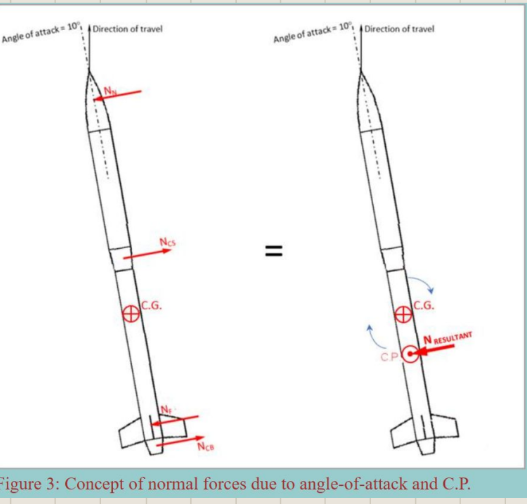
At a small angle-of-attack, not only the fins, but other components of the rocket, such as ________, _______ and _________ also generate a normal force. In the case of the nosecone and boattail, the forces generated by these components cause a ___________
The resultant of all of these normal forces acts at a point on the rocket body deemed the ____________This resultant force, which diminishes to zero as the angle-of-attack is corrected to zero, generates a stabilizing moment about the C.G.
It is clear from this discussion that the _____ must generate enough force to overcome the destabilizing forces to the extent that the C.P. lies ___ of the C.G. by a certain distance. This distance (measured in body diameters, or calibres, for convenience) is deemed the _______ (SM).
If the fins are too small, and as such generate a relatively small fin formal force, the resultant of the forces will lie _____ of the C.G. It is obvious, looking at the figure on the right, that the rocket will become unstable and tend to flip over.
positive
1.5 to 2.5
3
Fins and Rocket Stability: Stability Margin
Fins Considered to be
Last component to be designed
Stability margin to be ________
Good target value: ______
High stability margin, approx. ___, may tend to veer severely into the wind
Center of Gravity (CoG)
mass distribution
65% to 70%
1.5
forward shift
apogee.
liftoff.
Fin Sizing
sizing the fins last is for the adjustment of the computed value of the exact location of the __________ of the fully-assembled rocket must be known (usually with a loaded motor).
The C.G. depends on the ________ of all the components of the rocket. Once the C.G. location (xcg ) is known , the desired location of the C.P. (xcp) based on the desired Stability Margin.
For assumptions, location of the C.G. is about _______ of the rocket length.
Desired value of S.M. is at ____ when giving assumptions for Xcg
The fins are then sized to attain such a Stability Margin.
Note that the location of the rocket's C.G. will change during its flight. As propellant is consumed, the rocket's mass will decrease.
This will result in a ________ in the rocket C.G. which has a positive effect on the Stability Margin.
After burnout, the mass of the rocket is constant and the stability margin will likewise remain constant for the remainder of the flight to ______
As such, the minimum Stability Margin exists at ________ This is the design condition.
DELTA
High speed rockets
rounding tip
Rectangular
Simple
Ugly
Swept
Trapezoidal
Less aerodynamic
FIN PLANFORM PROFILE
Delta
Pro:
Flutter Resistant,
good choice for _________
Con:
Sharp tip may be susceptible to damage and may be a handling hazard (mitigate by _____)
Force coefficient less than the other shapes
_____________
Pro:
_______ to Make,
Structurally Robust
Flutter Resistant
Con:
Rather ____
May be susceptible to damage upon landing
____________
Pro:
Structurally Robust
Flutter Resistant
Con:
May be susceptible to damage upon landing
______________
Pro:
My go to shape
Structurally Robust
Can be clipped to shift CP Forward
Flutter Resistant
Con:
_________ than swept flatforms
Tapered Swept
high speed flights,
flutter
Clipped Delta
Ellipsoidal
aerodynamically
Barrowman shape
Clipped Taper Swept
FIN PLANFORM PROFILE
Tapered Swept
Pro:
Can be clipped to shift CP Forward
a good choice for ______ in particular for an upper stage
Con:
May be susceptible to _____
Can be susceptible to damage upon landing
__________________
Pro:
Structurally Robust
Can be clipped to shift CP Forward
Con:
Potentially susceptible to damage upon landing
_________________
Pro:
apparently __________ efficient
Hardest to make
Structurally robust and Flutter Resistant
Con:
Hard to Fabricate
Not a ___________ so calculating fin CP is less straightforward
___________________
Pro:
Can be clipped to shift CP Forward
an improvement over Tapered Swept
Con:
Can be susceptible to damage upon landing
May be susceptible to Flutter
finset
airflow.
non-zero angle-of-attack
wind gust
FIN RESTORING FORCE
The ______ on a rocket serves to provide stability by generating a restoring force, that is, a force normal (perpendicular) to the fin surface when a fin is deflected relative to the _____
This occurs when the rocket is flying at a _______, denoted by the symbol alpha (a). This angle-of-attack may result from a flight disturbance such as _________.
The restoring force is a function of angle-of-attack, such that when a=0, no restoring force is created (nor needed).
span width
fin surface area
dominant S/d squared
SPAN AND CHORD
Regarding fin design, there is one notable thing to bear in mind. As alluded to earlier, fin effectiveness, for a given shape, is more influenced by __________ than by chord length.
In other words, fin effectiveness (in shifting C.P. aftward) is not solely a function of _________.
The greater effectiveness of span width, compared to chord length, is a consequence of the _____________ term in the Barrowman equation for fin force coefficient (CN)F slope.
Along those same line, a particular fin shape influences its effectiveness in generating fin (restoring) force.
Fin skin friction and fin pressure drag
LoPER class,
subsonic range
20-25%
FIN DRAG
____________ and _________ are the primary drag forces generated by a finset.
For a __________ EX rocket that flies exclusively in the ___________, fin pressure drag force is generally not significant compared to the overall drag force acting on the rocket,
Skin friction drag accounts for ______of the total drag.
FIN FLUTTER
bending and twisting
airflow energy
natural resonance frequency.
High-speed airflow
oscillations.
increased drag
buzzing or whining
Metal fins
low shear modulus
_______________
It is a rapid oscillation of rocket fins caused by a combination of _______ and _______ when _______ excites the fin at its __________
This typically occurs at high speeds when the fin does not have sufficient stiffness.
Key points:
Cause: _________ interacting with fins that are not stiff enough.
Mechanism: Aerodynamic forces excite the fin’s natural vibration frequency, producing _______
Result: Can lead to _________, structural damage, or catastrophic fin failure (fins snapping off).
Sound: Flutter often produces a distinct _______ or _______sound.
Material effects:
________ rarely experience catastrophic flutter because of their high stiffness and strength.
Plastic and wood fins are more vulnerable due to their _____________

