Basic Bacteriology

0.0(0)
studied byStudied by 0 people
0.0(0)
full-widthCall Kai
learnLearn
examPractice Test
spaced repetitionSpaced Repetition
heart puzzleMatch
flashcardsFlashcards
GameKnowt Play
Card Sorting

1/20

encourage image

There's no tags or description

Looks like no tags are added yet.

Study Analytics
Name
Mastery
Learn
Test
Matching
Spaced

No study sessions yet.

21 Terms

1
New cards

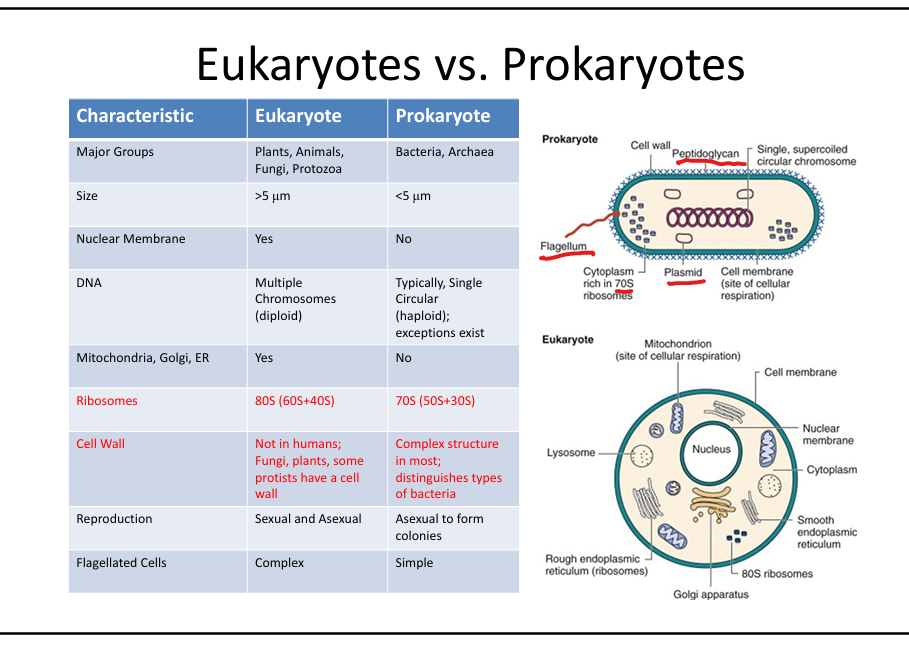
What are the structural differences between eukaryotes and prokaryotes?

Eukaryotes: >5 µm, nuclear membrane, multiple linear chromosomes, mitochondria/ER/Golgi, 80S ribosomes, sexual/asexual reproduction. Prokaryotes: <5 µm, no nuclear membrane, single circular chromosome, no organelles, 70S ribosomes, binary fission.
knowt flashcard image

<p>Eukaryotes: &gt;5 µm, nuclear membrane, multiple linear chromosomes, mitochondria/ER/Golgi, 80S ribosomes, sexual/asexual reproduction. Prokaryotes: &lt;5 µm, no nuclear membrane, single circular chromosome, no organelles, 70S ribosomes, binary fission.</p><img src="https://knowt-user-attachments.s3.amazonaws.com/b820351f-906d-4871-a5e4-ec691649a5d1.png" data-width="100%" data-align="center" alt="knowt flashcard image"><p></p>
2
New cards

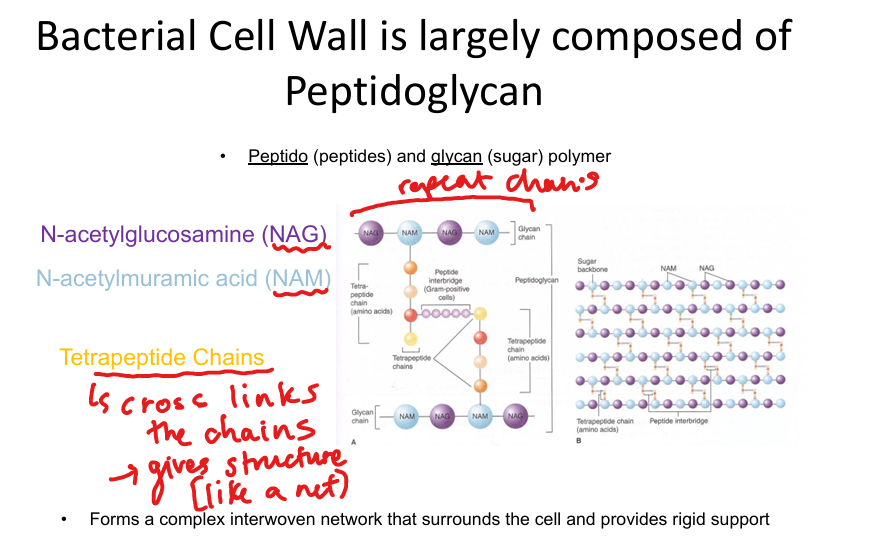
What is the major structural component of bacterial cell walls?

Peptidoglycan: alternating NAG/NAM sugars with tetrapeptide cross-links; provides rigidity and shape.
knowt flashcard image

<p>Peptidoglycan: alternating NAG/NAM sugars with tetrapeptide cross-links; provides rigidity and shape.</p><img src="https://knowt-user-attachments.s3.amazonaws.com/ff56dc7e-677b-44f2-878f-af66089cd4b5.png" data-width="100%" data-align="center" alt="knowt flashcard image"><p></p>
3
New cards

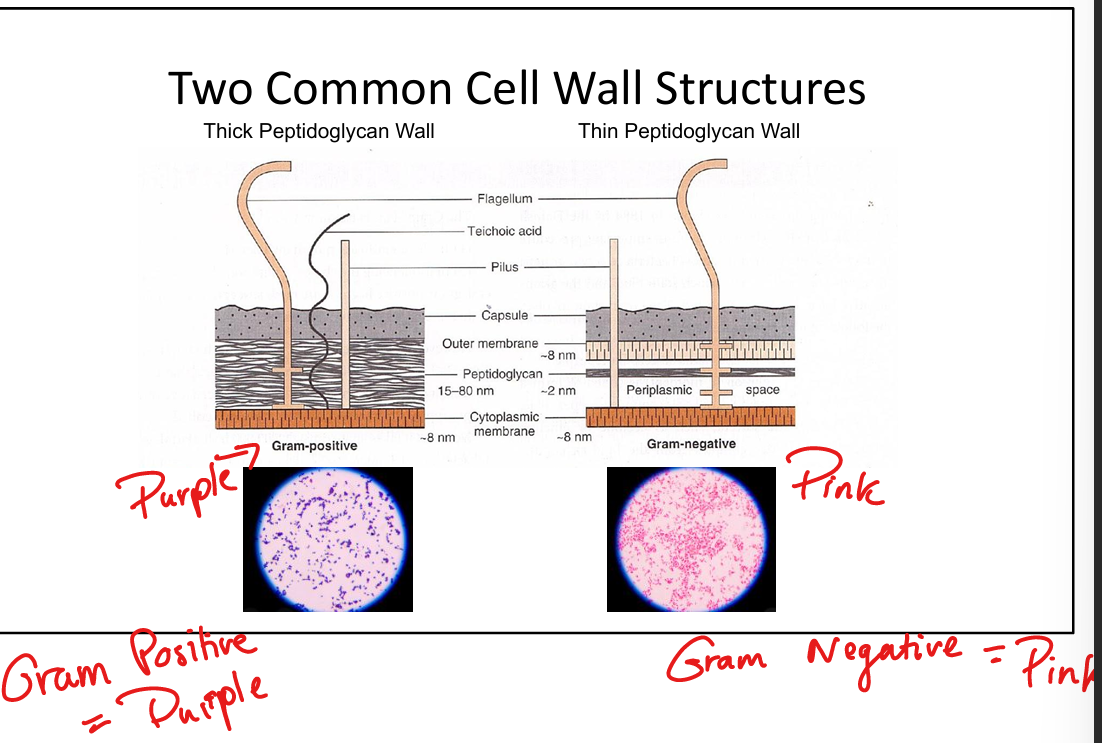
How do Gram-positive and Gram-negative cell walls differ?

Gram-positive: thick peptidoglycan, teichoic(flexibility)/lipoteichoic acids(adhesion), retain crystal violet → purple.

Gram-negative: thin peptidoglycan, outer membrane with LPS (O-antigen, core polysaccharide, Lipid A endotoxin), porins, periplasmic enzymes → lose crystal violet, take up safranin → pink/red.
knowt flashcard image

<p><strong>Gram-positive: thick peptidoglycan,</strong> teichoic(flexibility)/lipoteichoic acids(adhesion), retain crystal violet → purple. </p><p><strong>Gram-negative: thin peptidoglycan</strong>, outer membrane with LPS (O-antigen, core polysaccharide, Lipid A endotoxin), porins, periplasmic enzymes → lose crystal violet, take up safranin → pink/red.</p><img src="https://knowt-user-attachments.s3.amazonaws.com/a3b7ca51-997d-4b89-81af-58af1ddc7ef7.png" data-width="100%" data-align="center" alt="knowt flashcard image"><p></p>
4
New cards

What is the clinical significance of Lipid A in Gram-negative bacteria?

Lipid A is endotoxin; released during bacterial lysis; binds TLR4 → cytokine storm (IL-1, TNF) → septic shock.

knowt flashcard image

<p>Lipid A is endotoxin; released during bacterial lysis; binds TLR4 → cytokine storm (IL-1, TNF) → septic shock.</p><img src="https://knowt-user-attachments.s3.amazonaws.com/9dda7784-b98f-49bf-9247-502cc3e86d7d.png" data-width="100%" data-align="center" alt="knowt flashcard image"><p></p>
5
New cards

What is the role of teichoic and lipoteichoic acids in Gram-positive bacteria?

Teichoic acid=provide rigidity, resistance to osmotic stress, confer negative charge,

Lipoteichoic acid= aid adhesion/colonization, activate TLR2 → NF-κB → IL-1/TNF release.

6
New cards

What is the principle of Gram staining?

Crystal violet stains all cells → iodine forms complex → alcohol decolorizes Gram-negative → safranin counterstains Gram-negative pink/red while Gram-positive remain purple.

knowt flashcard image

<p>Crystal violet stains all cells → iodine forms complex → alcohol decolorizes Gram-negative → safranin counterstains Gram-negative pink/red while Gram-positive remain purple.</p><img src="https://knowt-user-attachments.s3.amazonaws.com/ca462414-dc99-4159-88d7-547c2f53a63b.png" data-width="100%" data-align="center" alt="knowt flashcard image"><p></p>
7
New cards

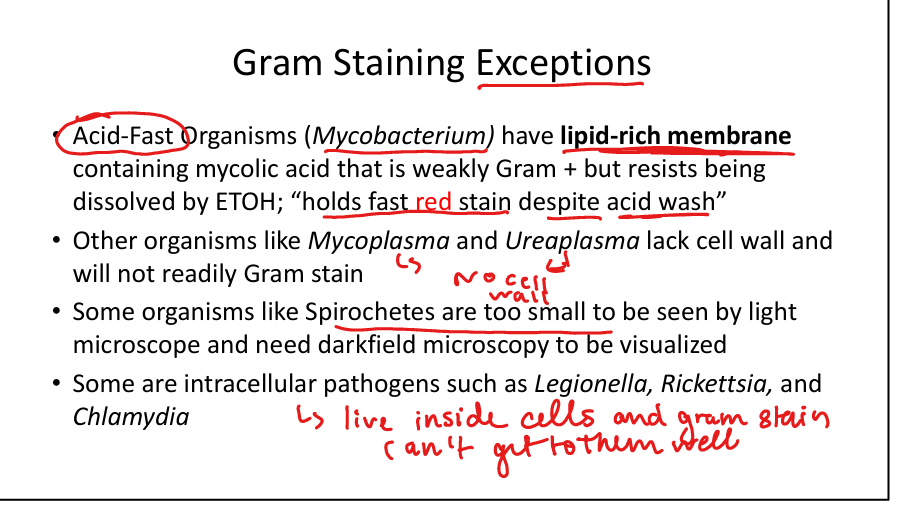
Which organisms are Gram stain exceptions?

Mycobacteria (acid-fast, lipid rich membrane with mycolic acids), Mycoplasma/Ureaplasma (no cell wall), Spirochetes (too thin, need darkfield), intracellular bacteria (Legionella, Rickettsia, Chlamydia).
knowt flashcard image

<p>Mycobacteria (acid-fast, lipid rich membrane with mycolic acids), Mycoplasma/Ureaplasma (no cell wall), Spirochetes (too thin, need darkfield), intracellular bacteria (Legionella, Rickettsia, Chlamydia).</p><img src="https://knowt-user-attachments.s3.amazonaws.com/fd06a016-c435-4b6c-b64c-ba96cc734389.png" data-width="100%" data-align="center" alt="knowt flashcard image"><p></p>
8
New cards

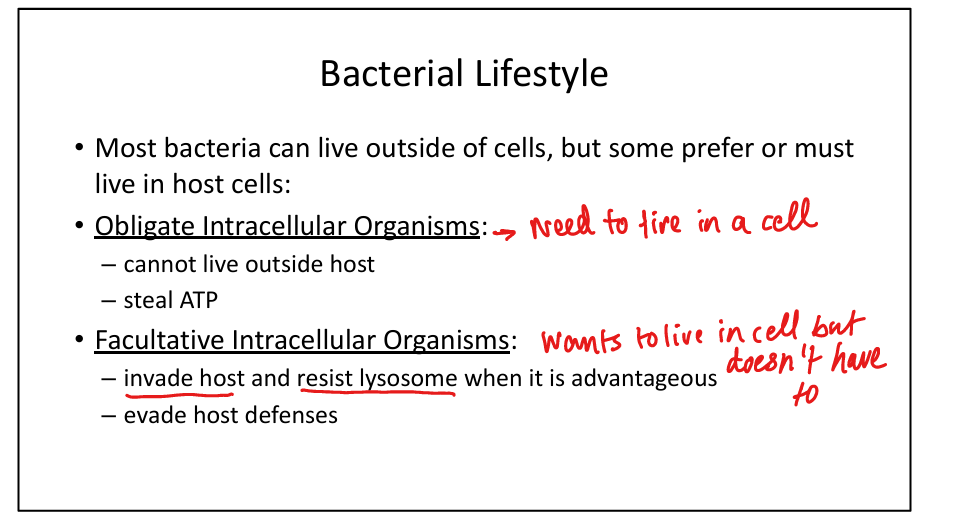
What are obligate intracellular organisms?

Rickettsia, Chlamydia → cannot survive outside host, steal ATP.
knowt flashcard image

<p>Rickettsia, Chlamydia → cannot survive outside host, steal ATP.</p><img src="https://knowt-user-attachments.s3.amazonaws.com/e6dfed45-91c7-4bae-832f-bb45fc223cb4.png" data-width="100%" data-align="center" alt="knowt flashcard image"><p></p>
9
New cards

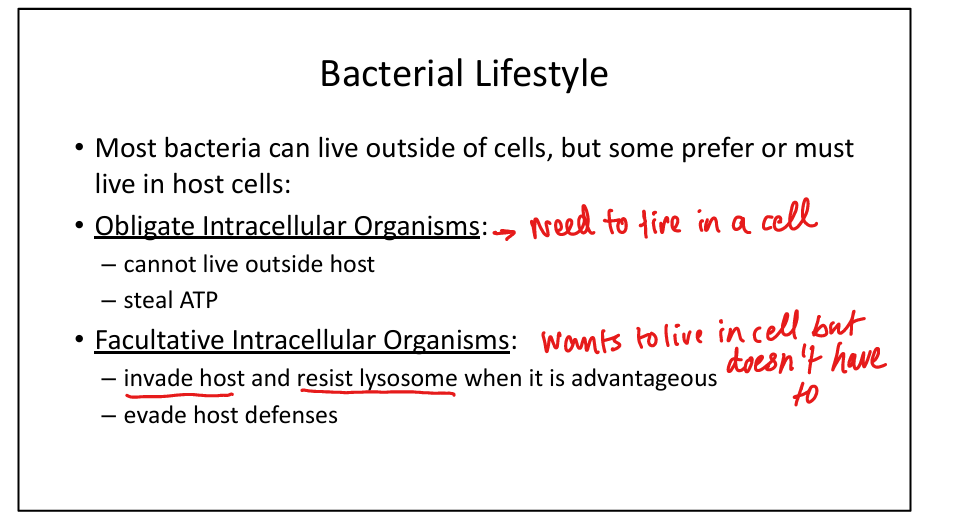
What are facultative intracellular organisms?

Listeria, Salmonella → invade host cells, resist lysosomal killing, evade immunity.
knowt flashcard image

<p>Listeria, Salmonella → invade host cells, resist lysosomal killing, evade immunity.</p><img src="https://knowt-user-attachments.s3.amazonaws.com/583fb287-259f-480b-876f-c8f0b6c0f08a.png" data-width="100%" data-align="center" alt="knowt flashcard image"><p></p>
10
New cards

Which bacteria form spores?

Gram-positive Bacillus and Clostridium species → resistant to heat, chemicals, desiccation; clinically relevant in anthrax, tetanus, botulism, C. difficile.
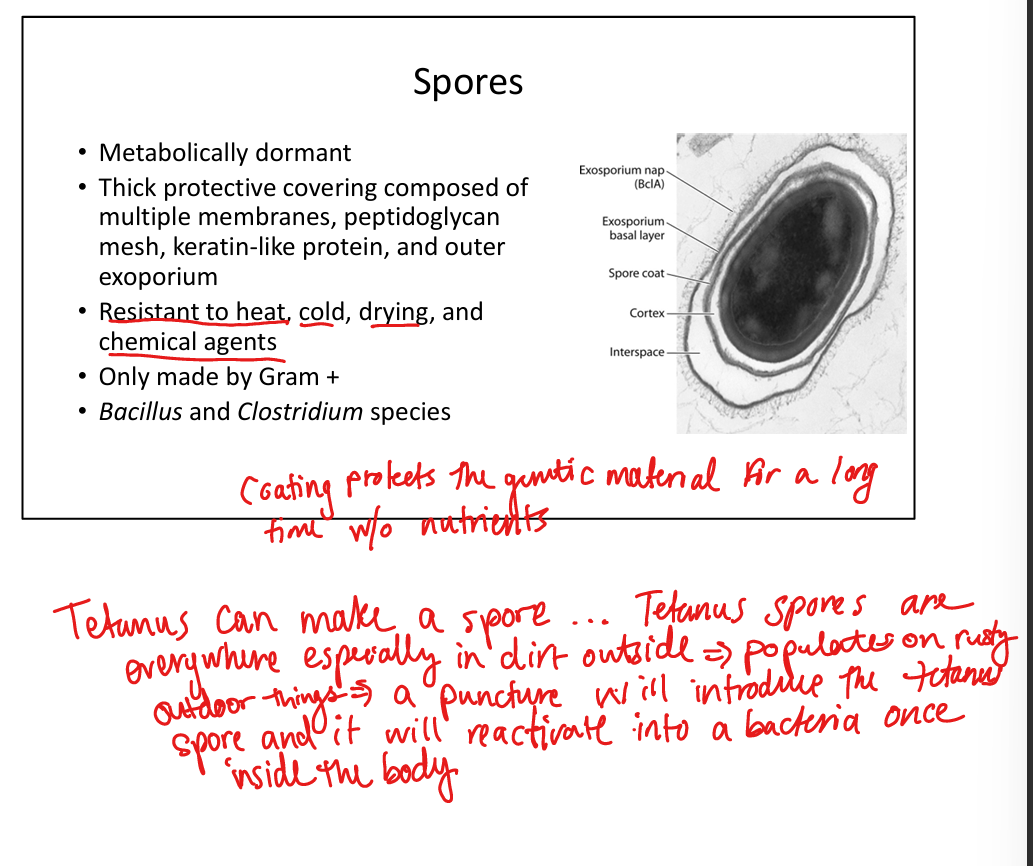
knowt flashcard image

<p>Gram-positive Bacillus and Clostridium species → resistant to heat, chemicals, desiccation; clinically relevant in anthrax, tetanus, botulism, C. difficile.</p><img src="https://knowt-user-attachments.s3.amazonaws.com/023d4a13-ae4a-4156-8ea7-c78779490bd7.png" data-width="100%" data-align="center" alt="knowt flashcard image"><p></p>
11
New cards

What is the role of coagulase in bacterial pathogenesis?

Converts fibrinogen → fibrin; cloaks bacteria in clot to evade immunity. Used to differentiate Staph aureus (coagulase +) from other staphylococci.
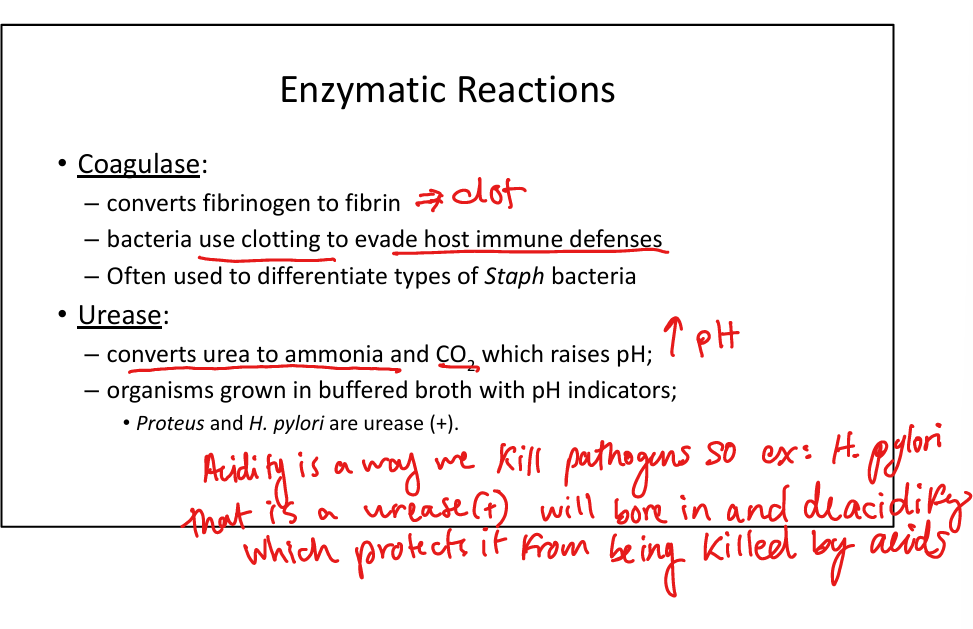
knowt flashcard image

<p>Converts fibrinogen → fibrin; cloaks bacteria in clot to evade immunity. Used to differentiate Staph aureus (coagulase +) from other staphylococci.</p><img src="https://knowt-user-attachments.s3.amazonaws.com/7aea805c-a291-4396-a669-50b478980b7a.png" data-width="100%" data-align="center" alt="knowt flashcard image"><p></p>
12
New cards

What is the role of urease in bacterial pathogenesis?

Converts urea → ammonia + CO₂ → raises pH, aids survival. Urease (+): Proteus, H. pylori. Used diagnostically in urease broth.
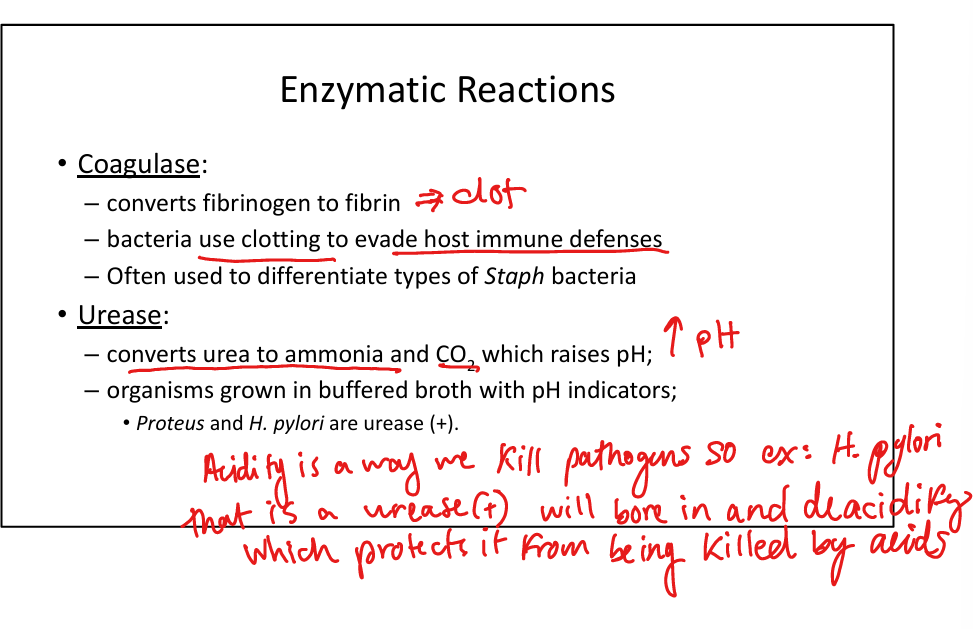
knowt flashcard image

<p>Converts urea → ammonia + CO₂ → raises pH, aids survival. Urease (+): Proteus, H. pylori. Used diagnostically in urease broth.</p><img src="https://knowt-user-attachments.s3.amazonaws.com/cb1193c2-af38-441d-8e69-5649da27edb7.png" data-width="100%" data-align="center" alt="knowt flashcard image"><p></p>
13
New cards

What are key bacterial virulence factors?

Capsule (anti-phagocytic, e.g. S. pneumoniae), exotoxins (protein toxins disrupting host), Protein A (Staph aureus, binds Fc of IgG to prevent opsonization), IgA protease (Neisseria, cleaves IgA allowing host to enter respiratory tract), M protein (Strep pyogenes, molecular mimicry → rheumatic fever).

knowt flashcard image

<p>Capsule (anti-phagocytic, e.g. S. pneumoniae), exotoxins (protein toxins disrupting host), Protein A (Staph aureus, binds Fc of IgG to prevent opsonization), IgA protease (Neisseria, cleaves IgA allowing host to enter respiratory tract), M protein (Strep pyogenes, molecular mimicry → rheumatic fever).</p><img src="https://knowt-user-attachments.s3.amazonaws.com/a523885c-86d8-465c-a493-09164f52f185.png" data-width="100%" data-align="center" alt="knowt flashcard image"><p></p>
14
New cards

What is the clinical importance of catalase in bacteria?

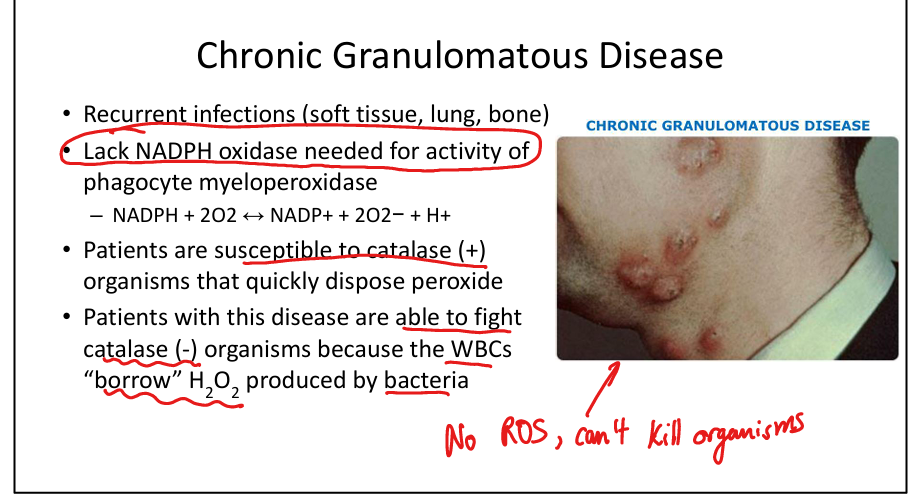
Catalase (+) organisms break down H₂O₂ and therefore lack ability to perform respiratory burst(killing of a pathogen); relevant in Chronic Granulomatous Disease (patients susceptible to catalase + infections).
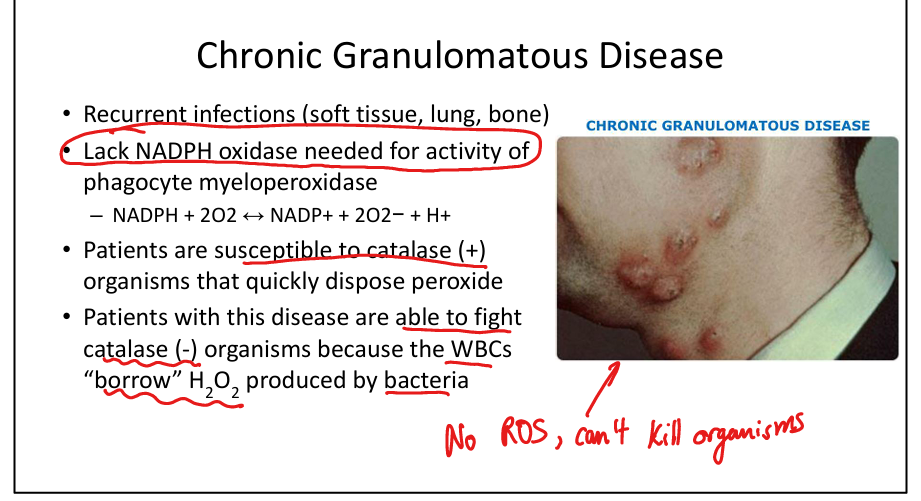
knowt flashcard image

<p>Catalase (+) organisms break down H₂O₂ and therefore lack ability to perform respiratory burst(killing of a pathogen); relevant in Chronic Granulomatous Disease (patients susceptible to catalase + infections).</p><img src="https://knowt-user-attachments.s3.amazonaws.com/81176fc8-f068-44c5-9467-087ea228b9ab.png" data-width="100%" data-align="center" alt="knowt flashcard image"><p></p>
15
New cards

What is Chronic Granulomatous Disease (CGD)?

X-linked/AR NADPH oxidase deficiency → impaired respiratory burst → recurrent infections with catalase (+) organisms (Staph, Serratia, Aspergillus). WBCs can fight catalase (−) organisms by “borrowing” H₂O₂.
knowt flashcard image

<p>X-linked/AR NADPH oxidase deficiency → impaired respiratory burst → recurrent infections with catalase (+) organisms (Staph, Serratia, Aspergillus). WBCs can fight catalase (−) organisms by “borrowing” H₂O₂.</p><img src="https://knowt-user-attachments.s3.amazonaws.com/2a31fe5a-8a54-4af2-8b86-fdbe8b7bb699.png" data-width="100%" data-align="center" alt="knowt flashcard image"><p></p>
16
New cards

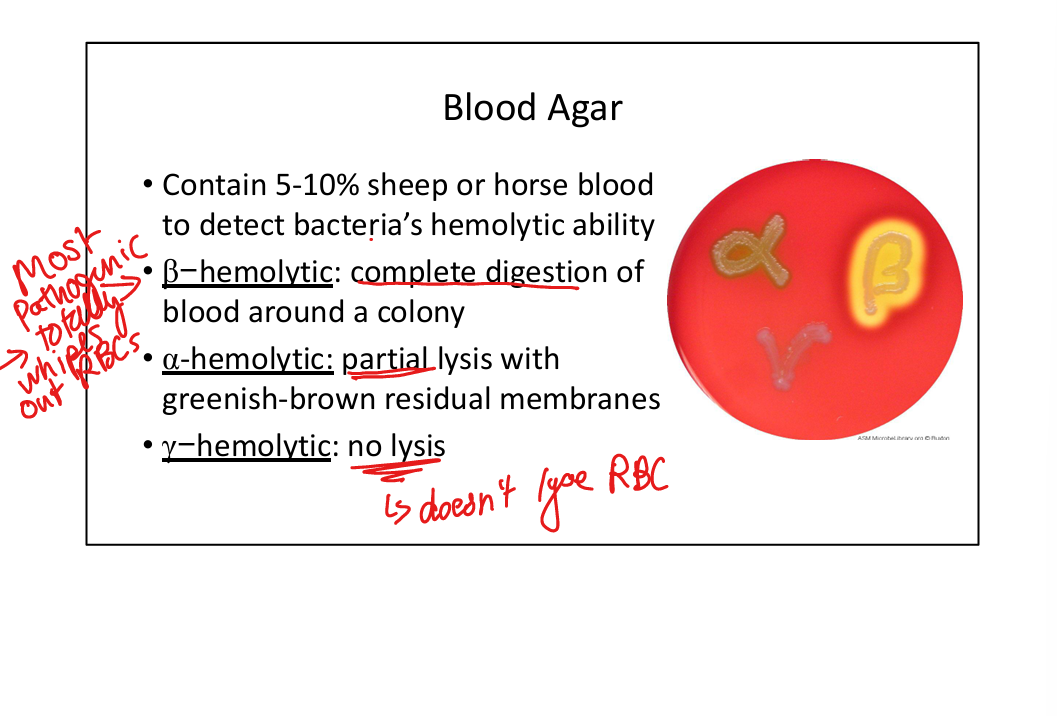
What is blood agar used for?

Detects hemolysis: β-hemolysis (complete clearing, e.g. Strep pyogenes), α-hemolysis (partial, greenish, e.g. Strep pneumoniae), γ-hemolysis (none).
knowt flashcard image

<p>Detects hemolysis: β-hemolysis (complete clearing, e.g. Strep pyogenes), α-hemolysis (partial, greenish, e.g. Strep pneumoniae), γ-hemolysis (none).</p><img src="https://knowt-user-attachments.s3.amazonaws.com/4503e286-f498-4235-9fa5-d883dd595872.png" data-width="100%" data-align="center" alt="knowt flashcard image"><p></p>
17
New cards

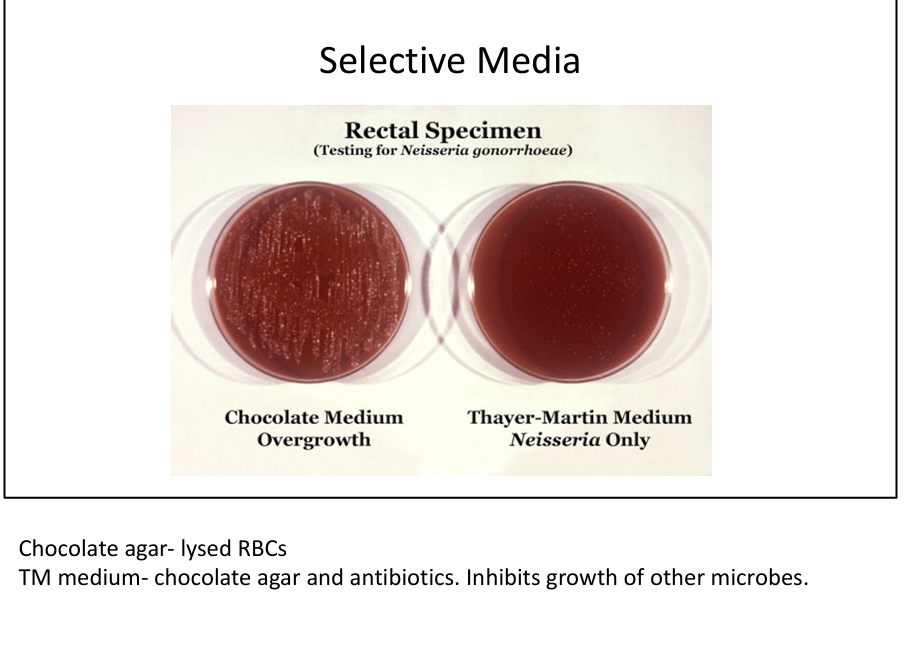
What is chocolate agar used for?

Lysed RBCs → release growth factors (NAD, hemin); supports fastidious organisms (Neisseria, H. influenzae).
knowt flashcard image

<p>Lysed RBCs → release growth factors (NAD, hemin); supports fastidious organisms (Neisseria, H. influenzae).</p><img src="https://knowt-user-attachments.s3.amazonaws.com/82934916-1501-4e2d-bfc5-fc14d92f0adf.png" data-width="100%" data-align="center" alt="knowt flashcard image"><p></p>
18
New cards

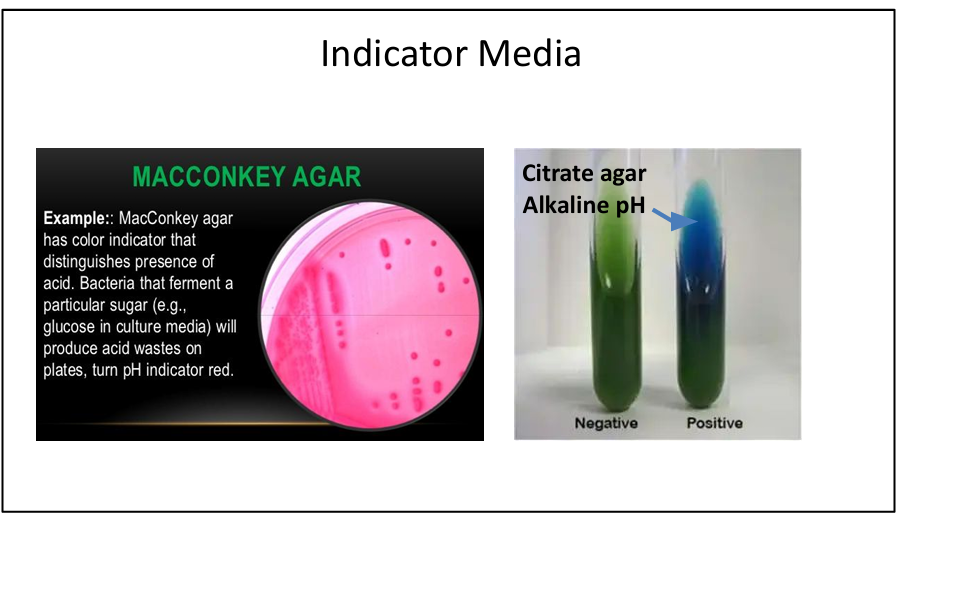
What is MacConkey agar used for?

Selective for Gram-negative rods; differentiates lactose fermenters (pink colonies: E. coli, Klebsiella) vs non-fermenters (colorless: Salmonella, Shigella).
knowt flashcard image

<p>Selective for Gram-negative rods; differentiates lactose fermenters (pink colonies: E. coli, Klebsiella) vs non-fermenters (colorless: Salmonella, Shigella).</p><img src="https://knowt-user-attachments.s3.amazonaws.com/076611f7-9812-40f6-883c-a3797f034820.png" data-width="100%" data-align="center" alt="knowt flashcard image"><p></p>
19
New cards

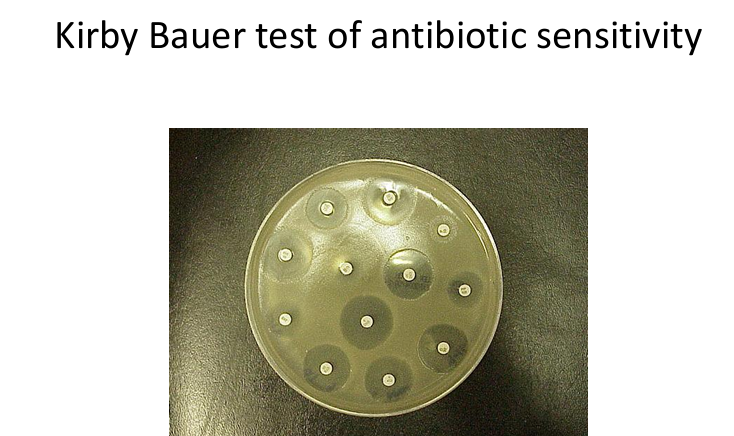
What is the Kirby-Bauer test?

Antibiotic sensitivity test using zones of inhibition around antibiotic discs.
knowt flashcard image

<p>Antibiotic sensitivity test using zones of inhibition around antibiotic discs.</p><img src="https://knowt-user-attachments.s3.amazonaws.com/9344605d-28a6-4e65-92a1-e3c3b57dd16e.png" data-width="100%" data-align="center" alt="knowt flashcard image"><p></p>
20
New cards

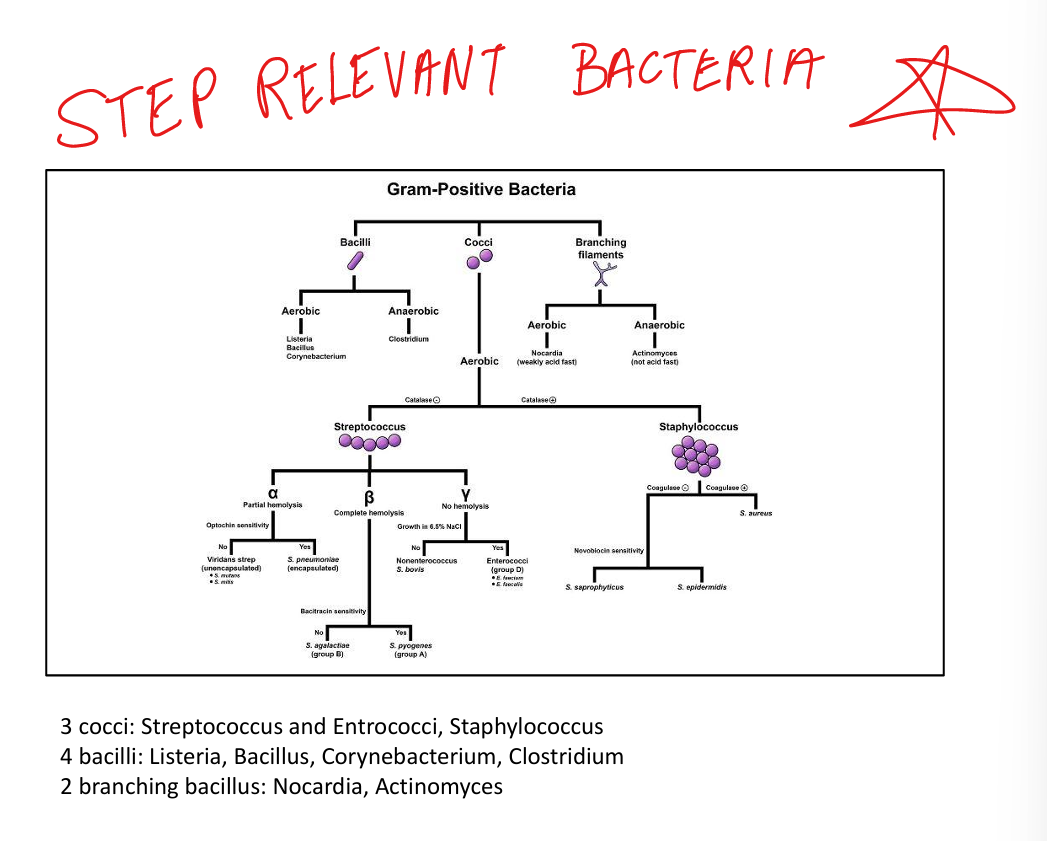
Step relevant Gram Positive Bacteria

knowt flashcard image

<img src="https://knowt-user-attachments.s3.amazonaws.com/2805b44c-3f59-421a-a6e8-5efa0d6b947e.png" data-width="100%" data-align="center" alt="knowt flashcard image"><p></p>
21
New cards

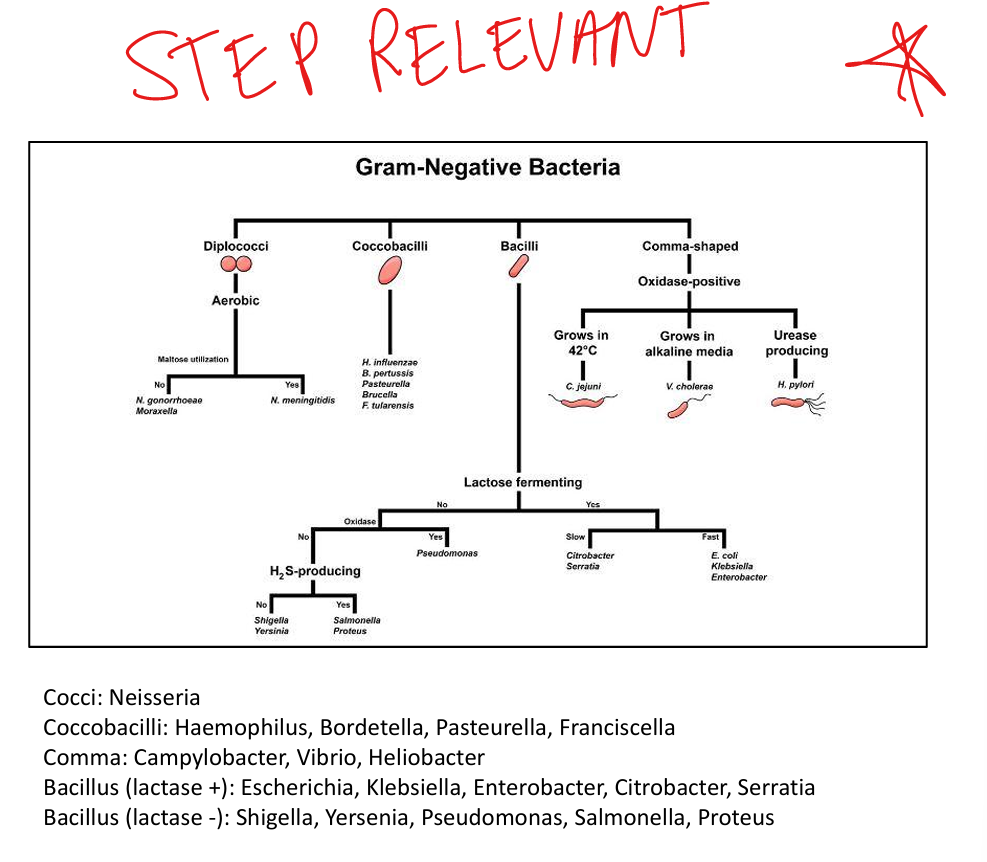
Step Relevant Gram Negative Bacteria

knowt flashcard image

<img src="https://knowt-user-attachments.s3.amazonaws.com/2bd3b3e6-a4bf-48bb-a412-daedf9e751cb.png" data-width="100%" data-align="center" alt="knowt flashcard image"><p></p>