Biological Psychology Unit Review
 Studied by 4 people
 Call with Kai
 Learn
Learn Practice Test
 Spaced Repetition
 Match
Match Flashcards
 Knowt Play
1/75

There's no tags or description
Looks like no tags are added yet.
Name | Mastery | Learn | Test | Matching | Spaced | Call with Kai |
|---|
No analytics yet
Send a link to your students to track their progress
76 Terms
nervous system
a collection of hundreds of billions of specialized and interconnected cells through which messages are sent between the brain and the rest of the body.
Central nervous system
made up of the brain and the spinal cord
Peripheral nervous system
the neurons that link the CNS to our skin, muscles, and glands.
Endocrine system
the chemical regulator of the body that consists of glands that secrete hormones.
Neuron
a cell in the nervous system whose function it is to receive and transmit information.
Sensory neurons
Neurons that send signals from the body to the brain.
Motor neurons
Neurons that send signals from the brain to the muscles.
Interneurons
Neurons that allow sensory and motor neurons to communicate with each other
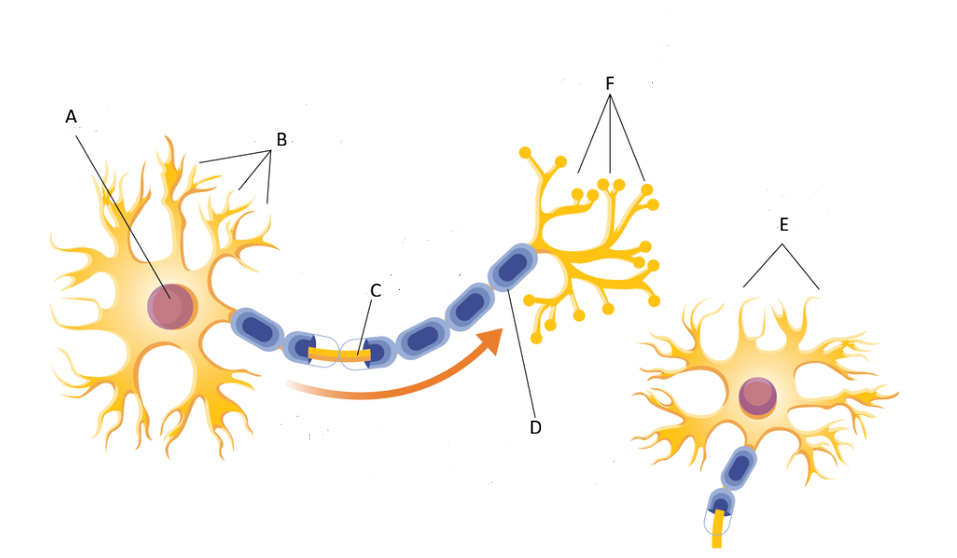
A
Cell body (aka Soma): contains the nucleus of the cell
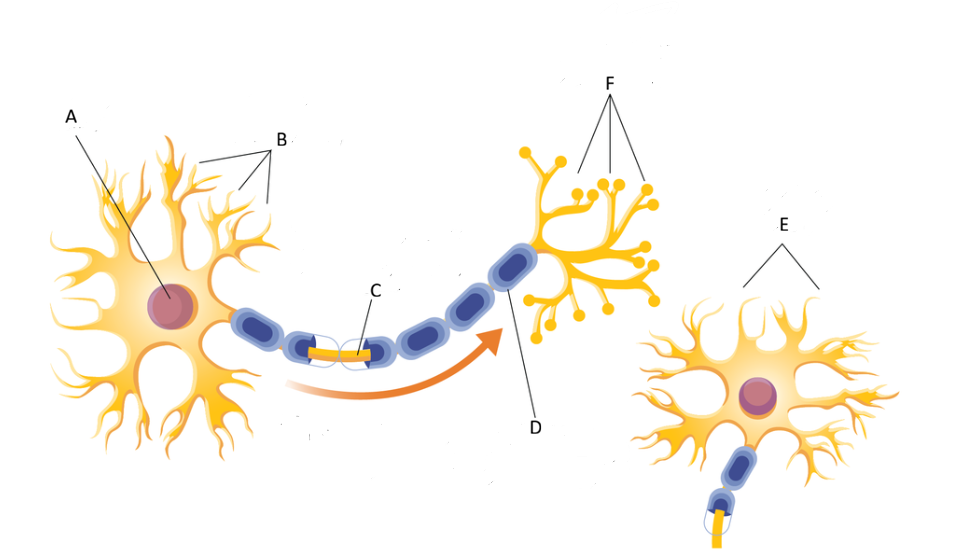
B
Dendrites: collect information from other cells and send the information to the cell body
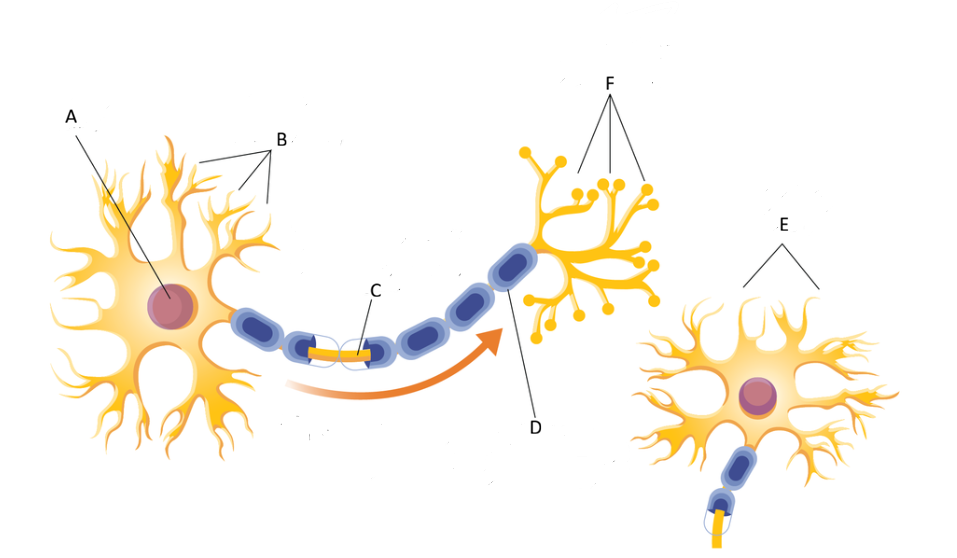
C
Axon: transmits information away from the cell body toward other neurons or to the muscles and glands.
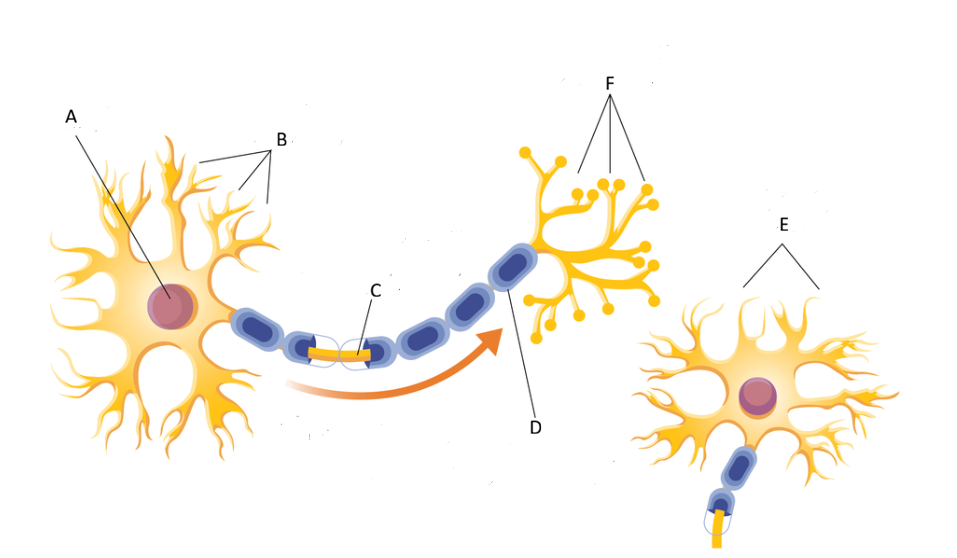
D
Myelin Sheath: a layer of fatty tissue surrounding the axon of a neuron that allows faster transmission of the electrical signal.
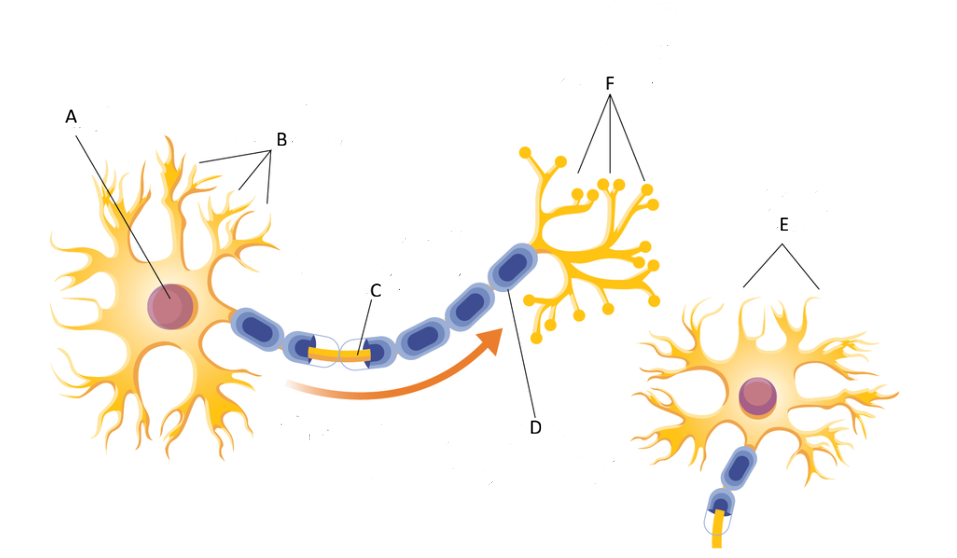
E
Dendrites: from another neuron
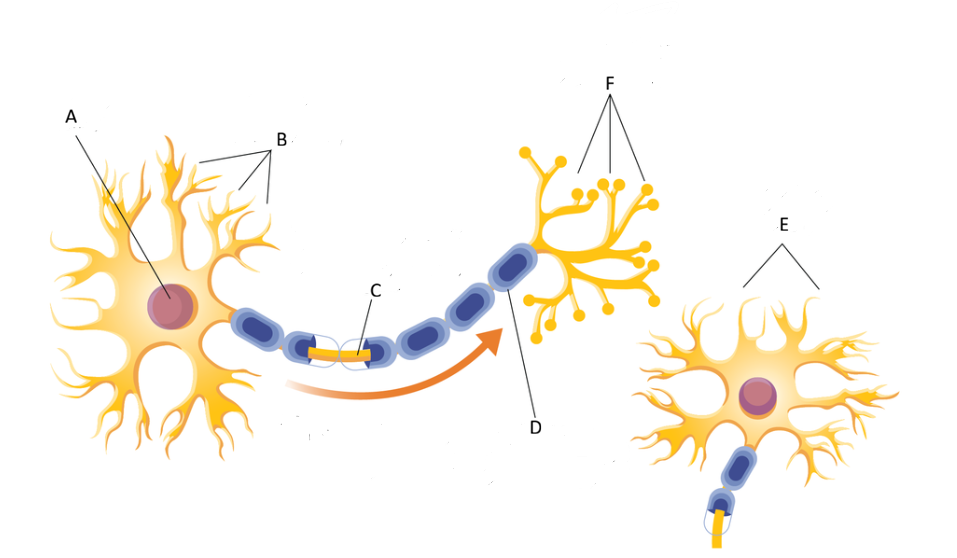
F
Terminal Buttons (axon terminals): form junctions with other cells
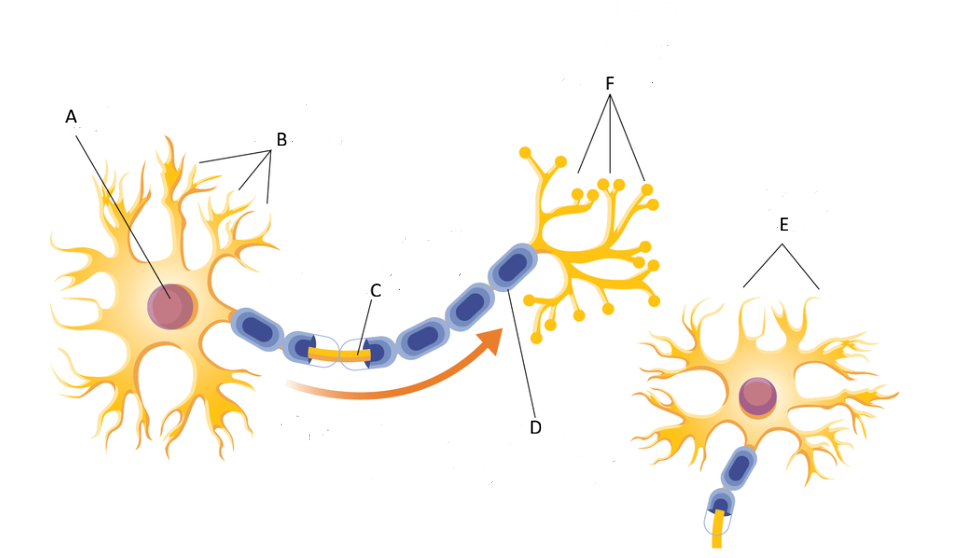
Orange arrow
Action potential: electrical signal traveling down the axon
Neurotransmitters
chemical messengers that allow neurons to communicate with each other
Synapse
the space between the axon terminal of one neuron and the dendrite of another neuron.
reuptake
a process in which neurotransmitters that are in the synapse are carried by transporters back into the transmitting axon terminal, ready to again be released after the neuron fires.
agonist
a drug that has chemical properties similar to a particular neurotransmitter and thus mimics the effects of the neurotransmitter. (Ex: morphine are this type of drug for endorphin neurotransmitters)
antagonist
a drug that reduces or stops the normal effects of a neurotransmitter. (Ex: poison curare is this type of drug for the neurotransmitter acetylcholine)
reuptake inhibitors
work by blocking the reuptake of the neurotransmitter itself. ( MDMA (3,4-methylenedioxy-methamphetamine, more commonly known as ecstasy or molly) is this type of drug for the neurotransmitters serotonin and dopamine.
Enzyme inhibitors
stop certain enzymes from breaking down any neurotransmitter left in the synapse.
Acetylcholine (ACh)
A common neurotransmitter used in the spinal cord and motor neurons to stimulate muscle contractions. Also used in the brain to regulate memory, sleeping, and dreaming.
Alzheimer’s disease is associated with an undersupply of this neurotransmitter. Nicotine is an agonist that acts like this neurotransmitter.
Dopamine
Involved in movement, motivation, and emotion; produces feelings of pleasure when released by the brain’s reward system. Also involved in learning.
Schizophrenia is linked to increases in this neurotransmitter; this neurotransmitter antagonists may be used to reduce symptoms. Parkinson’s disease is linked to reductions in this neurotransmitter; this neurotransmitter agonists may be used to reduce symptoms.
Endorphins
Released in response to behaviors such as vigorous exercise, orgasm, and eating spicy foods.
This neurotransmitter are natural pain relievers. They are related to the compounds found in drugs such as opium, morphine, and heroin.
GABA (gamma-aminobutyric acid)
The major inhibitory neurotransmitter in the brain.
A lack of this neurotransmitter can lead to involuntary motor actions, including tremors and seizures. Alcohol stimulates the release of this neurotransmitter, which inhibits the nervous system and makes us feel drunk. Low levels of this neurotransmitter can produce anxiety, and this neurotransmitter agonists (tranquilizers) are used to reduce anxiety.
Glutamate
The most common neurotransmitter, it is released in more than 90% of the brain’s synapses.
Excess of this neurotransmitter can cause overstimulation, migraines, and seizures.
Serotonin
Involved in many functions, including mood, appetite, sleep, and aggression.
Low levels of this neurotransmitter are associated with depression, and some drugs designed to treat depression (known as selective serotonin reuptake inhibitors, or SSRIs) serve to prevent their reuptake.
placebo effect
our expectations of receiving a treatment can make us feel better or make us experience side effects
blind to conditions
when the volunteers cannot know if they received the drug or the placebo
Experimenter Bias
researcher’s expectations of how a participant should feel or behave can inadvertently influence how the participant feels or behaves.
Double blind study
When both the participants and the researchers are blind to conditions
randomly controlled trial
(also sometimes called a randomized clinical trial). In type of trial, participants are randomly assigned to the levels of the independent variable (treatment or placebo) and the participants and researchers are both blind to conditions.
brainstem
oldest and innermost region of the brain, designed to control the most basic functions of life, including breathing, attention, and motor responses
Medulla
the area of the brainstem that controls heart rate and breathing.
Pons
a structure in the brainstem that helps control the movements of the body, playing a particularly important role in balance and walking
Reticular formation
Running through the medulla and the pons is this long, narrow network of neurons. Its job is to filter out some of the stimuli that are coming into the brain from the spinal cord and to relay the remainder of the signals to other areas of the brain.
thalamus
acts as a relay station filtering information between the brain and body. Except for olfaction [sense of smell], every sensory system has a [location in this brain structure] that receives, processes, and sends information to the cerebral cortex.
cerebellum
(“little brain”) consists of two wrinkled ovals behind the brainstem. It functions to coordinate voluntary movement and balance, and is important in learning and remembering skills that involve movement
Limbic system
a brain area, located between the brainstem and the two cerebral hemispheres, that governs emotion and memory. It includes the amygdala, the hypothalamus, and the hippocampus.
What is the limbic system responsible for?
responsible for memory of people, places, and events. It is also important in our experience of emotions, including our responses to reward and punishment.
amygdala
consists of two almond-shaped clusters (amygdala comes from the Latin word for “almond”). This part of the limbic system plays important roles in aggression and in regulating our experience of emotions, particularly fear and anxiety.
hypothalamus
Located just under the thalamus is this brain structure that controls the pituitary gland, thereby controlling the endocrine system. Through its many interactions with other parts of the brain, this structure helps regulate body temperature, hunger, thirst, sleep/wake cycles, and sexual arousal.
When a specific set of neurons within the hypothalamus is damaged or not working as it should, the result is
narcolepsy
hippocampus
is important in storing information in long-term memory.
cerebral cortex
the outer, bark-like layer of our brain that plays an important role in higher cognitive functions, such as planning, perception, and language.
frontal lobes
Part of the cerebral cortex; plays an important role in our sense of taste, judgement, planning, organizing, decision-making, controlling emotions, and personality.
motor cortex
the area responsible for voluntary muscle movement.
Parietal lobe
allow us to feel sensations on our skin and know the position of our body.
occipital lobes
located at the back of our head, important for vision, including detecting color, shapes, and motion, as well as reading
temporal lobes
located on the sides of our head, are important for our sense of hearing, sense of smell, and facial recognition.
association areas
the remainder of the cortex in which incoming information is combined and associated with our stored knowledge
neuroplasticity
the brain’s ability to change its structure and function in response to experience or damage.
neurogenesis
the forming of new neurons
Brain lateralization
the idea that the left and the right hemispheres of the brain are specialized to perform different functions
corpus callosum
the region that normally connects the two halves of the brain and supports communication between the hemispheres
Lesions
When the brains of living human beings may be damaged, for instance, as a result of strokes, falls, automobile accidents, and tumors. These damages are called
electroencephalography (EEG)
a technique that records the electrical activity produced by the brain’s neurons through the use of electrodes that are placed around the research participant’s head.
Functional magnetic resonance imaging (fMRI)
a type of brain scan that uses a magnetic field to create images of brain activity in each brain area.
Nerves
bundles of interconnected neurons that fire together to carry messages
spinal cord
the long, thin, tubular bundle of nerves and supporting cells that extends down from the brain. Conducts signals to and from the brain, controls reflex activities.
reflex
an involuntary and nearly instantaneous movement in response to a stimulus
autonomic nervous system
the division of the peripheral nervous system that governs the internal activities of the human body, including heart rate, breathing, digestion, salivation, perspiration, urination, and sexual arousal.
somatic nervous system
the division of the peripheral nervous system that controls the external aspects of the body, including the skeletal muscles, skin, and sense organs
The autonomic nervous system has two divisions:
sympathetic and parasympathetic
What does the sympathetic division of the autonomic nervous system do?
It energizes the body, preparing it for action (aka “fight or flight”) by doing things like dilating your pupil, accelerating your heartbeat, inhibiting your digestive activity, stimulating your glucose release, and stimulating secretion of epinephrine and norepinephrine.
What does the parasympathetic division of the autonomic system do?
It acts to calm the body, allowing it to rest by doing things like contracting your pupil, slowing your heartbeat, and stimulating digestive activity.
homeostasis
the natural balance in the body’s systems.
gland
groups of cells that function to secrete hormones
hormone
a chemical that moves through the bloodstream to help regulate emotions and behaviors
pituitary gland
small pea-sized gland located near the center of the brain and controlled by the hypothalamus, is responsible for controlling the body’s growth
adrenal glands
produce hormones that regulate the balance of salt and water in the body, and they are involved in metabolism, the immune system, and sexual development and function. The most important function of this glands is to secrete the hormones epinephrine (also known as adrenaline) and norepinephrine (also known as noradrenaline) when we are excited, threatened, or stressed.
ovaries
the female sex glands, are located in the pelvis. They produce eggs and secrete the female hormones estrogen and progesterone
testes
male sex glands
testosterone
the male sex hormone that regulates body changes associated with sexual development, including enlargement of the penis, deepening of the voice, growth of facial and pubic hair, and the increase in muscle growth and strength.
Estrogen
involved in the development of female sexual features, including breast growth, the accumulation of body fat around the hips and thighs, and the growth spurt that occurs during puberty.
 Note
Note  Flashcards (24)