Memory and the Brain
 Studied by 0 people
 Call with Kai
 Learn
Learn Practice Test
 Spaced Repetition
 Match
Match Flashcards
 Knowt Play
1/25

There's no tags or description
Looks like no tags are added yet.
Name | Mastery | Learn | Test | Matching | Spaced | Call with Kai |
|---|
No analytics yet
Send a link to your students to track their progress
26 Terms
What is learning and memory?
Learning: Process by which we acquire new info about world.
Memory: Product of learning; persistence enables us to call it up later.
What are the general stages of memory? (3)
1. Encoding: Process info for storage.
2. Storage: Maintaining permanent record, trace or 'engram' representing encoded info.
3. Retrieval: Bringing to mind a stored representation of info, event or action.
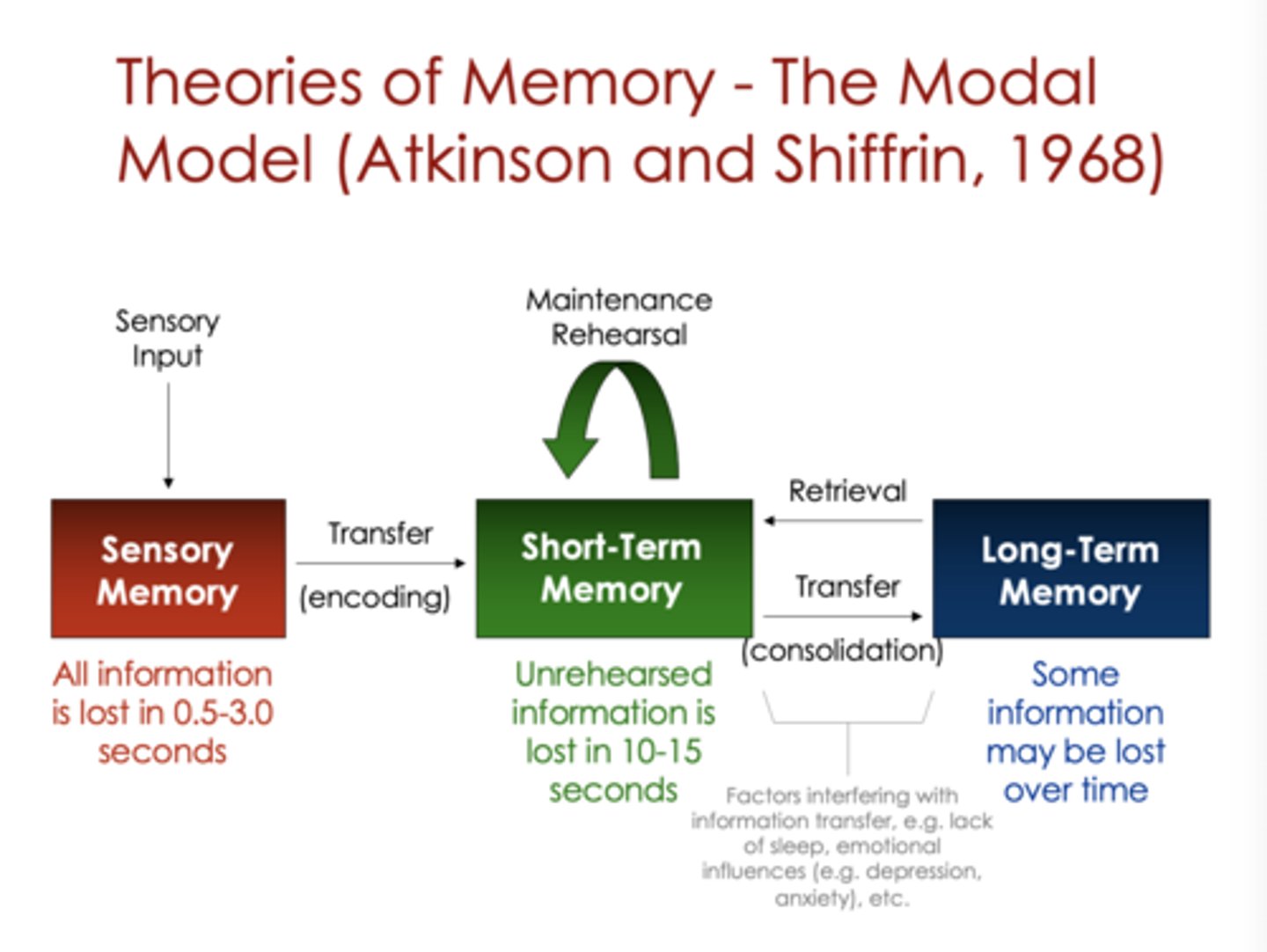
What is the modal memory model? (Atkinson and Shiffrin, 1968)
3 stores - sensory, short-term and long-term.
Sensory = senses via environment, lost in 0.5-3.0s. Encoded to short-term if relevant to start storage.
Short-term = temporary store for only 10-15s if unrehearsed, but is maintained if practiced, then consolidated to long-term.
Long-term = Kept for years, as long as you make use of it and go back to short-term memory to retrieve it.
What interferes with info transfer from short-term to long-term memory? (5)
1. Time
2. New information - overwritten by more relevant things
3. Motivation
4. Lack of sleep
5. Emotion - depression, anxiety
Give features of sensory memory. (3)
1. Shortest duration (ms-s) but larger capacity than short-term as you receive a lot more environmental input.
2. workes by 2 modalities - echoic (acoustic) which lasts 10s and iconic (visual) sensory traces to process info.
3. Items shift from sensory to STM via attention.
larger capacity then STM
How many items do iconic sensory traces retain?
About 12 items, but they fade too fast for verbal report.
Give features of short-term memory. (4)
1. Lasts seconds.
2. Capacity of 7 +/- 2 items eg. a single digit or piece of info.
3. Chunking info can create larger items.
4. Items are maintained and consolidated to LTM with active rehearsal, otherwise decay in10-15 sec over time.
Give features of long-term memory. (3)
1. Unlimited capacity, can last for hours-years.
2. Can be lost via interference of new material on old.
3. Info can only enter via STM, according to the modal model but neuropsychological research doesn't support this.
What is working memory?
Is short-term memory interacting with other subsystems i.e. more dynamic - a collection of structures that temporarily store and manipulate info eg. digit span and digit span backwards.
What is the working memory model? (Baddeley and Hitch, 1974)
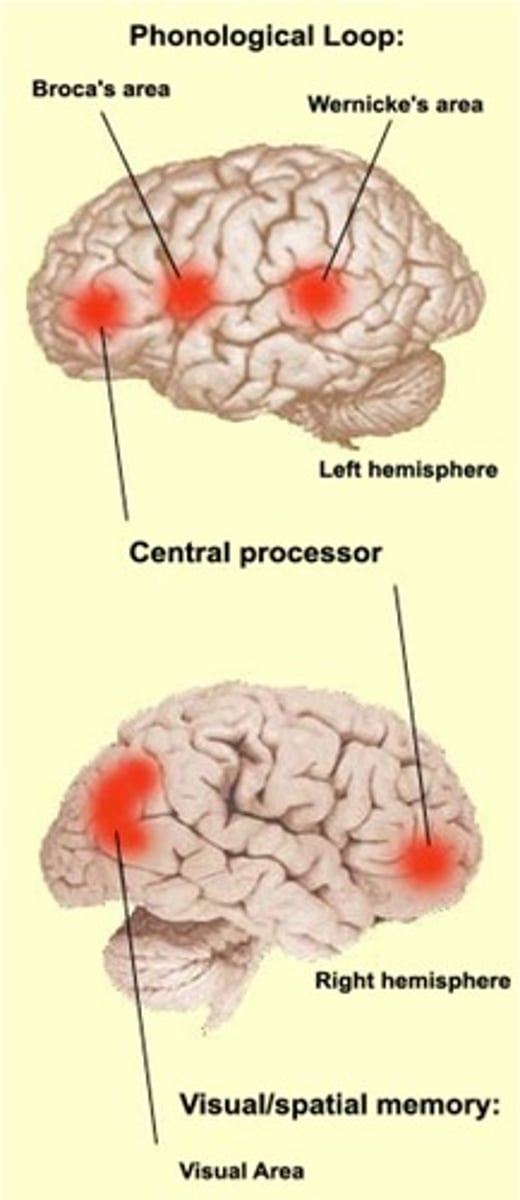
There are 3 systems:
Central processor: Coordinates 2 subsystems and commands what is processed, in frontal lobe.
Phonological loop: Acoustic and linguistic memory (sound and language), resides in temporal lobes of L hemisphere and activated by the central processor in the left hemisphere.
Visual/spatial loop: Visual and spatial information (reading a map), activated by central processor in R hemisphere and resides in R hemisphere in visual area.
What is amnesia and the 2 types?
Deficits in recall (memory retrieval) and recognition of facts and events experienced.
1. Retrograde amnesia: Before brain damage onset.
2. Anterograde amnesia: After brain damage onset.
STM abilities and intelligence remain unimpaired.
What are the possible causes of amnesia? (2)
1. Organic: due to brain damage from trauma, disease, drugs.
2. Functional: result of psychological factors.
What happened to H.M. undergoing an operation to relieve epileptic seizures?
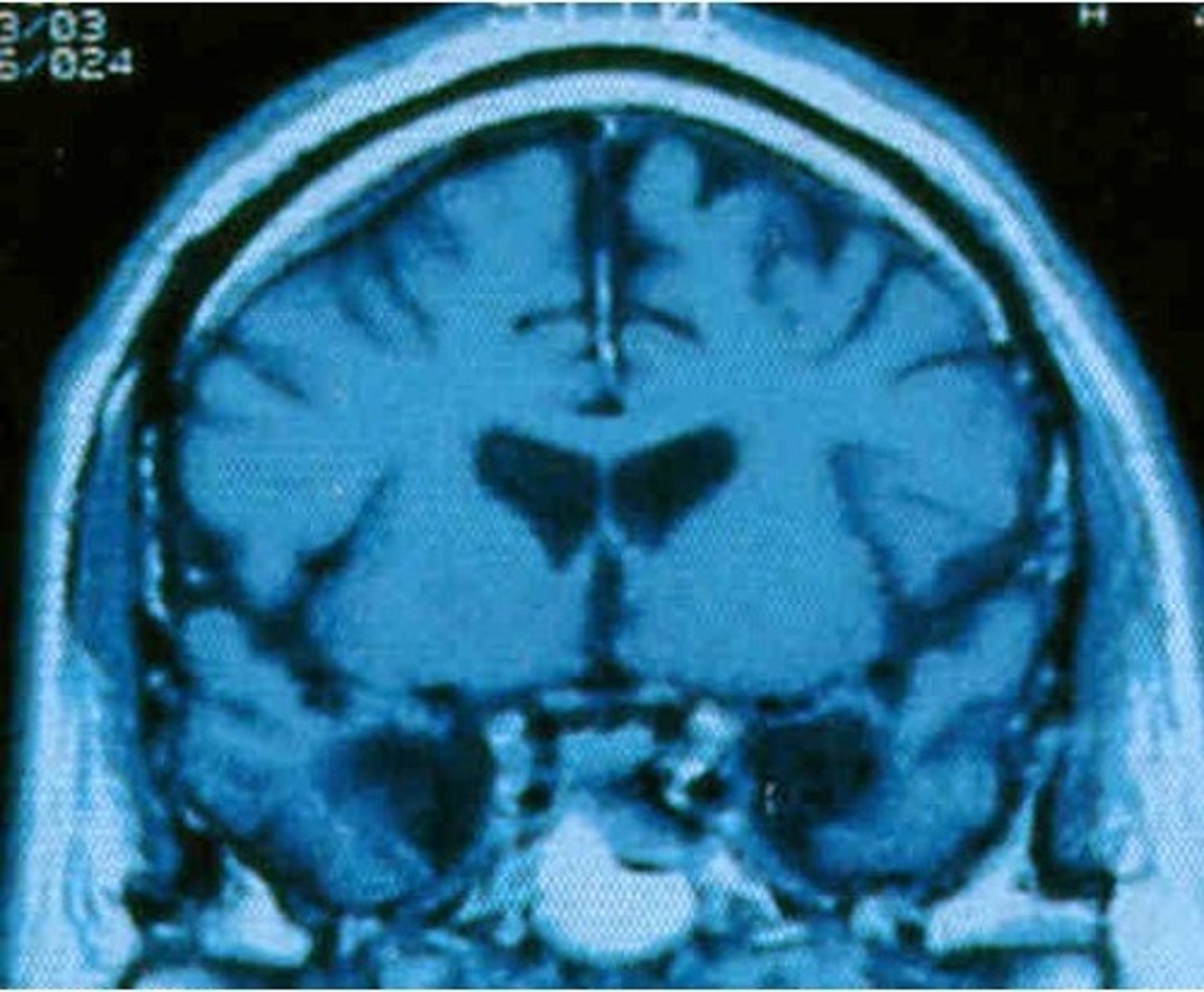
Had severe anterograde amnesia resulting from bilateral removal of hippocampal formation, amygdala and parts of multimodal association areas in temporal cortex.
His seizures went down but there was a profound failure in forming new memories since operation. Had better IQ
What is temporally graded retrograde amnesia?
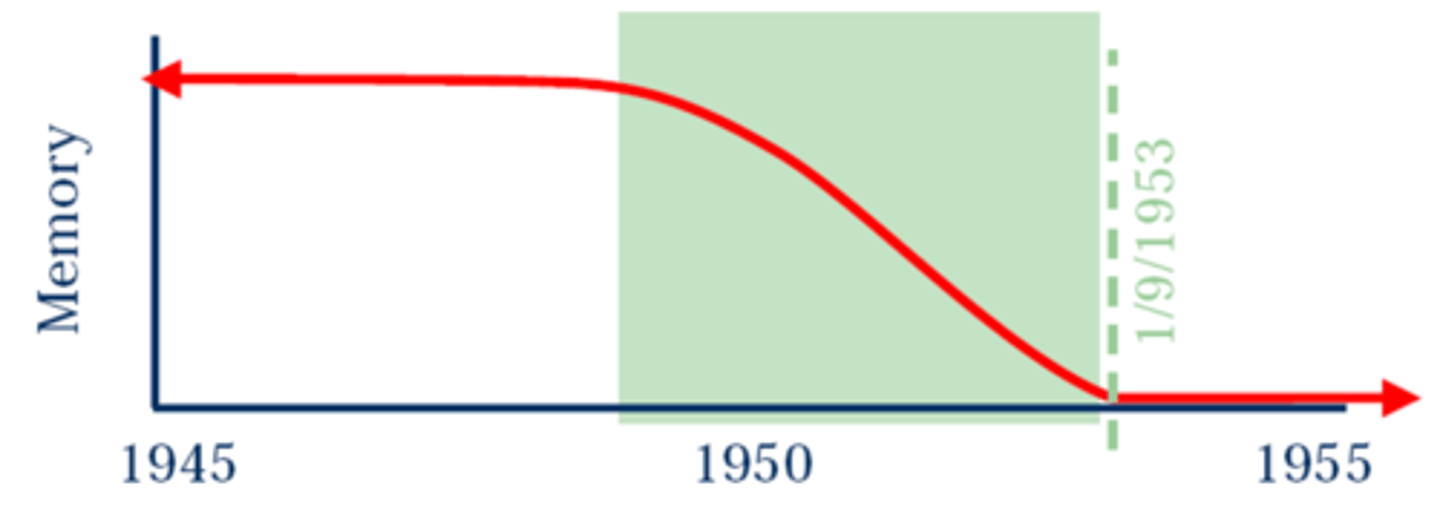
Seen in H.M.
Couldn't remember the facts/events a few years prior to the surgery. The info close to the time of surgery (immediately before) also didn't make it to long-term, suggesting consolidation takes time.
How was H.M's working memory affected? (2)
Intact -
1. Normal digit span
2. Rate of forgetting was in normal range unless interrupted (needs to be constantly rehearsing)
How was H.M's procedural memory affected? (2)
Intact -
1. Can learn new motor tasks or perform well eg. following moving object with stylus and drawing an image by tracing on a mirror i.e. good fine motor skills, hand-eye coordination.
2. Familiar with testing equipment
How was H.M's episodic and semantic memory affected? (3)
Suffered anterograde amnesia in these areas - autobiographical and factual memory:
1. Couldn't recognise people he had met since op
2. No spatial orientation, couldn't recall figures from visual memory
3. Language was frozen from the 50's.
Explain the case of Clive Wearing. (3)
Suffered from severe anterograde and retrograde amnesia due to:
1. Destroyed left hippocampus and parts of right
2. Damaged left temporal lobe
3. Damaged parts of inferior frontal lobe.
How was CW's working memory affected?
Compared to H.M. his short-term memory was impaired - could only process info for 7-30s in working memory on daily and neuropsychological tasks.
How was CW's episodic, semantic and procedural memory affected? (3)
1. Couldn't store new memories and only remember few facts from past (so both retro- and anterograde amnesia).
2. Deficit in episodic + semantic as he knew he was a musician but couldn't recall any concerts.
3. Intact new procedural memories.
Do procedural memories involve the hippocampus?
Don't seem to as both H.M. and C.W. had intact procedural memories; indicates the hippocampus has a role as a gateway to prepare contents for long-term storage in cortical areas.
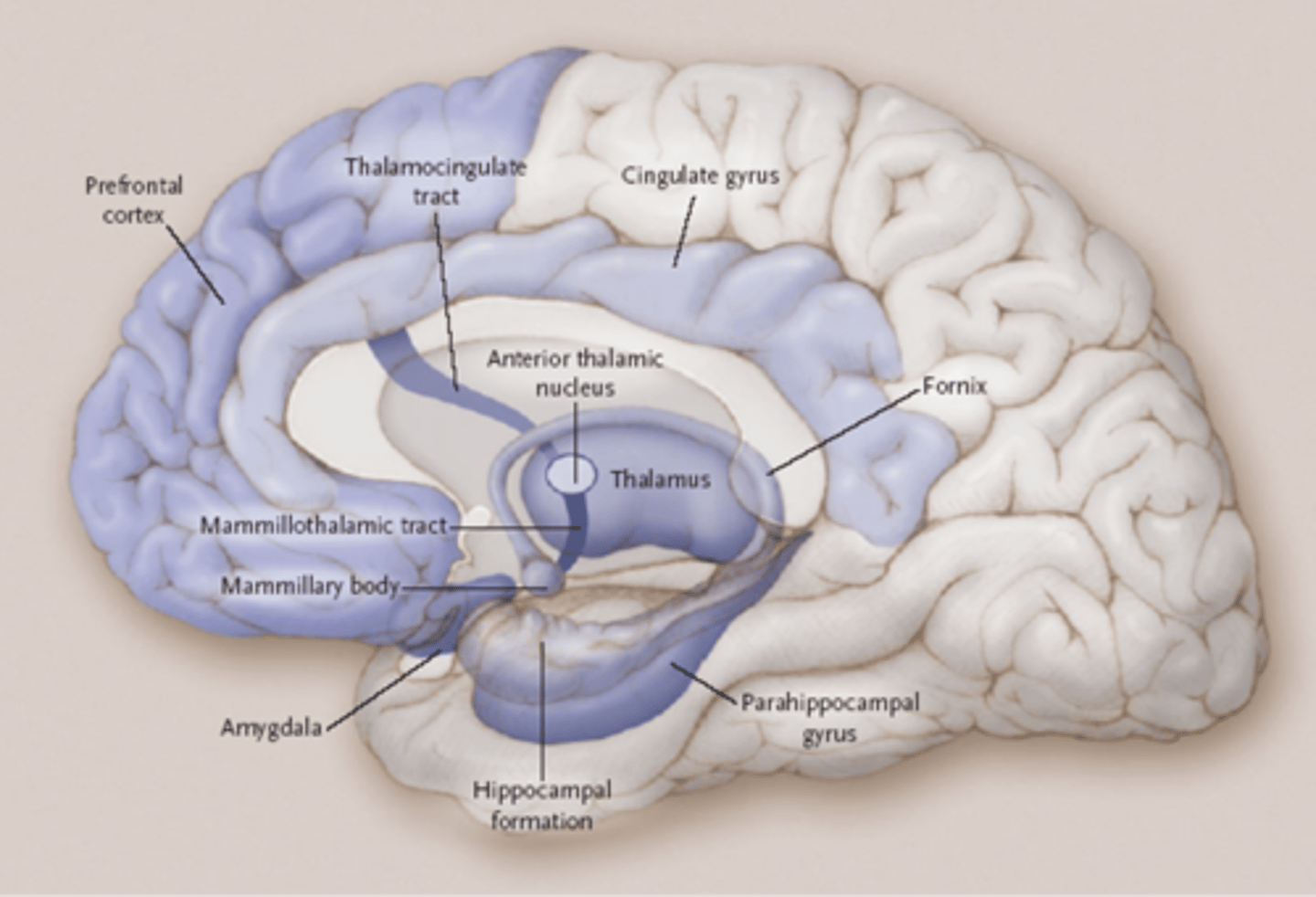
Show which parts of the brain control episodic memory.
Frontal lobe, temporal lobe, hippocampus and amygdala.
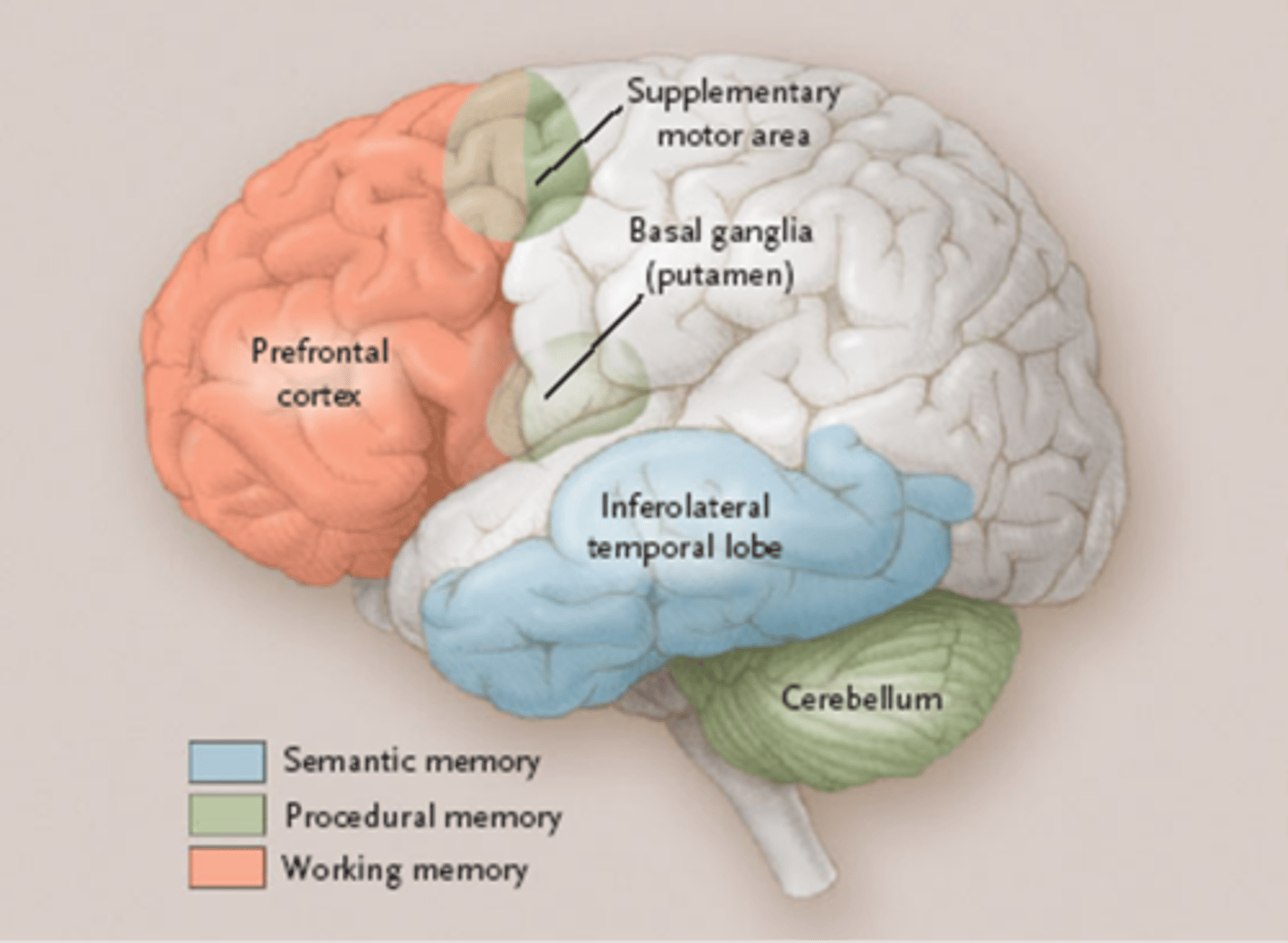
Show which parts of the brain control semantic, procedural and working memory.
Semantic: Inferolateral temporal lobe.
Procedural: Cerebellum, motor areas, basal ganglia.
Working memory: Prefrontal cortex.
How is memory affected in dementia eg. Alzheimer's? (2)
1. Short-term and working memory affected in early stages (recall failure, disorted recall) as disorder progresses.
2. Long-term is lost gradually through fading of episodic, semantic and procedural memories over time.
How is memory affected in depression and anxiety disorders? (2)
1. Short-term and working memory deficits eg. slow recall due to paying attention to -ve stimuli.
2. Long-term affected in severe/chronic states due to repressed traumatic memories and persistent low mood.
How is memory affected in psychotic disorders? (2)
1. Short-term and working memory deficits eg. low response accuracy, slow/distorted recall due to psychosis.
2. Long-term impairment - episodic and semantic.
 Note
Note  Flashcards (24)