risk of tectonic hazards 1
 Call Kai
 Learn
Learn Practice Test
 Spaced Repetition
 Match
Match Flashcards
 Knowt Play
1/21

There's no tags or description
Looks like no tags are added yet.
Name | Mastery | Learn | Test | Matching | Spaced | Call with Kai |
|---|
No analytics yet
Send a link to your students to track their progress
22 Terms
earthquake distribution
The majority of earthquakes (about 95%) occur close to or at a plate boundary
Many occur around the 'Ring of Fire' surrounding the Pacific Ocean
The most powerful earthquakes are usually associated with convergent or conservative plate boundaries
volcano distribution
at or near to plate boundaries
Many (about 75%) occur around the 'Ring of Fire' surrounding the Pacific Ocean
Volcanoes occur at convergent and divergent plate boundaries
They can also be found at hot spots in the middle of plates like Hawaii in the central Pacific
Tsunami distribution
Over 70% of tsunamis occur around the Pacific Ocean
15% Mediterranean Sea, 9% Caribbean Sea and Atlantic Ocean, and 6% Indian Ocean
They are caused by tectonic activity
Most occur due to activity at convergent boundaries
divergent plate boandary
Plates moving apart
The Mid-Atlantic Ridge is an example of a constructive plate boundary
Both volcanic eruptions and earthquakes can occur at this type of plate boundary
Convergent
Plates moving together
The denser, heavier oceanic plate subducts under the lighter, less dense continental plate
This forms deep ocean trenches in the subduction zone
the subduction is known as the benioff zone
Conservative plate boundary
plates moving past each other or in the same direction at different speeds
They become stuck and pressure builds, the plates eventually 'snap' past each other
The friction causes earthquakes but not volcanoes
Land is neither made or destroyed
intra plate earthquake
These can occur anywhere
The cause is not fully understood but is thought to be:
Tectonic stresses causing ancient fault lines to reactivate
The plates are moving over a spherical surface and this causes zones of weakness
The New Madrid earthquake in 1812 and the 2011 Virginia earthquake are examples of intra-plate earthquakes
Hotspot volcanoes
These occur over stationary magma plumes (columns of rising magma) in the asthenosphere
The tectonic plate moves over the plume leading to the formation of a chain of volcanic islands (Hawaii)
The oldest island is the one furthest away from the plume
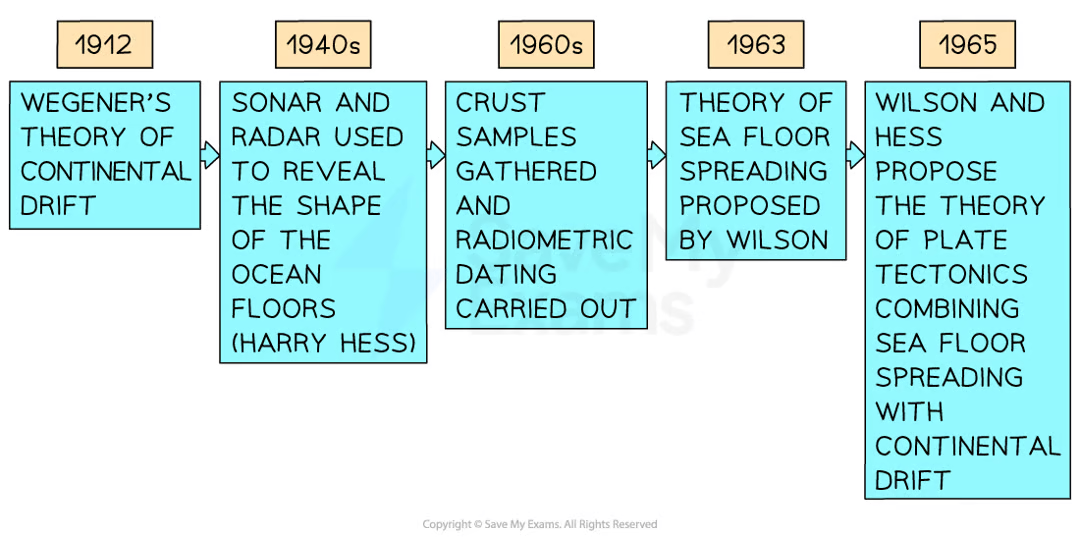
development of plate tectonic theory
The theory of convection currents
When magma is heated, it becomes less dense and rises, while cooler, denser fluid sinks, creating a cyclical flow known as a convection current.
The heat from radioactive decay in the core moves upwards into the mantle
It creates convection currents, which push up into the spreading mid-ocean ridges, forcing them further apart called the ridge push
paleomagneticism
A record of changes in the magnetic field of the earth, this is shown in the orientation of the magnetic field in the rocks
sea floor spreading
Palaeomagnetism provides evidence that the sea floor has gradually moved apart at a mid-ocean ridge
Lava cools and solidifies with the minerals lining up with the magnetic field
subduction
Convection currents in the mantle drag the overlying lithosphere towards each other
A subduction zone is formed when two plates meet
The heavier, denser plate subducts under the lighter, less dense plate
slab pull
As oceanic crust cools, it becomes denser and thicker, and gravity forces the lithosphere down into the subduction zone
As it sinks, it drags or pulls the plate with it
primary p waves
Body wave
Fastest
Reach the surface first
Travel through liquids and solids
Cause backwards and forwards shaking
Least damaging
secondary s waves
Body wave
Slower than P waves
Only travel through solids
Cause a sideways motion
More damaging
love l waves
Surface wave
Slowest
Cause a side to side motion
Larger and energy is focussed on the surface
Most damaging
primary hazards
A direct result of the earthquake
Ground shaking
Crustal fracturing (when the movement causes the Earth's crust to crack)
secondary hazards
A result of primary hazards
Landslides and avalanches - the movement of the Earth may trigger the collapse of material down steep slopes
Liquefaction - when the shaking causes particles in the ground to move further apart causing them to act like a liquid rather than a solid
Flooding - caused by tsunami
Primary hazards of volacanic hazards
Pyroclastic flow - a mix of dense, hot, rock, ash and gases
Lava flow - most move slowly enough that they are not a risk to human life but can reach over 1000oC
Ash falls - can travel many km, causing injuries, damage, deaths and disruption to transport
Gas eruptions - gases trapped in the magma are released during an eruption, they may form gas clouds which are hazardous to health
Secondary Hazards of volcanos
Lahars - a mixture of rocks, mud and water which flow down the volcano. They are fast-flowing and destroy everything in their path
Jökulhlaups - floods caused by a sudden release of water and rocks when glacial ice is melted by the eruption
causes of tsunamis
earthquake under the sea bed
Landslides which may be due to earthquakes and volcanic eruptions displacing the water
Underwater volcanic eruptions
Rarely they can be caused by a meteor strike

