GACE MATH
 Studied by 0 people
 Call Kai
 Learn
Learn Practice Test
 Spaced Repetition
 Match
Match Flashcards
 Knowt Play
1/107

There's no tags or description
Looks like no tags are added yet.
Name | Mastery | Learn | Test | Matching | Spaced | Call with Kai |
|---|
No analytics yet
Send a link to your students to track their progress
108 Terms
rational number
A number that can be written as a fraction
Rational numbers are
natural numbers , whole numbers and integers (-1,-2,1,3,0), mixed numbers
Natural Numbers
The set of numbers 1, 2, 3, 4, ... Also called counting numbers.
whole numbers
Natural numbers ( counting numbers) and zero; 0, 1, 2, 3...
Intergers
The set of whole numbers and their opposites
irrational numbers
Numbers that cannot be expressed as a ratio of two integers. Their decimal expansions are nonending and nonrepeating.
Irrational numbers are
Non-perfect squares, numbers with Pi, numbers that have a decimal going on forever and never repeating
magnitude
Greatness of size, strength, or importance
less than or equal to
comparison can be less than or equal to
greater than or equal to
a value that is "at least" as big as another value
has a closed circle
comparing negative numbers
left is less
right is greater
comparing decimals
Line up the numbers and fill in the missing zeros
Counting by ones
basic form of counting 1,2,3,4,5
skip counting
counting by twos, threes, counting only even or odd numbers, or counting by other multiples
counting on
Counting up from the lesser number to the greater number to find the difference of two numbers.
counting backwards
A math strategy that is a prerequisite to subtraction
counting collections
a collections of various objects that student can count to help develop numb sense and number relations
number line
A diagram that represents numbers as points on a line.
absolute value
The distance a number is from zero on a number line. ALWAYS POSITIVE
Cardinality
the number of elements in a set
Multiplicative Identity
When any number is multiplied by 1, the product is the number
Associative Property
The way in which numbers are grouped does not change their sum or product (a x b) x c = a x (b xc)
Communicative Property
Numbers can be added or multiplied in any order. That is: Commutative Property of Addition and multiplication it states that changing the order of addends does not change the sum or product.
Distrubutive Property
a(b+c)= ab+ac, where a,b, and c are real numbers
divdend
the number being divided (a)
divisor
the number that divides the dividend (b)
quotient
the answer to a division problem (c)
prime number
A whole number that has exactly two factors, 1 and itself. 3,5,7,11,13,17,&19
even number
An even number can be shown as 2 equal parts.
An even number has 0, 2, 4, 6, or 8 in the ones place.
odd number
A whole number that is not a multiple of 2
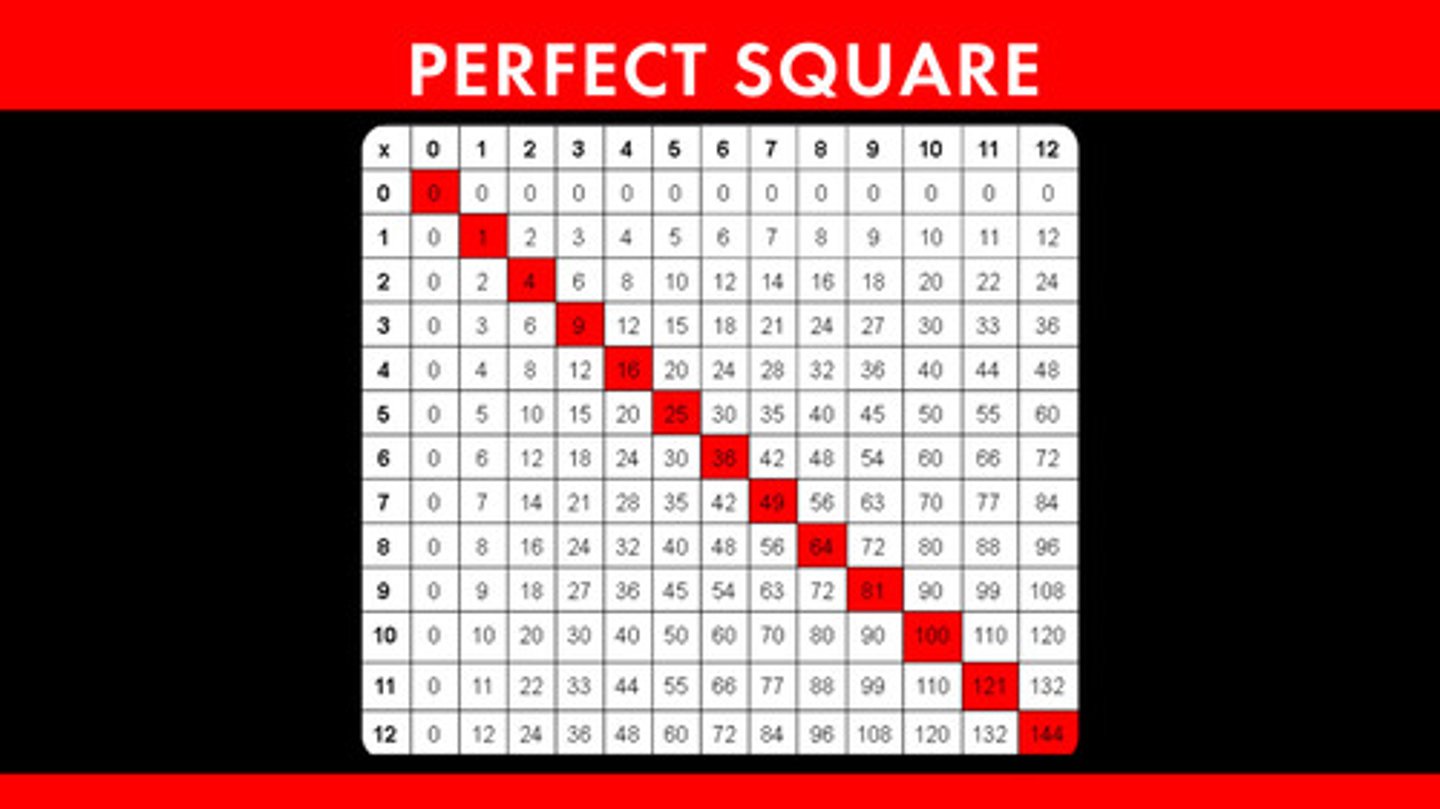
perfect square
A rational number whose square root is a whole number
multiplication key words
times, double, triple, product, of, multiplied by, twice, multiple
Division Key Words
Distribute, share, average, per, out of, percent, and quotient
Subtraction Key Words
How much more, less than, fewer than, exceeds, difference, and decreased
PEMDAS
Parentheses, Exponents, Multiplication, Division, Addition, Subtraction
factor
a number divided into another number without leaving a remainder
composite number
A number with at least three factors
place value
The value of a digit based on its position within a number
Base 10 Number System
a number system in which all numbers are expressed using the digits 0-9
what are base ten blocks use for ?
help understand place value and and assist with counting large numbers
standard form
actual number
expanded form
A way to write numbers that shows the place value of each digit.
decimal
A number with one or more digits to the right of the decimal point
common factor
A number that is a factor of two or more numbers
rectangle, square
all squares are rectangles but not all rectangles are squares
Natural Numbers
The set of numbers 1, 2, 3, 4, ... Also called counting numbers.
ordinal numbers
numbers that describe position or order (first, second . . .)
compass
tool to draw a circle
rounding numbers
means changing them to the nearest ten, hundred, thousand, and so on
Counting up method of subtraction
An alternative subtraction process that can be used to subtract or to check your work after having subtracted through standard processes. For each place value of the second number, count up to the next 10, 100, 1000. Once reaching the last place value of the higher number, add any remainder (ex. 327 - the remainder would be 27). Add all values together for the answer.
Volume
The amount of space an object takes up
Volume of a rectangle
L x W x H
symmerty
balanced proportions
line of symmetry
a line that divides a figure into two halves that are mirror images of each other
vertices
The point of intersection of two sides of a polygon. The point of intersection of three edges of a space figure.
corners of shapes
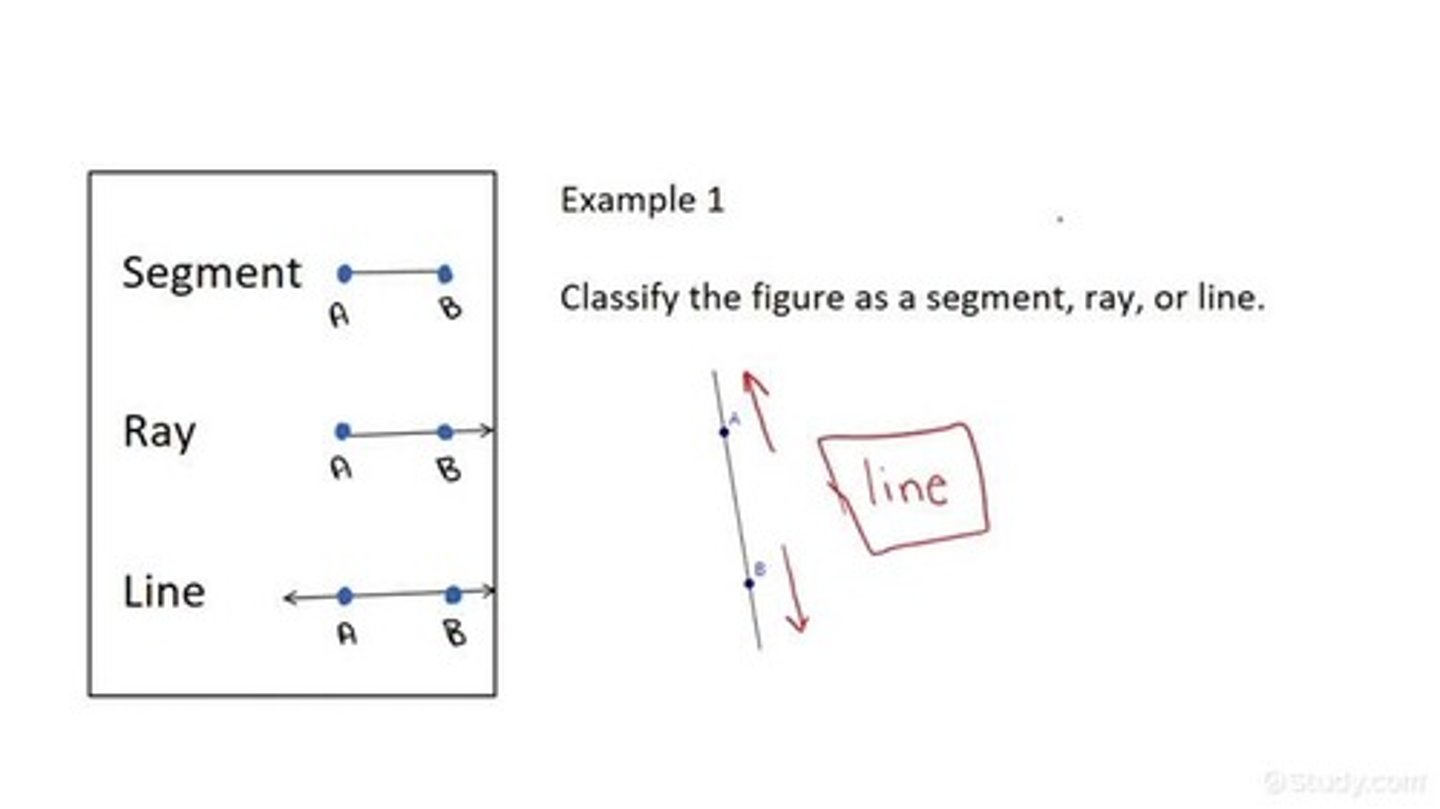
line
connects two points has no thickness and extends indefinitely in both directions beyond points
line segment
part of a line with two endpoints
ray
A part of a line, with one endpoint, that continues without end in one direction
whole numbers
Natural numbers ( counting numbers) and zero; 0, 1, 2, 3...
How to multiply decimals
1. Multiply as usual.
2. Count the number of digits above the line and to the right of all decimal points.
3. Place the decimal point in your answer.
Addition Property
If a=b, then a+c=b+c
proper fraction
a fraction with a numerator smaller than the denominator
improper fraction
a fraction whose numerator is larger than the denominator
numerator
the top number in a fraction
denominator
The bottom number in a fraction
long division
Divide, Multiply, Subtract, Check, Bring Down (Repeat)
DOES McDONALDS SELL CHEESE BURGERS?
area model
A model of multiplication that shows each place value product.
one-to-one correspondence
is the concept use when children relate a numeral to one item they can see and touch
quadrilateral
a four-sided polygon
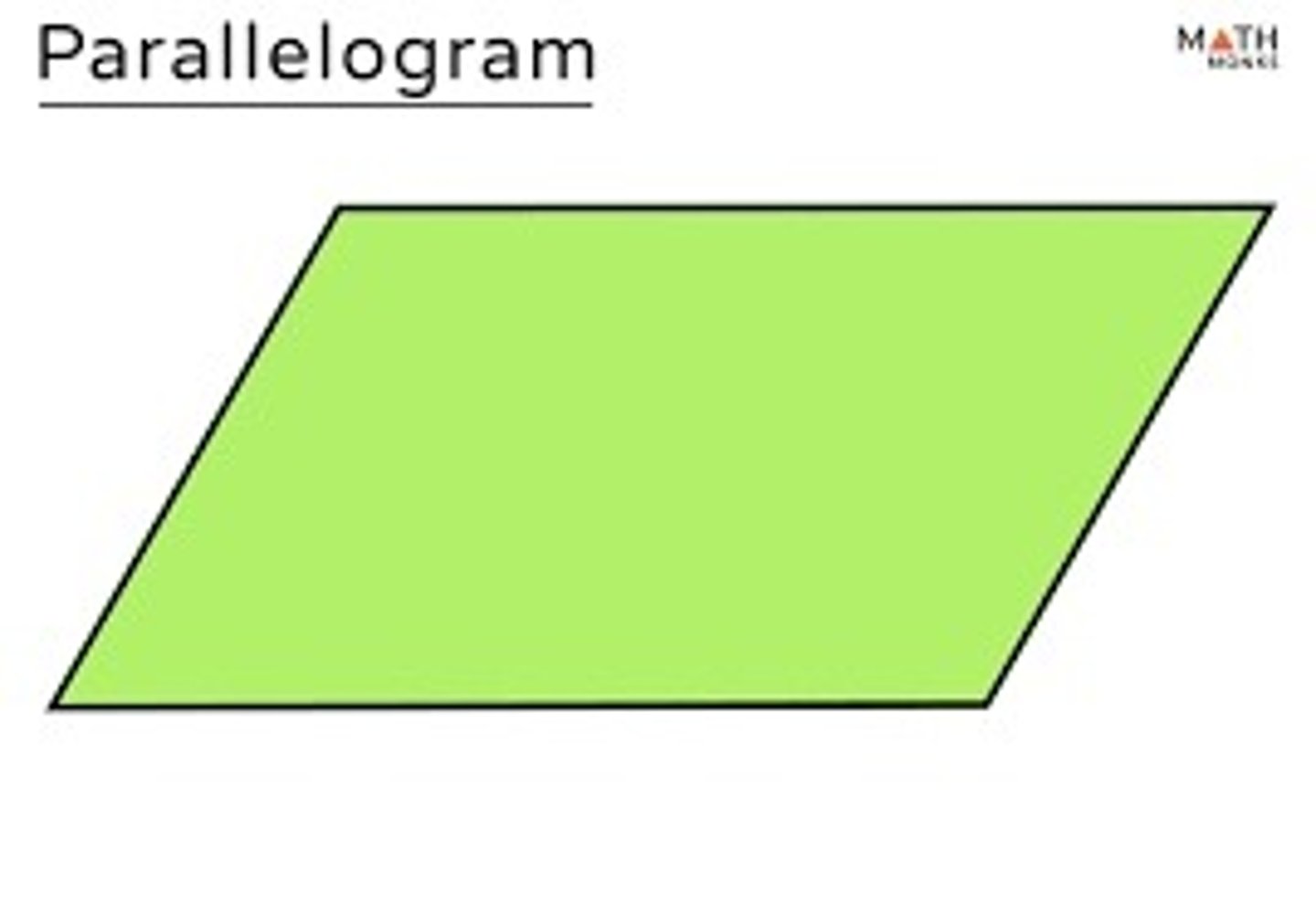
Parallelogram
A quadrilateral with two pairs of parallel sides
Trapezoid
A quadrilateral with exactly one pair of parallel sides
addends
numbers that are added together
adjacent angles
Two angles that share a common side and have the same vertex
complementary angles
Two angles whose sum is 90 degrees
perpendicular lines
Lines that intersect to form right angles
Coplanar
points that lie on the same plane
coordinate plane
A plane that is divided into four regions by a horizontal line called the x-axis and a vertical line called the y-axis.
Radius
A straight line from the center to the circumference of a circle or sphere.
diameter
A straight line passing from side to side through the center of a circle or sphere.
The bar in a fraction represents:
division
equivalent fractions
Fractions that have the same value
unit fraction
a fraction with a numerator of one, it names one of the equal parts of a whole
How to multiply fractions
1. Multiply the numerator.
2. Multiply the denominator.
3. Reduce to lowest term if necessary.
How to divide fractions
keep change flip 22/5 / 1/2 = 22/5 x 2/1 = 44/5
perimeter
the sum of the lengths of the sides of a polygon
How angles are measured
In degrees.
360 degrees
full circle
180 degrees
half of a circle
90 degrees
quarter circle
acute angle
an angle that measures less than 90 degrees
right angle
an angle that measures 90 degrees
obtuse angle
An angle that measures more than 90 degrees but less than 180 degrees
mixed number
a number made up of a whole number and a fraction
number line
A diagram that represents numbers as points on a line.
additive and subtractive identity
zero
equivalent fractions
Fractions that have the same value
metric system
The decimal measuring system based on the meter, liter, and gram as units of length, capacity, and weight or mass.
1 foot = ____ inches
12 inches
1 yard = ____ feet
3 feet
1 mile = ____ feet
5,280 feet
 Note
Note  Flashcards (20)