DNA transposition (ex 3 lec 5)
 Studied by 0 people
 Call Kai
 Learn
Learn Practice Test
 Spaced Repetition
 Match
Match Flashcards
 Knowt Play
1/25

There's no tags or description
Looks like no tags are added yet.
Name | Mastery | Learn | Test | Matching | Spaced | Call with Kai |
|---|
No analytics yet
Send a link to your students to track their progress
26 Terms
what are transposable elements
they move from one DNA molecule to another
exist in all life forms
can move within/between chromosomes
cant exist outside of larger DNA molecule
what is insertion sequence (IS)
simple jumping genes that can move to new locations within a genome (using transposition)
containing a transposase gene flanked by a short inverted repeat sequences
what is another way you can think of a transposable element
a piece of DNA that has become able to transfer itself from one location to another
heart of transposable element
it has a gene encoding a transposase
DNA sequences on either side of the element that can be recognized/acted on
what are the sequences in the heart of the transposable elements called
inverted repeats
they are identical to each other on opposite strands
how is inverted repeat layed on
inverted repeat-transposase gene-inverted repeat
5’-3’
3’-5’
what happens after a trnasposase has been translated from a gene within the IS
it then binds to the inverted repeat sequences
at the same time it interacts with another piece of DNA
what does the transposase make after interacting with another DNA and binding to transposons
it makes a pair of staggered cuts in the target DNA
cuts in different but nearby places on the two strands
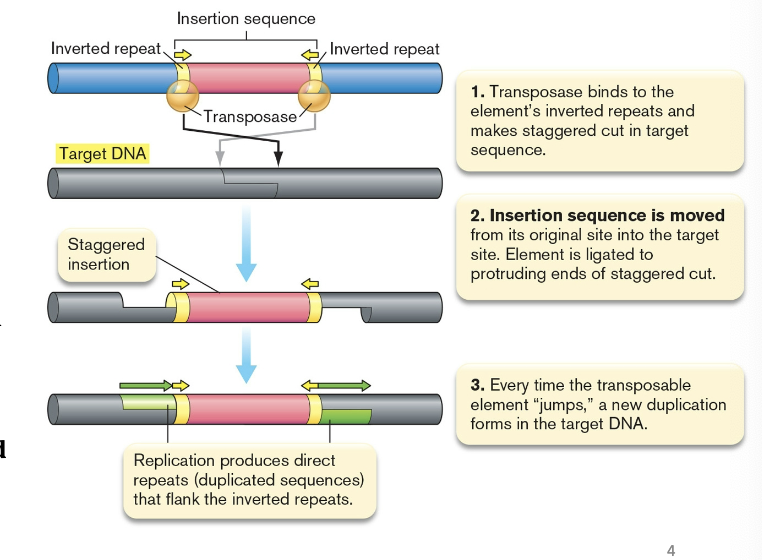
what happens to the IS (insertion sequence) after staggered cuts are made
it is either moved or copied into spaces between the two pieces of target DNA
the short single stranded regions are filled in
what are the two mechanisms transposable elements do
replicative transposition and non replicative transposition
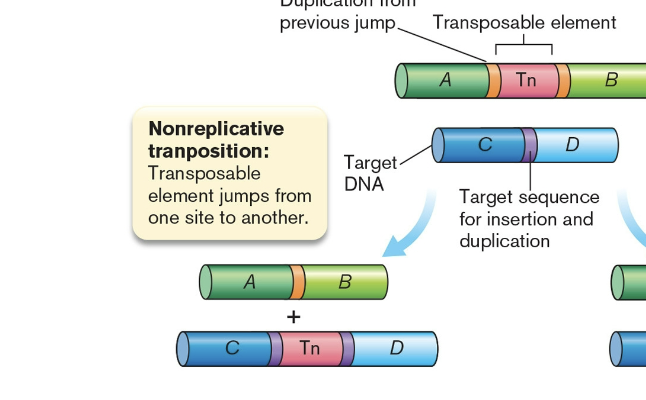
nonreplicative transposition
the elements jump from one site to another
a cut and a paste T.S is completely from OG spot and inserted into a new one leaving no copy behind
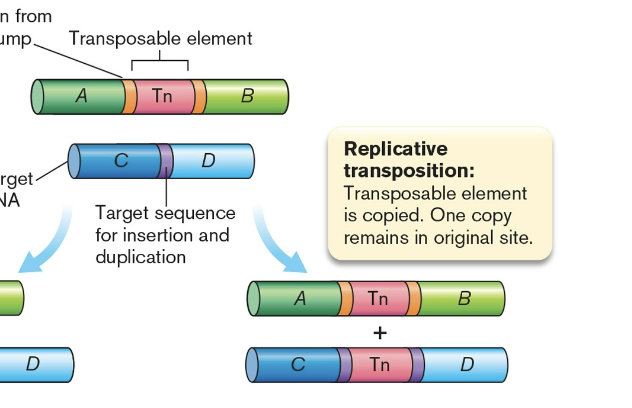
replicative transposition
the element is copied and one copy remains in the original site
what are transposon
they are transposable elements (jumping genes) that can jump from one location to another within a genome
same kind of genes that are in plasmids, including genes for transfer
what are conjugative transposons (also called integrative and conjugative elements or ICE)
they transfer from one cell to another via conjugation
same we saw for conjugative plasmids
they contribute to the spread of antibiotic resistance genes
what is SXT
a conjugative transposon carried by Vibrio cholerae
spreading of these genes from one member of the species to another can therefore have medical consequences
what happens in a cell with a copy of the SXT transposon
the transposon is integrated into a specific site in the chromosome (between a pair of direct repeats called att sites) under normal conditions the transposon will be along for the ride
the encoding gene (integrase) is not expressed when SXT is integrated
what will happen if the cell that SXT is in it healthy
SXT will be replicated every time the chromosome is replicated and the cell divides
what happens to the SXT transposon under stressful conditions
the SXT has ability to transfer to a new cell by conjugation
gene duplication
is the most important mechanism for generating new genes and biochemical processes
it frees a gene from its previous functional constraints and allows evolution through mutation
paralogous genes (paralogs)
genes that are related to eachother because they arose from duplication
orthologous genes (orthologs)
genes that are related to each other because they arose from speciation
what is genome reduction
a large scale loss of genes through evolution
nonfunctional pseudogenes
appear to encode an enzyme but are nonfunctional because a portion is missing as a result of mutation
what are pseudogenes formed from
genes that it no longer needs after becoming an obligate intracellular pathogen
genomic islands
they provide evidence for horizontal gene transfer
pathogenicity islands, symbiosis islands and fitness islands
characteristics that reveal identity of genomic islands
direct repeats or insertions of elements on either sides
remnant of transposition event
 Note
Note  Flashcards (77)