Physics - Radioactivity
 Call Kai
 Learn
Learn Practice Test
 Spaced Repetition
 Match
Match Flashcards
 Knowt Play
1/38

There's no tags or description
Looks like no tags are added yet.
Name | Mastery | Learn | Test | Matching | Spaced | Call with Kai |
|---|
No analytics yet
Send a link to your students to track their progress
39 Terms
What did the alpha scattering experiment show?
Most alpha particles passed straight through the foil, suggesting the atom was mostly empty space. Small amount of particles were deflected by a large amount, suggesting the centre of the atom is positively charged. Very few particles were deflected straight back at 90 degrees, suggesting that the centre of the atom was very dense.
Properties of alpha radiation
Few cm range in air, highly ionising, deflected by electric and magnetic fields, absorbed by paper
Properties of beta radiation
1m range in air, moderately ionising, deflected by electric and magnetic fields, absorbed by 3mm or aluminium foil.
Properties of gamma radiation
Infinite range, very weakly ionising, not deflected by electric or magentic fields, absorbed by several metres of concrete.
What is the inverse square law of gamma radiation?
I = k/x²
What is the equation for correct count of a radioactive sample?
Total count rate - background count
What is the decay constant?
The probability of a nucleus decaying per unit time.
What is the half-life of a sample?
The time taken for the number of unstable nuclei to half or for the activity of the sample to half.
What is the activity of a radioactive sample?
The number of nuclei that decay per second.
What is the mass defect?
The difference in mass of a nucleus and the sum of the individual masses of its protons and neutrons
What is the binding energy of a nucleus?
The energy released when a nucleus is formed from its constituents.
What is nuclear fission?
When a large nucleus is split into 2 smaller daughter nuclei
What is nuclear fusion?
The 2 smaller nuclei join together to form a larger nucleus.
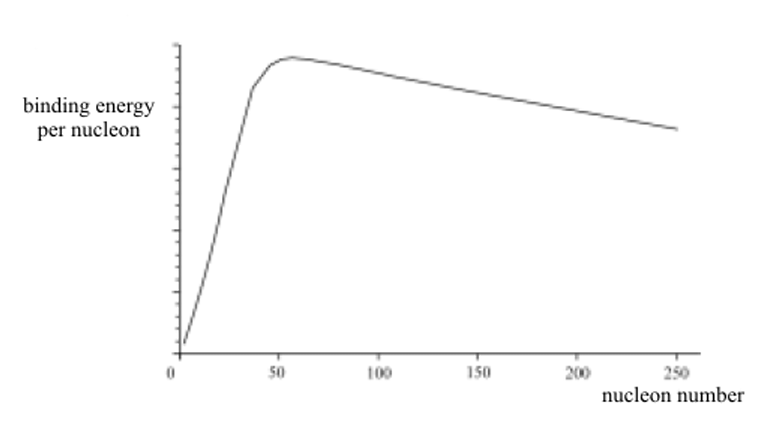
Which element has the highest binding energy per nucleon
Iron
Draw a graph of binding energy per nucleon against nucleon number.
What is the critical mass in a nuclear reactor?
The minimum mass of fuel needed to maintain a steady chain reaction. Too little and the reaction would eventually stop, too much and the reactor becomes unstable and explodes.
What is the main source of the highly radioactive waste from a nuclear reactor?
spent nuclear fuel
What is the purpose of a moderator?
Slows down the neutrons from fission reactions to thermal speeds.
How does the moderator slow down these neutrons?
Through elastic collisions with moderator nuclei where a large proportion of momentum is transferred.
What are the best moderators to use?
Water and graphite or any material whose atoms are approximately the same mass as the neutrons being slowed down.
What are the purpose of control rods?
Absorb excess neutrons in the reactor to control the chain reactions.
What are the control rods made of? Why are they chosen?
Boron and cadmium as they can absorb neutrons without undergoing fisson themselves
What is the purpose of a coolant in a nuclear reactor?
Absorb heat released during fission reactions in the core in order to make steam which powers turbines
What is often used as the coolant? and why?
Water as it has a high specific heat capacity so it can transfer large amounts of thermal energy.
What are some sources of background radiation?
Nuclear weapons testing, cosmic rays, rocks with naturally occuring radioactive isotopes
What is the decay constant?
The probability of a nucleus decaying per unit time
Draw a graph of N against Z for stable nuclei, include the N=Z line.
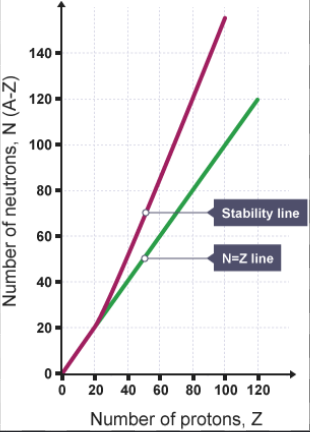
Why does the N/Z graph follow this curved shape instead of a straight line through the origin?
For lower atomic mass nuclei, the proton number is approximately equal to the neutron number so the strong force can hold the nucleus together easily. As the atomic mass increases, the number of protons also increases so the strength of the electrostatic force of repulsion increases exponentially. Therefore, many more neutrons are needed to increase the magnitude of the strong force so that it can overcome the repulsive forces.
Why is the distance of closest approach always an overestimate?
It does not consider the recoil of the nucleus being fired at
Describe a more accurate method to measure distance of closest approach?
Electron diffraction where firing electrons at a thin film of material causing them to diffract and form an interference pattern of concentric circles.
Why is electron diffraction more accurate than using the calculation for distance of closest approach?
Electrons are leptons so unlike the alpha particle, it will not interact with the nucleons in the nucleus through the strong force.
Draw the graph of intensity against angle of diffraction for the electron diffraction experiment.
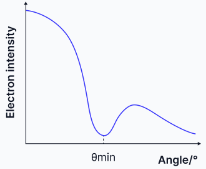
How is nuclear radius determined from the electron diffraction graph?
Use the angle of the first minimum in sin(theta)=0.61wavelength/radius
What is an estimate for the value of the radius of a nucleus?
1 × 10 ^-15 m
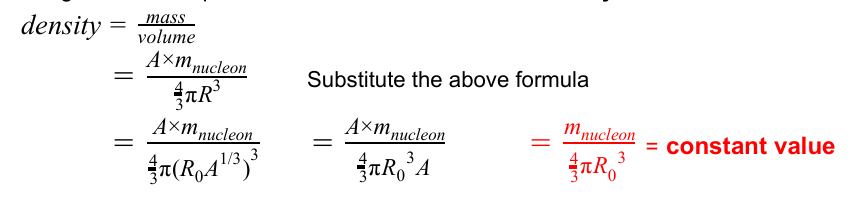
How can you use the nuclear radius equation to prove that nuclear density is a constant for all nuclei?
What is a thermal neutron?
A slow moving neutron that is in thermodynamic equilibrium with its surroundings
What are some sources of error in the inverse square law for gamma radiation experiment?
The geiger counter may suffer from an issure called dead time, this is where multiple counts happen simultaneously but the counter only registers one. The source may not be a pure gamma emitter so count rate may be higher than expected. The inverse square law assumes a point source which a normal source used in experiments is not.
What are some benefits of nuclear power?
Little greenhouse emissions, small amounts of fuel are needed to achieve the same amount of power, the power can be produced continuously
Describe simply how radioactive waste is treated?
Waste is placed in a cooling pond