Science
 Call Kai
 Learn
Learn Practice Test
 Spaced Repetition
 Match
Match Flashcards
 Knowt Play
1/95

Earn XP
Description and Tags
Name | Mastery | Learn | Test | Matching | Spaced | Call with Kai |
|---|
No analytics yet
Send a link to your students to track their progress
96 Terms
meaning of elektron in Greek
amber
“electrical fire” definition
electrically charged particles moving between atoms
nucleus definition
center of every atom
proton, electron, neutron definitions
positively particles, non-charged particles, negatively charged particles (respectively)
Newton’s 3 Laws of Motion
An object at rest remains at rest, an object in motion remains in motion (unless there is an unbalanced force).
An object’s acceleration is directly proportional to the force applied on it (F=ma).
Every action (force) has an equal and opposite reaction (force).
mass of proton
1.7\times10^{-27} \text{ kg}
mass of electron
9.1\times10^{-31} \text{ kg}
What are the four fundamental forces?
electromagnetic force
strong nuclear force
weak nuclear force
gravitational force
strong nuclear force definition (as per Curriculum)
keeps protons within nucleus (strongest force, acts over short distances)
weak nuclear force definition (as per Curriculum)
transforms particles into other particles, i.e. radioactive decay
equation for gravitational force ANYWHERE
F_G=
F_G=G\frac{m_1m_2}{r^2}
Coulomb's Law
F_E=\frac{kq_1q_2}{r²}
charge of proton/electron
\pm1.7\times10^{-19} \text{ coulombs}
k (Coulomb's constant)
8.99\times10^9 \frac{Nm²}{C²}
scalar fields vs. vector fields + examples from Curriculum
scalar fields: no direction, just magnitude (ex. temperature in room)
vector fields: direction and magnitude (ex. wind over Earth’s surface)
equation for gravitational force close to Earth
F_G=
F_G=mg
m is mass of object experiencing F_G, g is gravitational field created by Earth
strength of Earth’s gravitational force near surface
g
g=9.8 \text{ N/kg}
equation for vector field of electric force
F_E
F_{E}=qE , E is electric field in Newtons/Coulombs
equation for electric field
E
E = \frac{kq}{r²}
Gauss' law
\Phi_E=\frac{q}{\epsilon_0}
symbol for permittivity of free space
\epsilon_0
equation for permittivity of free space
\epsilon _ 0
\epsilon_0=\frac{1}{4\pi k}
symbol for electric field flux
\phi_{E}
equation for electric field flux
\Phi_{E}=
\Phi _E = EA
E is the strength of the constant electric field, A is the area of the Gaussian surface
symbol for charge density
\sigma
insulators vs. conductors
insulators: materials that don’t allow electrons to move freely
conductors: outer electrons are loosely bonded to nucleus, can easily move between atoms
What is the electric field inside a charged conductor?
0 (imagine room w/ people wanting to be as far away from each other as possible, w/ one person in the center)
3 Laws of Thermodynamics
Conservation of energy: energy cannot be created or destroyed, only transferred.
Heat flows from high temperature objects to low temperature objects.
No substance can ever reach a temperature of absolute zero.
“phlogiston” definition
it was originally thought that heat was its own substance called phlogiston
heat definition (as per Curriculum)
energy moving between objects at different temperatures
kinetic energy definition
the type of energy an object has due to its motion
temperature definition
average kinetic energy of atoms of a substance
gravitational potential energy definition
the type of energy an object has due to its position in a gravitational field
electric potential energy definition
the type of energy an object has due to its position in a electric field
voltage definition
differences in electric potential
electric potential definition
electric potential energy divided by charge
change in electric potential energy equation
\Delta E =
\Delta E = qV
What analogy is used in the Curriculum to explain how a proton moves from a positively charged metal plate towards a negatively charged metal plate?
a ball rolling downhill from high potential to low potential
battery definition
device that maintains constant voltage by keeping 2 collections of positive & negative charge separate from each other
electric current definition
amount of charge that flows past a point per second
Ohm's law
I=\frac{V}{R}
I is current, V is voltage of battery, R is resistance
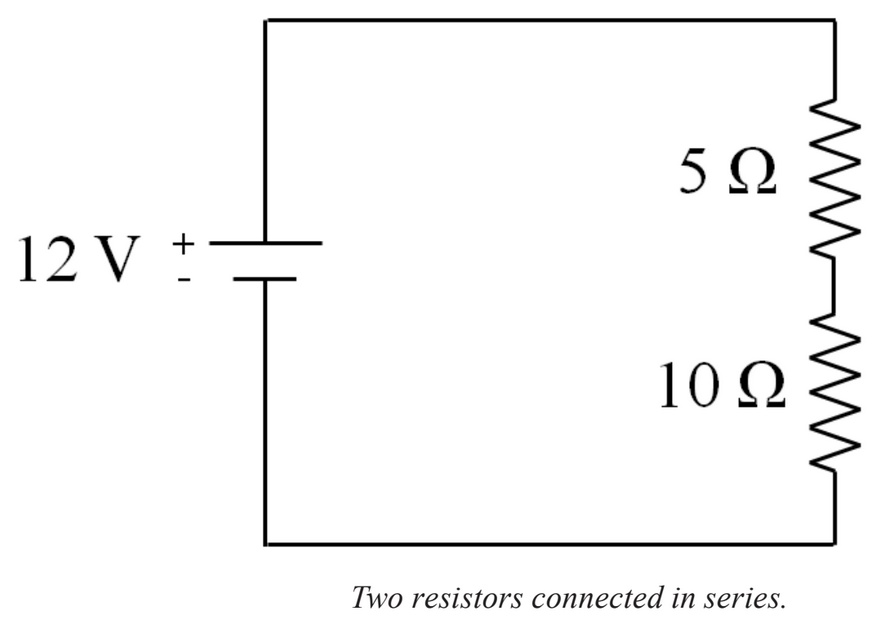
resistance of series circuit:
R_{series}=
add together resistances of each resistor:
R_{series} = R_1 + R_2 + … + R_n
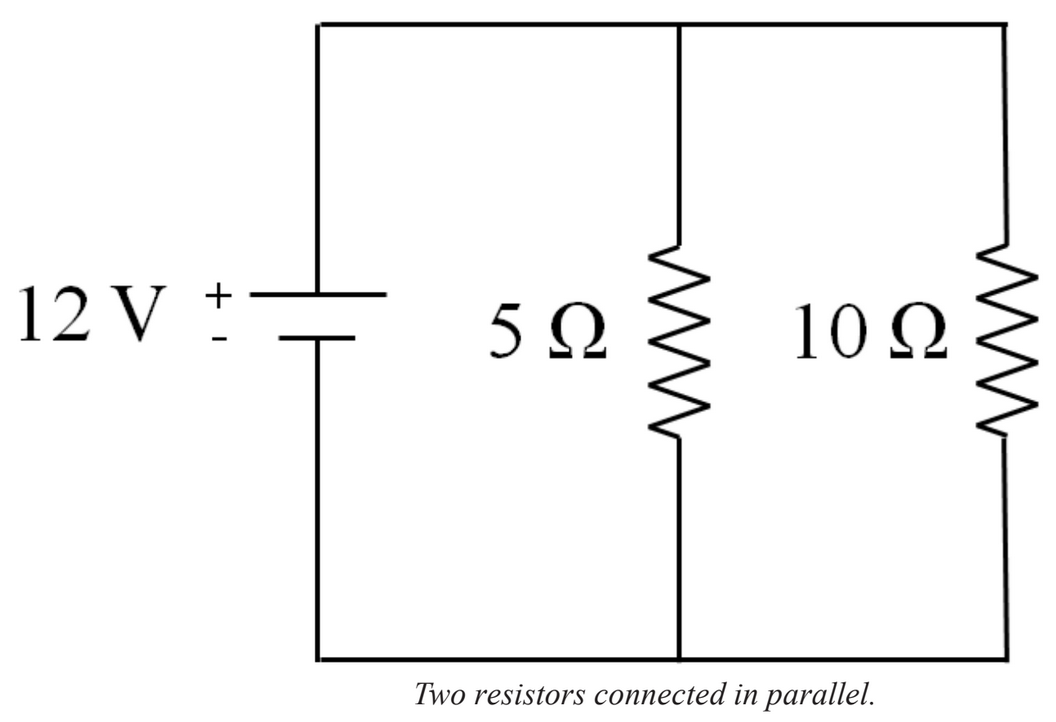
resistance of parallel circuit:
R_{parallel}
reciprocal of total resistance is sum of reciprocal of each resistor:\frac{1}{R_{parallel}} = \frac{1}{R_1} + \frac{1}{R_2} + … + \frac{1}{R_n}
power in terms of current and voltage
P = IV
capacitor definition
two conductors separated by small distance
capacitor example from Curriculum
Leyden jar
capacitance definition
how much charge a capacitor can store
dielectric definition
material placed between two conductors in capacitor
purpose of dielectrics
to prevent dielectric breakdown and toallow capacitors to hold more charge at lower voltages
ferromagnetic definition
permanent magnet
paramagnetic definition
impermanent magnet; only magnetized when exposed to external magnetic field
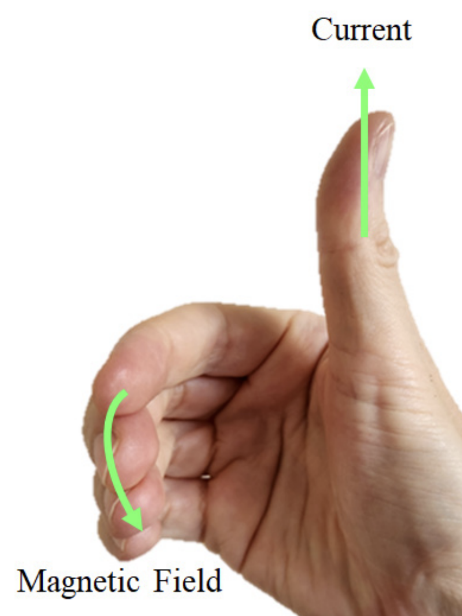
right-hand rule for magnetic field
right-hand rule for magnetic force
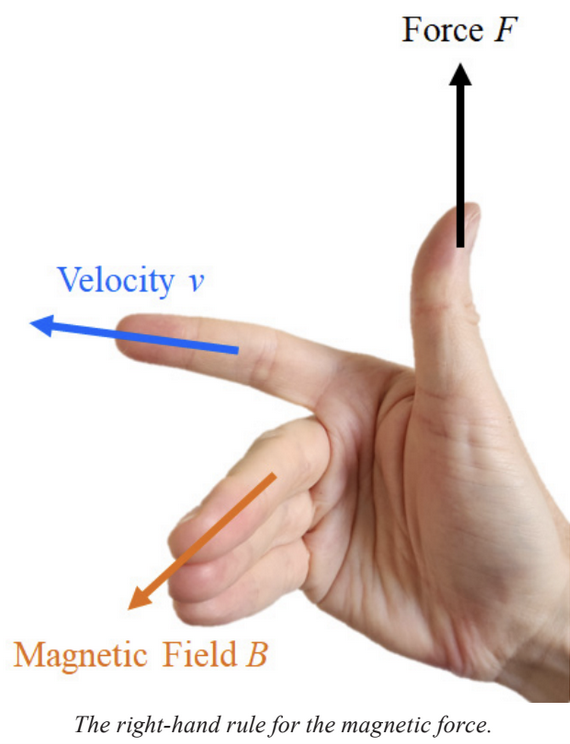
magnetic force equation
\vec{F}=q\vec{v}\vec{B}
where \vec{B} is magnetic field and \vec{v} is velocity of particle
strength of Earth's magnetic field
25\text{-}65 \text{ microTeslas}
use of mass spectrometer
determine atomic composition of unknown sample
Who discovered the electron and when?
J.J. Thomson in 1897
purpose of Ampere's law (as stated by Curriculum)
determine what magnetic field around objects looks like
equation of magnetic field of Amperian loop
B=
B=\frac{\mu_0I}{2\pi r} or B(2\pi r)=\mu_0I
B is magnetic field, I is current passing through Amperian loop, 2\pi r is the length around Amperian loop
symbol for permeability of free space
\mu_0
solenoid definition
multiple circular loops of wires
equation for magnetic field of solenoid
B=\mu_0I(\frac{N}{L})
Faraday's law
V=-N\frac{\Delta\Phi_{B}}{\Delta t}
alternating current (AC) definition
current (and magnetic field) is constantly switching directions
diode definition
device that allows current to flow through it in only one direction
inductor definition
solenoid attached to circuit at either end
purpose of inductor
to resist changes in current in electric circuit
What happens when you have both a capacitor and an inductor?
capacitor discharges, inductor opposes decrease in current using a countercurrent, capacitor recharges, and so on (think a swinging pendulum)
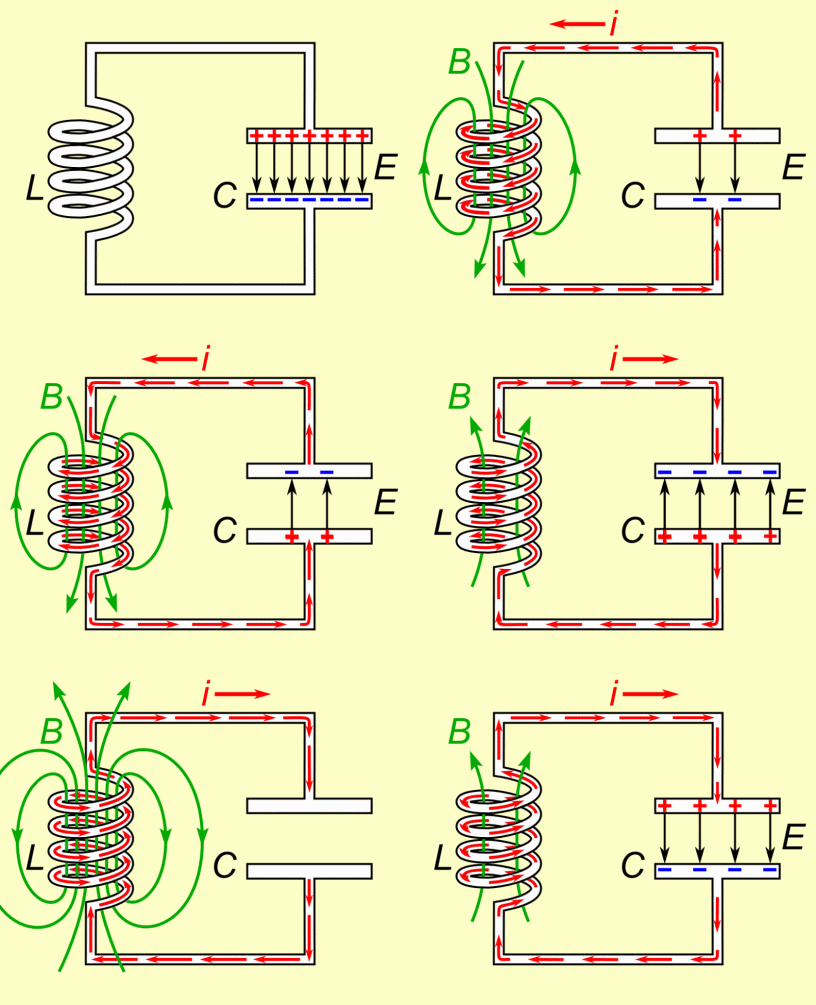
frequency of capacitor + inductor system
f=\frac{1}{2\pi\sqrt{LC}}
L is inductance of inductor, C is capacitance of capacitor
Who created the first electric light and when?
Frank Hauksbee in 1705 ("barometric light")
How did Humphrey Davy's arc lamp work?
dielectric breakdown between two pieces of metal created a miniature lightning bolt
velocity of electromagnetic wave using permittivity & permeability of free space
v=\frac{1}{\sqrt{\epsilon_0\mu_0}}
Who invented the three-phase generator?
Mikhail Dolivo-Dobrovolsky
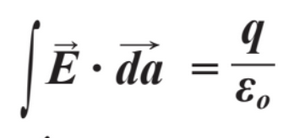
meaning of first of Maxwell’s equations
Gauss’ law: electric field created around charge
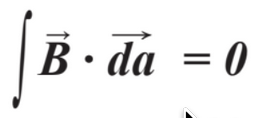
meaning of second of Maxwell’s equations
it is impossible to draw a closed surface thru which there is a non-zero magnetic flux: no individual magnetic charges, only dipoles
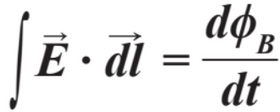
meaning of third of Maxwell’s equations
Faraday’s law: changing magnetic field causes electric field
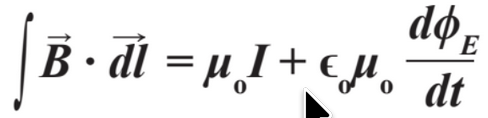
meaning of fourth of Maxwell’s equations
Ampere’s law: changing electric field gives rise to magnetic field
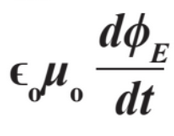
last term of fourth of Maxwell’s equations
Maxwell’s displacement current: changing electric field between plates of discharging capacitor
speed of light in terms of permittivity and permeability of free space
v=\frac{1}{\sqrt{\epsilon_0 \mu_0}}
longitudinal wave definition
direction of vibration parallel to direction of wave
transverse wave definition
direction of vibration perpendicular to direction of wave
wave frequency
how many full wavelengths pass through given point per second
hertz (Hz) definition
1 Hz = 1 wavelength per second
velocity of electromagnetic wave in terms of wavelength and frequency
v=\lambda f or c=\lambda f
\lambda is the wavelength, f is the frequency of the wave, c is the speed of light
electromagnetic spectrum, in order from longest to shortest wavelengths
radio waves, microwaves, infrared, visible light, ultraviolet, X-rays, and gamma rays
visible spectrum definition
400nm (blue) to 700nm (red)
Who discovered X-rays and when?
Wilhem Röntgen in 1895
amplitude modulation (AM)
amplitude of radio wave varied in proportion to frequency of sound wave
frequency modulation (FM)
frequency of radio wave varies with frequency of sound
cathode ray tube (CRT)
a device that accelerates electrons and then magnetically deflects them onto different parts of a screen to create an image
liquid crystal displays (LCDs)
one pixel is actually made of a red, green, and blue component
each pixel has liquid crystal between two glass plates (one vertically polarized, other horizontally polarized), pixel becomes dark when voltage applied
What are diodes often used for? (as mentioned in the Curriculum)
LEDs, convert from AC to DC
What is a light sail?
a large sheet of reflective material that “catches” sunlight like a wind sail
What is one of the most well-known failed experiments to measure a change in the speed of light? (as mentioned in the Curriculum)
Michelson-Morley experiment
Lorentz factor
\gamma = \frac{1}{\sqrt{1-\frac{v^2}{c^2}}}
v is the velocity of the object, c is the speed of light
purpose of Lorentz factor
tells the difference between how much time you experience versus how much time another observer will experience going at speed v relative to you

