WN26 BIOLOGY 205
 Studied by 0 people
 Call with Kai
 Learn
Learn Practice Test
 Spaced Repetition
 Match
Match Flashcards
 Knowt Play
1/115

There's no tags or description
Looks like no tags are added yet.
Name | Mastery | Learn | Test | Matching | Spaced | Call with Kai |
|---|
No study sessions yet.
116 Terms
What are the four organisms that play key roles in our understanding of development?
C. elegans (nematode worms)
Drosophila (fruit fly)
Arabidopsis (mustard plant)
Avian species including Chick & Quail
Stages of Animal Development
Gametogenesis
Fertilization
Cleavage
Gastrulation
Organogenesis
Post-embryonic
Gametogenesis
formation of haploid gametes (sperms + eggs) through meiosis
Fertilization
fusion of sperm + egg, creating the zygote
Cleavage
rapid divisions generate many cells from single cell zygote that contribute to gastrulation.
Gastrulation
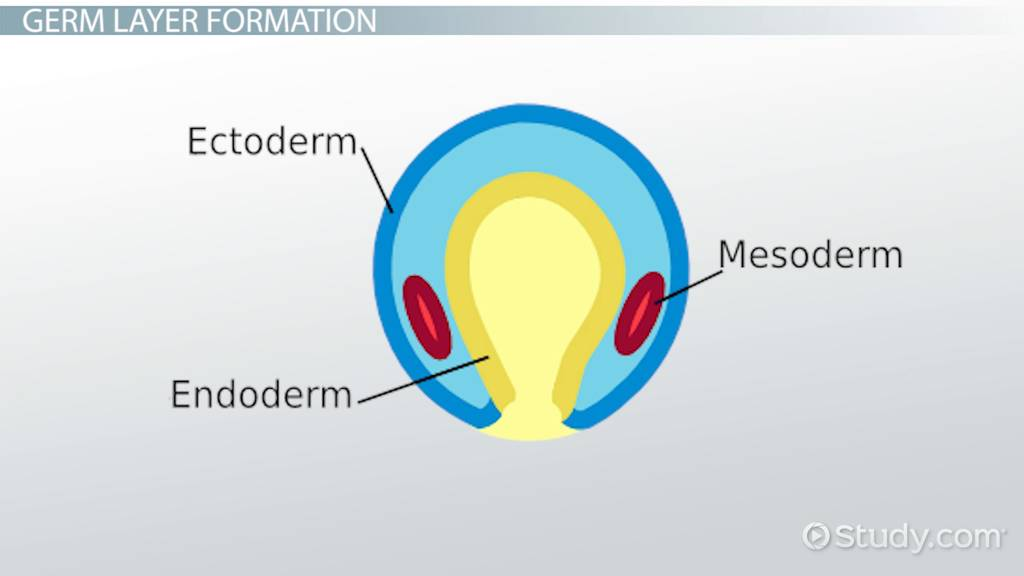
tissue folding + coordinated cell movement forms different cell layers: ectoderm, mesoderm, endoderm
Organogenesis
different parts of the embryo differentiate into specific combinations of cell types that perform an organ function.
Post-embryonic
transition from newly hatched/born organism to juvenile/adult. Marked by growth and dramatic changes in physical appearance.
Ectoderm
Gives rise to neural tissue (brain, central nervous system, peripheral nervous system)
Mesoderm
Gives rise to mesoderm → muscle, bone, heart, kidney, gonads
Endoderm
Give rise to digestive organs, respiratory organs
How do cells tisssue know how much to divide and where to go
Cell lineage studies (fate mapping)
Cell lineage studies
marking a specific cell and following it & its progeny through development
early studies used natural markers (e.g. pigment containing cells)
injection of vital (live) dyes (want to be easliy visualized but doesn’t affect cell health)
simply looking? can be done in relatively simple, transparent embryos like C. elegans.
Model organisms
an organism with characteristics that make it useful for uncovering fundamental biological principles and processes
What are useful characteristics of a model organism for a developmental studies?
short generation time, small and well characterized genome
easy to generate lots of embryos
easy to maintain in the laboratory
relevant to other organisms (esp. humans)
Why choose C. elegans (Nematode worm)?
small, powerful genetics, microscopically visible, 959 somatic cells
Embryos are transparent → easy to observe
Life cycle is quick (embryogenesis 9 hours)
Entire cell fate map (1 to 959) was determined by direct observation
Pronuclei
egg and sperm prior to fusing
Use of natural markers to trace lineage for non-transparent cells
natural markers
Chimeric embryos
embryos containing cell types from two sources.
E.g.) fate mapping using chick-chimeras. Quail has pigmentation that chicks don’t have, so you can look at feathers to look at what regions come from what animal without dissection. Le Dourain found that Quail eggs have very obvious nucleus compared to chick, so she can use a regular light microscope to see which cells came from chicks and quails.
Green Fluorescent Protein (GFP)
Fluorescent protein from jellyfish to show specific cells expressed. This is a viable protein as it’s expressed commonly in jellyfish cells. Easier to track cell lineage. Multiple variants and a rainbow of colors are now available.
What are challenges for chick-quail chimeras
need exquisite microdissection skill sto make viable chimeras
Limited ability to identify individual quail cells in a sea of chicken cells, but many quail cells are visible in a traditional light-microscope
Transplantation of quail cells into white chick background demonstrated that regions of the ectoderm and forming neural tissue gave rise to melanocytes and epidermal cells, e.g. feathers (good)
What are challenges for GFP lineage tracing
genetic tools needed to inject GFP sequence into the organism’s genome.
individual GFP+ cells are readily observed under fluorescence microscopy. (good)
different fluorescent proteins can be used to mark different populations of cells in same tissue → track multiple lineages. (good)
Not easily visible in adult animals without sacrificing
Apoptosis
programmed cell death
Caspase3 enzyme
cleaving enzyme that cuts up proteins. activates apoptosis
What are some crucial aspects of Drosophila larva?
it has segements.
Cleavage (drosophila)
after fertilization, there are 13 rounds of rapid nuclear mitosis without cytokinesis, resulting in a syncytium with approximately 6000 nuclei in a single-celled embryo.
develop in synctium first. nuclei in same envt.
Synctium
several nuclei sharing cytoplasm
Micropyle
opening through which sperm enters to fertilize egg
At the end of this syncytial stage…
nuclei are enveloped by plasma membrane → cellular blastoderm stage → gastrulation. This is when patterning events take place
Pros and cons of using Drosophila as a model?
Pros: can be live imaged and many cells tracked with computational methods.
Cons: tracking becomes more difficult once complex folding takes place.
Cellular blastoderm
future cell fate can be predicted at this stage based on their location.
What is the maternal determinant for drosophila
Bicoid mRNA is deposited by the mother’s ovary into the developing oocyte, where it is localized to the anterior. mRNA is translated into protein, protein forms a gradient in the shared yolky cytoplasm. Highest levels of bicoid protein specifies head lower levels specify thorax → patterning!
How do maternal determinants work?
Maternal determinants
loaded by the mother into the embryo to help with patterning
Nurse cells
nurse the development egg by providing ribosomes, lipids, etc that the embryo needs before it can produce those contents themselves
The oocyte is supported by —-
nurse cells
How are nurse cells connected
they are connected to each other and the oocyte through ring canals
During the first 3 hours after fertilization, the embryo is busy dividing. therefore…
no transcription during first 3 hours, the nurse cells provide all the nutrients needed for the embryo.
Ingression
cells release contacts from neighbors and migrate, similar to epithelial to mesenchymal transition
Some cells ingress from ___ and become neuroblasts
ectoderm
Bicoid
(“two tailed”) mutant
Bicoid comes from
the mother
Does the embryo make its own Bicoid for head formation?
No, the decision happens before embryoo develops by the mom
What is development?
A process of progressive change in an organism. The events that enable a single cell (fertilized egg) to give rise to a multicellular organism
What are some important definitions in development?
Sperm fertilizes an egg = zygote
Zygote grows and divides to produce a multicellular organism
This is an embryo
How do we figure out what happens during development?
Observation
Perturbation
Molecular perturbation
Observation
Requirements: to be able to see and record detail
However, it can’t tell you HOW
Perturbation
Disrupting development and ask: what happens?
Requirements: to be precise and to see and record detail.
However, it doesn’t tell you the molecules
Molecular perturbation
Altering individual/combinations of signals with mutations and drugs
However, there are limitations:
need mutants or specific drugs
Molecules may have multiple functions at different places/times
Preformation theory
organisms develop from miniature, fully-formed versions (homunculi) already existing within a sperm or an egg, which simply unfolded and grew
Epigenesis
Organisms develop from a single cell theory through gradual stages, with cells differentiating and organs forming sequentially, rather than being pre-formed miniatures.
What problem does the amniotic egg solve?
The amniote egg solved the problem of vertebrates being tied to water for reproduction by creating a self-contained, terrestrial aquatic environment, preventing the embryo from drying out, and allowing for gas exchange and waste removal on land.
All embryos have a ____ that controls the microenvironment
protective coating
What makes chicks (chicken embryos) a great model organism?
Easy to work with
small egg→practical
cheap to purchase
embryogenesis outside of mom, can watch embryo in real time.
What technique do you use to modify a chick embryo?
“Windowing” the chick egg. You break the egg, modify the embryo, and then seal the egg back up.
What’s difficult about using the chicken as a model
It’s hard to study the development of the egg in the oviduct.
Blastoderm in the chicken egg
20,000-60,000 cells at layering; single layer of cells that covers the yolk. Incomplete cytokinesis early on
Epiblast
future embryo
Hypoblast
Extra embryonic tissue (e.g. yolk sac), aka endoblast
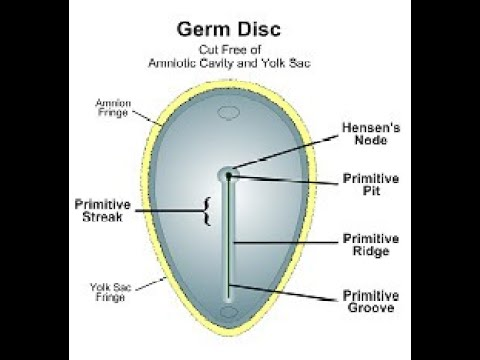
Primitive streak
Epiblast cell converge on the primitive streak, and the streak moves anteriorly from the posterior marginal zone / Koller’s sickle. Cells in the furrow of the streak move inward and spread out anteriorly and laterally, forming a layer of loosely connected cells called mesenchyme.
Gastrulation occurs here, forming various layers.
EMT
Epithelial to mesenchymal transition. a fundamental process where stationary epithelial cells lose their connections and polarity, transforming into migratory mesenchymal cells.
Necessary for gastrulation to occur.
Mesenchyme
Migratory cells
What happens in early gastrulation
Formation of Hensen’s node and primitive streak
Hensen’s node
an organizing center that patterns the body → determines fate of cells around. elongates from posterior to anterior node
Primitive streak
Site of cell movement at gastrulation
Gastrulation occurs by cells moving through…
the primitive streak
The ____ gets pushed out of the way by the invaginating cells, which have undergone an ____
hypoblast / endoblast , EMT
What would happen if you blocked EMT?
All cells become ectoderm
Can cells reverse EMT?
Yes, cells can under MET transition to become epithelial cells.
Cells moving through the primitive streak and Hensen’s node receive signals that….
determine their cell fate.
What allows us to trace cell movement
Lineage tracing, GFP
How does the embryo elongate?
Convergent extension and intercalation
Convergent Extension
Process which a tissue narrows along one axis and lengthens in a perpendicular (anti to post) axis, cells moving toward each other and intercalating; transforms the embryo from round to elongated

Intercalation
mechanism by which cells move together, establishing new contacts. Cells get new neighbors

What happens at the anterior of the primitive streak?
Cells condense, forming Henson’s node which secretes signals that influence cell fate. The streak regresses and Henson’s node moves posteriorly. The notochord is laid down in its wake, and mesoderm on each side of the node forms somites
Notochord
signature structures of chordates. Helps to pattern the neural tube (gives rise to the CNS0
Somites
blocks of mesodermal tissue that give rise to muscles and bone. During gastrulation, epiblast cells migrate through the primitive streak and displace the hypoblast (endoblast) from the center of the embryo.
What do the hypoblast/endoblast cells give rise to?
Extraembryonic tissue (e.g. yolk), which is packed with nutrients
In chicken egg, is fate pre-specified?
No, but cells that enter the streak early are more likely to become endoderm than cells that move through later.
Which events happen at the same time?
Gastrulation, formation of primitive streak, cells moving through the streak.
How does mammalian fertilization occur?
Mammalian egg = oocyte. Oocyte is released from ovary with follicle cells and zona pellucida. Fertilization in oviduct, then preimplantation development. ‘Hatching’ followed by implantation and formation of placenta.
In humans, initial cleavages are ___ ___ and zygotic transcription begins at the ___
very slow , two-cell stage
What similarities are there for the chicken and human embryogenesis
Both embryo derived from a flat epithelia cell.
14 day rule
“in vitro vulture of the human embryo is not allowed to proceed beyond the equivalent of day 14 of embryonic development, or the approximate time at which the primitive streak appears”
What makes mammalian development hard to study?
Everything happens in the utero
Trophectoderm
gives rise to extraembryonic tissues, eg. placenta. Doesn’t happen in birds
Inner cell mass
gives rise to the epiblast and primitive endoderm
Epiblast
gives rise to the three germ layers of the embryo
At the 16-cell stage…
The fate of cells haven’t been restricted yet
At the 64-cell stage…
the fate of cells have been set.
If the mother did not provide clues, then how does the anterior-posterior organization emerge?
Expression of Vg1 and Wnt8C (both signaling molecules) precedes streak and predicts where it forms
Self-organization
emergence of ordered structures and body axes emerge from dynamic local cell-cell interactions and movements, without a pre-specified blueprint or centralized instruction
Human embryonic stem cell (hESCs)
an undifferentiated cell from an early-stage embryo that can develop into different specialized cell types, including blood, neurons, or heart cells. They are regenerative, offering potential for disease treatment and research
Induced human embryonic stem cell (iPSCs)
a type of cell derived from adult cells that have been genetically reprogrammed to an embryonic stem cell-like state, allowing them to develop into any cell type.
What is a key difference between the way mesoderm forms in the fly vs. amniotes?
Mesoderm as a continuation of the epiblast.
Metazoan
Animalia kingdom - eukaryotes, multicellular organism.
How many layers of tissue are there possible?
A few animals only have one layer (e.g. sponges)
Some animals (e.g. Hydra) have diploblast with Oral-Aboral Polarity (endo and ecto) adhered by extracellular matrix.
Most Metazoans have a triploblast body plan - mesoderm, ectoderm, endoderm. There’s an empty space called the coelum
Cortical Reaction of Ferilization
the release of enzymes by the egg after the fusion of the sperm and oocyte membranes, which prevents further binding and entry of other sperm cells. This forms a protective envelope to prevent polyspermy.
Cortical Granule Exocytosis - Sea urchin fertilization
Wave of Calcium release triggers this. Sperm entry effects Calcium signal wave in egg. The calcium wave also carries positional information for some animals.
Briefly, what happens after fertilization for the sea urchin?
Cortical granule exocytosis → calcium signal → increase in respiration
Increase in protein synthesis, polyadenylation
Nuclear fusion
Mitosis
 Note
Note  Flashcards (39)